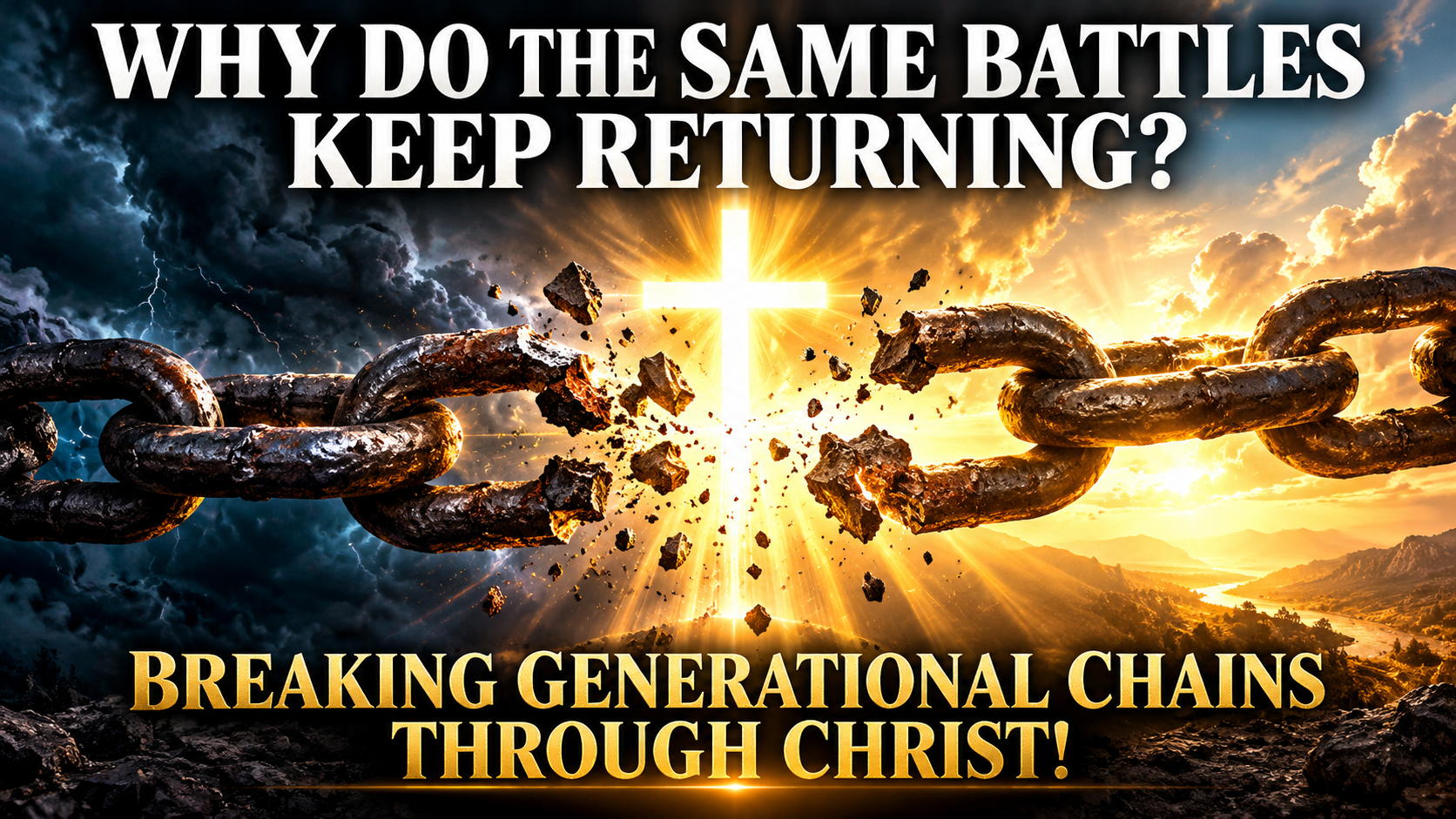
Why the patterns of yesterday continue into today—and how a generation can rise up in Christ and refuse to pass them on.
Have you ever stopped long enough to ask yourself why certain battles seem to follow entire generations? A father struggles with uncontrollable anger, only to watch his son wrestle with the same destructive behavior. A mother endures years of broken relationships, and decades later, her daughter finds herself walking through the same painful experiences. Addiction, fear, financial instability, abandonment, and spiritual confusion can become so deeply embedded within a family that each generation begins accepting them as an unavoidable part of life.
Yet there is a question the Body of Christ must be willing to confront: Are we witnessing the unavoidable consequences of our ancestry, or have we failed to recognize patterns that Scripture calls us to confront?
For too long, believers have approached these battles from opposite extremes. Some attribute virtually every hardship to a generational curse, while others dismiss the possibility that the spiritual decisions and destructive patterns of previous generations can influence those who follow. Neither position adequately addresses the full testimony of Scripture. The Word of God reveals that sin produces consequences extending beyond the individual, but it also declares that no generation is condemned to repeat the failures of those who came before it.
The Remnant must understand this distinction. We are not called to live in perpetual fear of what our ancestors may have done. We are called to discern what has been passed down, confront what contradicts the Word of God, and establish a new inheritance through the finished work of Jesus Christ.
1. GENERATIONAL CONSEQUENCES ARE REAL, BUT INHERITED GUILT IS NOT THE SAME THING
In Exodus 20:5–6, the Lord warns Israel concerning idolatry and speaks of visiting the iniquity of the fathers upon subsequent generations. These passages are frequently presented as proof that children automatically inherit the spiritual guilt of their ancestors. However, a careful examination of Scripture reveals a necessary distinction between the consequences of sin and personal accountability before God.
The prophet Ezekiel confronts this very issue:
“The soul that sinneth, it shall die. The son shall not bear the iniquity of the father, neither shall the father bear the iniquity of the son.” — Ezekiel 18:20, KJV
Notice what the Lord declares. The son does not automatically bear the father’s moral guilt simply because he was born into that family. Nevertheless, the consequences of a father’s decisions can profoundly affect his children. A household dominated by violence can produce generations struggling with fear and anger. A family governed by addiction may pass down destructive behaviors, instability, and deeply rooted emotional wounds. Children exposed to chronic financial irresponsibility may enter adulthood without ever witnessing sound stewardship.
These are genuine generational consequences, but we must not confuse them with an unavoidable spiritual sentence.
Consider the biblical account of Josiah. Although his grandfather Manasseh had led Judah into extraordinary wickedness and idolatry, Josiah did not have to continue that rebellion. He chose to seek the Lord, confront the corruption within the nation, and restore covenant obedience. His ancestry influenced the conditions he inherited, but it did not determine the direction he would take.
This is a truth the Remnant must recover: Your family history may explain certain battles, but it does not possess the authority to determine your spiritual destiny.
2. THE STRONGEST CHAINS ARE OFTEN THE ONES WE HAVE LEARNED TO CALL NORMAL
One of the most dangerous characteristics of generational bondage is its ability to disguise itself as ordinary family behavior. When certain practices have existed for decades, people often stop questioning whether those practices are righteous, healthy, or consistent with the character of Christ. What began as one generation’s compromise can eventually become the next generation’s accepted way of living.
Perhaps anger was the primary language spoken in your childhood home. Perhaps manipulation was mistaken for love, silence was used to conceal abuse, or bitterness became the accepted response to every disappointment. Some families normalize dishonesty, sexual immorality, substance abuse, or religious traditions that possess an appearance of godliness while resisting the transforming power of the Holy Spirit. Over time, repeated behavior can become an unwritten family covenant—not necessarily a supernatural agreement, but a deeply established pattern of belief and conduct.
Paul addresses the battlefield in which these patterns must be confronted:
“For the weapons of our warfare are not carnal, but mighty through God to the pulling down of strong holds; Casting down imaginations, and every high thing that exalteth itself against the knowledge of God, and bringing into captivity every thought to the obedience of Christ.” — 2 Corinthians 10:4–5, KJV
Notice that Paul connects the tearing down of strongholds with confronting thoughts and arguments that oppose the knowledge of God. This means spiritual warfare cannot be reduced to confronting demonic powers while ignoring the beliefs, attitudes, and actions that govern our daily lives. If a man repeatedly responds to his children with the same cruelty he experienced from his father, he must confront more than his family history. He must allow the Holy Spirit to expose and transform the thinking that continues reproducing that behavior.
The enemy does not need to invent a new deception when an old lie continues finding agreement in the next generation.
This is why discernment is indispensable. Before attempting to confront what we believe is a spiritual stronghold, we must honestly examine what Scripture identifies as sin, what may be learned behavior, what results from trauma or injury, and where genuine spiritual opposition may be involved. These realities can interact, but they should never be carelessly treated as identical.
3. CHRIST DID NOT REDEEM YOU SO THAT YOU WOULD REMAIN A PRISONER OF YOUR BLOODLINE
Here we arrive at the foundation upon which all legitimate spiritual warfare must stand: the completed redemptive work of Jesus Christ.
Paul declares:
“Christ hath redeemed us from the curse of the law, being made a curse for us.” — Galatians 3:13, KJV
This passage must be understood within its proper context. Paul is addressing the law, justification, faith, and the blessing promised through Abraham. He is not outlining a specialized ritual for removing ancestral curses. Nevertheless, the spiritual implications are profound. Those who belong to Christ do not establish their standing before the Father through ancestral purity, human performance, or the discovery of hidden spiritual agreements. Their covenant standing rests upon the finished work of the Son.
Colossians 2:13–15 further reveals that Christ has forgiven our trespasses, removed the record standing against us, and triumphed over principalities and powers through the Cross. The believer’s freedom therefore begins with what Christ has accomplished, not with the effectiveness of a particular prayer formula. Repentance, renunciation of sinful practices, forgiveness, and obedience are important responses to redemption, but they must never be presented as though they complete an insufficient Cross.
Think about what this means. Your grandfather may have practiced idolatry, but you are not required to continue his worship. Your father may have surrendered to addiction, but his choices do not possess sovereign authority over yours. Your family may have endured generations of broken relationships, but those failures do not have the final word concerning the household you are called to establish.
The enemy desires agreement with darkness. Christ calls us into agreement with truth.
A believer may still need healing, counseling, accountability, practical instruction, and sustained discipleship to overcome destructive patterns. These continuing needs do not invalidate redemption. They reveal that the transformation of a life involves learning to walk consistently in the freedom Christ has secured.
The Cross does not make our history disappear, but it prevents our history from becoming our master.
4. THERE COMES A MOMENT WHEN THE PATTERN MUST STOP WITH YOU
Ezekiel 18 presents one of the most powerful pictures of generational change found in Scripture. The prophet describes a son who observes the sins of his father, considers what he has witnessed, and refuses to do likewise. He does not deny the reality of his father’s conduct, nor does he pretend that its consequences have vanished. He recognizes the pattern and chooses a different response before God.
This is where spiritual warfare becomes intensely personal.
It is easy to identify the failures of previous generations while refusing to examine what we are reproducing in our own lives. A man may condemn his father’s anger while speaking to his children with the same destructive words. A woman may grieve the manipulation she experienced growing up while using guilt and control in her own relationships. We can spend years rebuking what we believe has followed our families while continuing to feed those very patterns through our choices.
The Holy Spirit does not expose these contradictions to condemn us. He brings them into the light so that repentance, healing, and genuine transformation can begin.
This distinction is especially important for those who have suffered abuse or neglect. Victims are never responsible for the wrongdoing committed against them. They must not be pressured to repent for having been wounded or told that their suffering proves spiritual agreement with darkness. Yet as healing progresses, every believer can seek God’s wisdom concerning the attitudes, boundaries, relationships, and decisions that will shape the future.
There comes a moment when someone must rise up and declare that what previous generations normalized will no longer govern the household entrusted to them.
But such a declaration must become more than powerful words spoken during an emotional moment. It must be demonstrated through repentance, disciplined obedience, changed behavior, sound decisions, and a life increasingly governed by the Holy Spirit.
The pattern does not stop merely because we denounce it. We must also stop participating in what gives it continuity.
5. BREAKING THE CHAIN IS ONLY THE BEGINNING—NOW YOU MUST BUILD
One of the greatest weaknesses in contemporary spiritual-warfare teaching is its tendency to concentrate almost exclusively on deliverance while giving insufficient attention to discipleship. Believers are instructed how to renounce strongholds, confront spiritual opposition, and pray for freedom, but far less attention is given to what happens after the immediate battle. Consequently, some experience significant breakthroughs yet struggle to establish a lasting way of life that reflects the freedom they have received.
The Exodus provides a powerful example. God delivered Israel from Egyptian bondage, but freedom from Pharaoh was only the beginning of His purpose. He brought them out of slavery to establish them as a covenant people, teaching them how to worship, obey, govern their relationships, and live under His authority. They departed Egypt in one night, yet the wilderness exposed how deeply the habits and fears of slavery remained embedded within their thinking.
The same principle applies to breaking generational patterns.
A household delivered from addiction must establish truthfulness, accountability, and healthy habits. A family determined to end financial chaos must learn stewardship and responsible decision-making. Parents refusing to repeat abusive patterns must learn how to discipline, communicate, and love without intimidation. Prayer remains vital throughout this process, but prayer does not eliminate the responsibility to obey the wisdom God has revealed.
Paul instructs believers to be transformed by the renewing of their minds (Romans 12:2). Transformation involves replacing thoughts that contradict God’s truth with a new understanding of our identity and responsibilities in Christ. It is not enough to identify the destructive foundations upon which previous generations built. We must establish foundations capable of supporting a righteous inheritance.
This is where the true significance of generational freedom begins to emerge. You are not simply fighting to escape what happened yesterday. You are taking responsibility for what will be established tomorrow.
Your children and grandchildren should inherit more than stories about the battles you survived. They should encounter the fruit of a life transformed by the Holy Spirit.
6. THE REMNANT MUST BECOME A GENERATION THAT REFUSES TO PASS ON BONDAGE
Psalm 78:4–7 reveals the responsibility of one generation to declare the works of the Lord to another. The purpose is not merely to preserve religious information, but to establish a people who place their hope in God, remember His works, and keep His commandments. Generational faithfulness is therefore both a spiritual inheritance and a deliberate responsibility.
The Remnant cannot fulfill this assignment by remaining consumed with the failures of its ancestors. We must learn from the past without surrendering our future to it. We must confront sin without making every hardship evidence of a curse, exercise spiritual authority without presumption, and pursue freedom without abandoning the patient work of discipleship. Above all, we must remember that the foundation of our victory is not our ability to identify every strategy of darkness, but the lordship of Jesus Christ.
Some battles may require sustained prayer and spiritual resistance. Others may require reconciliation, accountability, professional care, practical wisdom, or years of rebuilding what previous generations neglected. There is no shame in receiving help, and there is no biblical justification for confusing perseverance with spiritual failure. Mature spiritual warfare recognizes that the fruit of freedom must be cultivated long after the initial confrontation has ended.
I believe the hour has come for believers to stop asking only why the same battles keep returning and begin asking what must change so that the next generation does not inherit them.
The question is no longer simply, “What happened in my family?”
The greater question is, “What will my family inherit because I chose to follow Christ?”
A FINAL WORD TO THE REMNANT
You may have inherited a history you did not choose. You may have grown up surrounded by confusion, fear, addiction, rejection, or broken relationships. Perhaps you are only now beginning to recognize how deeply those experiences influenced your understanding of yourself, your family, and even your heavenly Father. But hear this clearly: The circumstances into which you were born do not possess greater authority than the Christ into whom you have been brought through redemption.
Do not become so fascinated with ancient chains that you lose sight of the One who has conquered sin, death, and the powers of darkness. Do not allow the failures of previous generations to become an excuse for continuing what the Holy Spirit is calling you to confront. Seek His wisdom, walk in repentance where repentance is needed, receive healing where wounds remain, and establish a household governed by truth. The Lord has not called His people merely to survive inherited battles, but to raise up generations who know Him, obey His Word, and carry His testimony into the future.
Remnant, let this be the generation that refuses to pass the chains on.
Not because we have discovered a secret formula, but because Jesus Christ is Lord, His Word is truth, and His grace empowers us to walk in a different way.
The chains may be ancient, but they are not greater than the Cross.
CLOSING PRAYER
Heavenly Father, in the mighty name of Jesus Christ, we come before You with thanksgiving for the redemption accomplished through Your Son. Search our hearts and reveal every belief, attitude, and practice that contradicts Your Word. Give us discernment to recognize the patterns that have influenced our families, humility to repent where we have participated in sin, and courage to confront what previous generations may have accepted as normal.
Holy Spirit, renew our minds and govern our steps. Bring healing to those who have suffered abuse, abandonment, and rejection, and surround them with the wisdom and support needed for restoration. Teach us to establish households marked by truth, righteousness, forgiveness, holiness, and the presence of God. May our children and grandchildren inherit a living testimony of Your faithfulness rather than the destructive patterns of our past.
Father, raise up a Remnant that understands its identity in Christ and refuses to surrender its inheritance to darkness. Let our lives declare that Jesus Christ is Lord over our households, our decisions, and the generations that follow.
In the mighty name of Jesus Christ, Amen.
Stay tuned, the journey continues…..
A voice of fire to the Remnant,
— Dr. Russell Welch
Dr. Russell Welch is a published author, prophetic teacher, apostolic builder, and founder of faith-driven publishing and media initiatives. His ministry carries a strong call to equip the Ecclesia for maturity, biblical clarity, spiritual discernment, and Kingdom assignment. Through his writing and teaching, he brings together Scripture, Church history, theology, and spiritual governance while challenging believers to move beyond religious tradition and into the mature life of sons and daughters who are led by Holy Spirit, established in truth, and wholly surrendered to Jesus Christ.
GO DEEPER INTO THE BATTLE
This teaching draws from Breaking Ancient Chains: A Comprehensive Biblical Guide to Spiritual Warfare, Generational Strongholds, and Territorial Breakthrough by Dr. Russell Welch. You can learn more about this book HERE
The book examines generational patterns, spiritual strongholds, inner agreements, family restoration, household consecration, and territorial intercession through a Christ-centered biblical framework. It challenges believers to move beyond identifying bondage and begin establishing a lasting inheritance of faithfulness, freedom, and Kingdom responsibility.
Discover more teachings and resources at RemnantWarrior.org.

