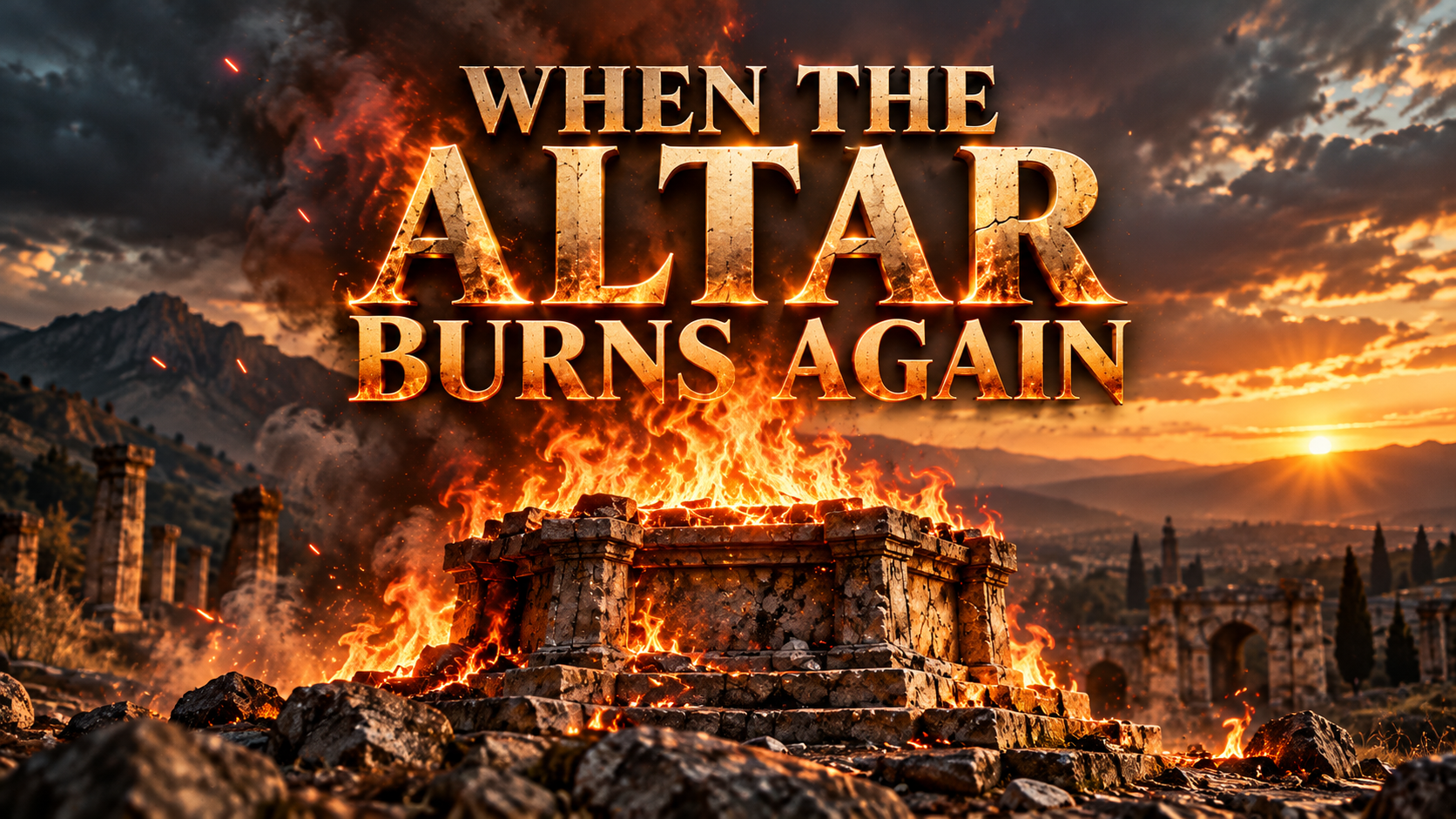
The Remnant, the Returning Fire, and the Restoration of God’s Ecclesia
A Three-Part Prophetic Series on Revival, Religious Systems, and the Restoration of the Ecclesia — Part Two
THE FIRE DID NOT DIE — THE ALTAR WAS ABANDONED
There is a profound difference between a generation that has never witnessed the fire of God and one that has inherited its testimony but forgotten how to live in His presence. The first may hunger for something it has never experienced, while the second may become dangerously satisfied with the memory of something it no longer knows. Across generations, believers have erected monuments to past awakenings, preserved the names of remarkable servants of God, and celebrated the extraordinary movements that reshaped communities and nations. Yet the question confronting us is not whether God moved in previous centuries. The question is whether we are willing to surrender ourselves to the same Holy Spirit who moved then.
In the first installment, When the Fire Became a Monument, we confronted the tragedy of religious movements that gradually exchanged living encounters for institutional preservation. We examined how revival movements, birthed through repentance, consecration, and dependence upon Holy Spirit, could eventually become systems more concerned with protecting their traditions than cultivating spiritual maturity. We also recognized that organization itself is not inherently evil; the danger arises when human structures cease serving Christ’s purposes and begin demanding the allegiance that belongs to Him alone.
But exposing the problem is not enough. A prophetic warning without a pathway toward obedience can leave believers angry at religious systems without becoming any more surrendered to the Father. The purpose of genuine prophetic confrontation is not to produce cynicism, rebellion, or spiritual superiority. It is to bring the people of God into repentance, restoration, and renewed alignment with Jesus Christ.
The Lord is not calling His people to become professional critics of dead religion. He is calling them to become living witnesses of His resurrected Son.
And that changes everything.
BEFORE THE FIRE RETURNS, THE ALTAR MUST BE REPAIRED
One of the most compelling pictures of spiritual restoration appears in 1 Kings 18, when Elijah confronted the prophets of Baal upon Mount Carmel. Israel had become divided in its allegiance, attempting to maintain a covenant identity while accommodating the worship of false gods. Elijah’s question in verse 21 exposed the contradiction: How long would the people hesitate between two competing objects of worship? The issue was not merely religious preference; it was covenant loyalty.
Before the fire fell, Elijah repaired the altar of the Lord that had been broken down (1 Kings 18:30).
That detail deserves our attention.
The prophet did not begin by attempting to manufacture fire through emotional excitement, extraordinary performance, or religious spectacle. He restored the place of covenant worship, arranged the sacrifice, and prayed that the people would know the Lord was God and that their hearts might be turned back again. The fire came from God, not from Elijah’s ability to manipulate the atmosphere.
There is a principle here that the modern Ecclesia desperately needs to recover. We cannot substitute religious activity for surrender and then demand that Heaven authenticate everything we have constructed. We cannot preserve divided allegiance, tolerate deliberate compromise, and treat the presence of God as something that can be summoned through musical intensity, charismatic personalities, or carefully arranged ministry programming.
The altar represents the place where our lives come under the authority of the One we worship.
Under the New Covenant, we do not rebuild Elijah’s sacrificial system or attempt to repeat the sacrifice of Christ. Jesus offered Himself once for all, accomplishing what repeated animal sacrifices could never accomplish (Hebrews 10:10–14). Our response to His finished work is not to earn acceptance through religious performance, but to offer ourselves to God as those made alive in Christ.
Romans 12:1 calls believers to present their bodies as living sacrifices, holy and acceptable unto God, which Paul describes as reasonable service. This is the language of consecration flowing from divine mercy. The altar we must recover is therefore not principally a piece of furniture inside a religious building. It is the surrendered life of a son or daughter who belongs wholly to the Father through Jesus Christ.
The fire of God was never given to make our religious monuments impressive. It was given to transform the people who belong to Him.
HOLY GHOST FIRE IS NOT AN EMOTIONAL EXPERIENCE TO BE MANUFACTURED
There is a dangerous temptation in contemporary Christianity to measure the presence of God by the intensity of a meeting. If the music is powerful, the atmosphere emotional, the congregation demonstrative, and the preacher animated, people may conclude that the fire has fallen. Yet Scripture calls us to a far more demanding standard of discernment.
Emotional expression is not inherently counterfeit. Throughout Scripture, encounters with God produced joy, trembling, repentance, thanksgiving, weeping, and extraordinary demonstrations of His power. The problem arises when we confuse the outward response with the inward work and begin judging spiritual authenticity primarily through what can be seen, heard, recorded, or promoted.
John the Baptist declared that the coming Messiah would baptize with the Holy Ghost and with fire (Matthew 3:11). His words occur within a context of repentance, judgment, and the separating work associated with the Messiah’s coming. They cannot responsibly be reduced to a promise of heightened emotional experience. At Pentecost, the disciples were filled with Holy Spirit and empowered to bear witness to the risen Christ, while the visible appearance of divided tongues resembling fire accompanied that extraordinary moment (Acts 2:1–4).
The New Testament does not present spiritual power as entertainment for religious consumers. It reveals the Holy Spirit glorifying Jesus Christ, convicting concerning sin and righteousness, leading believers into truth, distributing gifts for the common good, and forming the character of Christ within His people.
A congregation may experience powerful manifestations and still need correction. Corinth is perhaps the clearest example. The believers were not lacking in spiritual gifts, yet Paul confronted divisions, immaturity, disorder, and conduct inconsistent with the Gospel. Spiritual activity did not exempt them from the demands of love, holiness, discernment, and accountability.
We must recover that distinction.
The question is not merely whether people fell to the floor, raised their hands, shouted, wept, or testified about an extraordinary experience. The question is whether they are emerging from those encounters more surrendered to Christ, more obedient to His Word, more loving toward one another, and more available for the purposes of the Father.
Fire that never confronts compromise, purifies motives, or produces obedience should not be accepted uncritically as evidence of spiritual maturity.
THE SECRET PLACE MUST BECOME THE GOVERNING PLACE
One of the greatest distortions in the modern religious system is the separation of public ministry from private communion with God. We have developed an entire culture capable of recognizing gifted communicators while sometimes overlooking whether those gifts are being exercised from a life of abiding fellowship with Christ.
Jesus withdrew to pray. He sought solitude with the Father, even while multitudes were gathering to hear Him and receive healing. His public ministry was not disconnected from His communion with the Father. In John 5:19, He explained that the Son acted in perfect relationship with the Father, doing what He saw the Father doing.
If Jesus modeled such dependence, how can His servants imagine they are qualified to function independently of the Holy Spirit?
The secret place is not simply a location where believers occasionally retreat when life becomes overwhelming. It describes an abiding posture of dependence, trust, worship, and yielded fellowship with God. Prayer is not merely the preliminary activity that prepares us for our real assignment. Communion with the Father is central to the life from which every authentic Kingdom assignment must flow.
This is where many ministries encounter a dangerous contradiction. A leader may become so occupied managing the work of God that little attention remains for the presence of God. Sermons must be prepared, buildings maintained, finances supervised, programs coordinated, and digital platforms populated. None of these responsibilities is necessarily wrong, but all can become destructive when the administration of ministry begins consuming the inward life of the minister.
The apostolic pattern is instructive. In Acts 6:1–4, the apostles responded to a legitimate administrative need by ensuring that practical care was provided while preserving their devotion to prayer and the ministry of the Word. Their response did not diminish the importance of serving tables; it demonstrated that different responsibilities must be properly ordered so the whole community can flourish.
The Ecclesia cannot be governed by the tyranny of endless activity.
We must recover leaders who know how to be still before the Father, intercessors who listen as faithfully as they speak, and disciples who no longer mistake religious busyness for spiritual fruitfulness.
The secret place is not where we escape our Kingdom assignment. It is where our hearts become rightly ordered for it.
THE RETURNING FIRE WILL CONFRONT THE CULTURE OF SPIRITUAL CELEBRITY
If we are serious about the restoration of the Ecclesia, then we must confront one of the most persistent temptations in Christian ministry: the elevation of human personalities above the formation of Christlike disciples.
Paul addressed this problem directly in Corinth. Believers were identifying themselves with prominent ministers, declaring allegiance to Paul, Apollos, and Cephas. Rather than embracing their competing loyalties, Paul asked whether Christ was divided (1 Corinthians 1:10–13). Later, he described ministers as servants through whom the Corinthians had believed, while insisting that God was the One who gave the increase.
The lesson has not expired.
Our generation possesses extraordinary technological capabilities for spreading the Gospel. A faithful biblical teacher can reach people across continents, encourage isolated believers, and provide teaching that would have been inaccessible to previous generations. These opportunities should be stewarded with gratitude and responsibility.
Yet the same technology can encourage an unhealthy culture in which visibility is confused with authority, followers are confused with disciples, and branding becomes more important than biblical faithfulness.
The Kingdom of God does not advance because a minister becomes famous. It advances through the lordship of Jesus Christ, the proclamation of His Gospel, and the obedient witness of those who belong to Him.
When a ministry cannot tolerate correction, when leaders demand loyalty that belongs to Christ, when financial success becomes the measure of divine approval, or when the congregation exists primarily to sustain the prominence of its founder, something has gone terribly wrong.
Ephesians 4:11–16 establishes a different standard. Christ gives ministry gifts to equip the saints, build up His body, and bring believers toward maturity. The purpose of apostolic, prophetic, evangelistic, pastoral, and teaching ministry is not to produce permanent dependence upon a celebrated personality. It is to prepare God’s people to participate faithfully in the work of ministry.
A genuine apostolic work builds foundations upon Christ. A faithful prophetic ministry directs attention toward the Lord rather than cultivating fascination with the prophet. A true shepherd protects, feeds, and equips the flock rather than treating people as possessions.
The mature Ecclesia must learn to honor servants of God without placing them on thrones.
There is one Head of the Body, and His name is Jesus Christ.
FROM RELIGIOUS MEMBERSHIP TO KINGDOM SONSHIP
Perhaps one of the most consequential restorations needed within the modern Church concerns the believer’s identity in Christ.
For generations, many Christians have been taught primarily to understand themselves through their position within a religious organization. They are members of a denomination, attendees of a congregation, supporters of a ministry, volunteers in a program, or participants in a particular tradition.
These associations may serve legitimate purposes, but none establishes the believer’s deepest identity.
Romans 8:14 declares, “For as many as are led by the Spirit of God, they are the sons of God.” Paul continues by contrasting the spirit of bondage with the Spirit of adoption, through whom believers cry, “Abba, Father” (Romans 8:15).
This is not a minor adjustment in religious vocabulary. It is a fundamental transformation in the believer’s understanding of relationship, belonging, inheritance, and spiritual life.
Through Christ, we have been brought near to the Father. We are not strangers attempting to earn entrance into a distant religious kingdom. We are received through the Son, granted access by the Spirit, and called to live as beloved children under the Father’s loving government.
Ephesians 2:4–6 further reveals that God, rich in mercy, has made us alive together with Christ, raised us together, and seated us together in heavenly places in Christ Jesus. This position is grounded in union with Christ, not human achievement or presumed independent authority.
Yet sonship must never become another slogan divorced from obedience.
A believer who understands their identity in Christ should increasingly reflect the character of the Son. We cannot celebrate heavenly citizenship while continuing to be governed by pride, envy, bitterness, greed, and the fear of man. We cannot declare spiritual authority while refusing the correction and guidance of Holy Spirit.
The restoration of sonship is not permission for spiritual arrogance. It is an invitation to deeper intimacy, responsibility, humility, and maturity.
The Father is not raising a generation merely capable of quoting verses about its authority. He is forming sons and daughters whose lives demonstrate the government and character of Jesus Christ.
THE ECCLESIA MUST RECOVER THE LIFE OF ACTS 2
When we speak about restoring the Ecclesia, we must resist the temptation to imagine that the solution is simply replacing one religious structure with another.
A congregation does not automatically become spiritually mature because it meets in a home instead of a sanctuary. A ministry is not necessarily more faithful because it rejects denominational labels. An assembly does not become apostolic merely by adopting the terminology of apostles, prophets, Kingdom government, or spiritual warfare.
The question is whether the people are living under the headship of Jesus Christ and practicing the life revealed in Scripture.
Acts 2:42 describes believers continuing steadfastly in the apostles’ doctrine, fellowship, breaking of bread, and prayers. This was not merely an attendance model. It was a shared life of worship, learning, covenant relationships, generosity, spiritual formation, and devotion to the risen Lord.
The believers gathered both publicly and in their homes. They shared meals, cared for needs, praised God, and continued in the instruction of those commissioned by Christ. Their fellowship was not a religious audience assembled around a weekly presentation, but a developing community whose lives were being reshaped by the Gospel.
This is the kind of restoration that must capture our attention.
Imagine congregations where believers are thoroughly equipped to understand Scripture rather than conditioned merely to repeat the preacher’s conclusions. Imagine households where prayer and worship are woven into daily life, where children learn to recognize the character of Jesus Christ through the conduct of their parents, and where spiritual gifts operate with both freedom and biblical accountability.
Imagine leaders who measure success by the maturity of the people they serve rather than the size of their platform. Imagine gatherings where communion is received with genuine reverence for Christ and His body, where the wounded encounter compassionate care, and where those struggling with sin are called toward repentance and restoration rather than simply discarded.
These are not invitations to abandon biblical leadership, congregational order, or sound doctrine. They are a call to recover their proper purpose.
The Ecclesia exists to embody the life of Christ in the world, not merely to perpetuate an institution bearing His name.
WHEN THE FIRE RETURNS, THE WORLD SHOULD ENCOUNTER CHRIST
There is one final danger that must be confronted before we can speak responsibly about a fresh awakening.
Believers may become so captivated by the restoration of spiritual experiences that they forget the purpose for which Holy Spirit empowers them.
In Acts 1:8, Jesus promised that His disciples would receive power when the Holy Ghost came upon them, and that they would become His witnesses. The promise was never separated from the mission. Pentecost was not an invitation to build a permanent spiritual spectacle around the upper room. It empowered the disciples to proclaim Christ and carry His Gospel beyond the boundaries of Jerusalem.
The same principle must govern our understanding of revival today.
If the fire returns to our gatherings, our communities should encounter believers who speak truth with courage and love. Families should witness transformed relationships. The poor and vulnerable should encounter genuine compassion rather than religious slogans. The lost should hear the Gospel of Jesus Christ clearly proclaimed, and new believers should discover communities willing to walk with them into mature discipleship.
Signs, wonders, and miracles remain subjects that deserve serious biblical attention, faithful prayer, and responsible testimony. Yet extraordinary manifestations must never be exploited, exaggerated, or separated from the character and message of Jesus. The gifts of the Spirit are not trophies establishing the greatness of a ministry; they are expressions of divine grace intended to serve God’s purposes and build up His people.
Our expectation must be greater than the next extraordinary meeting.
We must desire communities transformed by truth, marriages strengthened through repentance and forgiveness, children nurtured in the ways of the Lord, captives finding freedom in Christ, and believers equipped to carry the Gospel into the places where God has assigned them.
The world does not need another generation that knows how to perform revival while remaining unchanged.
It needs faithful witnesses whose lives make the reality of Jesus Christ unmistakable.
THE REMNANT MUST BECOME WHAT IT HAS BEEN PRAYING FOR
There is a particular danger for those who identify themselves as part of the Remnant. It is possible to discern genuine failures within organized Christianity and yet begin developing a new religious identity around criticizing those failures.
A remnant that becomes proud of its discernment while neglecting humility has already begun reproducing the very spirit it claims to resist.
In 1 Kings 19, Elijah believed himself to be alone in his faithfulness, yet the Lord revealed that seven thousand in Israel had not bowed to Baal. The prophet’s limited perspective did not define the full extent of God’s preserved people.
We should remember that lesson.
The Remnant is not established by its ability to expose every compromised institution or identify every false religious practice. Its testimony is found in covenant faithfulness, obedience to Christ, devotion to truth, and perseverance under the leadership of Holy Spirit.
If we are calling the Church back to prayer, we must become people of prayer. If we are confronting compromised leadership, we must welcome accountability in our own lives. If we are declaring that the Ecclesia must recover the presence of God, then our private fellowship with the Father must become more important than our public reputation.
We cannot demand a consecration from others that we refuse to embrace ourselves.
We cannot proclaim that the Church has abandoned the altar while privately neglecting the very surrender we are calling others to recover.
And we cannot honestly pray for a fresh move of God while insisting that He preserve every ambition, preference, relationship, and structure we are unwilling to submit to His authority.
The coming season will require more than passionate preaching about transformation.
It will require transformed people.
THE FIRE WE NEED IS NOT A REPLICA OF YESTERDAY
The great awakenings of previous centuries remain important testimonies of what God accomplished through imperfect but often deeply surrendered people. Their histories can inspire courage, reveal costly obedience, and warn future generations about the dangers of compromise.
Yet our assignment is not to reproduce the outward appearance of Azusa Street, Cane Ridge, the Great Awakening, or any other historic movement.
The Lord has not commissioned us to recreate the cultural conditions of another century.
He has called us to faithfully represent Jesus Christ in the generation in which we have been placed.
The Gospel has not changed. The Lordship of Christ has not changed. The call to repentance, holiness, discipleship, and Spirit-empowered witness has not changed. But the circumstances in which we must obey are our own, and faithfulness requires that we discern the present responsibilities entrusted to us.
Perhaps the restoration will begin quietly.
Perhaps it will emerge through households where parents recover their responsibility to disciple their children, through small assemblies where believers learn to minister to one another, through intercessors who remain faithful without public recognition, and through leaders who abandon the pursuit of personal kingdoms.
Perhaps the first signs of genuine awakening will not be measured by attendance, financial growth, or social media engagement, but by repentance, reconciled relationships, biblical maturity, sacrificial generosity, and believers whose hearts are increasingly governed by Holy Spirit.
We do not control where or how the sovereign God chooses to work. We are not promised another historic revival simply because we reproduce certain practices or declare that the hour has arrived. But we are commanded to walk in obedience, remain filled with the Spirit, make disciples, and live as those who belong to Jesus Christ.
And that is more than enough to occupy the faithful Remnant.
A PROPHETIC CALL — REPAIR THE ALTAR AND RETURN TO THE FATHER
I believe the challenge confronting our generation is becoming unmistakably clear.
We have spent decades debating worship styles, ministry methods, denominational distinctions, and competing theological systems. We have watched ministries rise, expand, fracture, and disappear. We have witnessed the extraordinary possibilities of global Gospel communication alongside the troubling consequences of celebrity culture, religious manipulation, and institutional self-preservation.
Yet the invitation of Jesus remains profoundly simple.
Abide in Me.
Follow Me.
Love one another.
Make disciples.
The restoration of the Ecclesia will not begin when every believer agrees upon every secondary doctrinal controversy. It will begin wherever men and women submit themselves to the truth of Scripture, acknowledge the lordship of Christ, repent of known sin, and yield their lives to the guidance and transforming ministry of Holy Spirit.
We must refuse both dead religious formalism and undisciplined spiritual sensationalism. We must reject human control without rejecting biblical accountability. We must embrace spiritual gifts without making manifestations the measure of maturity. We must honor the faithful witnesses of yesterday without allowing their monuments to become substitutes for our own obedience.
The fire we are praying for must first be welcomed as a refining work within us.
Let the Father expose our pride.
Let Holy Spirit confront our compromises.
Let the Word dismantle our inherited assumptions wherever they contradict the truth of Christ.
Let Jesus reclaim His rightful place as the unquestioned Head of His Body.
And let the Remnant arise, not as a rebellious faction searching for religious enemies, but as mature sons and daughters who carry the character, truth, compassion, and authority of the risen King.
We were not created to maintain the ashes of yesterday’s awakening. We were called to flourish in the presence of our Father, live from our union with Christ, and carry His light into a world desperately in need of His truth.
The altar must be restored.
The people must be consecrated.
The Ecclesia must mature.
And the glory must belong to Jesus Christ alone.
A PRAYER FOR THE RESTORATION OF THE ALTAR
Father, in the mighty name of Jesus Christ, we come before Your throne acknowledging that no human effort, religious performance, or institutional accomplishment can substitute for the life that flows from Your presence. Forgive us for the times we have placed greater confidence in our methods than in Your Word, greater value upon our reputation than upon obedience, and greater emphasis upon the appearance of spiritual power than upon the character of Your Son.
Search us, Father. Let Your Word expose every hidden ambition, every agreement with compromise, every expression of pride, and every place where the fear of man has displaced our devotion to You. Restore within us the joy of communion, the discipline of prayer, the hunger for truth, and the willingness to obey even when obedience carries a cost.
Holy Spirit, govern our thoughts, purify our motives, and form within us the character of Jesus Christ. Teach us to distinguish genuine spiritual authority from human control, authentic manifestations of Your grace from religious performance, and biblical order from institutional bondage. Raise up leaders who equip rather than dominate, shepherds who care rather than exploit, and disciples who love truth more than recognition.
Father, awaken households, restore covenant fellowship, strengthen intercessors, and bring renewed biblical maturity to Your Ecclesia. Let those who are wounded encounter Your mercy, those who are bound discover freedom in Christ, and those who have grown weary find renewed strength through Your presence. May every gift, every teaching, every testimony, and every act of service direct attention toward the glory of Your Son.
We declare our allegiance to Jesus Christ, the Head of the Body and the King of kings. We renounce the desire to build personal kingdoms beneath the appearance of ministry, and we yield our lives afresh to the government of Your Holy Spirit.
Let the fire of consecration burn within us, not so that we may become impressive before men, but so that our lives may become faithful witnesses to the risen Christ.
In the mighty and matchless name of Jesus Christ, Amen!
THE JOURNEY CONTINUES — PART THREE
FROM THE ALTAR TO THE NATIONS: WHEN THE REMNANT BECOMES A LIVING WITNESS
The restoration of the altar was never intended to end with the believer’s personal spiritual experience. In our final installment, we will examine how a Christ-governed Ecclesia carries the Gospel beyond religious walls, equips disciples for Kingdom assignments, and demonstrates the life of Jesus Christ in families, communities, and nations.
The fire was never meant to remain contained.
A voice of fire to the Remnant,
— Dr. Russell Welch
Radical Disciples — A Remnant Revolution
Continue the Journey
For a deeper exploration of the historical awakenings, spiritual conflicts, and extraordinary testimonies that helped shape Christianity in America, discover:
Flames of Faith: From Persecution to Pentecost — The Hidden River of Holy Ghost Fire and the Call of the Remnant
Available on Amazon. FLAMES TO FAITH
History reveals where previous generations walked with God. Our responsibility is to walk faithfully with Him in our own.
Dr. Russell Welch is a published author, prophetic teacher, apostolic builder, and founder of faith-driven publishing and media initiatives. His ministry carries a strong call to equip the Ecclesia for maturity, biblical clarity, spiritual discernment, and Kingdom assignment. Through his writing and teaching, he brings together Scripture, Church history, theology, and spiritual governance while challenging believers to move beyond religious tradition and into the mature life of sons and daughters who are led by Holy Spirit, established in truth, and wholly surrendered to Jesus Christ.
At the heart of this ministry is a burden to prepare and equip the Lord’s Remnant—to awaken identity, restore biblical order, strengthen spiritual maturity, and help believers recognize the assignments God has placed before them. The vision is not simply to produce messages, books, or media, but to help form a people who carry the character of Christ, hear the voice of Holy Spirit, and faithfully advance the Kingdom of God wherever the Father sends them.
To learn more about Remnant Warrior Ministries, the vision, and the assignment of the Remnant, visit:

