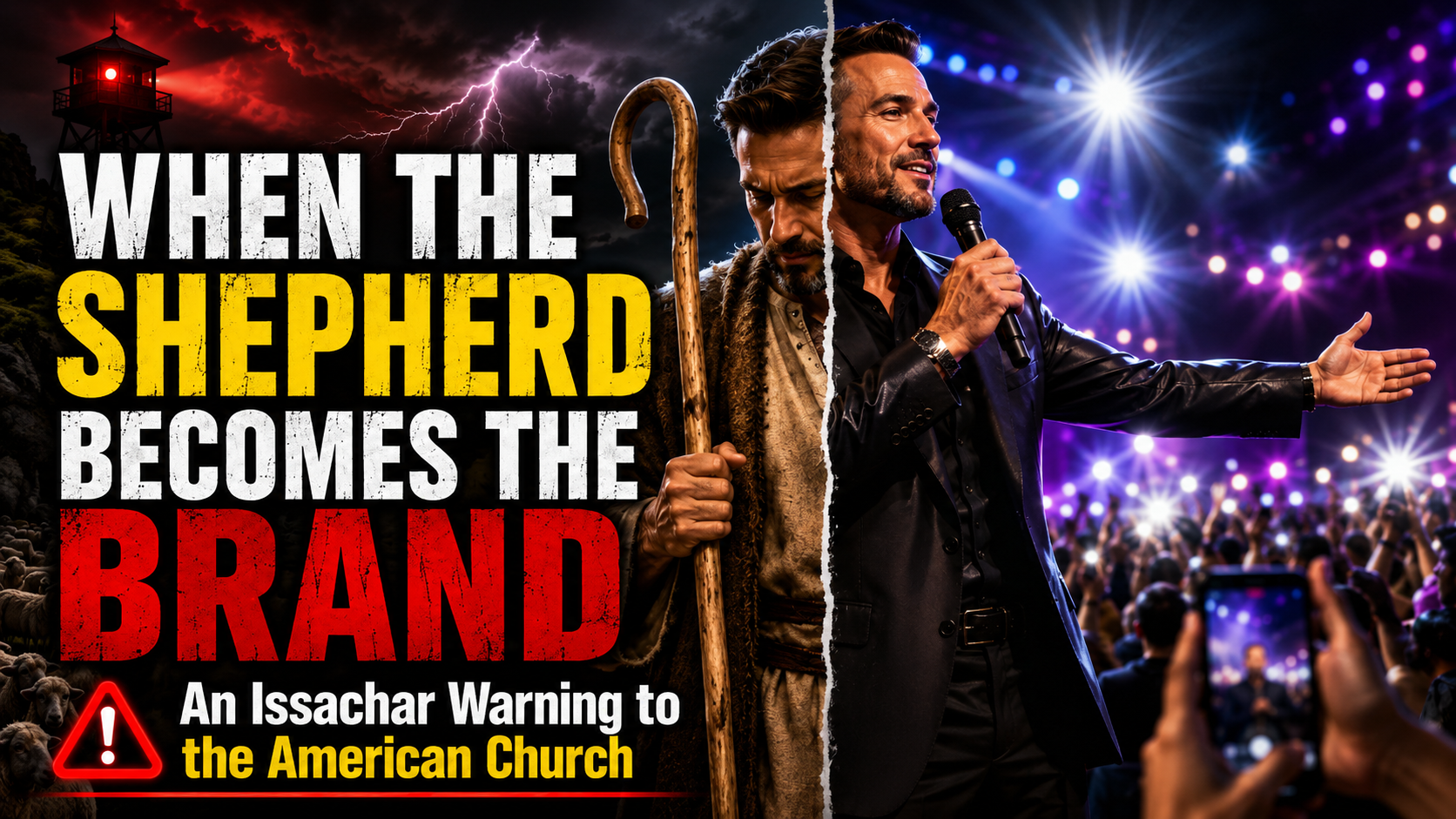
An Issachar Warning to the American Church
There is a profound difference between seeing what is happening and discerning what it means. First Chronicles 12:32 describes the sons of Issachar as men who had “understanding of the times, to know what Israel ought to do.” They were not simply informed. They were discerning. They possessed the spiritual clarity to recognize the moment before them and the wisdom to understand how the people of God should respond.
The American Church needs that kind of discernment again.
For several decades, we have witnessed the rise of the megachurch, the conference personality, the Christian influencer, and what has increasingly become known as the celebrity pastor. In many cases, a leader’s public image becomes almost inseparable from the ministry itself. Clothing, appearance, stage presentation, social media imagery, personal style, language, branding, and lifestyle begin to form a recognizable public identity.
None of those things automatically proves compromise. Scripture does not teach that a large congregation is ungodly, nor does it condemn a minister simply because his influence extends beyond a local assembly. Thousands followed Jesus. Thousands were added to the Church at Pentecost. Paul’s ministry affected cities and regions. Church history itself contains faithful men and women whose influence stretched across nations.
The real issue is not size, visibility, technology, or personal style. The issue is whether the shepherd is still pointing the sheep toward Christ, or whether the ministry has slowly begun training the sheep to gather around the shepherd.
That distinction matters because Jesus never taught us to measure spiritual legitimacy by growth alone. In Matthew 15:13 He declared, “Every plant, which my heavenly Father hath not planted, shall be rooted up.” Growth can occur without divine origin. Popularity can develop without Heaven’s approval. Something can become large, recognizable, culturally influential, and financially successful while still drifting from the nature of the Kingdom it claims to represent.
This is where the American Church must recover discernment. We have too often allowed attendance, reach, book sales, conference invitations, campuses, production quality, social media numbers, and influence to become substitutes for biblical fruit. Yet Jesus did not tell us we would know people by their platform. He said we would know them by their fruit.
The biblical questions are therefore much deeper. Are believers becoming mature? Are they learning to recognize the voice of God? Are they growing in Scripture, prayer, holiness, discernment, love, courage, and obedience? Are they being equipped to minister, withstand deception, endure hardship, and carry the Gospel beyond the walls of a building? Are they becoming increasingly dependent upon Christ, or increasingly dependent upon the personality standing on the platform?
Those are the questions an Issachar people must be willing to ask.
THE BIBLICAL SHEPHERD POINTS BEYOND HIMSELF
One of the clearest warnings concerning spiritual leadership appears in Acts 20. Paul gathered the elders from Ephesus and warned them of dangers that would arise after his departure. He spoke of grievous wolves entering among the flock, but then he added something even more sobering. Acts 20:30 says, “Also of your own selves shall men arise, speaking perverse things, to draw away disciples after them.”
The danger was not only opposition from outside the Church. Paul warned that men could arise from within the believing community and begin drawing disciples around themselves.
That warning deserves serious attention in an age where Christian success is often discussed in the language of followers, influence, reach, personal platforms, and brand identity. Social media itself is not the enemy, and influence can certainly be used for the Kingdom. The problem begins when the objective subtly shifts from helping people follow Christ to gathering people around the minister.
Paul understood this danger well. In 2 Corinthians 4:5 he wrote, “For we preach not ourselves, but Christ Jesus the Lord; and ourselves your servants for Jesus’ sake.” The preacher was never meant to become the message. The servant could be visible, recognized, and influential, but Christ had to remain central.
John the Baptist demonstrated the same posture when his disciples became troubled because people were beginning to follow Jesus. John did not defend his audience, protect his influence, or attempt to preserve his movement. He answered, “He must increase, but I must decrease” (John 3:30). That is one of the clearest pictures of Kingdom leadership in Scripture because John understood that his assignment was fulfilled when attention moved away from him and toward Christ.
That principle stands in direct tension with a culture that teaches people to build recognizable identities, protect platforms, cultivate audiences, and develop personal brands. Again, the problem is not visibility. The problem is what visibility begins to serve.
A faithful shepherd uses influence to make Christ more visible. A dangerous system gradually makes Christ the language while the leader becomes the center.
WHEN IMAGE BECOMES PART OF THE MINISTRY PRODUCT
We live in an age shaped by branding. Corporations understand it. Politicians understand it. Entertainers understand it. Social media influencers understand it. Branding creates recognition through appearance, style, language, imagery, repetition, and identity.
That same thinking has increasingly entered Christian ministry.
There is nothing inherently sinful about a minister changing his appearance or developing a personal style. A man may grow a beard, wear contemporary clothing, get tattoos, dress casually, or change the way he presents himself without any spiritual compromise whatsoever. The issue is not the outward element itself. The issue is what that outward presentation begins to accomplish.
There is a difference between simply having a style and deliberately constructing a marketable persona.
When the clothing, photography, platform design, social media presence, vocabulary, stage presentation, merchandise, public appearances, and lifestyle all begin reinforcing one recognizable personality, the Church has every right to ask whether it is still witnessing ordinary ministry communication or whether it has entered the territory of celebrity culture.
That question should not be asked with suspicion, jealousy, or hostility. It should be asked with biblical discernment. Paul told the Thessalonians, “Prove all things; hold fast that which is good” (1 Thessalonians 5:21), while John instructed believers, “Beloved, believe not every spirit, but try the spirits whether they are of God” (1 John 4:1).
The New Testament never teaches blind loyalty to Christian leaders. It teaches honor, accountability, discernment, and examination.
The Bereans were commended because they received apostolic teaching eagerly while still searching the Scriptures daily to determine whether what they heard was true. If Paul’s teaching could be examined in the light of Scripture, then no modern pastor, apostle, prophet, teacher, influencer, or conference personality should ever be placed beyond biblical examination.
THE DANGER OF PREEMINENCE
Third John introduces us to a man named Diotrephes, and John identifies the central problem in remarkably clear language. Diotrephes “loveth to have the preeminence among them.”
He did not merely lead. He loved prominence.
That desire affected his behavior. He resisted apostolic authority, spoke maliciously, rejected faithful brethren, and attempted to exercise control over those who disagreed with him. His problem was not leadership itself. His problem was the desire to occupy a place that did not belong to him.
Colossians 1:18 declares concerning Jesus Christ that “in all things he might have the preeminence.” That makes the issue even more serious. Preeminence belongs to Christ.
Whenever a Christian leader begins occupying emotional, spiritual, or organizational space that belongs to Jesus, the Church has crossed into dangerous territory. A healthy shepherd continually directs people toward the Chief Shepherd. An unhealthy system slowly teaches people to interpret everything through the personality, revelation, approval, or presence of the leader.
This is where we must distinguish between biblical honor and unhealthy dependence. Scripture certainly teaches believers to honor faithful leaders. Paul told Timothy that elders who rule well are worthy of double honor, and Hebrews speaks seriously about responding properly to spiritual oversight. Yet biblical honor never becomes spiritual dependency.
A pastor is not the source of revelation. He is not the mediator between God and the believer. He is not the believer’s access point to the presence of God. He is a servant under Christ who has been entrusted with the responsibility of equipping the saints.
When honor turns into dependence, the system has moved beyond the New Testament pattern.
THE FIVEFOLD MINISTRY WAS GIVEN TO EQUIP THE BODY
Ephesians 4 provides one of the clearest descriptions of ministry leadership in the New Testament. Christ gave apostles, prophets, evangelists, pastors, and teachers “for the perfecting of the saints, for the work of the ministry, for the edifying of the body of Christ.”
The purpose of the ministry gifts is not to perform Christianity while everyone else watches. Their assignment is to equip the saints so that the Body can function.
That changes the measurement of ministry success.
The biblical question is not merely how many people attend, but whether the people under that ministry are becoming equipped. Are they becoming spiritually mature? Are they learning to recognize deception? Are they able to handle Scripture responsibly? Are they growing into Christ? Are they able to minister, disciple others, pray, serve, endure pressure, and function beyond the environment of the Sunday gathering?
If thousands of people attend a church year after year yet remain incapable of functioning spiritually without the presence, teaching, personality, or platform of one leader, we should ask whether the Ephesians 4 mandate has truly been fulfilled.
The purpose of a shepherd is not to create permanent spectators. The purpose of a shepherd is to help raise mature believers who can carry the life and government of Christ into the world.
THE NEW TESTAMENT GATHERING WAS CHRIST-CENTERED
When we examine the gatherings of the early Church, we discover something very different from much of modern Christian culture.
Acts 2:42 says the believers continued steadfastly in the apostles’ doctrine, fellowship, breaking of bread, and prayers. Their community life revolved around truth, relationship, communion, generosity, worship, prayer, and devotion to Christ.
Acts 4 describes believers praying together until the place where they were assembled was shaken. Acts 13 presents prophets and teachers at Antioch ministering to the Lord and fasting until the Holy Spirit spoke and commissioned Barnabas and Saul for apostolic work.
That scene is especially important because the gathering was oriented toward God rather than toward a personality. They were ministering to the Lord, and from that God-centered environment came divine direction and apostolic mission.
First Corinthians 14 also reveals a participatory gathering in which the Body contributed under the order and direction of the Holy Spirit. Paul speaks of one bringing a psalm, another a doctrine, another a revelation, another a tongue, and another an interpretation. The gathering was not leaderless, but neither was it structured around the passive observation of one personality.
Healthy leadership makes room for the Body to function.
When the people of God become dependent upon a particular platform, personality, atmosphere, or production in order to encounter God, something has shifted away from the New Testament pattern. The gathering should strengthen believers for life and mission, not condition them to remain spiritual consumers.
FALSE TEACHERS DO NOT ALWAYS LOOK FALSE
Jesus repeatedly warned His disciples about false prophets and false teachers. In Matthew 7:15 He said, “Beware of false prophets, which come to you in sheep’s clothing, but inwardly they are ravening wolves.”
The imagery is intentional because deception often appears familiar. False teachers may speak Christian language, quote Scripture, understand church culture, carry recognizable titles, and move comfortably among believers. Peter later warned in 2 Peter 2:1 that false teachers would arise “among you,” while Paul told Timothy that a time would come when people would no longer endure sound doctrine but would gather teachers according to their own desires.
That reveals an uncomfortable reality. False teaching does not grow simply because deceptive teachers exist. It also grows because audiences can desire teachers who confirm what they already want to hear.
Paul confronted this mentality directly in Corinth. Some believers were declaring allegiance to Paul, others to Apollos, and others to Cephas. Paul’s response was immediate: “Is Christ divided?” He recognized the danger of believers organizing their spiritual identity around human ministers.
In 1 Corinthians 3 he went even further, describing himself and Apollos merely as servants through whom the Corinthians believed. One planted, another watered, but God gave the increase. Paul was not diminishing ministry. He was restoring proper order.
The servant matters, but the servant is never the center.
COULD RELIGION USE SUCCESS TO WEAKEN THE CHURCH?
This is where we must ask a harder question.
We commonly think of the enemy weakening the Church through persecution, deception, temptation, or open opposition. Scripture certainly reveals those strategies. Yet spiritual opposition can also work through distraction, substitution, and misdirection.
If the enemy cannot stop believers from gathering, he may attempt to redefine what gathering is for. If attendance can be mistaken for discipleship, people may sit in churches for years without ever becoming equipped. If preaching becomes inspiration without transformation, believers may leave encouraged while remaining spiritually immature. If worship becomes dependent upon atmosphere, stagecraft, and professional production, people may never learn how to encounter God when those elements disappear.
And if leadership becomes celebrity-driven, believers can gradually transfer emotional and spiritual dependence from Christ to personalities while still believing they are honoring God.
This is where the spirit of religion becomes especially dangerous.
Religion does not always oppose Christian activity. Sometimes it multiplies Christian activity while quietly removing Kingdom life.
Jesus confronted religious leaders who knew Scripture, prayed, fasted, tithed, taught, traveled to make converts, and maintained highly developed religious systems. Yet in Matthew 23 He accused some of them of shutting the Kingdom of Heaven in people’s faces.
Their activity was religious, but their system could still prevent people from entering the life God intended.
That should sober the modern Church. Busyness is not the same as life, growth is not the same as maturity, and attendance is not the same as discipleship. We must examine what our systems actually produce.
A CHURCH CAN BE FULL AND STILL BE OUT OF THE BATTLE
Paul tells us in Ephesians 6 that our struggle is not against flesh and blood. He describes believers as armed, prayerful, watchful, resistant, and prepared to stand. Jesus describes His Ecclesia as a people against whom the gates of Hades will not prevail.
The Church in Acts was anything but passive. Believers prayed, evangelized, healed the sick, confronted demonic powers, endured persecution, cared for the poor, planted churches, raised leaders, discipled communities, confronted corrupt systems, and carried the testimony of Jesus into hostile environments.
The New Testament Church was trained for engagement.
That reality should force us to examine what we have produced. If a person can attend church for twenty years and still be unable to discern truth from error, something in the system has failed. If believers know the personality of their pastor better than they know the character of Christ, something is out of order. If they can quote sermons but cannot search Scripture for themselves, if they can participate in worship services but cannot pray through spiritual pressure, and if their faith collapses when a leader falls, then we may have built far more around personalities than we were willing to admit.
The enemy does not necessarily need to shut down every church building in order to weaken the Church. He only needs believers to remain spiritually passive, distracted, dependent, and unequipped.
That is how an army can be removed from the battlefield without ever being defeated in open combat.
THIS IS NOT AN ATTACK ON LARGE CHURCHES
We must remain careful here because the opposite error is equally dangerous.
A small church is not automatically pure, and a large church is not automatically compromised. A pastor with fifty people can be controlled by ego just as easily as a pastor with fifty thousand. A minister wearing a traditional suit can crave recognition just as deeply as someone wearing expensive streetwear.
The issue is not size. The issue is the heart, the system, the fruit, and the direction of the ministry.
There are large churches faithfully preaching Christ, equipping believers, serving communities, raising missionaries, planting congregations, and carrying tremendous Kingdom influence. Their size should not be used as evidence against them. Likewise, there are very small ministries built almost entirely around the personality and authority of one leader.
Biblical discernment therefore requires better questions. We should examine whether Christ is exalted, whether the whole counsel of God is preached, whether leadership lives under genuine accountability, whether correction can be received, whether finances are handled with integrity, whether believers are being equipped, and whether the culture points people toward Christ rather than toward continual dependence upon the platform.
We should also pay attention to what happens when the leader is absent, challenged, corrected, or questioned. Those moments often reveal the actual spiritual culture of a ministry more clearly than the Sunday service does.
THE SPIRIT OF RELIGION AND THE DESIRE TO CONTROL
One of the most dangerous features of religious systems is their ability to create dependency while presenting that dependency as spiritual order.
Jesus confronted leaders who placed heavy burdens upon people while positioning themselves as the interpreters of righteousness. In Matthew 23 He condemned those who loved titles, recognition, places of honor, and public visibility while neglecting the humility, justice, mercy, and faithfulness of the Kingdom.
His model of authority was radically different. Jesus taught that the greatest among His people must become a servant.
Kingdom leadership serves because it exists for the sake of others. Religious leadership controls because it needs others for the preservation of the system. Kingdom leadership equips believers toward maturity, while religious systems can create long-term dependence upon the institution or the leader.
That is why the Church must be cautious whenever questioning the leader becomes equivalent to questioning God. No human shepherd owns the sheep.
Jesus said in John 10 that He is the Good Shepherd. Peter likewise reminded elders in 1 Peter 5 that they were shepherding the flock of God. He warned them against domineering over those entrusted to their care and told them to lead by example, always remembering that the Chief Shepherd would one day appear.
That language restores everything to proper order.
The flock belongs to Christ.
Every pastor serves under Him.
AN ISSACHAR PEOPLE MUST DISCERN WITHOUT BECOMING CYNICAL
The answer to celebrity Christianity is not suspicion, bitterness, or cynicism. It is maturity.
We do not need a generation that automatically distrusts every pastor. We need a generation that knows Scripture well enough to recognize healthy leadership. We do not need believers obsessed with hunting for scandal. We need believers who can examine doctrine, recognize fruit, test character, and refuse to surrender their discernment to charisma.
Nor should we dishonor genuine fathers and mothers in the faith. Healthy spiritual leadership is a gift from Christ to His Church, and faithful ministers deserve honor.
But the gift must never replace the Giver.
An Issachar people understands that honor and discernment are not enemies. We can honor leaders without worshiping personalities. We can celebrate influence without confusing it with anointing. We can rejoice when ministries grow while still examining the fruit that growth produces.
The Church must stop assuming that everything successful was therefore ordained by God.
The question is whether Christ remains preeminent.
REMNANT, RETURN TO THE CHIEF SHEPHERD
The hour requires a Church that belongs completely to Jesus Christ.
The Church does not belong to denominations, networks, movements, apostles, prophets, conference personalities, social media influencers, or local pastors. She was purchased with the blood of Jesus.
Every faithful minister should therefore spend his life helping believers become more rooted in Christ, more mature in Scripture, more discerning in spirit, more capable in ministry, and more faithful in their own assignment.
The shepherd should never become the destination. His assignment is to point continually toward Christ.
If our platforms become larger while our disciples become weaker, we have misunderstood success. If our leaders become increasingly recognizable while Jesus becomes increasingly secondary, we have lost our way. If our churches produce admirers rather than mature disciples, then no amount of attendance can compensate for what has been lost.
The sons of Issachar understood the times and knew what Israel ought to do. The American Church needs that same discernment now, not so that we can tear down the Church, but so that we can awaken her. We do not need to attack shepherds; we need shepherds who remember that they serve beneath the authority of the Chief Shepherd. We do not need less influence; we need influence purified of self-exaltation and returned to Kingdom purpose.
The hour is too serious for believers to remain spectators while darkness advances around them. The Ecclesia was called to pray, stand, discern, disciple, confront darkness, carry the Gospel, and demonstrate the government of Jesus Christ in the earth.
This is not the hour for the Church to gather around personalities. It is the hour for the Church to gather around the King.
May every human throne become low enough for Christ to be seen clearly. May every shepherd remember whose sheep he is tending. May every believer recover the responsibility to search the Scriptures, hear the Holy Spirit, test what is being taught, and walk in mature obedience to Jesus.
And may the American Church once again become what Christ intended her to be: not an audience gathered around a brand, but a living, equipped, discerning Ecclesia standing under the absolute lordship of Jesus Christ.
Stay tuned, the journey continues…..
A voice of fire to the Remnant,
— Dr. Russell Welch
Dr. Russell Welch is a published author, prophetic teacher, apostolic builder, and founder of faith-driven publishing and media initiatives. He is known for crafting bold, Kingdom-centered messages that call the Ecclesia into maturity, doctrinal clarity, and governmental authority. With a passion for equipping the Remnant and honoring generational legacy, Dr. Welch writes and teaches at the intersection of Scripture, history, and spiritual governance, challenging believers to live as sons and daughters who legislate Heaven on earth through truth, holiness, and unwavering fidelity to Christ.
Be sure to check out his book, America at War: The Spiritual Battle for a Nation’s Soul, available exclusively on Amazon

