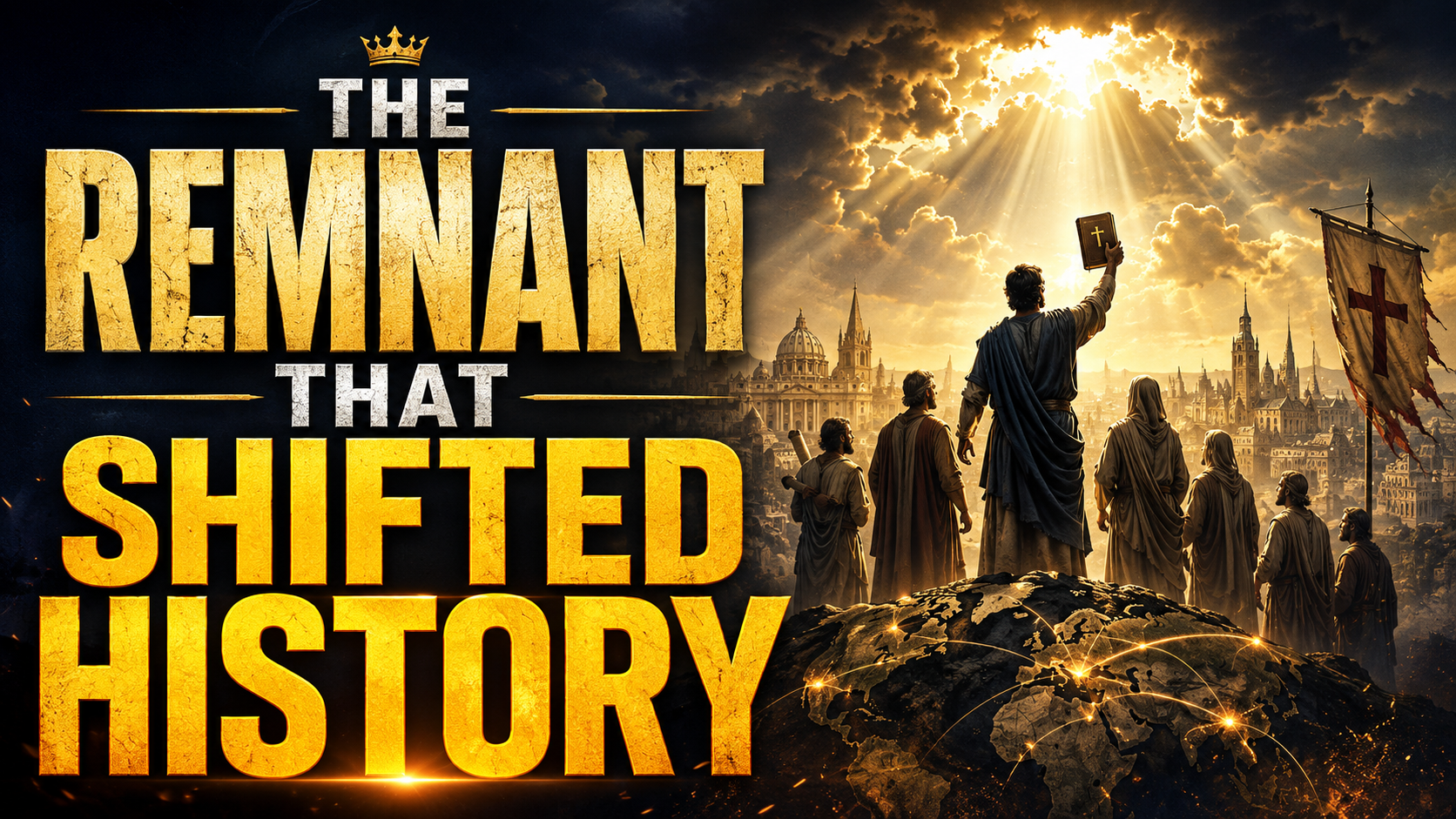
When Consecrated Believers Changed Cities, Regions, and Nations
Throughout the history of the Church, God has repeatedly demonstrated that He does not require a majority in order to transform a territory. Again and again, when culture was deteriorating, religious systems had grown cold, or nations were drifting farther from righteousness, the Lord raised up a consecrated people who refused to accept darkness as inevitable. They prayed, preached, discipled, confronted injustice, served their communities, and carried the presence of God beyond the walls of their gatherings.
This is one of the great lessons we must recover in this hour. The Remnant has never been defined primarily by its numerical strength. It has been defined by its willingness to hear God and obey Him when others would not. Scripture establishes this pattern long before we reach Church history. Gideon’s army was reduced before victory came. Elijah stood against the prophets of Baal while seven thousand remained who had not bowed the knee. Jesus began the New Covenant movement with a relatively small company of disciples, yet within generations the Gospel had penetrated cities throughout the Roman world.
The history of the New Testament Ecclesia continues that same testimony. At crucial moments, the Lord has raised up relatively small communities of believers whose impact became far greater than their size.
THE MORAVIANS: WHEN PRAYER BECAME A MISSION TO THE NATIONS
In the eighteenth century, a small community of believers gathered at Herrnhut under the leadership of Count Nikolaus Ludwig von Zinzendorf. They came from different backgrounds and had experienced internal tensions, yet something happened when reconciliation, consecration, and prayer became central to their community. What emerged became one of the most remarkable prayer and missionary movements of the modern Church.
The Moravians did not remain satisfied with experiencing God among themselves. Their prayer produced assignment. Believers began leaving the security of their community and traveling into distant nations to proclaim Christ, often entering difficult and dangerous territories. A relatively small gathering of believers became a missionary force whose influence traveled far beyond Saxony.
That is one of the great principles of Remnant ministry: true intercession eventually produces movement. When a congregation truly encounters the heart of God for a territory or a people, prayer cannot forever remain contained within the prayer room. Heaven begins revealing assignments.
THE CLAPHAM BELIEVERS: WHEN THE REMNANT ENTERED THE GATES OF GOVERNMENT
In late eighteenth- and early nineteenth-century England, a group of committed evangelical Christians associated with Clapham became deeply involved in confronting some of the great moral evils of their generation. Among the best known was William Wilberforce, whose Christian convictions fueled his long campaign against the British slave trade.
These believers understood something the modern Church must recover: government is not a territory from which the righteous should automatically withdraw. If darkness is operating through laws, institutions, commerce, or public policy, then believers must be willing to carry righteousness into those gates.
Their influence did not come through prayer alone, although prayer was foundational. They organized, wrote, spoke, built alliances, presented evidence, endured political setbacks, and remained committed for years. Their Christianity became public obedience.
Spiritual warfare is incomplete when we rebuke darkness but refuse to enter the places where darkness has established influence.
THE WESLEYAN AWAKENING: WHEN REVIVAL LEFT THE BUILDING
John Wesley and the early Methodists ministered in an England experiencing enormous spiritual and social challenges. Wesley famously preached outside established church buildings when traditional structures could no longer contain the people who needed to hear the Gospel. Coal miners, laborers, prisoners, the poor, and those largely neglected by respectable religious society became the mission field.
Yet the movement did more than produce emotional meetings. Converts were organized into societies and smaller discipleship groups where believers were taught accountability, holiness, prayer, Scripture, generosity, and practical Christian living. The awakening began affecting families and communities because people were not simply converted; they were discipled.
This is essential for understanding territorial transformation. Revival without discipleship can produce moments. Revival joined with discipleship can begin producing culture.
The Ecclesia is not merely called to gather people around an experience with God. We are called to raise men and women who carry the Kingdom of God into everyday life.
THE WELSH REVIVAL: WHEN REPENTANCE TOUCHED THE COMMUNITY
The Welsh Revival of 1904–1905 remains one of the most discussed awakenings of the modern era. Meetings were marked by fervent prayer, confession, worship, and a profound awareness of God’s presence. Yet what made the revival especially significant was that its influence was not restricted to church services.
Testimonies from the period describe changed personal behavior, reconciliation, renewed spiritual hunger, and communities experiencing the effects of large numbers of people turning toward Christ. The atmosphere of revival moved beyond the meeting place because transformed people returned to their homes, workplaces, neighborhoods, and communities carrying different values.
That is the kind of awakening we desperately need again.
If revival only changes our church services, we have not yet seen its full fruit. When revival touches a territory, homes begin changing. Relationships begin changing. Businesses begin changing. Community values begin changing because the people inhabiting that culture have encountered God.
THE SALVATION ARMY: WHEN WARFARE LOOKED LIKE COMPASSION
When William and Catherine Booth began ministering among the poor in nineteenth-century London, they entered places much of respectable religious society preferred to avoid. Poverty, homelessness, alcoholism, prostitution, hunger, and hopelessness were realities surrounding their ministry.
Their response was both spiritual and practical. They preached salvation through Christ while also confronting the human suffering that surrounded them. The movement that became the Salvation Army understood that the Gospel must reach the soul while the love of Christ also reaches the person.
There is an important lesson here for those of us who speak about spiritual warfare. Territorial warfare is not merely identifying demons, strongholds, or spiritual resistance. Sometimes the most devastating blow against darkness is feeding someone who is hungry, discipling someone trapped in addiction, restoring dignity to the forgotten, caring for children, strengthening families, or giving someone a genuine opportunity to rebuild their life.
The Kingdom confronts darkness by demonstrating what the rule of Christ actually looks like.
THE PATTERN HAS NOT CHANGED
When we study these movements together, a remarkable pattern begins emerging. These believers did not merely gather and complain about what was wrong with their generation. They sought God until they understood what obedience required.
Prayer became mission.
Revival became discipleship.
Conviction became reform.
Compassion became ministry.
And spiritual awakening eventually became cultural influence.
This is where the modern Remnant must mature. We cannot spend our lives identifying everything darkness is doing while never asking what Heaven has assigned us to do in response.
Paul reminds us in 2 Corinthians 10:4–5 that the weapons of our warfare are not carnal but mighty through God for the pulling down of strongholds. Yet Paul never envisioned spiritual warfare as passive religious rhetoric. The apostolic Church prayed, preached, planted congregations, confronted false systems, discipled believers, cared for people, entered cities, and established Kingdom communities within hostile cultures.
Likewise, Ephesians 6:12 tells us that our struggle is ultimately not against flesh and blood. That truth should change the way we engage our cities. People are not the enemy. Political parties are not the ultimate enemy. Broken people are not the enemy. Our warfare must remain spiritual even while our obedience becomes profoundly practical.
The question, therefore, is not simply whether darkness exists in our city. We already know it does.
The question is whether there is an Ecclesia in that city that knows what Heaven has assigned it to do.
As I have studied the history of the New Testament Church, this pattern has become increasingly difficult to ignore. Again and again, the Lord has raised up Remnant believers and congregations whose obedience shifted the spiritual and cultural atmosphere around them. Some affected neighborhoods. Others affected cities. Still others influenced regions and nations.
This historical study became part of the foundation for my forthcoming Kingdom War Colleger Training book, GOVERNING THE GATES: 12 Kingdom Assignments for Spiritual Warfare Over Your City and State. The purpose is not simply to teach people how to pray harder. It is to help the Remnant begin discerning what strategic Kingdom assignment God has given the Ecclesia within its territory.
Because perhaps the question we should be asking is no longer, “Lord, why is our city becoming darker?”
Perhaps we should be asking:
“Lord, what gate have You assigned us to?”
The Remnant has never been called merely to observe history.
We have been called to become obedient participants in what God desires to do within it.
We must become the altar where the fire falls again.
Stay tuned, the journey continues…..
A voice of fire to the Remnant,
— Dr. Russell Welch
Dr. Russell Welch is a published author, prophetic teacher, apostolic builder, and founder of faith-driven publishing and media initiatives. He is known for crafting bold, Kingdom-centered messages that call the Ecclesia into maturity, doctrinal clarity, and governmental authority. With a passion for equipping the Remnant and honoring generational legacy, Dr. Welch writes and teaches at the intersection of Scripture, history, and spiritual governance, challenging believers to live as sons and daughters who legislate Heaven on earth through truth, holiness, and unwavering fidelity to Christ.
Be sure to check out his book, America at War: The Spiritual Battle for a Nation’s Soul, available exclusively on Amazon

