Dismantling Replacement Theology with the Light of Truth and the Unbroken Covenant of God with Israel
Replacement Theology is not merely a harmless doctrinal difference. It becomes dangerous when it teaches the Church to boast against the very root that carries her. It becomes toxic when it suggests that God cast away Israel in order to replace her with a Gentile Church. It becomes deceptive when it takes the promises, covenants, prophetic destiny, and covenant identity given to Israel and transfers them in such a way that the Jewish people are treated as abandoned, rejected, or irrelevant to God’s redemptive plan.
Romans 11 stands as one of the clearest apostolic rebukes against this error.
Paul opens Romans 11 with a question that leaves no room for confusion: “Has God cast away His people?” His answer is immediate and forceful: “God forbid.” In Greek, Paul uses the phrase mē genoito, which carries the sense of “May it never be,” “Absolutely not,” or “Let such a thing never be thought.” This is not a soft disagreement. This is Paul slamming the door on the idea that God has rejected Israel.
Romans 11:1 says, “I say then, Hath God cast away his people? God forbid. For I also am an Israelite, of the seed of Abraham, of the tribe of Benjamin.”
The Greek word translated “cast away” is apōtheō, meaning to push away, reject, thrust aside, or repudiate. Paul is directly confronting the idea that God has shoved Israel out of His covenant purpose. His answer is no. God has not repudiated His people. God has not divorced Himself from the covenant promises given to Abraham, Isaac, Jacob, and their descendants.
The Aramaic/Syriac Peshitta carries the same force. The question reads with the sense of whether God has rejected or cast off His people, and the response is emphatic: “Far be it.” The Syriac witness strengthens the same apostolic conclusion: God’s covenant people have not been discarded. Israel has experienced a partial hardening, but not covenant abandonment.
This distinction matters.
Paul does not say Israel has been replaced.
Paul says Israel has experienced a partial hardening.
Paul does not say the Church became Israel in a way that erases Israel.
Paul says Gentiles have been grafted into the covenant blessing through Messiah.
Paul does not say the root now depends on the branches.
Paul says the branches depend on the root.
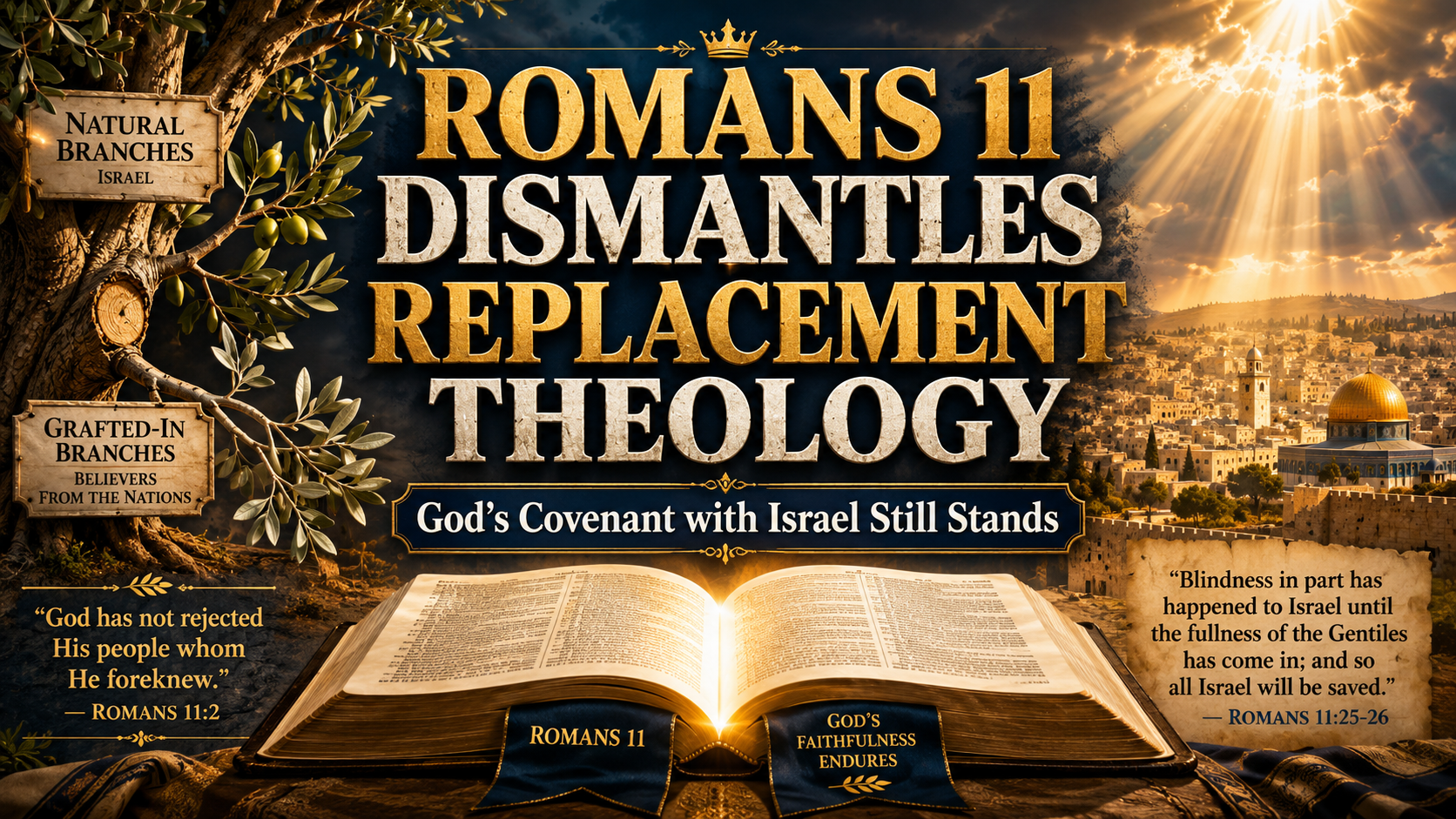
Romans 11:2 declares, “God hath not cast away his people which he foreknew.”
The Greek word foreknew is proginōskō, meaning to know beforehand, to set covenantal knowledge upon, to recognize in advance. This is more than God having information ahead of time. It speaks of covenant recognition and divine intention. The people God foreknew, He did not abandon. The covenant God initiated, He did not cancel. The promises God swore, He did not break.
The Aramaic witness preserves this same covenant logic. God has not rejected the people He knew from before. This is covenant language. This is faithfulness language. This is the language of divine remembrance.
Replacement Theology collapses because Romans 11 is built upon the faithfulness of God.
If God can break His covenant with Israel, then what confidence does the Church have that He will keep His covenant promises to us? If God can revoke His oath to Abraham, then how can we trust His promises in Christ? Paul’s entire argument is not merely about Israel. It is about the character of God. The issue is not only Israel’s destiny; the issue is whether God is faithful to His own Word.
Romans 11:11 says, “Have they stumbled that they should fall? God forbid.”
Again Paul uses mē genoito: absolutely not. Israel stumbled, but Israel did not fall beyond recovery. Their stumbling opened a door of mercy to the nations, but the mercy shown to the nations was never meant to become arrogance against Israel. Gentile inclusion was designed to provoke Israel to holy jealousy, not to create Gentile superiority.
Paul then gives the olive tree picture.
Romans 11:17–18 says, “And if some of the branches be broken off, and thou, being a wild olive tree, wert grafted in among them… boast not against the branches. But if thou boast, thou bearest not the root, but the root thee.”
This is devastating to Replacement Theology.
The Greek word for “grafted in” is enkentrizō. It speaks of inserting a branch into a living tree so it may draw life from the root. Gentile believers are not planted as a separate replacement tree. They are grafted into the existing covenantal olive tree. The tree existed before the Gentile branches were added. The root is not Gentile. The root is covenantal. The root runs through the patriarchs, the promises, the covenants, the prophets, and ultimately Messiah Himself, who came according to the flesh from Israel.
The Aramaic/Syriac Peshitta also presents the Gentiles as branches grafted in among the natural branches. The image remains the same: the Gentile believer receives life by being joined into what God had already cultivated. The wild branch does not become the root. The wild branch does not own the tree. The wild branch does not replace the natural branches. The wild branch is sustained by mercy.
Paul’s warning is sharp: “Boast not against the branches.”
The Greek word for boast carries the idea of exalting oneself over another. Paul is warning Gentile believers not to become arrogant toward Jewish unbelief. He is not giving the Church permission to mock Israel, erase Israel, spiritualize away Israel’s promises, or claim Israel’s identity in a way that denies Israel’s future restoration.
Romans 11:20 says, “Be not highminded, but fear.”
In Greek, the phrase carries the force of, “Do not think lofty thoughts about yourself, but stand in reverent fear.” Replacement Theology often produces the very attitude Paul warned against. It becomes high-minded. It assumes that Gentile believers now possess the covenant in such a way that Israel no longer matters. Paul says that attitude is not faith. It is arrogance.
Then Paul brings the argument to its covenant climax.
Romans 11:25 says, “Blindness in part is happened to Israel, until the fulness of the Gentiles be come in.”
The Greek phrase pōrōsis apo merous means “hardening in part.” This is critical. Paul does not say total blindness. He does not say permanent blindness. He does not say covenant rejection. He says partial hardening. The phrase “until the fullness of the Gentiles” means there is a divine timetable. Israel’s present condition is not the final word. God is still moving toward covenant fulfillment.
The Aramaic witness also speaks of a measure of blindness or dullness coming upon Israel until the fullness of the nations enters. Again, the idea is not replacement. The idea is sequence, mystery, timing, mercy, and restoration.
Romans 11:26 then says, “And so all Israel shall be saved.”
This verse must not be handled carelessly. Paul is not teaching salvation apart from Messiah. He is not saying Jewish identity alone saves. He is saying that God’s covenant dealings with Israel are not finished and that a future turning of Israel to Messiah belongs to the mystery of God’s redemptive plan.
The Greek word houtōs, translated “so,” means “in this manner” or “in this way.” Paul is explaining the divine pattern: partial hardening has come upon Israel, fullness is coming among the Gentiles, and then Israel’s restoration will unfold according to God’s covenant faithfulness.
Romans 11:27 says, “For this is my covenant unto them, when I shall take away their sins.”
The Greek word diathēkē means covenant. Paul grounds Israel’s future salvation not in human merit, but in divine covenant. God made promises. God swore by Himself. God does not lie. God does not revoke His covenant oath because of Gentile misunderstanding.
The Aramaic/Syriac Peshitta also holds the covenant language strongly. The taking away of sins is tied to God’s covenant action. Israel’s restoration is not sentimental nationalism. It is covenantal redemption through the mercy of God in Messiah.
Then Paul makes the statement that should end the replacement argument:
Romans 11:28–29 says, “As concerning the gospel, they are enemies for your sakes: but as touching the election, they are beloved for the fathers’ sakes. For the gifts and calling of God are without repentance.”
The Greek word for “election” is eklogē, meaning divine choosing. Israel remains beloved because of the fathers. Which fathers? Abraham, Isaac, and Jacob. Paul does not say Israel used to be beloved. He says they are beloved. Present tense covenant affection remains upon them because of patriarchal promise.
The phrase “without repentance” comes from the Greek ametamelēta, meaning irrevocable, not to be regretted, not taken back. God does not regret His covenant gifts. God does not withdraw His calling. God does not erase Israel from His redemptive purpose.
The Aramaic witness carries the same meaning: the gifts and calling of God are not reversed. They are not subject to cancellation. God’s covenant faithfulness remains intact.
This means Replacement Theology collapses under the weight of Romans 11.
The Church is not “the new Israel” in a way that erases ethnic Israel. The Church is the one new man in Messiah, made up of believing Jews and believing Gentiles, reconciled through the cross, sharing in covenant blessing by grace. Gentiles are not outsiders anymore, but neither are they covenant thieves. We have been brought near by the blood of Messiah. We have been grafted in by mercy. We have become fellow heirs, not replacement heirs.
The land of Israel also cannot be casually dismissed as though the biblical covenants were merely metaphors with no earthly consequence. The Abrahamic covenant included seed, blessing, nations, and land. The prophets repeatedly tie Israel’s restoration to both spiritual renewal and covenantal return. While salvation is only through Messiah, and while the modern political state of Israel must still be judged by righteousness and truth like every nation, the biblical land promise cannot be erased by Gentile theology without doing violence to the text.
The issue is not blind political worship of a nation-state. The issue is the integrity of God’s covenant Word.
We do not worship Israel.
We worship the God of Israel.
We do not preach salvation through ethnicity.
We preach salvation through Jesus the Messiah.
We do not deny the Church’s glorious identity in Christ.
We deny the arrogant doctrine that says the Church replaced Israel and inherited her promises by erasing her future.
Paul’s warning must be heard again in this generation: “Do not boast against the branches.”
Replacement Theology is dangerous because it teaches the grafted-in branch to boast against the natural branch. It teaches the wild olive branch to act like it owns the root. It forgets that Jesus is Jewish according to the flesh, the apostles were Jewish, the prophets were Jewish, the covenants were given to Israel, the Scriptures came through Israel, and the Messiah came through Israel.
Romans 11 is not a side issue. It is a covenant courtroom. Paul brings the Gentile Church before the witness stand and asks: Will you stand in mercy, or will you boast in arrogance?
The true apostolic position is clear.
God has not cast away Israel.
Israel’s hardening is partial, not total.
Israel’s stumbling is temporary, not final.
Gentiles are grafted in, not installed as replacements.
The root supports us; we do not support the root.
Israel remains beloved for the fathers’ sake.
The gifts and calling of God are irrevocable.
The covenant-keeping God will finish what He started.
Therefore, the Remnant Ecclesia must reject the false replacement gospel and recover the fear of the Lord concerning Israel. We bless what God has blessed. We honor what God has covenanted. We pray for the peace of Jerusalem. We preach Messiah to Jew and Gentile alike. We stand against antisemitism, arrogance, and theological theft. And we proclaim with Paul that the mercy of God is wide enough to gather the nations without abandoning Israel.
The light of truth dismantles the lie.
God’s covenant with Israel has not been broken.
God’s Word has not failed.
God’s promises have not expired.
God’s election has not been revoked.
And the God of Abraham, Isaac, and Jacob will be faithful to His covenant until the fullness of His redemptive plan is complete.
Stay tuned, the journey continues…..
A voice of fire to the Remnant,
— Dr. Russell Welch
Dr. Russell Welch is a published author, prophetic teacher, apostolic builder, author, and founder of faith-driven publishing and media initiatives. He is known for crafting bold, Kingdom-centered messages that call the Ecclesia into maturity, doctrinal clarity, and governmental authority. With a passion for equipping the Remnant and honoring generational legacy, Dr. Welch writes and teaches at the intersection of Scripture, history, and spiritual governance, challenging believers to live as sons and daughters who legislate Heaven on earth through truth, holiness, and unwavering fidelity to Christ.
Be sure to check out his book: Restoring God’s Prophetic Voice: Unleashing the Watchman’s Power in the Church’s Guide to Holy Living, available exclusively on Amazon … here
Amazon Author Page