Archive for the ‘disciples life’ Category


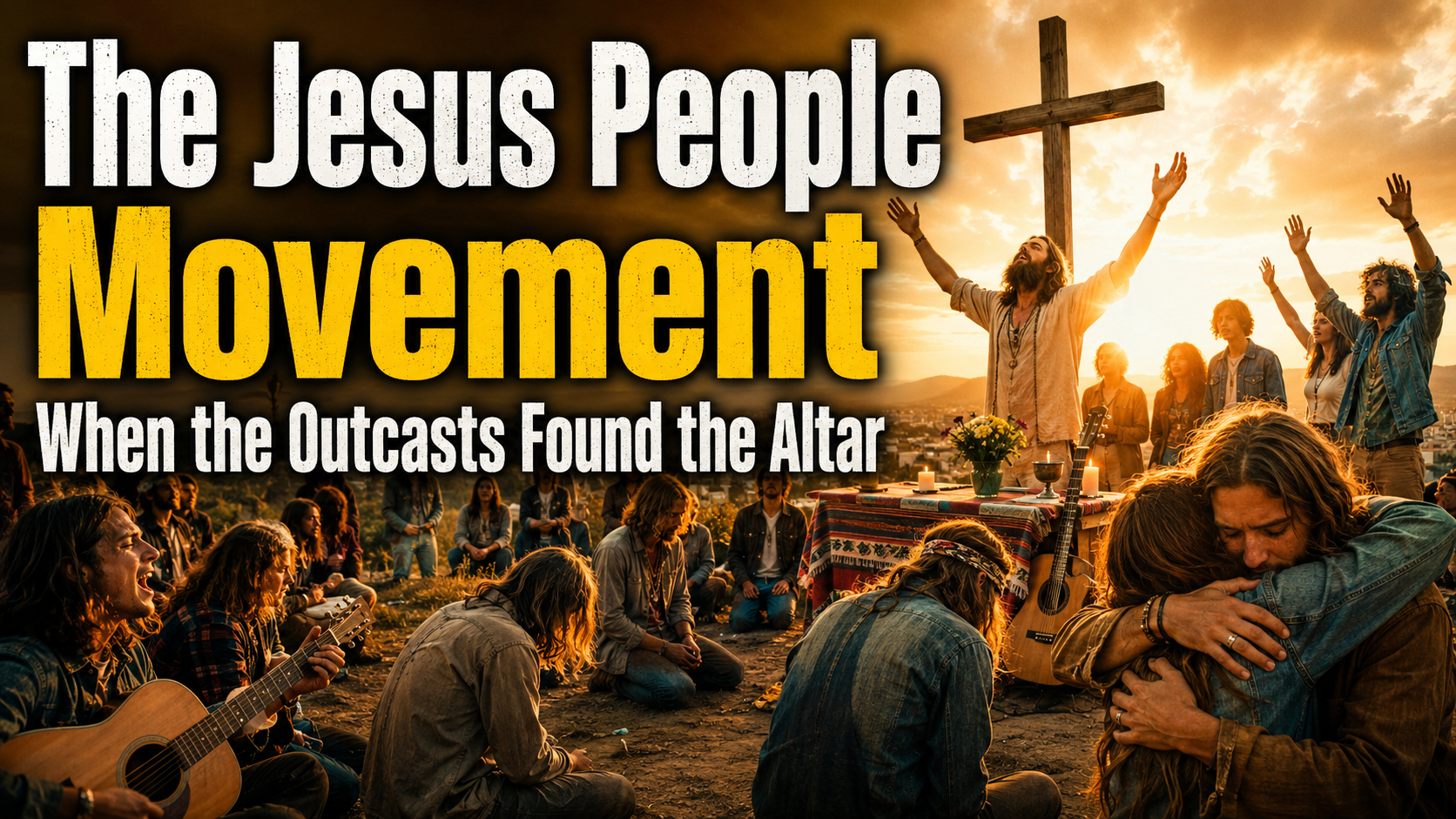
When the Outcasts Found the Altar

There are seasons in history when God refuses to move where religion expects Him to move. He steps outside the polished walls, beyond the managed platforms, past the respectable circles of religious comfort, and He begins breathing upon those the church has often misunderstood, ignored, rejected, or feared. The Jesus People Movement was one of those moments.

It did not begin in stained-glass respectability. It did not arrive dressed in the clothing of religious approval. It came in the middle of cultural shaking, generational confusion, rebellion, war protests, drug culture, broken families, spiritual hunger, and young people searching desperately for something real. America was trembling. A generation was asking questions the system could not answer. Many were running from the emptiness of materialism, the hypocrisy of dead religion, and the pain of homes that looked whole on the outside but were fractured within.

And into that chaos, Jesus stepped.

Not the religious caricature of Jesus. Not the domesticated Jesus of powerless tradition. Not the distant Jesus locked behind pulpits and programs. The living Christ walked into the highways and beaches, coffeehouses and street corners, communes and college campuses, and He began calling sons and daughters home. The outcasts found the altar, and the altar found them.

This is the scandal of revival. God often begins where the religious elite would never think to look.

The Jesus People Movement became a holy disruption. Hippies, seekers, musicians, addicts, runaways, intellectuals, broken youth, and spiritual wanderers began encountering the living Christ. Many had chased peace through drugs, freedom through rebellion, enlightenment through Eastern mysticism, and identity through counterculture. Yet when they met Jesus, they found what every false altar had failed to give them. They found forgiveness. They found deliverance. They found family. They found purpose. They found the burning reality of the Kingdom.

The world had called them lost. Religion had called them dangerous. Heaven called them beloved.

That is the heart of revival.

Jesus has always been drawn to those who know they are sick enough to need a Physician. In Matthew 9:12–13, Jesus said, “They that be whole need not a physician, but they that are sick.” Then He declared, “I will have mercy, and not sacrifice: for I am not come to call the righteous, but sinners to repentance.” That word shattered the religious arrogance of His day, and it still shatters ours.

The Jesus People Movement reminds us that revival is not born when the church becomes impressed with herself. Revival is born when the desperate cry out, the broken come near, the proud are humbled, and the altar becomes wet with repentance again. It is born when Jesus becomes more than a sermon topic. He becomes the obsession of a generation.

These young people were not looking for a better religious product. They were not asking for polished church branding, celebrity preachers, or spiritual entertainment. They were hungry for reality. They wanted the Jesus of the Gospels. They wanted the Christ who touched lepers, cast out devils, forgave prostitutes, confronted Pharisees, healed the sick, raised the dead, and announced a Kingdom that could not be shaken.

And when they found Him, they could not keep quiet.

Street evangelism became one of the sounds of the movement. Young converts took the Gospel into public spaces with boldness that embarrassed comfortable religion. They spoke of Jesus in parks, on sidewalks, on beaches, in coffeehouses, and in homes. They did not wait until they had a degree, a title, a platform, or a denominational endorsement. They had encountered Christ, and the fire of first love became their credential.

That does not mean everything was mature. It does not mean everything was balanced. It does not mean every stream that touched the movement remained pure. Every revival must be tested, shepherded, discipled, and brought under the lordship of Christ. Fire without formation can burn wildly. Zeal without truth can become unstable. Freedom without holiness can drift into deception. But we must never allow the imperfections of a move to blind us to the mercy of God within it.

The lesson is not that disorder should be celebrated. The lesson is that God is not afraid of messy beginnings.

The early church was messy. Corinth was messy. Peter was messy. The disciples were messy. The book of Acts was filled with glory, power, persecution, correction, conflict, miracles, deliverance, and apostolic order emerging in real time. God has never required polished people before He begins moving. He requires surrendered people.

The Jesus People Movement carried a sound of raw surrender. It helped renew worship in ways that still echo today. Songs became simpler, more intimate, more direct, and more accessible. Worship moved from performance into participation. Guitars, choruses, and heartfelt songs of devotion began rising from people who had once sung the anthems of rebellion but were now singing to the King.

The altar had taken their sound captive.

This is one of the great marks of true revival: the sound changes. When God moves upon a people, their language changes, their songs change, their desires change, their gatherings change, and their witness changes. What once glorified the flesh begins to glorify Christ. What once carried confusion begins to carry consecration. What once served rebellion becomes a weapon of worship.

That is redemption.

The enemy loves to convince people that their past disqualifies them. But the Gospel declares something far greater: whatever has been surrendered to Christ can become testimony. The very generation that had been labeled unreachable became a generation of witnesses. Those once enslaved by drugs began preaching freedom. Those once wandering through spiritual darkness began proclaiming the Light of the world. Those once looking for belonging in broken communities began forming households of faith.

The Father knows how to turn prodigals into preachers.

Luke 15 gives us the picture. The younger son wasted his inheritance, lost his dignity, and ended up in the pigpen. But when he came to himself and returned home, the father did not meet him with a lecture first. He met him with compassion. He ran. He embraced. He restored. The robe, the ring, the sandals, and the feast all testified that the son was not returning as a slave but as family.

That was the prophetic picture behind much of the Jesus People Movement. The Father was running toward a generation covered in the smell of the far country.

Religion often stands like the older brother, offended that mercy is being given to people who did not earn it. But revival never begins with what men think people deserve. Revival begins with the mercy of God breaking into places of despair and calling dead things back to life.

The outcasts found the altar because the Father had not forgotten their names.

This should shake the church in our hour. We are again living in a generation filled with confusion, addiction, anxiety, rebellion, spiritual hunger, identity crisis, broken homes, occult fascination, ideological deception, and deep distrust of institutions. Many young people are not rejecting the true Christ; they are rejecting the powerless version of Christianity they were shown. They are not always running from Jesus. Many are running from hypocrisy, dead religion, spiritual abuse, and a church culture that talked about power while living without presence.

The answer is not to entertain them into the Kingdom. The answer is not to dilute the Gospel until it becomes palatable to the flesh. The answer is not to replace holiness with relevance. The answer is to lift up the real Jesus again.

The Jesus People Movement reminds us that a generation can be swept into radical discipleship when Christ is preached with conviction, love, power, and authenticity. Not a Christ made in the image of culture. Not a Christ stripped of His demands. Not a Christ who saves without transforming. The real Jesus forgives sinners, but He also says, “Go, and sin no more.” He welcomes the broken, but He also calls them to take up the cross. He eats with outcasts, but He does not leave them bound.

True revival never excuses bondage. It breaks it.

This is where the church must recover both compassion and conviction. Compassion without conviction becomes sentimental weakness. Conviction without compassion becomes religious cruelty. Jesus carried both perfectly. He could weep over Jerusalem and still cleanse the temple. He could touch the leper and rebuke the Pharisee. He could forgive the woman caught in adultery and command her to leave her life of sin. He could welcome fishermen, tax collectors, zealots, and broken women into His company, then form them into witnesses of the Kingdom.

The Jesus People Movement carried this beautiful offense: Jesus was not ashamed to be found among the rejected.

That truth must burn in us again.

Some of the greatest harvest fields in our time are not sitting comfortably in pews. They are in recovery homes, college campuses, street corners, broken families, music scenes, prisons, homeless camps, online communities, and among young people who have been told by culture that they can invent themselves while their souls are collapsing under the weight of confusion. They do not need a religious system that simply condemns them from a distance. They need an Ecclesia filled with Holy Spirit, truth, mercy, deliverance, and fire.

They need fathers and mothers in the faith who will not compromise the Gospel, but also will not despise the broken when they come home smelling like the far country.

The altar must be ready.

The Jesus People Movement also confronts our obsession with appearances. Many churches of that era struggled to know what to do with long-haired, barefoot, unconventional converts. They did not look like church people. They did not speak the language of church culture. They brought questions, wounds, habits, and sounds that made religious people uncomfortable. Yet many of them were genuinely being saved, baptized, delivered, and discipled.

God was making sons and daughters out of those who did not fit the mold.

This is apostolic Christianity. The Kingdom does not advance by protecting religious comfort zones. It advances when Christ takes territory in human hearts, and then those transformed lives become living witnesses in the earth. The early church did not grow because it looked respectable to Rome. It grew because the dead were raised, demons were cast out, the poor were cared for, the Word of God spread, and believers loved not their lives unto death.

Radical discipleship is not a brand. It is the normal Christian life.

The tragedy of many revival movements is that the church celebrates the fire after history has made it safe, while resisting the same kind of fire when it appears in their own generation. We praise past revivals while rejecting the very kind of people those revivals reached. We speak fondly of transformed outcasts from decades ago while remaining suspicious of the outcasts standing in front of us today.

May God deliver us from romanticizing yesterday’s fire while refusing today’s harvest.

The Jesus People Movement should not merely make us nostalgic. It should provoke us. It should ask us hard questions. Where are the broken youth finding altars today? Where are the seekers encountering the real Jesus? Where are the saints carrying the Gospel outside the walls? Where are the worship sounds rising from redeemed lives instead of manufactured platforms? Where are the spiritual fathers and mothers willing to disciple messy converts into mature sons and daughters?

A movement becomes dangerous when converts are made but disciples are not formed. Jesus did not command us to gather crowds; He commanded us to make disciples. The fruit of revival must become formation, holiness, community, mission, and obedience. Fire must become faithfulness. Encounter must become endurance. Testimony must become transformation. Passion must become purity.

This is where the Jesus People Movement gives both inspiration and warning. It shows us what can happen when Jesus captures a generation, but it also reminds us that every move of God must be stewarded with truth, humility, accountability, and apostolic foundations. Revival is not a substitute for discipleship. Revival is the doorway into it.

The altar is not the finish line. It is the place of death and resurrection.

When the outcasts found the altar, they found more than emotional relief. They found a cross. They found a King. They found a Kingdom. They found a new life that demanded everything. The true Jesus does not simply add peace to our rebellion. He crucifies the old man and raises us into newness of life.

That is what our generation needs again.

We do not need a revival of religious excitement without repentance. We do not need gatherings that stir emotions but leave chains intact. We do not need another wave of spiritual language without holiness, deliverance, and obedience. We need a Jesus movement that is truly centered on Jesus: crucified, risen, reigning, and returning in glory.

We need the kind of move that finds the addict and makes him free. The kind that finds the runaway and brings her home. The kind that finds the seeker and fills him with truth. The kind that finds the worshiper buried beneath shame and releases a new song. The kind that finds the rebel and turns him into a witness. The kind that finds the broken youth and forms them into burning disciples.

The church must stop fearing the harvest because it does not arrive dressed for Sunday morning.

When Heaven moves, the nets often fill with fish that have not yet been cleaned. That is not a problem for the Kingdom. That is the work of discipleship. Fishermen catch the fish; the Lord cleanses, transforms, and prepares them for purpose. Too often, the church wants cleaned fish before it will cast the net. But Jesus said, “Follow me, and I will make you fishers of men.”

The Jesus People Movement was a net-casting moment.

It was a reminder that the Gospel still works in the streets. It was a reminder that worship can rise from the ashes of rebellion. It was a reminder that Christ can invade youth culture without surrendering His holiness to it. It was a reminder that the Spirit of God is not intimidated by chaos. He hovered over the waters in Genesis, and He still hovers over the deep places of human brokenness, ready to speak light into darkness.

Let there be light.

That is the cry for our hour.

Let there be light in the streets again. Let there be light in the schools again. Let there be light in the homes again. Let there be light in the churches again. Let there be light in the hearts of sons and daughters who have wandered into the far country. Let the altar be restored, not as a religious decoration, but as a place of surrender, repentance, fire, healing, and commissioning.

May the outcasts find the altar again.

May the church have enough love to receive them, enough truth to disciple them, enough holiness to confront what binds them, and enough fire to send them back into the world as witnesses of the risen King.

The Jesus People Movement was never meant to be a museum piece. It is a prophetic reminder. God can move among the unlikely. God can save the unreachable. God can turn seekers into saints. God can transform the sound of a generation. God can take what culture discarded and make it a vessel of glory.

The question is not whether God can do it again.

The question is whether the church is ready to carry the fire with clean hands, open arms, and uncompromising truth.

The altar is calling.

And somewhere, in the middle of the noise, the confusion, the rebellion, and the hunger of this generation, the Father is already watching the road for prodigals.

May they find the altar burning when they come home.

Stay tuned, the journey continues…..

A voice of fire to the Remnant,

— Dr. Russell Welch

Dr. Russell Welch is a published author, prophetic teacher, apostolic builder, and founder of faith-driven publishing and media initiatives. He is known for crafting bold, Kingdom-centered messages that call the Ecclesia into maturity, doctrinal clarity, and governmental authority. With a passion for equipping the Remnant and honoring generational legacy, Dr. Welch writes and teaches at the intersection of Scripture, history, and spiritual governance, challenging believers to live as sons and daughters who legislate Heaven on earth through truth, holiness, and unwavering fidelity to Christ.

Be sure to check out his book, Spirit Wind People: Those Who are Moved by the Impulses of Holy Spirit, available exclusively on Amazon.

Amazon Author Page


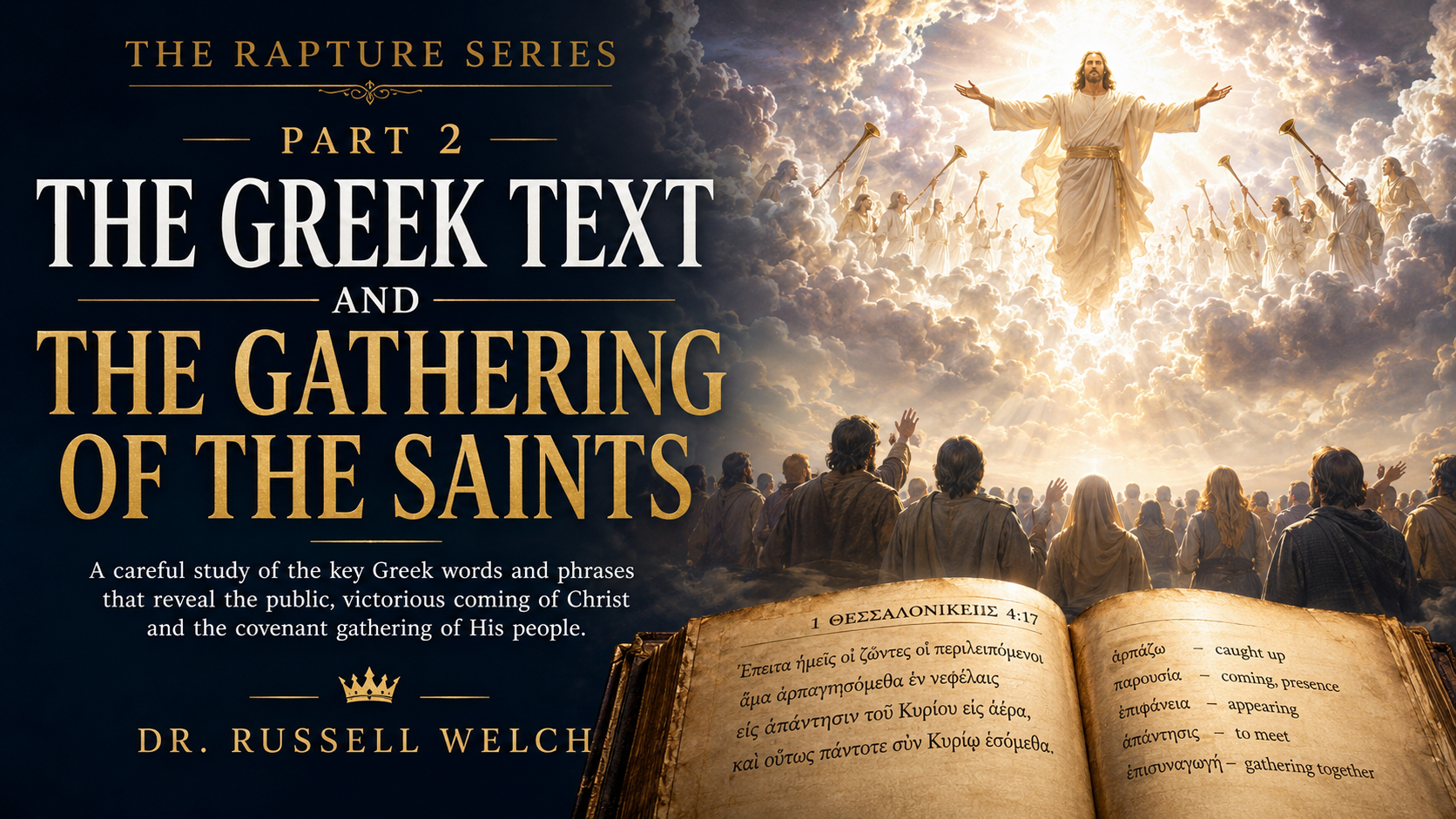
The Language of Resurrection, Royal Arrival, and Public Appearing

The faithful do not need to fear careful study. Truth does not tremble when the Greek text is opened. Truth does not panic when the words of Scripture are examined in their covenant setting, historical setting, and apostolic context. If a doctrine is truly built upon the Word of God, then the original language will strengthen it, not weaken it. But if a doctrine has been built by removing words from context, forcing phrases into a modern prophetic system, and then asking the text to serve a chart instead of the King, then the light of Scripture will expose the weakness of that system.

This is where we must begin with humility and courage. The issue is not whether sincere people have believed the Rapture doctrine. Many have. The issue is not whether good men and women have preached it. Many have. The issue is whether the doctrine itself can survive the careful examination of the language used by the Holy Spirit through the apostles. We are not called to protect a tradition because it is familiar. We are called to test all things, hold fast that which is good, and allow Scripture to correct our assumptions.

The Greek text must be allowed to speak for itself. When it does, the language of the New Testament points us toward resurrection, royal arrival, public appearing, covenant gathering, and final victory. It does not naturally point us toward a secret evacuation of the Church before the visible triumph of Christ. The hope of the saints is not escape from the battlefield while darkness increases. The hope of the saints is the appearing of the King, the resurrection of the dead, the transformation of the living, and the fullness of His Kingdom being revealed in victory.

The first word that must be examined is the word often placed at the center of the Rapture doctrine: ἁρπάζω, harpazō. In 1 Thessalonians 4:17, Paul says that those who are alive and remain shall be “caught up” together with the resurrected saints in the clouds to meet the Lord in the air. The phrase “caught up” is real. We must not deny it, weaken it, or explain it away. The Greek word carries the idea of being seized, snatched, taken, or carried by force. It is a strong word. It speaks of divine action, not human effort.

However, the presence of the word “caught up” does not automatically create a secret Rapture doctrine. This is where many have made a serious interpretive mistake. They have taken one word, isolated it from the passage, and then built an entire end-time system around it. Paul is not writing in 1 Thessalonians 4 to reveal a secret evacuation. He is comforting grieving believers concerning those who have died in Christ. The entire passage is framed by resurrection hope. Paul says the dead in Christ shall rise first. Then those who are alive and remain will be caught up together with them. The emphasis is not disappearance. The emphasis is resurrection reunion.

This matters deeply. Paul is answering the fear that deceased believers would somehow miss the coming glory of Christ. His answer is not, “Do not worry, the Church will escape seven years before trouble begins.” His answer is, “The dead in Christ will rise first.” That places the passage in the resurrection category, not the evacuation category. The faithful are not being told to expect a hidden removal from the earth. They are being told that when the Lord comes, the dead will be raised, the living faithful will be gathered with them, and all will be with the Lord.

The details in 1 Thessalonians 4 are anything but secret. Paul speaks of the Lord Himself descending from heaven with a shout, with the voice of the archangel, and with the trumpet of God. These are not images of silence, secrecy, or hidden activity. These are royal, public, victorious, covenantal sounds. A shout, an archangelic voice, and the trumpet of God do not describe Heaven trying to sneak the Church out of history. They describe the King arriving in glory.

The second word we must examine is παρουσία, parousia, commonly translated “coming.” This word does not merely describe movement from one place to another. It carries the sense of arrival and presence. In the world of the New Testament, parousia could be used for the arrival or visitation of a ruler, king, or dignitary. When the New Testament uses this word for Christ, it is not presenting Him as a nervous rescuer slipping His people out the back door. It is presenting Him as the reigning Lord whose arrival changes everything.

This becomes especially clear when we compare Scripture with Scripture. In Matthew 24:27, Jesus says that as lightning comes from the east and shines unto the west, so also shall the coming, the parousia, of the Son of Man be. That is not hidden language. That is visible language. That is not private language. That is public language. Lightning does not ask permission to be noticed. It tears across the sky and announces itself. Jesus used this kind of imagery to guard His disciples from secret-coming claims.

Paul uses the same family of expectation when he writes in 2 Thessalonians. In 2 Thessalonians 2:1, he speaks of “the coming of our Lord Jesus Christ” and “our gathering together unto Him.” He does not separate these into two unrelated events. He joins them together. The coming and the gathering are linked. Then, in the same chapter, Paul says the lawless one will be destroyed by the brightness, or appearing, of the Lord’s coming. This is crucial. The appearing of His coming destroys the lawless one. That is not the language of a secret evacuation before confrontation. That is the language of royal manifestation and victory.

The third word we must examine is ἀπάντησις, apantēsis, translated “to meet.” In 1 Thessalonians 4:17, the saints are caught up “to meet the Lord in the air.” This phrase has often been treated as though it means the saints meet Jesus in the air and then immediately depart with Him away from the earth for a hidden period of time. But the word itself does not demand that conclusion. In the New Testament, this word carries the idea of going out to meet someone who is arriving. It is the language of reception, honor, and welcome.

This becomes powerful when we consider the royal imagery. In the ancient world, when a king or dignitary approached a city, the people would go out to meet him and escort him in with honor. The meeting was not an escape from the city. It was a reception of the arriving ruler. That background fits the passage naturally. The saints rise to meet the arriving King. The Church does not flee because the devil is winning. The faithful rise in resurrection victory because the King is appearing.

This also fits Matthew 25, where the virgins go out to meet the bridegroom. The bridegroom is arriving. The wise are prepared. The meeting is connected to readiness, not evacuation. In Acts 28, believers go out to meet Paul as he approaches Rome. They do not meet him and then take him away from Rome. They meet him and accompany him toward his destination. This does not mean every usage must be pressed beyond measure, but it does show that the word “meet” does not naturally require the modern Rapture storyline. It fits a royal reception far better than a hidden escape.

The fourth word group we must examine is the language of appearing and unveiling. The New Testament uses words such as ἐπιφάνεια, epiphaneia, and ἀποκάλυψις, apokalypsis. Epiphaneia speaks of appearing, manifestation, or brightness. Apokalypsis speaks of revelation or unveiling. These words do not move us toward secrecy. They move us toward visibility. They do not hide Christ. They reveal Christ.

Titus 2:13 calls the faithful to look for the blessed hope and the glorious appearing of our great God and Savior, Jesus Christ. The blessed hope is not described as a secret disappearance. It is described as an appearing. Paul tells Timothy of the appearing of Christ. Peter speaks of grace being brought at the revelation of Jesus Christ. John opens Revelation by declaring that every eye shall see Him. The consistent direction of the New Testament is not concealment but manifestation.

This is where we must challenge the modern prophetic imagination. Many have been taught to think of the hope of the Church as vanishing before trouble reaches its fullness. But the apostolic hope is not rooted in fear of tribulation. It is rooted in the appearing of Christ. The early believers were not told, “Comfort one another because you will never face pressure.” They were told to endure, overcome, remain faithful, and look for the appearing of the King. The hope of the saints is not that darkness gets the final word on earth while the Church escapes. The hope of the saints is that Jesus appears in glory, raises the dead, judges evil, vindicates the faithful, and fills all things with the authority of His Kingdom.

The fifth word we must examine is ἐπισυναγωγή, episynagōgē, translated “gathering together.” This word appears in 2 Thessalonians 2:1, where Paul says, “concerning the coming of our Lord Jesus Christ, and our gathering together unto Him.” Again, Paul links the coming and the gathering. He does not tell the Thessalonians to separate them into two different prophetic events divided by years of hidden history. The gathering belongs to the coming.

This gathering language carries deep covenant echoes. The prophets spoke of God gathering His people. Jesus spoke of angels gathering His elect from the four winds. The language of gathering is not foreign to Israel’s covenant story. It is restoration language. It is harvest language. It is Kingdom language. It is the language of God bringing His people into the fullness of what He promised.

In Matthew 24:31, Jesus says that after the tribulation of those days, the Son of Man will send His angels with a great sound of a trumpet, and they will gather together His elect from the four winds. Whether one wrestles with the immediate historical setting of Jerusalem, the wider prophetic horizon, or the fullness of future fulfillment, the language is still public, cosmic, and covenantal. It is not the language of a secret Church removal hidden from the nations. It is the language of divine gathering under the authority of the Son of Man.

This is where the modern Rapture system often creates confusion. It takes gathering language, trumpet language, coming language, and appearing language, then assigns them to different events based on a pre-built chart. But the New Testament itself does not demand those separations. In fact, the natural reading often moves in the opposite direction. The coming, the gathering, the resurrection, the trumpet, the appearing, and the victory of Christ belong together in the apostolic witness.

This does not mean every passage is simple. It does not mean every question is answered in one verse. It does not mean we should be careless with prophecy, history, or fulfillment. But it does mean we must stop forcing Scripture to speak the language of modern end-time fiction. The apostles were not writing from a twenty-first-century prophecy conference. They were writing from the world of covenant, empire, persecution, resurrection hope, and the enthronement of Jesus Christ as Lord.

The sixth issue is context. Words do not live in isolation. A Greek word must be interpreted within its sentence, its paragraph, its letter, and the larger biblical story. When a word is removed from its setting, it can be made to serve almost any system. This has happened repeatedly with the Rapture doctrine. “Caught up” is removed from resurrection. “Coming” is removed from appearing. “Meeting” is removed from royal arrival. “Gathering” is removed from covenant restoration. “Clouds” are removed from biblical glory imagery. “Trumpet” is removed from public announcement and divine intervention.

Once those words are detached from their biblical setting, they can be rearranged into a doctrine the apostles never plainly taught. But when they are returned to their context, the picture becomes far stronger and far more victorious. The King descends. The dead are raised. The living faithful are transformed. The saints meet the Lord. The gathering takes place in connection with His coming. His appearing destroys lawlessness. His revelation brings vindication. His Kingdom triumphs.

This is not bad news. This is glorious news. The removal of a false escape doctrine does not weaken the hope of the Church. It strengthens it. It calls the faithful back to endurance. It calls the Ecclesia back to authority. It calls the saints back to the victorious Gospel of the Kingdom. It reminds us that Jesus did not commission a defeated people waiting for darkness to get bad enough so they could leave. He commissioned a governing body, filled with the Spirit, clothed with authority, and sent into the nations to disciple, baptize, teach, overcome, and bear witness until the King is revealed in glory.

The Greek text does not ask us to build a doctrine of fear. It calls us to behold the victory of Christ. It does not train the Church to pray for escape from responsibility. It summons the faithful to stand in resurrection hope. The language of the New Testament is not the language of abandonment. It is the language of arrival. It is not the language of defeat. It is the language of appearing. It is not the language of panic. It is the language of gathering. It is not the language of darkness winning history. It is the language of the King coming in glory.

The faithful must therefore return to the text with clean hands and honest hearts. We must be willing to lay down charts when they contradict Scripture. We must be willing to surrender traditions when they weaken the Gospel of the Kingdom. We must be willing to admit that some doctrines have survived not because they were deeply biblical, but because they were emotionally comforting and constantly repeated.

But repetition does not equal revelation. Familiarity does not equal truth. Popularity does not equal apostolic doctrine. The question is not, “How many have believed this?” The question is, “What does the Word of God actually say?” The question is not, “Does this make me feel safe?” The question is, “Does this agree with the language, context, and covenant witness of Scripture?”

When the Greek text is allowed to speak, it does not present a Church secretly evacuated from the earth while darkness inherits the nations. It presents the resurrecting, gathering, appearing, conquering Christ. It presents the saints meeting the King in the atmosphere of His glory. It presents the public vindication of the faithful. It presents the destruction of lawlessness by the brightness of His coming. It presents the blessed hope as the appearing of our great God and Savior, Jesus Christ.

The conclusion is simple: the Church should not fear the Greek text. The faithful should welcome it. The original language does not belong to scholars alone. It belongs to the household of faith as a servant of truth. When rightly handled, it does not make Scripture cold. It makes Scripture burn. It turns a verse into a meal. It breaks open the bread of revelation and feeds the spirit with substance.

Therefore, let every doctrine be tested. Let every chart bow. Let every tradition come under the authority of Scripture. Let the Greek text speak in context. Let the covenant story be restored. Let the saints be strengthened with resurrection hope. Let the faithful stop looking for evacuation and start looking for the appearing of the King.

Jesus is not returning as a thief who lost the earth and came back only to rescue survivors. He is returning as the victorious King, the risen Lord, the One who disarmed principalities and powers, the One who is seated far above all rule and authority, the One before whom every knee shall bow and every tongue shall confess that He is Lord.

The gathering of the saints is not the confession of a defeated Church. It is the reception of a victorious King.

Stay tuned, the journey continues…..

A voice of fire to the Remnant,

— Dr. Russell Welch

Dr. Russell Welch is a published author, prophetic teacher, apostolic builder, and founder of faith-driven publishing and media initiatives. He is known for crafting bold, Kingdom-centered messages that call the Ecclesia into maturity, doctrinal clarity, and governmental authority. With a passion for equipping the Remnant and honoring generational legacy, Dr. Welch writes and teaches at the intersection of Scripture, history, and spiritual governance, challenging believers to live as sons and daughters who legislate Heaven on earth through truth, holiness, and unwavering fidelity to Christ.

Be sure to check out his book, The Vanishing Gospel: Exposing False End‑Time Doctrine and Restoring the Kingdom Gospel, available exclusively on Amazon.

Amazon Author Page


Separated, Consecrated, and SentThe True Remnant Will Not Bow

There are many in the Remnant in this hour who must understand that the call of God will not always allow you to continue walking with everyone you once walked with. There comes a moment when assignment begins to separate what fellowship once held together. It is not always because someone is wicked, and it is not always because someone has become your enemy. Sometimes the call simply reveals that you are no longer drinking from the same stream, marching under the same sound, or being governed by the same fire.

It reminds me of Gideon’s army in Judges 7, when the Lord separated the men by how they drank water. What looked like a small detail became a divine distinction. God was not looking for the largest crowd; He was marking the company He could trust in the battle. In this hour, Heaven is still separating those who are alert, surrendered, and ready from those who are present but not prepared.

Your devotion to Christ alone will send fear through the dark realms, especially where the spirit of religion has built comfortable thrones. Religion can tolerate talent, titles, programs, and performance, but it trembles when it encounters a son or daughter who cannot be bought, branded, silenced, or controlled. The spirit of religion does not fear church activity; it fears surrendered obedience. It fears those who have decided that Jesus is Lord, and no man-made system gets to sit on His throne.

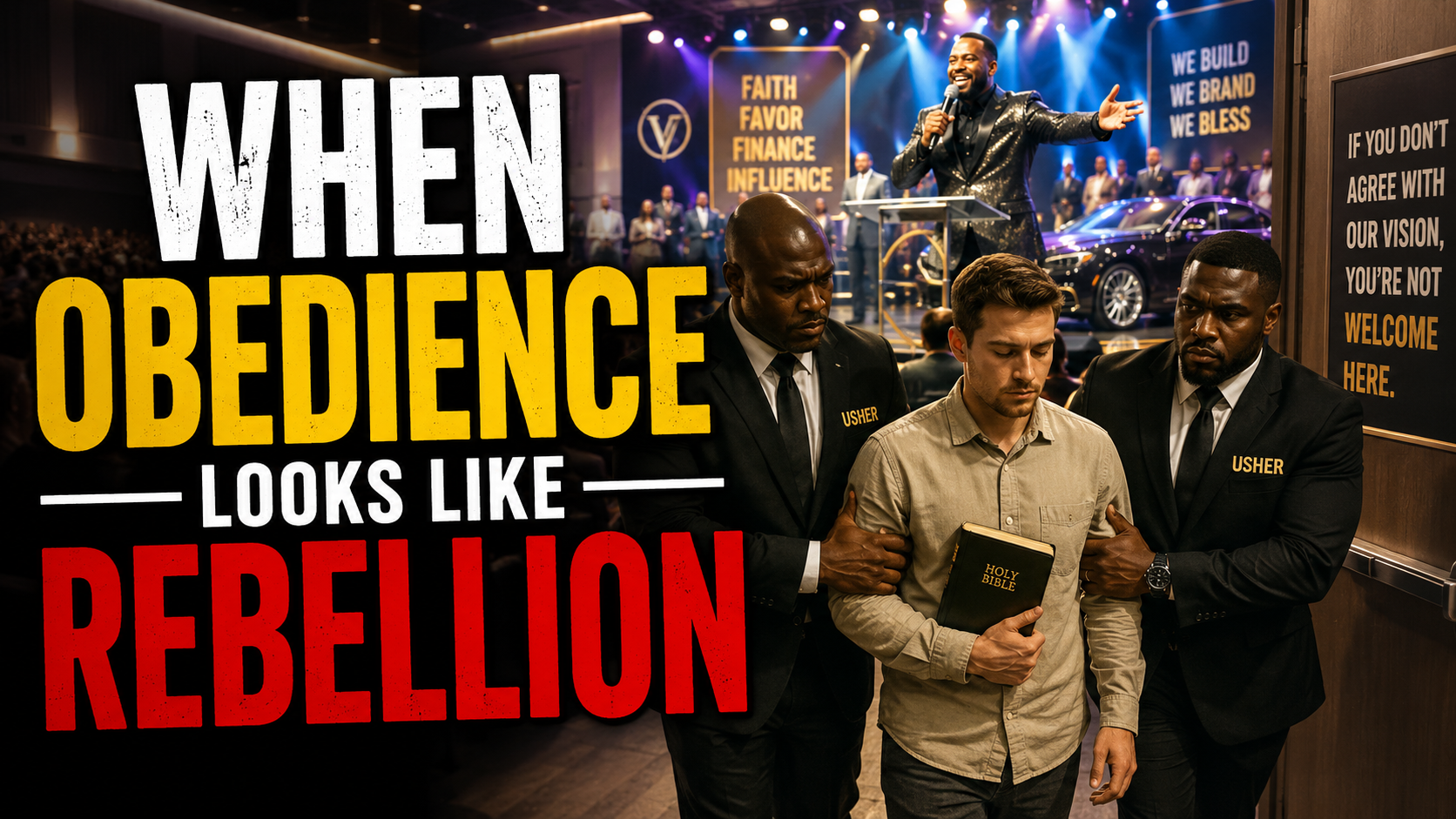
Many will call your refusal to bend “rebellion,” but Heaven may be calling it obedience. Your unwillingness to bow to dead traditions, powerless rituals, sacred cow doctrines, and church customs that Holy Spirit never authorized may be misunderstood by those who have mistaken control for covering. They may say you are difficult, unteachable, dishonoring, or out of order. But sometimes what they call “out of order” is actually a life finally coming under the order of the King.

There will be some who find themselves faced with a painful choice: bend the knee to the system or quietly take the exit. Bow to the brand or follow the Lamb. Keep the seat or keep the fire. Preserve the approval of men or obey the voice of the One who called you from before the foundation of the world.

Jesus said, “Follow Me,” and that call has always carried separation within it. Peter and Andrew left their nets. Matthew left the tax booth. Abraham left his country. Elisha left the plow. There is always a leaving attached to the higher call, because you cannot fully step into what God is assigning while clinging to what He is telling you to release.

This is not a call to arrogance, bitterness, dishonor, or reckless independence. This is a call to holy allegiance. The Remnant must walk low before God, clean in heart, quick to forgive, slow to accuse, and unwilling to let offense become the fuel of their departure. But they must also refuse to let fear, false loyalty, or religious intimidation keep them chained to a place where the fire of God is being quenched.

Paul said, “If I yet pleased men, I should not be the servant of Christ” (Galatians 1:10). That verse must become a sword in the hand of every son and daughter who is being pulled between obedience and acceptance. There comes a time when you must decide whose approval governs your yes. If pleasing men becomes your master, obedience to Christ will always be negotiated.

So to the Remnant who feel the separation happening, do not panic. Do not let grief convince you that you missed God. Do not let the accusations of others define the purity of your obedience. Sometimes the narrow road gets even narrower right before the assignment becomes clearer.

Stand in love, but do not bow to fear. Walk in humility, but do not surrender your assignment to religious control. Honor people, but worship Christ alone. And when Heaven says move, move — because your obedience may be the very thing that breaks the chains off someone else who has been too afraid to step out.

The Remnant is not being separated so they can become isolated.

They are being separated so they can be consecrated.

And once consecrated, they can be sent with fire.

Stay tuned, the journey continues…..

A voice of fire to the Remnant,

— Dr. Russell Welch

Dr. Russell Welch is a published author, prophetic teacher, apostolic builder, author, and founder of faith-driven publishing and media initiatives. He is known for crafting bold, Kingdom-centered messages that call the Ecclesia into maturity, doctrinal clarity, and governmental authority. With a passion for equipping the Remnant and honoring generational legacy, Dr. Welch writes and teaches at the intersection of Scripture, history, and spiritual governance, challenging believers to live as sons and daughters who legislate Heaven on earth through truth, holiness, and unwavering fidelity to Christ.

Be sure to check out his book: Restoring God’s Prophetic Voice: Unleashing the Watchman’s Power in the Church’s Guide to Holy Living, available exclusively on Amazon … here

Amazon Author Page


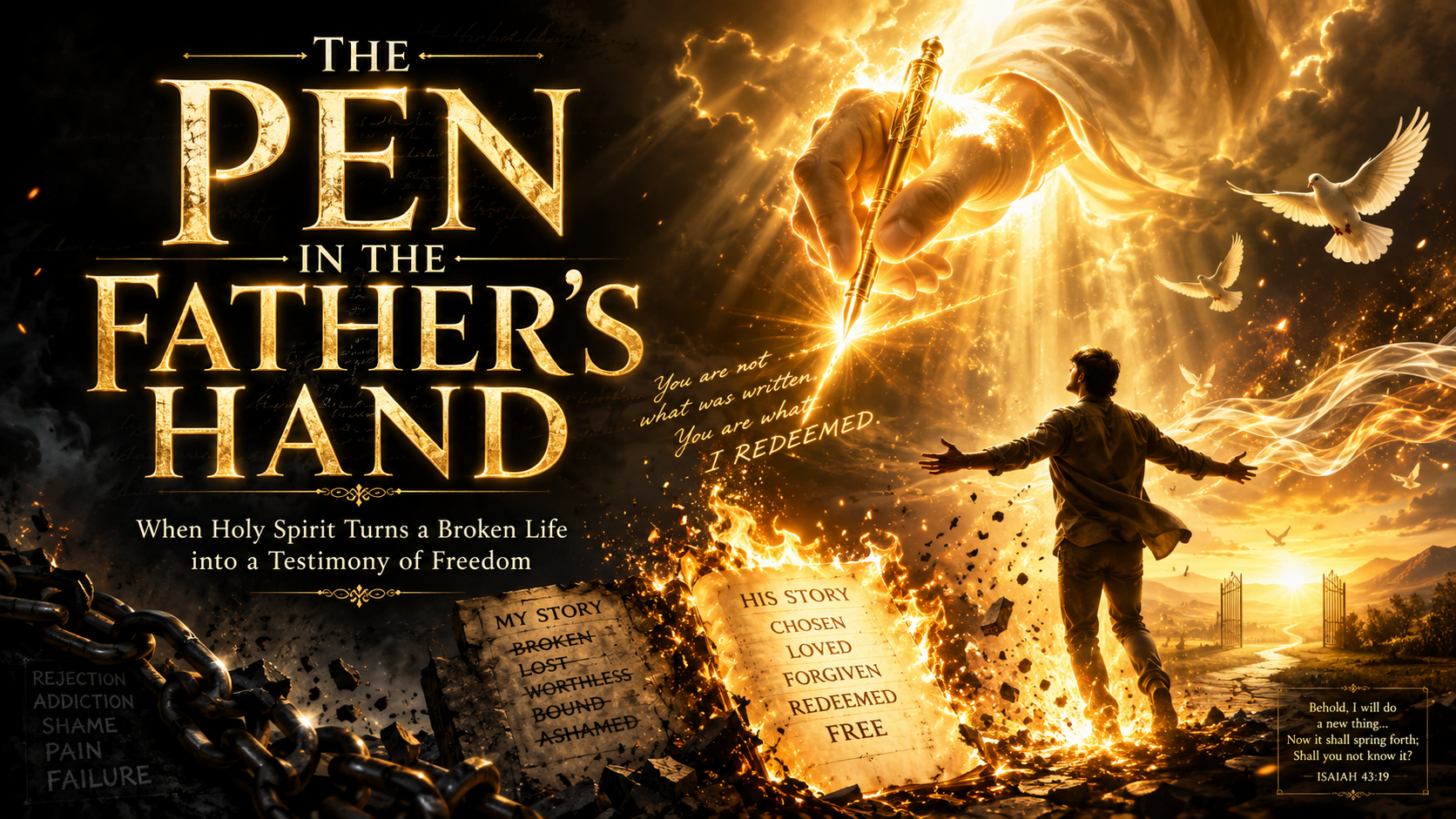
When Holy Spirit Turns a Broken Life into a Testimony of Freedom

A couple of weeks ago, Holy Spirit took me back to a prophetic word that had been released over my life years ago by the late Bill Johnson of Christian International, Restoration Life, and Synergy Church in Tallahassee, Florida. In that word, he said the Lord had called me to be one of His watchmen seers, and that the way Holy Spirit had been speaking to me for several years would begin to make sense. Then his wife, Linda, prophesied over me that she saw God using me like a pen in His hand.

At the time, I received it by faith. But after close to ten years passing, as Holy Spirit brought those words back before me, I can look back and clearly to see how the hand of the Father has been woven through my life in ways I could not fully understand when the words were first spoken. Sometimes a prophetic word does not explain your life immediately. Sometimes it waits until obedience, suffering, warfare, repentance, and surrender have prepared your heart to understand what Heaven already knew.

Jeremiah heard the Lord say, “Before I formed thee in the belly I knew thee; and before thou camest forth out of the womb I sanctified thee” (Jeremiah 1:5). Paul said we are “His workmanship, created in Christ Jesus unto good works, which God hath before ordained that we should walk in them” (Ephesians 2:10). That means your life is not an accident. Your scars are not wasted. Your history is not stronger than His calling. The enemy may have tried to write chapters of addiction, shame, confusion, failure, and delay, but he never owned the pen.

The Father did.

Most of the time, Holy Spirit speaks to me through pictures. There have been seasons when I did not understand that. I would see things, feel things, perceive things, and wonder why my spirit was interpreting life through images, impressions, and scenes. Even when watching a movie, Holy Spirit would often unveil something deeper. I remember watching Tron as a teenager, and at the end of the movie I saw something that struck me deeply: the Creator entering into the world He made to redeem what had been lost, even at the cost of His own life. I did not have the language for it then, but I can see it clearly now. Holy Spirit was training my eyes to see Christ in pictures before I ever knew how to preach it, teach it, or write it.

Jesus often taught in pictures. He spoke of seed and soil, sheep and shepherds, lamps and oil, bread and wine, rivers and vineyards, houses built on rock, and treasure hidden in a field. The prophets saw visions. Ezekiel saw wheels within wheels. Zechariah saw lampstands and olive trees. Daniel saw kingdoms rising and falling. John was caught up in the Spirit and saw a throne set in Heaven. The Bible is filled with men who did not merely hear words; they saw by the Spirit.

Heaven Is Restoring the Sight Religion Tried to Hide

And I believe this is one of the things the Lord is restoring to His people in this hour. Not imagination untethered from Scripture. Not fantasy. Not soulish dreams dressed up in prophetic language. But sanctified sight. Spirit-governed vision. The eyes of the heart enlightened, as Paul prayed in Ephesians 1:18, so that the people of God may know the hope of His calling, the riches of His inheritance, and the exceeding greatness of His power toward those who believe.

In this season, those visions have been coming more often. And there are moments when I sit down to write and understand, in my own measure, what many Spirit-filled writers and servants of God have described throughout history: the mystery of becoming a yielded vessel. Richard Baxter once prayed that he had nothing to do with his “Tongue and Pen” but to speak to God, speak for God, and publish His glory and will. That is the cry of every surrendered messenger. Not “look what I can write,” but “Father, take the pen.” Not “look what I have built,” but “Lord, let this life publish Your glory.”

That is exactly what happened when I sat down to write my testimony of freedom from addiction in my book, Beyond the Shadows: A Journey from the Life of Addiction to Absolute Freedom in Christ. It was my testimony, but it felt as though Heaven was helping me see my story from the Father’s perspective. I was not just remembering pain. I was watching redemption interpret pain. I was not merely recounting bondage. I was watching the Cross answer bondage. I was not writing as a victim trying to survive his past. I was writing as a son learning that the Father had been present even in the places where I once thought I was abandoned.

That is the grace of God.

Grace does not simply cover the past; grace confronts it, redeems it, heals it, and turns it into a weapon of testimony. Revelation 12:11 says, “And they overcame him by the blood of the Lamb, and by the word of their testimony.” The blood of Jesus destroys the legal claim of the accuser, and the testimony of the redeemed silences the narrative of hell. The enemy wants your story buried in shame. The Father wants it raised in glory.

David understood something of this mystery. When the Spirit of the Lord came upon him, he could take a harp in his hand and release a sound that drove torment from Saul. He could look at a giant and see not an impossible enemy, but an uncircumcised Philistine standing illegally before the armies of the living God. He could fall, repent, weep, worship, write, and rise again. David’s life was not perfect, but his heart belonged to God. And from that surrendered place came psalms that still carry fire thousands of years later.

There are times I feel that same holy assistance when I write books, blogs, teachings, and prophetic content. It is not that I am great. It is not that I am impressive. It is not that I possess some natural brilliance. The truth is, I know where I came from. I know what I was rescued from. I know what addiction did. I know what shame tried to do. I know what failure sounded like. I know what it feels like to look at your own life and wonder whether anything good could ever come out of it.

But I also know the Cross.

I know repentance.

I know mercy.

I know deliverance.

I know the Father who runs toward prodigals.

I know the Christ who breaks chains.

I know the Holy Spirit who teaches men what no classroom could ever give them.

I was not naturally educated in the way some people might expect. I struggled in school. I failed tests. I battled through things that made me feel unqualified. But somewhere along the way, I learned how to pray, “Lord, help me.” And He did. My GED, my pest control licensing, my doctorate in theology, my books, my preaching, my teaching, my ministry assignment, and my writing all stand as memorial stones of grace. They are not monuments to my ability. They are altars to His faithfulness.

James 1:5 says, “If any of you lack wisdom, let him ask of God, that giveth to all men liberally.” I lacked wisdom, and He gave it. I lacked discipline, and He formed it. I lacked understanding, and He taught me. I lacked purity, and He cleansed me. I lacked identity, and He called me son. I lacked freedom, and He brought me out.

This is why no man can take the glory.

Not even me.

Paul said, “By the grace of God I am what I am” (1 Corinthians 15:10). That is my testimony. That is my confession. That is the altar where every book, every message, every blog, every sermon, every podcast, and every prophetic word must bow. By the grace of God, I am what I am.

And this is the word I want to release to every captive, every recovering prodigal, every wounded vessel, every hidden writer, every rejected watchman, every misunderstood seer, every person who feels disqualified because of their past: the Father is not finished writing.

You may have been in addiction, but addiction is not the author.

You may have walked through shame, but shame is not the author.

You may have failed, fallen, wandered, rebelled, or wasted years, but failure is not the author.

Jesus is “the author and finisher of our faith” (Hebrews 12:2).

The enemy may have tried to stain the pages, but the blood of Jesus speaks a better word. The world may have labeled you. Religion may have dismissed you. People may have remembered only who you were before grace interrupted the story. But Heaven does not define a redeemed life by the chapter where the man was bound. Heaven defines it by the Lamb who broke the chains.

So hand Him the pen.

Hand Him the pain.

Hand Him the memory.

Hand Him the shame.

Hand Him the testimony.

Hand Him the gift.

Hand Him the unfinished pages.

Because when the Father takes the pen, He does not merely write information. He writes resurrection. He writes freedom. He writes sonship. He writes deliverance. He writes purpose. He writes fire.

And when Holy Spirit breathes upon a surrendered life, even the chapters hell tried to destroy become weapons in the hand of God.

— Dr. Russell Welch
A voice of fire to the Remnant, awakening warriors, restoring Kingdom identity, and calling the Ecclesia back under the government of Holy Spirit.


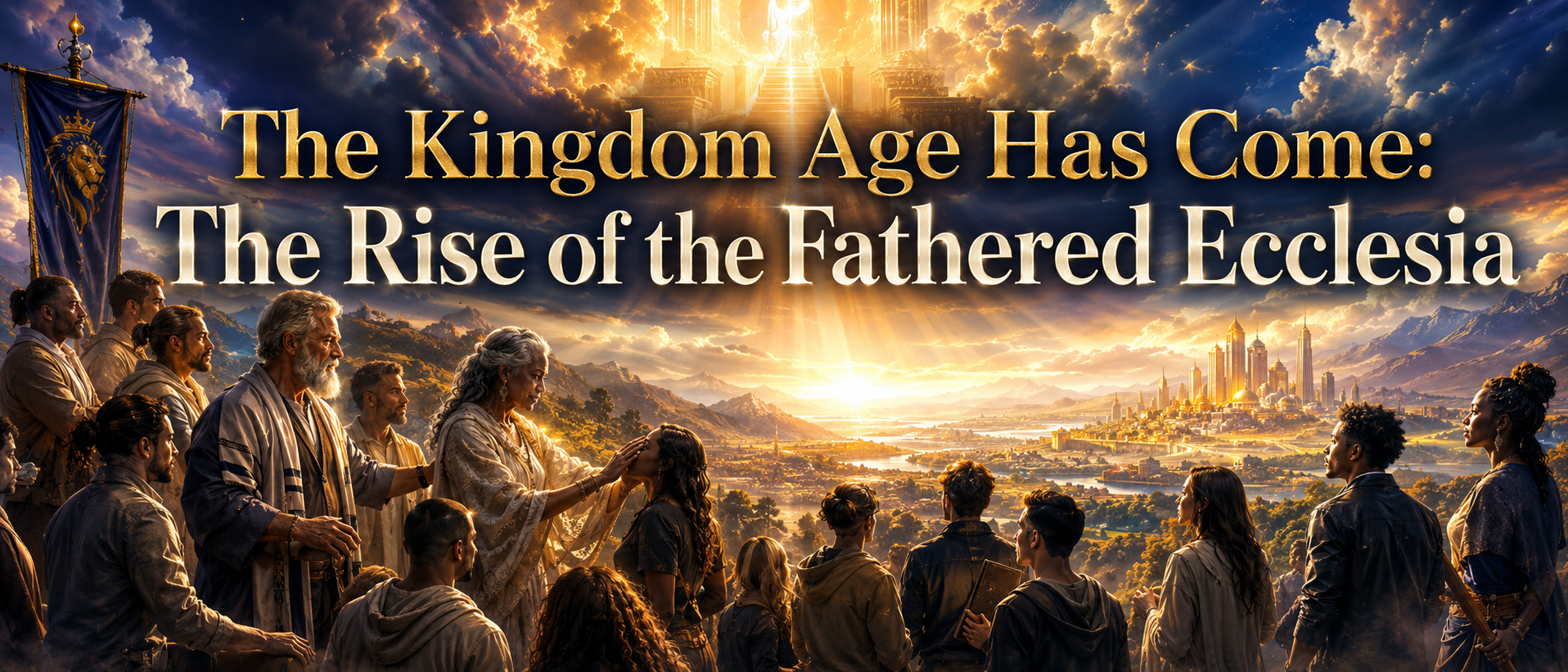
The Kingdom Age Has Come -The Old Wineskins Cannot Carry the Glory of the King

The watchmen of the Lord have been crying from the walls, and those with ears to hear can discern the sound. The Church has shifted into a new hour. This is not the end of the Lord’s Ecclesia; it is the awakening and restoration of the Lord’s Ecclesia. The Father is not abandoning His Church. He is reforming His people, calling them out of passive religious systems and back into their original Kingdom assignment.

For too long, much of what has been called “church” has been shaped by platforms, personalities, performance, and one-man religious systems. Yet Jesus did not come to build celebrity ministries, religious empires, or spiritual theaters centered around human charisma. He said, “I will build My Ecclesia, and the gates of Hades shall not prevail against it” (Matthew 16:18). Then He declared, “I will give you the keys of the Kingdom of heaven” (Matthew 16:19). That means the Ecclesia was never called merely to gather around a pulpit. She was called to carry governmental authority under the Lordship of the King.

The old wineskins of the Church Age cannot carry the new wine of the Kingdom Age. The old wineskin says, “Come watch one man minister.” The Kingdom wineskin says, “Equip the saints for the work of ministry.” The old wineskin says, “Build my name, my brand, my platform, and my following.” The Kingdom wineskin says, “Let the King be glorified, let the Lamb receive the reward of His suffering, and let the Ecclesia rise in mature sonship.”

This is why the one-man religious show will not function in this new age. It may still attract crowds, but it will not carry the glory. It may still produce noise, but it will not produce Kingdom transformation. It may still gather spectators, but it will not form sons and daughters. Heaven is no longer breathing upon systems that exalt man while merely mentioning Jesus. The Father is looking for a people who will decrease so the King may increase.

Jesus did not preach the gospel of church culture. He preached the gospel of the Kingdom. He declared, “Repent, for the kingdom of heaven is at hand” (Matthew 4:17). After His resurrection, He spent forty days speaking to His apostles concerning the Kingdom of God (Acts 1:3). Paul ended his ministry “preaching the kingdom of God and teaching the things concerning the Lord Jesus Christ” (Acts 28:31). And Jesus Himself said, “This gospel of the kingdom will be preached in all the world as a witness to all the nations, and then the end will come” (Matthew 24:14).

The message of this hour is not religious survival. It is Kingdom manifestation. The Lord is raising a Remnant Ecclesia who will no longer bow to the machinery of man-made religion. They are not rebels. They are sons. They are not church-haters. They are Kingdom reformers. They are not dishonoring the Body of Christ. They are calling the Body of Christ back under the government of the Head, Christ Jesus.

In this Kingdom Age, the King must be glorified above every ministry, every movement, every denomination, every network, and every human name. The Kingdom does not revolve around gifted men. The Kingdom revolves around the enthroned Christ. Every true apostle, prophet, evangelist, pastor, and teacher exists for one holy purpose: to equip the saints until the Body comes into maturity (Ephesians 4:11–13). The fivefold ministry was never given to replace the saints. It was given to activate them.

And now the heavens are revealing the true apostles in this age. They are not being revealed by titles, stages, entourages, or religious branding. They are being revealed by fatherhood. True apostles father sons and daughters even as Christ fathered His disciples. They pour into others what the Father has poured into them. They do not hoard revelation to secure dependency. They impart truth, wisdom, authority, character, courage, and Kingdom responsibility so the next generation can carry the assignment further.

This is a season when true apostles and prophets must pour into their sons and daughters all that the Father has entrusted to them. They must not raise followers around their personality; they must raise mature Kingdom firebrands who can walk under the government of Holy Spirit. Like the Lord, they must have faith that Holy Spirit will guide, correct, teach, mature, and empower those who have been entrusted to their care. Jesus did not cling to His disciples in fear. He trained them, formed them, commissioned them, and trusted Holy Spirit to lead them into truth.

This was also the pattern of the apostles and fathers of the first centuries of the New Covenant Ecclesia. They carried the unadulterated Gospel of the Kingdom with reverence, courage, holiness, and fire. They understood that the faith was not to be commercialized, diluted, or reshaped around the appetites of the age. They guarded the deposit, contended for the truth, formed disciples, and raised witnesses who could stand under persecution, resist mixture, and proclaim Christ as King.

That same apostolic spirit must return to the Ecclesia now. The Lord is not looking for spiritual celebrities who collect sons and daughters as trophies. He is raising fathers who pour, prophets who purify, teachers who anchor, shepherds who mature, and apostles who build according to Heaven’s blueprint. The true apostolic will not make people dependent upon the man. It will bring people under the Lordship of Christ, the authority of Scripture, and the government of Holy Spirit.

The Remnant must now understand who they are. They are not merely church members, religious consumers, or passive attenders waiting for one anointed man to do everything. They are blood-bought sons and daughters of the King. They are ambassadors of Christ, a royal priesthood, a holy nation, and the called-out Ecclesia of the living God. They have been entrusted with keys of Kingdom authority, not for prideful dominion, but for faithful representation of Heaven in the earth.

To legislate Heaven on earth means we come into agreement with what Heaven has already declared. It means we bind what Heaven has forbidden and loose what Heaven has authorized. It means we pray from the victory of the cross, not toward it. It means we confront darkness with the authority of the risen Christ and decree what the King has spoken, not what human emotion desires. It means our lives, homes, cities, regions, and assignments must come under the rule of Jesus Christ.

This is why the old wineskins must break. A spectator Church cannot carry a governing Kingdom. A personality-driven Church cannot carry a corporate anointing. A religious machine cannot carry the fire of Holy Spirit. A man-centered system cannot carry the glory of the enthroned King. The Kingdom Age requires a mature Ecclesia, a people formed in sonship, trained in obedience, anchored in Scripture, purified in reverence, and governed by Holy Spirit.

The Lord is tearing down the scaffolding of religious performance so His house can be built according to His pattern. He is exposing mixture, confronting pride, shaking celebrity Christianity, and judging systems that used His name while resisting His government. But in the same hour, He is awakening His Remnant: a people without price tags, without idols, without applause addiction, and without loyalty to the machinery of man-made religion.

This is the hour of the glorified King. The Church has not been discarded; she is being restored. The Lord is transitioning His people from passive religion into Kingdom authority, from spectator Christianity into governmental sonship, from one-man ministry systems into the corporate anointing of the Remnant Ecclesia. The old wineskin cannot carry what Heaven is pouring out, but the surrendered, purified, fathered, and commissioned Ecclesia shall become a vessel of Kingdom fire in the earth.

So let the watchmen cry. Let the apostles father. Let the prophets purify. Let the intercessors travail. Let the sons and daughters rise. Let the Ecclesia awaken. The King is on His throne, the keys are in the hands of His people, Holy Spirit is governing the movement, and the Remnant is being commissioned to carry the unadulterated Gospel of the Kingdom until the kingdoms of this world become the Kingdom of our Lord and of His Christ.

Stay tuned, the journey continues…..

A voice of fire to the Remnant,

— Dr. Russell Welch

Dr. Russell Welch is a published author, prophetic teacher, apostolic builder, author, and founder of faith-driven publishing and media initiatives. He is known for crafting bold, Kingdom-centered messages that call the Ecclesia into maturity, doctrinal clarity, and governmental authority. With a passion for equipping the Remnant and honoring generational legacy, Dr. Welch writes and teaches at the intersection of Scripture, history, and spiritual governance, challenging believers to live as sons and daughters who legislate Heaven on earth through truth, holiness, and unwavering fidelity to Christ.

Be sure to check out his book: The Consecrated Firebrand: A Warrior’s Guide to Holy Living, available exclusively on Amazon … here

Amazon Author Page


The Church does not need another system built around winning souls

Somewhere along the way, much of the modern evangelical Church began measuring success by how many souls it could “win,” while losing sight of the actual commission Christ gave. The language of “winning souls” may sound biblical, and Proverbs 11:30 certainly says, “The fruit of the righteous is a tree of life, and he who wins souls is wise.” Yet when that verse is detached from the whole counsel of Scripture, it can be twisted into a religious system of numbers, decisions, emotional responses, altar calls, and spiritual production lines. The Church was never commissioned to manufacture converts. The Church was commissioned to make disciples.

In the Hebrew, Proverbs 11:30 reads, “Peri-tsaddiq etz chayyim, ve-loqe’ach nefashot chakam.” The phrase “fruit of the righteous” speaks of the produce, outcome, and harvest of a life that has been brought into right order with God. The righteous person does not merely carry religious language; his life produces something that nourishes others. His walk becomes fruit-bearing. His obedience becomes life-giving. His nature becomes evidence that he is rooted in the Lord.

The phrase “tree of life” is etz chayyim, and the word chayyim carries the sense of lives, life, fullness, and ongoing vitality. This means the righteous life becomes a place where others can encounter the life of God. The fruit of the righteous is not manipulation. It is not pressure. It is not religious performance. It is not a spiritual sales pitch. It is a life so governed by God that it becomes a tree of life to those who are wounded, wandering, hungry, and searching.

Then the verse says, “he who wins souls is wise.” But the Hebrew phrase is deeper than the modern English expression. Loqe’ach nefashot comes from the idea of taking, receiving, gathering, laying hold of, or bringing in lives. Nefashot speaks of souls, lives, persons, inner beings. It does not present a man as the savior of another man’s soul. It speaks of wisdom that knows how to gather lives toward the way of God. It speaks of righteous influence, holy persuasion, rescue, shepherding, and life-giving formation.

That means Proverbs 11:30 must not be used to suggest that man has the power to save what only Christ can redeem. Only the Lord can win the soul in the deepest sense. Only Holy Spirit can convict the heart. Only the Father can draw men to the Son. Jesus said, “No one can come to Me unless the Father who sent Me draws him” (John 6:44). Paul said, “I planted, Apollos watered, but God gave the increase” (1 Corinthians 3:6). These Scriptures should humble every religious system that has tried to turn salvation into a humanly managed result.

The Church has a role, but it is not the role of Holy Spirit. We preach Christ. We proclaim the Gospel of the Kingdom. We bear witness to the resurrection. We call men to repentance. We teach the commands of Jesus. We pray, labor, warn, exhort, and model the life of the Kingdom. But we do not regenerate the dead heart. We do not give new birth. We do not transfer men from darkness into light by the strength of our programs. God alone gives life.

This is where much of the modern Church needs correction and redirection. We have spent enormous energy trying to produce converts while often neglecting the long, costly, holy labor of making disciples. We have celebrated decisions without always forming obedience. We have counted responses without always cultivating transformation. We have built systems that know how to gather crowds but often fail to raise sons and daughters who carry the nature of Christ. That is not apostolic Christianity. That is religious machinery dressed in spiritual language.

Jesus did not say, “Go therefore and collect converts.” He said, “Go therefore and make disciples of all the nations, baptizing them…and teaching them to observe all things that I have commanded you” (Matthew 28:19–20). The command is not merely to bring people to a moment of response, but to bring them into a life of surrender, baptism, teaching, obedience, formation, and Kingdom allegiance. The Great Commission is not complete when someone repeats a prayer. The commission moves toward maturity, fruitfulness, obedience, and Christlikeness.

This is why the Church must recover the difference between a convert and a disciple. A convert may acknowledge a message, but a disciple submits to a Master. A convert may be counted in a meeting, but a disciple is formed in the way. A convert may respond emotionally, but a disciple learns obedience when no crowd is watching. A convert may be attracted to blessing, but a disciple takes up the cross. Jesus said, “If anyone desires to come after Me, let him deny himself, and take up his cross daily, and follow Me” (Luke 9:23).

The early Ecclesia did not build itself around religious marketing, entertainment, or spiritual consumerism. Acts 2:42 says, “They continued steadfastly in the apostles’ doctrine and fellowship, in the breaking of bread, and in prayers.” That was not a shallow system of religious attendance. That was a discipling culture. Doctrine shaped them. Fellowship joined them. Prayer governed them. The table formed them. Their lives became a witness because the life of Christ was being reproduced among them.

This is the foundation we must return to. The Church does not need better machinery for producing outward responses. It needs a return to the ancient path of forming Christ in people. Paul said, “My little children, for whom I labor in birth again until Christ is formed in you” (Galatians 4:19). That is discipleship. It is not merely informing the mind. It is the travail of seeing the nature, obedience, humility, holiness, and love of Christ formed in the life of another person.

The tragedy of much modern evangelical culture is that it has often placed more emphasis on getting people into buildings than getting Christ formed in people. It has often become more skilled at building platforms than building altars. It has often become more committed to expanding visibility than cultivating spiritual maturity. But Jesus never told us to create religious spectators. He called us to form obedient followers who hear His voice, keep His Word, walk in His Spirit, love one another, and bear fruit that remains.

John 15:5 gives us the true foundation: “I am the vine, you are the branches. He who abides in Me, and I in him, bears much fruit; for without Me you can do nothing.” Fruit does not come from religious pressure. Fruit comes from abiding. The Church cannot disciple nations while detached from the Vine. We cannot produce Kingdom life through fleshly systems. We cannot manufacture what only abiding can bear. A Church that is disconnected from the presence and government of Christ may still gather crowds, but it cannot produce the fruit of the Kingdom.

This brings us back to Proverbs 11:30 with a clearer understanding. The wise do not try to replace God in the salvation of souls. The wise become trees of life through righteousness and then gather lives toward the Lord through truth, love, wisdom, witness, and discipleship. The wise understand that soul-winning is not religious conquest. It is not the triumph of human persuasion. It is the overflow of a righteous life cooperating with the drawing, convicting, saving, and sanctifying work of God.

The Church must repent where it has trusted systems more than Spirit, methods more than presence, decisions more than discipleship, and crowds more than formation. We must stop confusing numerical response with Kingdom fruit. We must stop believing that a moment of public agreement is the same as a life being brought under the Lordship of Jesus Christ. Christ did not die to create religious attenders. He died to redeem, restore, indwell, transform, and conform a people into His image.

This does not mean we stop preaching to the lost. God forbid. It means we preach with purity, without manipulation. It means we witness with boldness, without pretending we are the ones who save. It means we call men to repentance, while depending fully upon Holy Spirit to convict. It means we labor in the field, plant the seed, water with prayer and truth, and trust God for the increase. It means we understand our assignment without trespassing into the Lord’s office.

Only the Lord can truly win the soul.

Only Holy Spirit can convict the heart.

Only the Father can draw men to the Son.

Only Christ can redeem, regenerate, deliver, and make a dead man alive.

The correction is simple, but it is weighty: Christ wins the soul; the Ecclesia disciples the life. Christ saves; we witness. Holy Spirit draws; we shepherd those He brings. The Father gives the increase; we remain faithful in planting and watering. This is not a call to less evangelism. It is a call to purified evangelism that flows into real discipleship, real obedience, real formation, and real transformation.

The Church must return to the foundation of its calling.

Not religious systems.

Not spiritual production lines.

Not shallow altar-call Christianity.

Not numbers without transformation.

Not converts without discipleship.

The hour demands fathers and mothers in the faith, mature sons and daughters, households of prayer, tables of fellowship, altars of consecration, and believers who carry the nature of Christ in the ordinary places of life.

We must stop trying to mass-produce converts and return to forming disciples one life at a time, until the nature of Christ is seen in their character, obedience, love, holiness, and witness.. That means walking with people until the Word becomes flesh in their conduct, until prayer becomes breath in their home, until obedience becomes normal, until holiness becomes beautiful, until love becomes visible, until the government of Christ begins to order their thoughts, choices, relationships, and assignments. This is slower than religious machinery, but it is the way of the Kingdom. Jesus spent time with twelve. He formed men, not crowds.

The modern Church does not need another system built around manufacturing converts. It needs to recover the wisdom of Proverbs 11:30, the obedience of Matthew 28:19–20, the dependence of 1 Corinthians 3:6, the abiding of John 15:5, and the formation of Galatians 4:19. The fruit of the righteous is still a tree of life, and the wise still gather souls toward God. But only Christ saves the soul, and only Holy Spirit can draw the heart. Our commission is to preach the Kingdom, bear witness to the King, and disciple those whom God brings into the life of His Son.

Stay tuned, the journey continues…..

— Dr. Russell Welch

Dr. Russell Welch is a published author, prophetic teacher, apostolic builder, author, and founder of faith-driven publishing and media initiatives. He is known for crafting bold, Kingdom-centered messages that call the Ecclesia into maturity, doctrinal clarity, and governmental authority. With a passion for equipping the Remnant and honoring generational legacy, Dr. Welch writes and teaches at the intersection of Scripture, history, and spiritual governance, challenging believers to live as sons and daughters who legislate Heaven on earth through truth, holiness, and unwavering fidelity to Christ.

Be sure to check out his book: The Consecrated Firebrand: A Warrior’s Guide to Holy Living, available exclusively on Amazon … here

Amazon Author Page


The Radical Road to Spiritual Freedom

When I entered into my doctoral studies through Trinity Seminary, I did so with hesitation, knowing full well that it was an ultra-Calvinist institution and sensing from the start that I would be stepping into a place where sharp doctrinal tensions would challenge me deeply. Yet looking back now, I can see that the hand of God was all over that season, because it drove me into the Scriptures with a depth, intensity, and desperation I had never known before.

What the enemy may have hoped to use for confusion, the Lord used to press me deeper into His Word, for “the entrance of thy words giveth light” and “giveth understanding unto the simple” (Psalm 119:130). I was reading, praying, studying, writing, wrestling, and pressing, and in many ways I truly believed I was pursuing truth with all my heart. But somewhere in that journey, something dark fastened itself to me like a hidden hitchhiker, cloaked in the language of zeal and conviction, yet breathing with the venom of bondage. Holy Spirit later showed me that what had attached itself was not merely theological rigidity, but the spirit of religion, subtle, cruel, and deeply parasitic.

Holy Spirit showed me years ago that this invasion did not begin in seminary, nor did it come because of the doctrines of the school itself. The real doorway had opened much earlier, when I was only around three years old, at a time when innocence should have been protected but instead was pierced by fracture and loss. My mother divorced my father, a violent alcoholic, and in the aftermath my grandmother determined that if her son could not have his children, neither would his wife.

In that storm, the enemy planted something sinister in the soil of a little boy’s heart, and through that wound there entered the spirit of rejection and the orphan spirit. It is just like hell to place doorjams in the soul of a child, preparing access points for later invasions while the heart is too tender and too young to understand what has been done. Scripture says, “Neither give place to the devil” (Ephesians 4:27), yet many wounds are suffered before a child even knows what a door is. That early pain became more than memory; it became an unhealed breach through which lying spirits would later try to define my worth, my identity, and even my picture of God.

As I grew older, Holy Spirit revealed how that rejection did not remain alone, because rejection rarely travels by itself. It opened the door to pride, and when pride joins itself to rejection and the orphan spirit, it begins to forge one of the most devastating character assassins a person can battle. It whispers that you must prove your worth, earn your acceptance, defend your value, and establish your place through performance, intellect, striving, and visible success.

Worse still, it projects that distortion onto God Himself, making you believe that when you fail, His walls of rejection only rise higher and higher against you. Of course, this is a lie from the pit, because Scripture declares that we are “accepted in the beloved” (Ephesians 1:6), not tolerated through performance and not loved in proportion to our success. But territorial lies do not feel weak when they are entrenched in the soul; they feel like truth because they have been living there so long. That is why strongholds can operate in stealth mode, hiding behind intellect, discipline, achievement, and even ministry while the heart remains shackled to a false identity.

I had powerful men in my life, men who knew warfare, men who loved God, men who carried authority in many areas. Yet because some of them themselves were bound by the same spirit in subtler ways, they could not discern it working in me. Such is the cruelty of hidden bondage: what is tolerated in one vessel is rarely confronted in another. Spiritual captivity often survives not because no one around us loves God, but because the enemy has cloaked the chain with language that sounds holy.

Religion is especially vile in this way, because it can make bondage appear like maturity, harshness look like conviction, and self-defense feel like righteousness. Jesus rebuked the religious spirit more fiercely than any other because it honored God with the lips while the heart remained far from Him (Matthew 15:8). It was that same spirit that began to ride the wounds of rejection in me, seeking to transform pain into a false righteousness and insecurity into spiritual combativeness.

So what did that look like in practice while I was spirit-filled and sitting in a Baptist setting that denied much of what I knew the Word revealed? Instead of allowing the love and meekness of Christ to anchor me, I developed a prideful warrior mentality. I was determined to prove they were wrong and I was right, not merely because I loved truth, but because somewhere deep inside I needed victory in the argument to validate my worth. Rather than laying down a foundation of truth with patience, humility, and the hope that blinded eyes might be opened, I built a defensive wall designed to protect my wounded soul.

My academic strength became a weapon, not merely a tool, and I was fighting not only for doctrine, but for self-justification. What I called zeal was in part a cry of an orphaned heart still trying to earn what can only be received. “Knowledge puffeth up, but charity edifieth” (1 Corinthians 8:1), and though I possessed truth in many areas, I was still learning how deeply truth must be married to love if it is to look like Christ.

Yet this is where I can now see the hand of God with even greater clarity, because even in the middle of my mixture, He was building something in me that would remain long after the bondage was broken. Though pride had found a place to operate, my obedience in the study of His Word was real. The long hours of reading, praying, reading again, writing, and then returning once more to prayer became the very foundation upon which I still live daily.

God, in His mercy, was using even that troubled season to anchor me in Scripture, to train my mind to search deeply, and to teach me how to tarry before Him until truth opened. The enemy rode in through a wound, but he could not stop the Lord from laying a foundation beneath my feet. What hell meant to twist into religion, God still worked into hunger for His voice, reverence for His Word, and a life formed around seeking Him. That foundation remains one of the great mercies of God in my story.

The spirit of religion is the nastiest of them all because it does not merely torment the mind or oppress the emotions; it seeks to reshape the believer’s image of the Father. It tells you that God is perpetually disappointed, reluctantly tolerant, and forever measuring your spiritual value by your latest success or failure. It teaches you to labor like a servant in the house while never resting as a son in the Father’s embrace. It will let you preach, study, argue, labor, and even suffer, so long as you never come into the freedom of beloved identity. But Scripture does not say we have received the spirit of bondage again to fear; it says we have received “the Spirit of adoption, whereby we cry, Abba, Father” (Romans 8:15).

Beloved identity is terrifying to the spirit of religion because once a son knows he is loved, he no longer needs to perform for affection or strive for approval. The orphan heart says, “I must become enough,” but the beloved heart says, “In Christ, I am received, and from that place I now obey.”

The freedom itself came instantly in 2016 through a face-to-face encounter with the Lord. In that holy moment, the chains were broken, the lie was exposed, and the power of those spirits lost their grip under the weight of His presence. What years of hidden bondage had built, one encounter with the living Christ shattered in a moment, because whom the Son sets free is free indeed (John 8:36). There are deliverances that unfold slowly, but this freedom came as a decisive act of the Lord, sudden, undeniable, and deeply personal. He did not merely inform me that I was bound; He met me and broke what had held me. It was not theory, and it was not emotionalism, but a real invasion of divine mercy into the history of my soul. In that encounter, the prisoner in me met the Deliverer face to face.

Yet while the freedom was instant, the revelation of that freedom, especially the revelation of beloved identity, has been a nine-year unfolding that is still continuing even now. The chains broke in a moment, but the renewing of the mind, the healing of perception, and the deeper understanding of what it means to live as one accepted in the Beloved has been a sacred process. “Behold, what manner of love the Father hath bestowed upon us, that we should be called the sons of God” (1 John 3:1), and I am still learning the depths of that love.

The Cross did not merely forgive my sin; it shattered the lie that I had to spend my life proving my worth, and ever since then Holy Spirit has been teaching me how to live from sonship rather than striving. So this testimony is not merely about being delivered from the spirit of religion, rejection, pride, and the orphan spirit. It is about being brought into the lifelong unfolding revelation that the Father is not holding me at a distance behind walls of rejection, but has drawn me near in Christ, called me beloved, and is still teaching my heart how to live free.

I wish that school were still in operation, though it closed down during the Covid season, because there is now a part of me that would gladly return, not to win an argument, but to reveal the love I wish I had carried back then. I would not go back to prove them wrong, nor to display what I believed I knew, but to lay before them the same mercy that Christ has so patiently laid before me.

Where I once came armed with a wall of defense, I would now desire to come clothed in humility, tenderness, and truth wrapped in love. The heart of Christ is not driven by the need to conquer men, but by the desire to open blind eyes and call hearts into freedom. I look back now and realize that while I may have had truth in certain areas, I did not yet carry it with the fragrance of the Father’s heart. And if given that opportunity today, I would count it an honor to return and share not only truth more clearly, but love more deeply.

Stay tuned, the journey continues…..

— Dr. Russell Welch

Dr. Russell Welch is a published author, prophetic teacher, apostolic builder, author, and founder of faith-driven publishing and media initiatives. He is known for crafting bold, Kingdom-centered messages that call the Ecclesia into maturity, doctrinal clarity, and governmental authority. With a passion for equipping the Remnant and honoring generational legacy, Dr. Welch writes and teaches at the intersection of Scripture, history, and spiritual governance, challenging believers to live as sons and daughters who legislate Heaven on earth through truth, holiness, and unwavering fidelity to Christ.

Be sure to check out his book: The Consecrated Firebrand: A Warrior’s Guide to Holy Living, available exclusively on Amazon … here

Amazon Author Page


Remnant Warrior Ministries stands as the spiritual covering and apostolic headquarters of a global movement birthed by the Spirit of God. It is not merely an organization—it is a mantle, a governing house, and a clarion call to the Remnant across the nations. From this apostolic center flows every ministry expression entrusted to our care: Highway to Heaven Church, Kingdom War College, Remnant Warrior India, and Remnant Warrior Philippines—each one carrying the same DNA, the same fire, and the same mandate to awaken, equip, and send forth Kingdom warriors into every sphere of influence.

This is the heartbeat of our assignment: to raise sons and daughters who know their identity, walk in authority, and advance the Kingdom with purity and power. We are not building programs; we are building people. We are not chasing platforms; we are establishing altars. Every sermon, every training, every outreach is a weapon of transformation forged in the presence of God.

WindWalker Enterprise LLC — The Kingdom Business Arm

Out of this spiritual foundation, the Holy Spirit birthed WindWalker Enterprise LLC—a Kingdom-based business designed to steward resources, creativity, and influence with integrity and excellence. It is the business framework that carries the prophetic vision into the marketplace, ensuring that every endeavor remains aligned with Heaven’s order.

Under WindWalker Enterprise resides Remnant Warrior Publishing, the prophetic voice in print, and WindWalker Book Writing Consultation, the equipping arm for authors and messengers called to release truth into the earth. These are not commercial ventures—they are Kingdom assignments. Every book, every consultation, every creative project is a seed of revelation planted to awaken hearts and restore identity.

WindWalker Enterprise is where business becomes ministry, and ministry becomes movement. It is the bridge between revelation and execution—the place where Kingdom vision becomes Kingdom impact.

Our Unified Mandate

Together, these expressions form one living organism—a unified Kingdom ecosystem advancing under a single banner:

Publishing Truth. Training Warriors. Advancing the Kingdom.

We exist to awaken the Remnant, equip the called, disciple nations, and establish Kingdom government in every sphere. We publish truth to confront deception. We train warriors to stand in authority. We advance the Kingdom to fulfill Heaven’s agenda on earth.

This is not a brand—it is a covenant. This is not a business—it is obedience. This is not a ministry—it is a movement.

The Declaration

Remnant Warrior Ministries — the covering, the mantle, the movement. Highway to Heaven Church — the altar. Kingdom War College — the training ground. Remnant Warrior India & Philippines — the global outposts. WindWalker Enterprise LLC — the Kingdom business foundation. Remnant Warrior Publishing — the prophetic voice in print. WindWalker Consultation — the equipping of future authors and messengers.

Together, we march under one banner, one mandate, one Spirit. We are the Remnant. We are the builders. We are the warriors. We are the ones advancing the Kingdom.

— Dr. Russell Welch

Dr. Russell Welch is a published author, prophetic teacher, apostolic builder, author, and founder of faith-driven publishing and media initiatives. He is known for crafting bold, Kingdom-centered messages that call the Ecclesia into maturity, doctrinal clarity, and governmental authority. With a passion for equipping the Remnant and honoring generational legacy, Dr. Welch writes and teaches at the intersection of Scripture, history, and spiritual governance, challenging believers to live as sons and daughters who legislate Heaven on earth through truth, holiness, and unwavering fidelity to Christ.

Be sure to check out his book: The Consecrated Firebrand: A Warrior’s Guide to Holy Living, available exclusively on Amazon … here

Amazon Author Page


We believe the time has finally come to cast this vision into the open waters. For decades we have carried it quietly—praying over it, protecting it, and waiting for the Lord to breathe on it with unmistakable clarity. Now, in this hour, we sense the Spirit saying, “Release it. Speak it. Declare it.” What was once held in the secret place is now being brought into the light. The vision of New Creation Ranch is no longer something for the future—it is something the Lord is calling us to begin building, believing for, and inviting others into right now.

New Creation Ranch has lived in our hearts for more than four decades, growing quietly like a seed the Lord planted long before we understood its purpose. We have carried this vision through seasons of waiting, refining, and deep surrender, trusting that God would reveal the right moment to speak it into the open. Today, we feel the wind of His timing stirring, and we are releasing this message with faith and expectation. We see a ranch filled with life—gardens flourishing, hands working, hearts healing, and sons and daughters discovering who they truly are in Christ. This is a place where the rhythms of Scripture, prayer, and discipleship shape every day, and where the love of God becomes tangible through community, work, and worship.

At the center of this vision is a deep desire to serve those who have been overlooked, forgotten, or wounded by life—especially our homeless veterans, the addicted, and those carrying emotional and spiritual scars. We envision New Creation Ranch as a refuge where men and women can step out of survival mode and into a Christ‑centered environment that restores dignity and identity. Through mentorship, discipleship, practical skills, and the steady love of a Kingdom family, we believe lives will be rebuilt from the inside out. This ranch will not be a program or a quick fix; it will be a place where people are given time, space, and spiritual covering to heal. We long to see those who arrive burdened by trauma rise again with purpose, confidence, and hope.

We see a ranch where the land itself becomes part of the healing—fields to cultivate, animals to tend, and quiet places to pray and reflect. The environment will be intentionally crafted to restore the mind, strengthen the body, and awaken the spirit. Work becomes worship, and daily tasks become opportunities for discipleship and growth. We believe that when people are given meaningful work, loving community, and the presence of God, transformation becomes not only possible but inevitable. Every part of the ranch will serve the greater purpose of helping people rediscover their worth and calling.

One of the most sacred elements of this vision is the creation of anointed walking trails—paths intentionally set apart for encountering the Lord. Inspired by the thin places of Ireland and Scotland, these trails will be carved through the land as places of prayer, reflection, and divine encounter. We envision quiet pathways where the veil feels light, where the wind carries peace, and where hearts open easily to the whisper of the Holy Spirit. These trails will become places where people walk, listen, weep, heal, and hear God with clarity they have never known. Just as the Celtic believers created spaces where heaven and earth seemed to touch, we believe New Creation Ranch will carry that same sacred atmosphere.

This vision also carries a generational mandate. We feel called to father and mother those who have never been spiritually parented, guiding them the way Jesus guided His disciples—with patience, truth, correction, and love. Many who will come to New Creation Ranch have never had someone walk with them long enough to see them healed, whole, and established. Our heart is to be that steady presence, to create a place where people are not rushed through a system but nurtured into maturity. We believe the next generation of leaders, servants, and Kingdom carriers will rise from this soil. This is a place where identity is restored, purpose is awakened, and destiny is shaped.

As we speak this vision out, we do so with open hands and surrendered hearts, trusting the Lord to breathe on it and bring it to life in His perfect timing. We believe He will align the right relationships, open the right doors, and provide the land and resources needed to build what He has placed in our spirits. This is His vision, His timing, and His work, and we are simply stewards of what He has entrusted to us. We release this message believing it will reach the hearts God has prepared—intercessors, partners, builders, and those who feel the same burden for restoration. We trust that the Lord will confirm His word as only He can.

We stand in faith that New Creation Ranch will become a testimony of God’s power to restore what was broken, revive what was lost, and raise up sons and daughters who walk in freedom and identity. As we release this message, we invite the Lord to lead, to speak, and to establish every step. We believe this ranch will become a place where lives are transformed by the love of Christ and where a new generation of Kingdom carriers is raised up. And we trust that those who read these words will sense the same stirring we have carried for years—a holy invitation to believe with us for a place where healing, family, and purpose come alive.

The vision of New Creation Ranch is no longer something we carry alone—it is something the Lord is calling the Remnant to build together. We believe the time is now to speak it, share it, and sow it into the earth. Every prayer, every seed, every act of partnership becomes part of the foundation the Lord is laying. If your spirit bears witness to this assignment… if something in you stirs for veterans, for discipleship, for Kingdom community, or for a place where Heaven touches earth… then we invite you to step into this story with us.

To read the full vision, connect with the mission, or learn how you can pray, partner, or sow into the work, visit:

👉 https://remnantwarrior.org/new-creation-ranch

May the Lord guide your steps, stir your heart, and reveal your part in what He is building.

— Dr. Russell Welch

Dr. Russell Welch is a published author, prophetic teacher, apostolic builder, author, and founder of faith-driven publishing and media initiatives. He is known for crafting bold, Kingdom-centered messages that call the Ecclesia into maturity, doctrinal clarity, and governmental authority. With a passion for equipping the Remnant and honoring generational legacy, Dr. Welch writes and teaches at the intersection of Scripture, history, and spiritual governance, challenging believers to live as sons and daughters who legislate Heaven on earth through truth, holiness, and unwavering fidelity to Christ.

Be sure to check out his book: The Consecrated Firebrand: A Warrior’s Guide to Holy Living, available exclusively on Amazon … here

Amazon Author Page


A move of God often begins long before anyone realizes it. For me, it began with a holy disruption—a stirring in my spirit that refused to be quieted, a longing that no sermon outline, ministry routine, or theological framework could satisfy. I knew the Holy Spirit was calling me deeper, but I didn’t yet understand that He was also calling me to write. What I didn’t know then was that this stirring would become the book that launched my journey as a Christian author: God’s Wind Walkers: A Life Governed by the Wind of Holy Spirit.

The Moment Eveything Shifted

There comes a point in every believer’s life when the familiar rhythms of Christianity no longer carry the weight they once did. You can love God, serve faithfully, and still feel the ache of something missing—something Jesus promised but many never fully experience.

For me, that ache became a divine invitation.

I began to see that the Spirit‑filled life Jesus described in John 3:8 wasn’t poetic language. It was a blueprint. A calling. A way of life. A life where the wind of the Spirit becomes the governing force—unpredictable, undeniable, and beautifully disruptive.

As I surrendered to that call, the Holy Spirit began to teach, correct, awaken, and lead me in ways I had never known. And in the middle of that journey, He whispered something that changed everything:

“Write what I’m teaching you.”

When Obedience Turns Into Assignment

I didn’t set out to become an author. I set out to obey.

But obedience has a way of unlocking assignments you never imagined.

As I wrote, I realized the message wasn’t just for me. It was for every believer who longed for more than predictable Christianity. It was for those who felt stuck, stagnant, or spiritually numb. It was for those who sensed the Holy Spirit calling them into a life marked by clarity, intimacy, and supernatural leading.

That message became God’s Wind Walkers: A Life Governed by the Wind of Holy Spirit — a book rooted in Scripture, shaped by encounter, and forged in surrender.

Why Wind Walkers Resonated So Deeply

From the moment it released, something unusual happened. Messages began pouring in from Bible study groups, classrooms, pastors, and everyday believers who said the same thing in different words:

“This book brought me closer to the Lord.” “I’m hearing the Holy Spirit again.” “My walk with God feels alive.” “This unlocked something in me.”

People weren’t just reading it—they were encountering God through it.

And that’s when I realized: this wasn’t just a book. It was a doorway. A catalyst. A wind that carried people into the life Jesus always intended for them.

The Heart Behind the Message

Wind Walkers is built on three unshakable truths:

  • The Holy Spirit still leads His people with clarity.
  • Identity is discovered through surrender, not striving.
  • The supernatural life is not for the few—it’s the birthright of every believer.

Through Scripture-rich teaching and practical guidance, the book helps believers:

  • Recognize the voice of the Spirit
  • Break free from spiritual stagnation
  • Walk confidently as sons and daughters
  • Live in daily sensitivity to God’s movements
  • Experience the supernatural life Jesus promised

It’s not theory. It’s not hype. It’s the life Jesus modeled and the early Church lived.

A Book That Became a Beginning

Looking back, I see now that Wind Walkers didn’t just launch my writing career—it launched a movement in my own heart. It set the foundation for every book that followed, every message I’ve preached, and every assignment God has entrusted to me.

It taught me that when you yield to the Wind of the Spirit, He will take you places you never planned to go—yet always where you were created to be.

And for countless readers, it has become the beginning of their own Spirit‑governed journey.

If you’re longing for a deeper walk with the Holy Spirit… if you’re hungry for clarity, intimacy, and supernatural leading… if you know there is more to your faith than what you’ve experienced so far…

Your journey can begin today.

👉 Start your Wind Walker journey: https://www.amazon.com/dp/B0CR1WTJZN

— Dr. Russell Welch

Dr. Russell Welch is a published author, prophetic teacher, apostolic builder, author, and founder of faith-driven publishing and media initiatives. He is known for crafting bold, Kingdom-centered messages that call the Ecclesia into maturity, doctrinal clarity, and governmental authority. With a passion for equipping the Remnant and honoring generational legacy, Dr. Welch writes and teaches at the intersection of Scripture, history, and spiritual governance, challenging believers to live as sons and daughters who legislate Heaven on earth through truth, holiness, and unwavering fidelity to Christ.

Be sure to check out his book: The Consecrated Firebrand: A Warrior’s Guide to Holy Living, available exclusively on Amazon … here

Amazon Author Page