The Language of Resurrection, Royal Arrival, and Public Appearing
The faithful do not need to fear careful study. Truth does not tremble when the Greek text is opened. Truth does not panic when the words of Scripture are examined in their covenant setting, historical setting, and apostolic context. If a doctrine is truly built upon the Word of God, then the original language will strengthen it, not weaken it. But if a doctrine has been built by removing words from context, forcing phrases into a modern prophetic system, and then asking the text to serve a chart instead of the King, then the light of Scripture will expose the weakness of that system.
This is where we must begin with humility and courage. The issue is not whether sincere people have believed the Rapture doctrine. Many have. The issue is not whether good men and women have preached it. Many have. The issue is whether the doctrine itself can survive the careful examination of the language used by the Holy Spirit through the apostles. We are not called to protect a tradition because it is familiar. We are called to test all things, hold fast that which is good, and allow Scripture to correct our assumptions.
The Greek text must be allowed to speak for itself. When it does, the language of the New Testament points us toward resurrection, royal arrival, public appearing, covenant gathering, and final victory. It does not naturally point us toward a secret evacuation of the Church before the visible triumph of Christ. The hope of the saints is not escape from the battlefield while darkness increases. The hope of the saints is the appearing of the King, the resurrection of the dead, the transformation of the living, and the fullness of His Kingdom being revealed in victory.
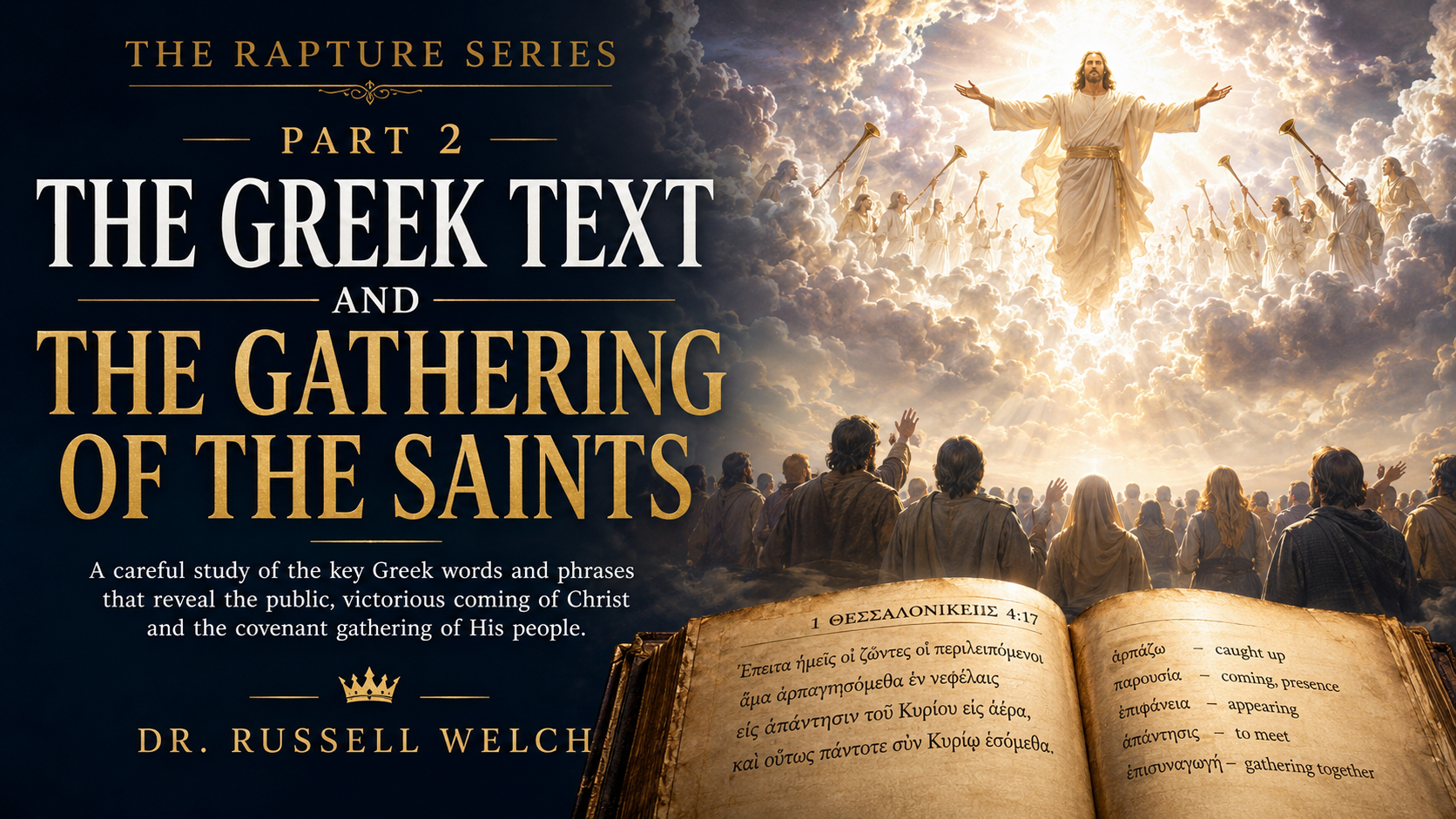
The first word that must be examined is the word often placed at the center of the Rapture doctrine: ἁρπάζω, harpazō. In 1 Thessalonians 4:17, Paul says that those who are alive and remain shall be “caught up” together with the resurrected saints in the clouds to meet the Lord in the air. The phrase “caught up” is real. We must not deny it, weaken it, or explain it away. The Greek word carries the idea of being seized, snatched, taken, or carried by force. It is a strong word. It speaks of divine action, not human effort.
However, the presence of the word “caught up” does not automatically create a secret Rapture doctrine. This is where many have made a serious interpretive mistake. They have taken one word, isolated it from the passage, and then built an entire end-time system around it. Paul is not writing in 1 Thessalonians 4 to reveal a secret evacuation. He is comforting grieving believers concerning those who have died in Christ. The entire passage is framed by resurrection hope. Paul says the dead in Christ shall rise first. Then those who are alive and remain will be caught up together with them. The emphasis is not disappearance. The emphasis is resurrection reunion.
This matters deeply. Paul is answering the fear that deceased believers would somehow miss the coming glory of Christ. His answer is not, “Do not worry, the Church will escape seven years before trouble begins.” His answer is, “The dead in Christ will rise first.” That places the passage in the resurrection category, not the evacuation category. The faithful are not being told to expect a hidden removal from the earth. They are being told that when the Lord comes, the dead will be raised, the living faithful will be gathered with them, and all will be with the Lord.
The details in 1 Thessalonians 4 are anything but secret. Paul speaks of the Lord Himself descending from heaven with a shout, with the voice of the archangel, and with the trumpet of God. These are not images of silence, secrecy, or hidden activity. These are royal, public, victorious, covenantal sounds. A shout, an archangelic voice, and the trumpet of God do not describe Heaven trying to sneak the Church out of history. They describe the King arriving in glory.
The second word we must examine is παρουσία, parousia, commonly translated “coming.” This word does not merely describe movement from one place to another. It carries the sense of arrival and presence. In the world of the New Testament, parousia could be used for the arrival or visitation of a ruler, king, or dignitary. When the New Testament uses this word for Christ, it is not presenting Him as a nervous rescuer slipping His people out the back door. It is presenting Him as the reigning Lord whose arrival changes everything.
This becomes especially clear when we compare Scripture with Scripture. In Matthew 24:27, Jesus says that as lightning comes from the east and shines unto the west, so also shall the coming, the parousia, of the Son of Man be. That is not hidden language. That is visible language. That is not private language. That is public language. Lightning does not ask permission to be noticed. It tears across the sky and announces itself. Jesus used this kind of imagery to guard His disciples from secret-coming claims.
Paul uses the same family of expectation when he writes in 2 Thessalonians. In 2 Thessalonians 2:1, he speaks of “the coming of our Lord Jesus Christ” and “our gathering together unto Him.” He does not separate these into two unrelated events. He joins them together. The coming and the gathering are linked. Then, in the same chapter, Paul says the lawless one will be destroyed by the brightness, or appearing, of the Lord’s coming. This is crucial. The appearing of His coming destroys the lawless one. That is not the language of a secret evacuation before confrontation. That is the language of royal manifestation and victory.
The third word we must examine is ἀπάντησις, apantēsis, translated “to meet.” In 1 Thessalonians 4:17, the saints are caught up “to meet the Lord in the air.” This phrase has often been treated as though it means the saints meet Jesus in the air and then immediately depart with Him away from the earth for a hidden period of time. But the word itself does not demand that conclusion. In the New Testament, this word carries the idea of going out to meet someone who is arriving. It is the language of reception, honor, and welcome.
This becomes powerful when we consider the royal imagery. In the ancient world, when a king or dignitary approached a city, the people would go out to meet him and escort him in with honor. The meeting was not an escape from the city. It was a reception of the arriving ruler. That background fits the passage naturally. The saints rise to meet the arriving King. The Church does not flee because the devil is winning. The faithful rise in resurrection victory because the King is appearing.
This also fits Matthew 25, where the virgins go out to meet the bridegroom. The bridegroom is arriving. The wise are prepared. The meeting is connected to readiness, not evacuation. In Acts 28, believers go out to meet Paul as he approaches Rome. They do not meet him and then take him away from Rome. They meet him and accompany him toward his destination. This does not mean every usage must be pressed beyond measure, but it does show that the word “meet” does not naturally require the modern Rapture storyline. It fits a royal reception far better than a hidden escape.
The fourth word group we must examine is the language of appearing and unveiling. The New Testament uses words such as ἐπιφάνεια, epiphaneia, and ἀποκάλυψις, apokalypsis. Epiphaneia speaks of appearing, manifestation, or brightness. Apokalypsis speaks of revelation or unveiling. These words do not move us toward secrecy. They move us toward visibility. They do not hide Christ. They reveal Christ.
Titus 2:13 calls the faithful to look for the blessed hope and the glorious appearing of our great God and Savior, Jesus Christ. The blessed hope is not described as a secret disappearance. It is described as an appearing. Paul tells Timothy of the appearing of Christ. Peter speaks of grace being brought at the revelation of Jesus Christ. John opens Revelation by declaring that every eye shall see Him. The consistent direction of the New Testament is not concealment but manifestation.
This is where we must challenge the modern prophetic imagination. Many have been taught to think of the hope of the Church as vanishing before trouble reaches its fullness. But the apostolic hope is not rooted in fear of tribulation. It is rooted in the appearing of Christ. The early believers were not told, “Comfort one another because you will never face pressure.” They were told to endure, overcome, remain faithful, and look for the appearing of the King. The hope of the saints is not that darkness gets the final word on earth while the Church escapes. The hope of the saints is that Jesus appears in glory, raises the dead, judges evil, vindicates the faithful, and fills all things with the authority of His Kingdom.
The fifth word we must examine is ἐπισυναγωγή, episynagōgē, translated “gathering together.” This word appears in 2 Thessalonians 2:1, where Paul says, “concerning the coming of our Lord Jesus Christ, and our gathering together unto Him.” Again, Paul links the coming and the gathering. He does not tell the Thessalonians to separate them into two different prophetic events divided by years of hidden history. The gathering belongs to the coming.
This gathering language carries deep covenant echoes. The prophets spoke of God gathering His people. Jesus spoke of angels gathering His elect from the four winds. The language of gathering is not foreign to Israel’s covenant story. It is restoration language. It is harvest language. It is Kingdom language. It is the language of God bringing His people into the fullness of what He promised.
In Matthew 24:31, Jesus says that after the tribulation of those days, the Son of Man will send His angels with a great sound of a trumpet, and they will gather together His elect from the four winds. Whether one wrestles with the immediate historical setting of Jerusalem, the wider prophetic horizon, or the fullness of future fulfillment, the language is still public, cosmic, and covenantal. It is not the language of a secret Church removal hidden from the nations. It is the language of divine gathering under the authority of the Son of Man.
This is where the modern Rapture system often creates confusion. It takes gathering language, trumpet language, coming language, and appearing language, then assigns them to different events based on a pre-built chart. But the New Testament itself does not demand those separations. In fact, the natural reading often moves in the opposite direction. The coming, the gathering, the resurrection, the trumpet, the appearing, and the victory of Christ belong together in the apostolic witness.
This does not mean every passage is simple. It does not mean every question is answered in one verse. It does not mean we should be careless with prophecy, history, or fulfillment. But it does mean we must stop forcing Scripture to speak the language of modern end-time fiction. The apostles were not writing from a twenty-first-century prophecy conference. They were writing from the world of covenant, empire, persecution, resurrection hope, and the enthronement of Jesus Christ as Lord.
The sixth issue is context. Words do not live in isolation. A Greek word must be interpreted within its sentence, its paragraph, its letter, and the larger biblical story. When a word is removed from its setting, it can be made to serve almost any system. This has happened repeatedly with the Rapture doctrine. “Caught up” is removed from resurrection. “Coming” is removed from appearing. “Meeting” is removed from royal arrival. “Gathering” is removed from covenant restoration. “Clouds” are removed from biblical glory imagery. “Trumpet” is removed from public announcement and divine intervention.
Once those words are detached from their biblical setting, they can be rearranged into a doctrine the apostles never plainly taught. But when they are returned to their context, the picture becomes far stronger and far more victorious. The King descends. The dead are raised. The living faithful are transformed. The saints meet the Lord. The gathering takes place in connection with His coming. His appearing destroys lawlessness. His revelation brings vindication. His Kingdom triumphs.
This is not bad news. This is glorious news. The removal of a false escape doctrine does not weaken the hope of the Church. It strengthens it. It calls the faithful back to endurance. It calls the Ecclesia back to authority. It calls the saints back to the victorious Gospel of the Kingdom. It reminds us that Jesus did not commission a defeated people waiting for darkness to get bad enough so they could leave. He commissioned a governing body, filled with the Spirit, clothed with authority, and sent into the nations to disciple, baptize, teach, overcome, and bear witness until the King is revealed in glory.
The Greek text does not ask us to build a doctrine of fear. It calls us to behold the victory of Christ. It does not train the Church to pray for escape from responsibility. It summons the faithful to stand in resurrection hope. The language of the New Testament is not the language of abandonment. It is the language of arrival. It is not the language of defeat. It is the language of appearing. It is not the language of panic. It is the language of gathering. It is not the language of darkness winning history. It is the language of the King coming in glory.
The faithful must therefore return to the text with clean hands and honest hearts. We must be willing to lay down charts when they contradict Scripture. We must be willing to surrender traditions when they weaken the Gospel of the Kingdom. We must be willing to admit that some doctrines have survived not because they were deeply biblical, but because they were emotionally comforting and constantly repeated.
But repetition does not equal revelation. Familiarity does not equal truth. Popularity does not equal apostolic doctrine. The question is not, “How many have believed this?” The question is, “What does the Word of God actually say?” The question is not, “Does this make me feel safe?” The question is, “Does this agree with the language, context, and covenant witness of Scripture?”
When the Greek text is allowed to speak, it does not present a Church secretly evacuated from the earth while darkness inherits the nations. It presents the resurrecting, gathering, appearing, conquering Christ. It presents the saints meeting the King in the atmosphere of His glory. It presents the public vindication of the faithful. It presents the destruction of lawlessness by the brightness of His coming. It presents the blessed hope as the appearing of our great God and Savior, Jesus Christ.
The conclusion is simple: the Church should not fear the Greek text. The faithful should welcome it. The original language does not belong to scholars alone. It belongs to the household of faith as a servant of truth. When rightly handled, it does not make Scripture cold. It makes Scripture burn. It turns a verse into a meal. It breaks open the bread of revelation and feeds the spirit with substance.
Therefore, let every doctrine be tested. Let every chart bow. Let every tradition come under the authority of Scripture. Let the Greek text speak in context. Let the covenant story be restored. Let the saints be strengthened with resurrection hope. Let the faithful stop looking for evacuation and start looking for the appearing of the King.
Jesus is not returning as a thief who lost the earth and came back only to rescue survivors. He is returning as the victorious King, the risen Lord, the One who disarmed principalities and powers, the One who is seated far above all rule and authority, the One before whom every knee shall bow and every tongue shall confess that He is Lord.
The gathering of the saints is not the confession of a defeated Church. It is the reception of a victorious King.
Stay tuned, the journey continues…..
A voice of fire to the Remnant,
— Dr. Russell Welch
Dr. Russell Welch is a published author, prophetic teacher, apostolic builder, and founder of faith-driven publishing and media initiatives. He is known for crafting bold, Kingdom-centered messages that call the Ecclesia into maturity, doctrinal clarity, and governmental authority. With a passion for equipping the Remnant and honoring generational legacy, Dr. Welch writes and teaches at the intersection of Scripture, history, and spiritual governance, challenging believers to live as sons and daughters who legislate Heaven on earth through truth, holiness, and unwavering fidelity to Christ.
Be sure to check out his book, The Vanishing Gospel: Exposing False End‑Time Doctrine and Restoring the Kingdom Gospel, available exclusively on Amazon.

