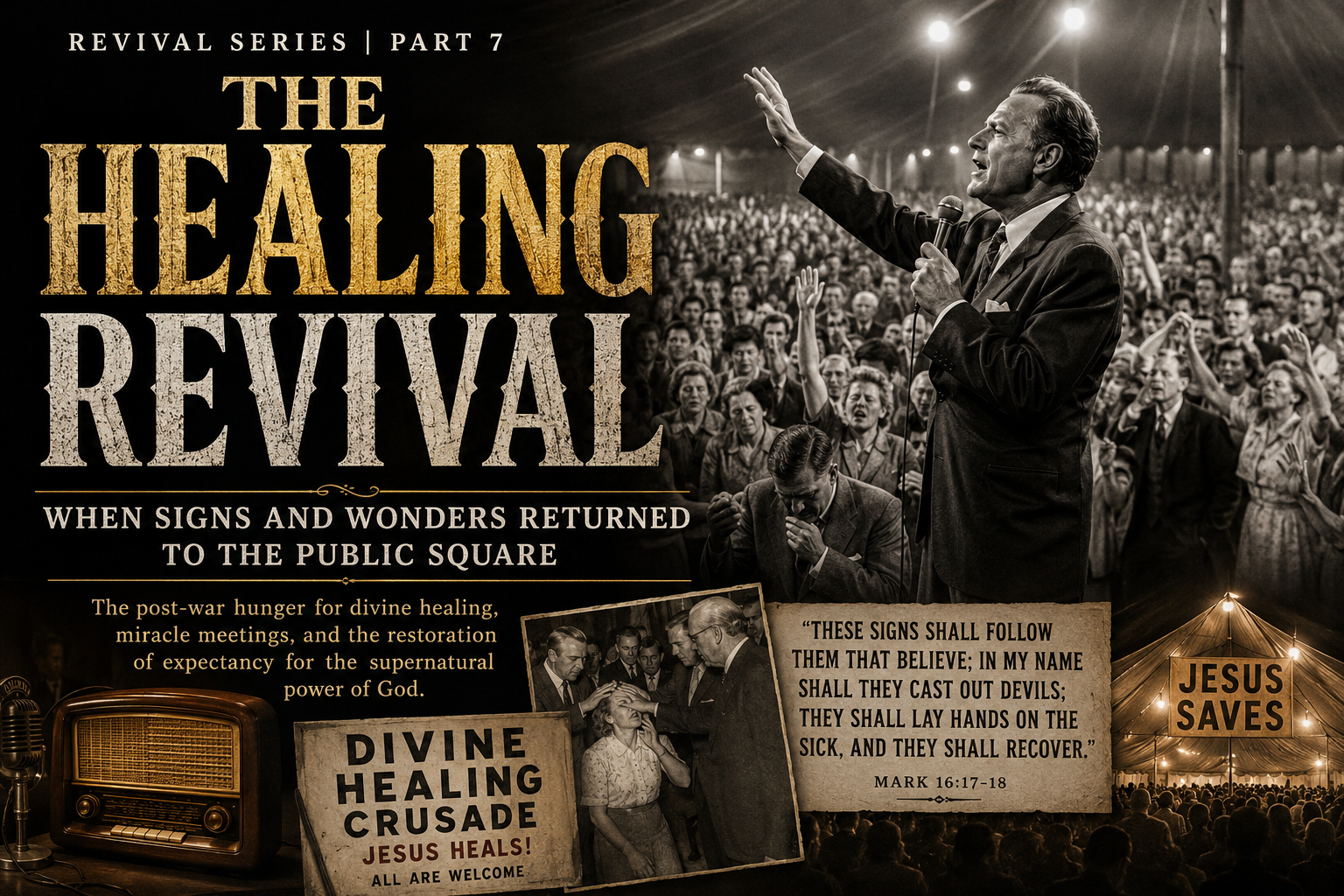
The Post-War Hunger for Divine Healing and the Restoration of Holy Spirit Expectancy
The Healing Revival
When Signs and Wonders Returned to the Public Square
After the fires of war had swept across the earth, the world stepped into the late 1940s carrying wounds deeper than statistics could measure. Nations had been shaken. Families had buried sons. Bodies had returned from battlefields carrying scars, trauma, amputations, sickness, and grief. The human soul had seen what modern machinery could do when separated from righteousness. Into that atmosphere, God began to awaken something that many parts of the Church had allowed to grow dim: the expectancy that Jesus Christ still heals, still delivers, still moves in power, and still confirms His Word with signs following.
The Healing Revival that emerged in the post-war years is commonly associated with the late 1940s through the 1950s. Many historians connect its rise with large-scale healing campaigns, tent meetings, radio broadcasts, prayer lines, and evangelistic gatherings where divine healing was proclaimed publicly again. This movement helped renew the Church’s expectation for the supernatural and became one of the major streams that later fed into the broader Charismatic movement.
This was not merely a season of emotional meetings. It was a response to a deep spiritual hunger. People were tired of religion that had language without power, structure without presence, and doctrine without demonstration. They wanted to know whether the Jesus who opened blind eyes, cleansed lepers, healed the lame, cast out demons, and raised the dead was still moving through His Church. The Healing Revival answered that hunger with a thunderous declaration: “Jesus Christ is the same yesterday, today, and forever” (Hebrews 13:8).
The public square began to hear again that sickness was not beyond the reach of Christ. Pain was not greater than the cross. Torment was not stronger than the blood. Disease was not more authoritative than the name of Jesus. In an age marked by grief, loss, and medical limitation, healing evangelists stepped into tents, auditoriums, churches, radio programs, and crusade platforms declaring that the living Christ still stretched out His hand toward the broken.
Names such as Oral Roberts, William Branham, Gordon Lindsay, F. F. Bosworth, Jack Coe, A. A. Allen, and others became associated with this era. Some carried powerful healing testimonies. Some drew massive crowds. Some helped awaken faith in entire regions. Gordon Lindsay’s Voice of Healing became a major publication connected to the movement, helping spread testimonies and reports of healing campaigns across Pentecostal and evangelical circles.
But to understand the Healing Revival rightly, we must look deeper than personalities. The true issue was not the platform. The true issue was the restoration of expectancy. The Church was being confronted with a question that every generation must answer: Do we only believe in the miracles of the Bible as historical memories, or do we believe the same Holy Spirit still empowers the Ecclesia to minister in the authority of Jesus Christ?
The book of Acts never presents signs and wonders as entertainment. They are not spiritual theater. They are not religious performance. They are the mercy of God breaking into human suffering and the authority of the Kingdom confronting the works of darkness. Acts 4:29–30 records the prayer of the early Church: “Lord, behold their threatenings: and grant unto thy servants, that with all boldness they may speak thy word, by stretching forth thine hand to heal; and that signs and wonders may be done by the name of thy holy child Jesus.”
Notice the order. They asked for boldness to speak the Word, and they asked God to stretch forth His hand to heal. The miracle was not meant to replace the message. The miracle was meant to bear witness to the message. Healing was never supposed to become the center; Jesus was always the center. But where Jesus is truly preached in fullness, the compassion and power of His Kingdom cannot remain theoretical.
This is where the Healing Revival carried a necessary correction to much of the Western Church. Many believers had settled into a powerless form of Christianity. They believed God could heal, but they no longer expected Him to. They honored the miracles of Scripture, but quietly treated them as if they belonged only to a former age. The Healing Revival challenged that unbelief. It forced the Church to wrestle again with Mark 16:17–18, James 5:14–15, 1 Corinthians 12, Acts 3, Acts 5, Acts 8, Acts 10, and Acts 19.
The message was simple but disruptive: the Gospel of the Kingdom is not word only. Paul wrote in 1 Corinthians 4:20, “For the kingdom of God is not in word, but in power.” That does not mean power without truth. It means truth confirmed by the living presence of God. It means the Kingdom is not merely explained; it is demonstrated through surrendered vessels who carry the authority of the King.
Yet we must also be honest. Like many moves of God, the Healing Revival carried both glory and warning. There were genuine miracles, salvations, deliverances, and awakenings. There were also controversies, exaggerations, doctrinal errors, financial abuses, personality-driven ministries, exhaustion among leaders, and places where the gift became more visible than the Giver. Some Pentecostal leaders and denominations eventually became concerned about sensationalism, questionable fundraising practices, doctrinal conflict, and lack of accountability within parts of the movement.
This matters because the Remnant must learn from history without dishonoring what God truly did. We do not need to throw away the fire because some men mishandled the altar. We also do not need to excuse disorder simply because miracles were reported. The mature Ecclesia must be able to say both things at once: God truly restored healing expectancy in that generation, and the Church must never allow signs and wonders to become separated from holiness, humility, truth, character, and the Lordship of Jesus Christ.
The Healing Revival reminds us that power without character becomes dangerous, but character without power can become religiously respectable unbelief. The biblical pattern is not one or the other. The biblical pattern is Spirit and truth. Jesus moved in perfect compassion, perfect holiness, perfect obedience, and perfect authority. He did not heal to build a brand. He healed because the Kingdom had come near. He healed because the Father’s heart was being revealed. He healed because the works of the devil were being destroyed.
Acts 10:38 declares that “God anointed Jesus of Nazareth with the Holy Ghost and with power,” and that He “went about doing good, and healing all that were oppressed of the devil; for God was with him.” This verse gives us a Kingdom lens. Healing is not merely physical relief. It is the collision between Heaven’s government and the oppression of darkness. It reveals the goodness of God, the authority of Christ, and the nearness of the Kingdom.
That is why the Healing Revival belongs in the story of revival history. It reintroduced the public square to the possibility that God was not silent, distant, or retired from supernatural intervention. It reminded post-war America that Heaven was not intimidated by trauma, sickness, grief, or despair. It brought people into tents and meetings where they heard the Gospel, received prayer, witnessed testimonies, and encountered a dimension of Christianity many had only read about.
But now the question comes to our generation.
Will we recover healing without hype?
Will we recover signs and wonders without celebrity?
Will we recover miracle faith without manipulation?
Will we recover public demonstrations of the Kingdom while remaining deeply submitted to Scripture, holiness, humility, and the government of Holy Spirit?
The Remnant must understand this: signs and wonders were never given so the Church could become impressive. They were given so Christ would be revealed. Healing is not a marketing strategy. Deliverance is not a platform tool. Miracles are not spiritual entertainment. They are acts of mercy from the King, bearing witness that the Gospel is alive, the Kingdom is present, and Jesus still destroys the works of the devil.
The Healing Revival showed us what can happen when divine expectancy returns to the public square. But it also warned us what happens when gifting runs faster than formation. The next healing movement must not be built around personalities. It must be carried by purified sons and daughters who know how to steward power from a place of surrender. The next wave must not be tent-centered, platform-centered, or personality-centered. It must be Christ-centered, Spirit-governed, Scripture-rooted, and holiness-anchored.
The Church does not need a return to yesterday’s methods. We need a return to biblical expectancy. We need prayer rooms where the sick are not treated as interruptions. We need altars where torment is confronted with compassion and authority. We need believers who lay hands on the sick in faith, not because they are chasing a name, but because they are obeying the Word. We need pastors, teachers, evangelists, prophets, apostles, intercessors, and everyday disciples who once again believe that the same Spirit who raised Christ from the dead dwells in the people of God.
Romans 8:11 declares that if the Spirit of Him who raised Jesus from the dead dwells in us, He who raised Christ shall also quicken our mortal bodies by His Spirit. That is not weak language. That is resurrection language. That is Kingdom language. That is the language of divine life invading mortal limitation.
The Healing Revival was a trumpet blast to a wounded generation. It declared that Jesus still heals. Jesus still delivers. Jesus still saves. Jesus still moves in power. But the Remnant must now carry that revelation with greater purity, greater maturity, and greater accountability. We must refuse both dead religion and reckless sensationalism. We must refuse unbelief dressed as discernment, and we must refuse hype dressed as faith.
The true healing ministry of Jesus flows from intimacy with the Father, obedience to Holy Spirit, compassion for the broken, hatred for the works of darkness, and submission to the Word of God. When those things are in order, healing does not become a show. It becomes a witness.
The public square still needs that witness.
Hospitals are full. Homes are broken. Minds are tormented. Bodies are afflicted. Families are grieving. Addictions are destroying destinies. Trauma is locking people in invisible prisons. And the Church cannot answer this hour with religious language alone. The Gospel must be preached. The Kingdom must be demonstrated. The sick must be prayed for. The oppressed must be delivered. The broken must encounter the living Christ.
The Healing Revival reminds us that post-war hunger opened a door for supernatural expectancy. But our generation carries its own wounds, its own wars, its own trauma, its own despair, and its own desperate need for the healing power of Jesus Christ.
So let the Remnant rise with clean hands and burning hearts.
Let the Ecclesia recover the courage to pray for the sick.
Let the altar be purified from performance.
Let the gifts of the Spirit operate under the Lordship of Christ.
Let healing return without hype, miracles return without manipulation, and signs and wonders return as witnesses to the supremacy of Jesus.
Because the same Jesus who healed then still heals now.
The same Holy Spirit who moved then still moves now.
And the same Kingdom that broke into the public square in the book of Acts is still advancing through surrendered sons and daughters today.
Scripture for Reflection:
“And these signs shall follow them that believe; In my name shall they cast out devils; they shall speak with new tongues… they shall lay hands on the sick, and they shall recover.”
Mark 16:17–18
“How God anointed Jesus of Nazareth with the Holy Ghost and with power: who went about doing good, and healing all that were oppressed of the devil; for God was with him.”
Acts 10:38
“For the kingdom of God is not in word, but in power.”
1 Corinthians 4:20
Prayer:
Father, restore holy expectancy to Your people. Purify our motives, cleanse our altars, and deliver us from both unbelief and performance. Teach us to carry the healing ministry of Jesus with humility, compassion, authority, and obedience. Let signs and wonders return as witnesses to the Gospel of the Kingdom, and let every miracle point back to the Lordship of Jesus Christ. Amen.
Stay tuned, the journey continues…..
A voice of fire to the Remnant,
— Dr. Russell Welch
Dr. Russell Welch is a published author, prophetic teacher, apostolic builder, author, and founder of faith-driven publishing and media initiatives. He is known for crafting bold, Kingdom-centered messages that call the Ecclesia into maturity, doctrinal clarity, and governmental authority. With a passion for equipping the Remnant and honoring generational legacy, Dr. Welch writes and teaches at the intersection of Scripture, history, and spiritual governance, challenging believers to live as sons and daughters who legislate Heaven on earth through truth, holiness, and unwavering fidelity to Christ.
Be sure to check out his book: Restoring God’s Prophetic Voice: Unleashing the Watchman’s Power in the Church’s Guide to Holy Living, available exclusively on Amazon … here

