Posts Tagged ‘Christian life’


Dismantling Replacement Theology with the Light of Truth and the Unbroken Covenant of God with Israel

Replacement Theology is not merely a harmless doctrinal difference. It becomes dangerous when it teaches the Church to boast against the very root that carries her. It becomes toxic when it suggests that God cast away Israel in order to replace her with a Gentile Church. It becomes deceptive when it takes the promises, covenants, prophetic destiny, and covenant identity given to Israel and transfers them in such a way that the Jewish people are treated as abandoned, rejected, or irrelevant to God’s redemptive plan.

Romans 11 stands as one of the clearest apostolic rebukes against this error.

Paul opens Romans 11 with a question that leaves no room for confusion: “Has God cast away His people?” His answer is immediate and forceful: “God forbid.” In Greek, Paul uses the phrase mē genoito, which carries the sense of “May it never be,” “Absolutely not,” or “Let such a thing never be thought.” This is not a soft disagreement. This is Paul slamming the door on the idea that God has rejected Israel.

Romans 11:1 says, “I say then, Hath God cast away his people? God forbid. For I also am an Israelite, of the seed of Abraham, of the tribe of Benjamin.”

The Greek word translated “cast away” is apōtheō, meaning to push away, reject, thrust aside, or repudiate. Paul is directly confronting the idea that God has shoved Israel out of His covenant purpose. His answer is no. God has not repudiated His people. God has not divorced Himself from the covenant promises given to Abraham, Isaac, Jacob, and their descendants.

The Aramaic/Syriac Peshitta carries the same force. The question reads with the sense of whether God has rejected or cast off His people, and the response is emphatic: “Far be it.” The Syriac witness strengthens the same apostolic conclusion: God’s covenant people have not been discarded. Israel has experienced a partial hardening, but not covenant abandonment.

This distinction matters.

Paul does not say Israel has been replaced.
Paul says Israel has experienced a partial hardening.
Paul does not say the Church became Israel in a way that erases Israel.
Paul says Gentiles have been grafted into the covenant blessing through Messiah.
Paul does not say the root now depends on the branches.
Paul says the branches depend on the root.

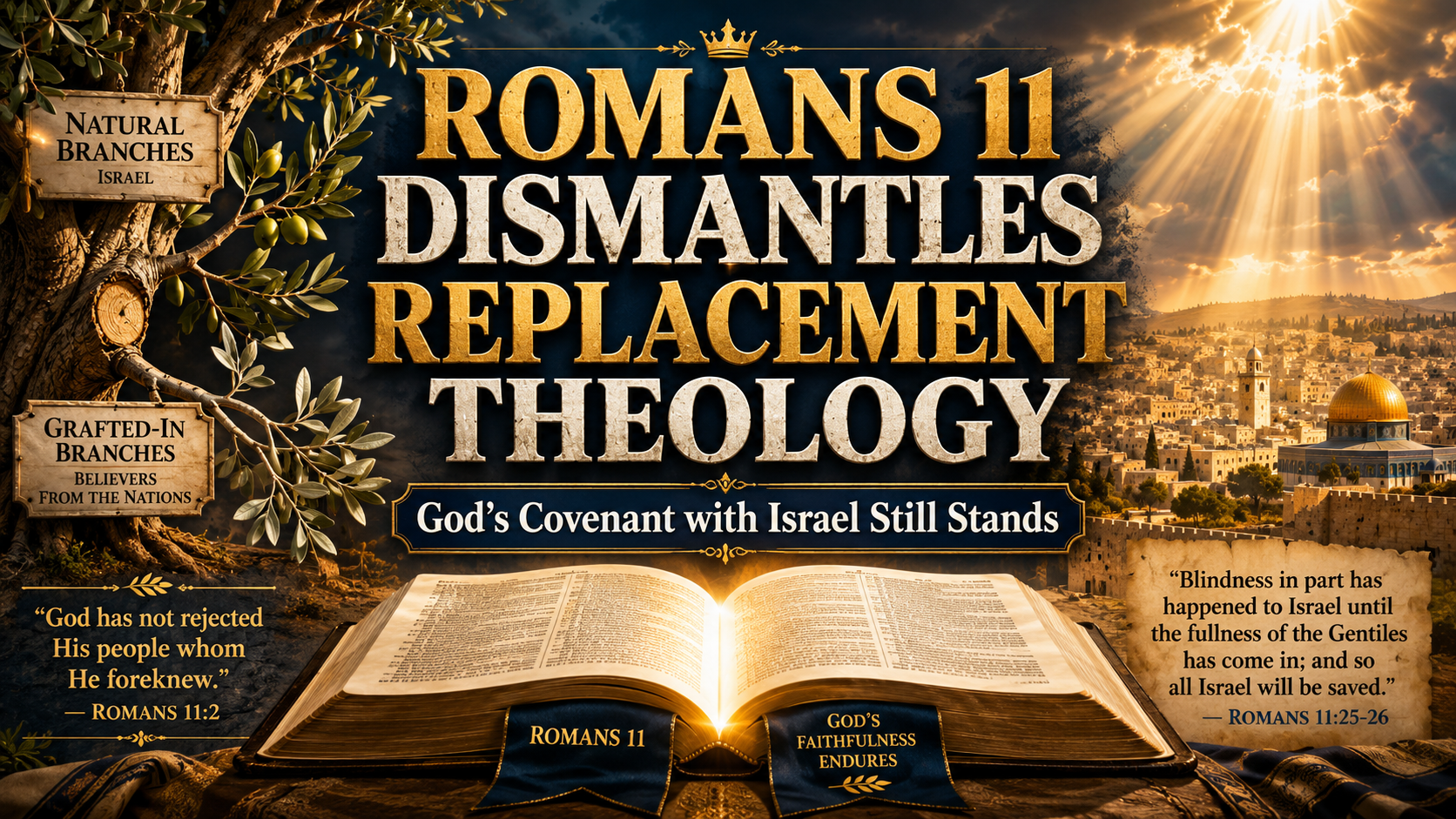
Romans 11:2 declares, “God hath not cast away his people which he foreknew.”

The Greek word foreknew is proginōskō, meaning to know beforehand, to set covenantal knowledge upon, to recognize in advance. This is more than God having information ahead of time. It speaks of covenant recognition and divine intention. The people God foreknew, He did not abandon. The covenant God initiated, He did not cancel. The promises God swore, He did not break.

The Aramaic witness preserves this same covenant logic. God has not rejected the people He knew from before. This is covenant language. This is faithfulness language. This is the language of divine remembrance.

Replacement Theology collapses because Romans 11 is built upon the faithfulness of God.

If God can break His covenant with Israel, then what confidence does the Church have that He will keep His covenant promises to us? If God can revoke His oath to Abraham, then how can we trust His promises in Christ? Paul’s entire argument is not merely about Israel. It is about the character of God. The issue is not only Israel’s destiny; the issue is whether God is faithful to His own Word.

Romans 11:11 says, “Have they stumbled that they should fall? God forbid.”

Again Paul uses mē genoito: absolutely not. Israel stumbled, but Israel did not fall beyond recovery. Their stumbling opened a door of mercy to the nations, but the mercy shown to the nations was never meant to become arrogance against Israel. Gentile inclusion was designed to provoke Israel to holy jealousy, not to create Gentile superiority.

Paul then gives the olive tree picture.

Romans 11:17–18 says, “And if some of the branches be broken off, and thou, being a wild olive tree, wert grafted in among them… boast not against the branches. But if thou boast, thou bearest not the root, but the root thee.”

This is devastating to Replacement Theology.

The Greek word for “grafted in” is enkentrizō. It speaks of inserting a branch into a living tree so it may draw life from the root. Gentile believers are not planted as a separate replacement tree. They are grafted into the existing covenantal olive tree. The tree existed before the Gentile branches were added. The root is not Gentile. The root is covenantal. The root runs through the patriarchs, the promises, the covenants, the prophets, and ultimately Messiah Himself, who came according to the flesh from Israel.

The Aramaic/Syriac Peshitta also presents the Gentiles as branches grafted in among the natural branches. The image remains the same: the Gentile believer receives life by being joined into what God had already cultivated. The wild branch does not become the root. The wild branch does not own the tree. The wild branch does not replace the natural branches. The wild branch is sustained by mercy.

Paul’s warning is sharp: “Boast not against the branches.”

The Greek word for boast carries the idea of exalting oneself over another. Paul is warning Gentile believers not to become arrogant toward Jewish unbelief. He is not giving the Church permission to mock Israel, erase Israel, spiritualize away Israel’s promises, or claim Israel’s identity in a way that denies Israel’s future restoration.

Romans 11:20 says, “Be not highminded, but fear.”

In Greek, the phrase carries the force of, “Do not think lofty thoughts about yourself, but stand in reverent fear.” Replacement Theology often produces the very attitude Paul warned against. It becomes high-minded. It assumes that Gentile believers now possess the covenant in such a way that Israel no longer matters. Paul says that attitude is not faith. It is arrogance.

Then Paul brings the argument to its covenant climax.

Romans 11:25 says, “Blindness in part is happened to Israel, until the fulness of the Gentiles be come in.”

The Greek phrase pōrōsis apo merous means “hardening in part.” This is critical. Paul does not say total blindness. He does not say permanent blindness. He does not say covenant rejection. He says partial hardening. The phrase “until the fullness of the Gentiles” means there is a divine timetable. Israel’s present condition is not the final word. God is still moving toward covenant fulfillment.

The Aramaic witness also speaks of a measure of blindness or dullness coming upon Israel until the fullness of the nations enters. Again, the idea is not replacement. The idea is sequence, mystery, timing, mercy, and restoration.

Romans 11:26 then says, “And so all Israel shall be saved.”

This verse must not be handled carelessly. Paul is not teaching salvation apart from Messiah. He is not saying Jewish identity alone saves. He is saying that God’s covenant dealings with Israel are not finished and that a future turning of Israel to Messiah belongs to the mystery of God’s redemptive plan.

The Greek word houtōs, translated “so,” means “in this manner” or “in this way.” Paul is explaining the divine pattern: partial hardening has come upon Israel, fullness is coming among the Gentiles, and then Israel’s restoration will unfold according to God’s covenant faithfulness.

Romans 11:27 says, “For this is my covenant unto them, when I shall take away their sins.”

The Greek word diathēkē means covenant. Paul grounds Israel’s future salvation not in human merit, but in divine covenant. God made promises. God swore by Himself. God does not lie. God does not revoke His covenant oath because of Gentile misunderstanding.

The Aramaic/Syriac Peshitta also holds the covenant language strongly. The taking away of sins is tied to God’s covenant action. Israel’s restoration is not sentimental nationalism. It is covenantal redemption through the mercy of God in Messiah.

Then Paul makes the statement that should end the replacement argument:

Romans 11:28–29 says, “As concerning the gospel, they are enemies for your sakes: but as touching the election, they are beloved for the fathers’ sakes. For the gifts and calling of God are without repentance.”

The Greek word for “election” is eklogē, meaning divine choosing. Israel remains beloved because of the fathers. Which fathers? Abraham, Isaac, and Jacob. Paul does not say Israel used to be beloved. He says they are beloved. Present tense covenant affection remains upon them because of patriarchal promise.

The phrase “without repentance” comes from the Greek ametamelēta, meaning irrevocable, not to be regretted, not taken back. God does not regret His covenant gifts. God does not withdraw His calling. God does not erase Israel from His redemptive purpose.

The Aramaic witness carries the same meaning: the gifts and calling of God are not reversed. They are not subject to cancellation. God’s covenant faithfulness remains intact.

This means Replacement Theology collapses under the weight of Romans 11.

The Church is not “the new Israel” in a way that erases ethnic Israel. The Church is the one new man in Messiah, made up of believing Jews and believing Gentiles, reconciled through the cross, sharing in covenant blessing by grace. Gentiles are not outsiders anymore, but neither are they covenant thieves. We have been brought near by the blood of Messiah. We have been grafted in by mercy. We have become fellow heirs, not replacement heirs.

The land of Israel also cannot be casually dismissed as though the biblical covenants were merely metaphors with no earthly consequence. The Abrahamic covenant included seed, blessing, nations, and land. The prophets repeatedly tie Israel’s restoration to both spiritual renewal and covenantal return. While salvation is only through Messiah, and while the modern political state of Israel must still be judged by righteousness and truth like every nation, the biblical land promise cannot be erased by Gentile theology without doing violence to the text.

The issue is not blind political worship of a nation-state. The issue is the integrity of God’s covenant Word.

We do not worship Israel.
We worship the God of Israel.
We do not preach salvation through ethnicity.
We preach salvation through Jesus the Messiah.
We do not deny the Church’s glorious identity in Christ.
We deny the arrogant doctrine that says the Church replaced Israel and inherited her promises by erasing her future.

Paul’s warning must be heard again in this generation: “Do not boast against the branches.”

Replacement Theology is dangerous because it teaches the grafted-in branch to boast against the natural branch. It teaches the wild olive branch to act like it owns the root. It forgets that Jesus is Jewish according to the flesh, the apostles were Jewish, the prophets were Jewish, the covenants were given to Israel, the Scriptures came through Israel, and the Messiah came through Israel.

Romans 11 is not a side issue. It is a covenant courtroom. Paul brings the Gentile Church before the witness stand and asks: Will you stand in mercy, or will you boast in arrogance?

The true apostolic position is clear.

God has not cast away Israel.
Israel’s hardening is partial, not total.
Israel’s stumbling is temporary, not final.
Gentiles are grafted in, not installed as replacements.
The root supports us; we do not support the root.
Israel remains beloved for the fathers’ sake.
The gifts and calling of God are irrevocable.
The covenant-keeping God will finish what He started.

Therefore, the Remnant Ecclesia must reject the false replacement gospel and recover the fear of the Lord concerning Israel. We bless what God has blessed. We honor what God has covenanted. We pray for the peace of Jerusalem. We preach Messiah to Jew and Gentile alike. We stand against antisemitism, arrogance, and theological theft. And we proclaim with Paul that the mercy of God is wide enough to gather the nations without abandoning Israel.

The light of truth dismantles the lie.

God’s covenant with Israel has not been broken.
God’s Word has not failed.
God’s promises have not expired.
God’s election has not been revoked.
And the God of Abraham, Isaac, and Jacob will be faithful to His covenant until the fullness of His redemptive plan is complete.

Stay tuned, the journey continues…..

A voice of fire to the Remnant,

— Dr. Russell Welch

Dr. Russell Welch is a published author, prophetic teacher, apostolic builder, author, and founder of faith-driven publishing and media initiatives. He is known for crafting bold, Kingdom-centered messages that call the Ecclesia into maturity, doctrinal clarity, and governmental authority. With a passion for equipping the Remnant and honoring generational legacy, Dr. Welch writes and teaches at the intersection of Scripture, history, and spiritual governance, challenging believers to live as sons and daughters who legislate Heaven on earth through truth, holiness, and unwavering fidelity to Christ.

Be sure to check out his book: Restoring God’s Prophetic Voice: Unleashing the Watchman’s Power in the Church’s Guide to Holy Living, available exclusively on Amazon … here

Amazon Author Page


“Some words are not meant to be rushed — they are meant to be seasoned in the secret place”

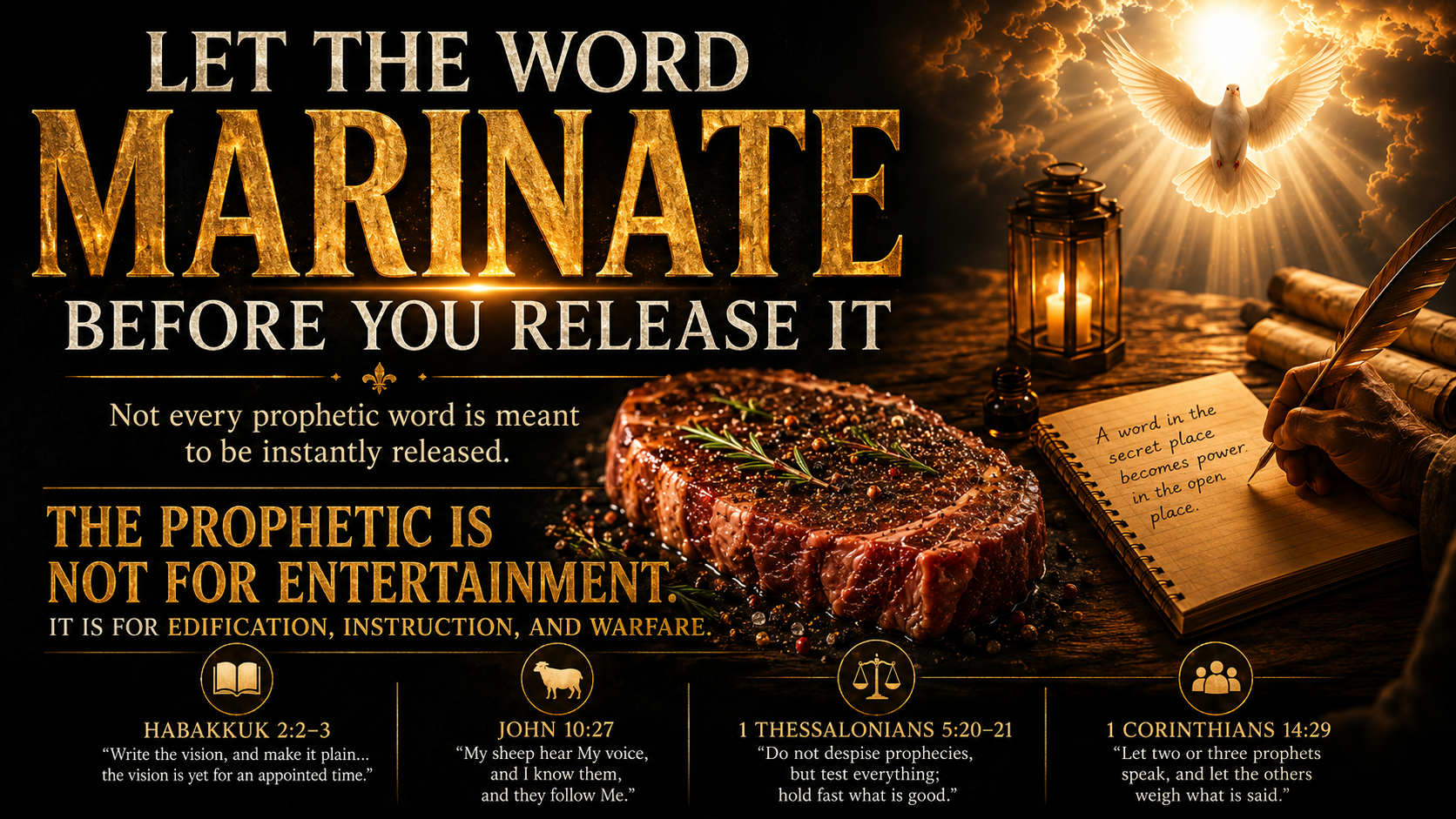
As a chef, I learned something very early: if you want a good steak, you do not simply pull it out of the refrigerator, slap it on the grill, throw a little salt and pepper on it, and expect greatness. You may end up with something edible. You may even end up with something that has a little flavor. But if you want depth, tenderness, richness, and excellence, you season it properly and let it marinate.

Twelve hours is good. Twenty-four hours is even better.

Why? Because time allows the seasoning to penetrate beneath the surface.

And over the years, Holy Spirit has shown me that prophetic words often work the same way.

Not every word you receive from Heaven is meant to be instantly released. Some words are born for the moment, yes. There are times when the fire of God comes upon a messenger and the word must be released immediately. Jeremiah said the word of the Lord was like fire shut up in his bones, and he could not hold it in. But there are also words that are not meant to be thrown onto the public grill the moment they arrive. Some words must remain in the birthing chamber of prayer until the holy oils of the Throne Room have fully saturated them.

Habakkuk was told, “Write the vision, and make it plain,” but he was also told, “the vision is yet for an appointed time” (Habakkuk 2:2–3). That means not every true word is an immediate word. Some words are accurate in content but premature in timing. Some words are from Heaven, but they must first be seasoned in intercession, purified in surrender, tested in humility, and weighed before the Lord.

This is why the prophetic life must be governed by Holy Spirit, not by the hunger for a platform.

Jesus said, “My sheep hear My voice, and I know them, and they follow Me” (John 10:27). The mature prophetic vessel does not merely hear; the mature vessel follows. Following means we do not just ask, “Lord, what are You saying?” We also ask, “Lord, when do You want this spoken? Who is this for? Is this for public release, private intercession, personal obedience, or a decree in the secret place?”

Paul instructed the Church, “Do not despise prophecies, but test everything; hold fast what is good” (1 Thessalonians 5:20–21). He also wrote, “Let two or three prophets speak, and let the others weigh what is said” (1 Corinthians 14:29). In other words, the New Testament prophetic culture was never meant to be reckless, sensational, or entertainment-driven. It was meant to be submitted, weighed, holy, and governed by the Spirit of God.

Much of what is called prophetic today has been shaped more by stage production than by the secret place. It has created a false hunger in many people to chase the next word, the next dramatic declaration, the next emotional high, the next public spectacle. But the Kingdom does not operate by spiritual entertainment. The Kingdom operates through obedience, consecration, discernment, timing, purity, and the fear of the Lord.

The early Church understood this tension. The Didache, one of the earliest Christian writings outside the New Testament, warned believers not to simply accept every person who claimed prophetic speech, but to discern the life and fruit of the messenger. Irenaeus, writing in the second century, defended the reality of prophetic gifts in the Church, yet also warned against false prophets who spoke from vanity, personal gain, or a spirit not from God. The ancient Church did not throw away the prophetic, but neither did they allow it to become lawless.

That is the balance we must recover.

The prophetic must be honored, but it must also be purified.

The gifts must be received, but the vessel must be consecrated.

The voice must be released, but only under the government of Holy Spirit.

Throughout Church history, those who walked deeply with God understood that the word of the Lord is not a toy for the gifted; it is a sacred trust for the surrendered. The desert fathers spoke often of silence, purity of heart, and the danger of spiritual pride. The mystics of the Church understood that deep revelation must be held in humility. Andrew Murray wrote powerfully about waiting on God, reminding the saints that spiritual life is not sustained by human striving but by God Himself working within the soul. Oswald Chambers would later call believers into absolute surrender, warning that the life of faith is not driven by self-importance but by yieldedness to the One who leads.

And this is exactly what Holy Spirit is restoring in this hour.

He is raising up a new breed of Watchmen.

Not performers.

Not spiritual celebrities.

Not prophetic entertainers.

Not men and women addicted to applause, platforms, followers, or public affirmation.

He is raising up Watchmen who know how to hear in the secret place before they speak in the public place. Watchmen who understand that some words are not sermons; they are assignments. Some words are not posts; they are intercessions. Some words are not for the crowd; they are for the altar. Some words are not meant to impress men; they are meant to move mountains in the unseen realm.

These are the spiritual mystics of the Kingdom—not in the sense of confusion, New Age mixture, or unbiblical imagination, but in the holy biblical sense of men and women drawn into the mysteries of God. Like Isaiah, who saw the Lord high and lifted up. Like Jeremiah, who carried the burden of the word of the Lord. Like Daniel, who received mysteries in the night. Like Ezekiel, who saw visions of God by the river. Like John on Patmos, who was caught up in the Spirit and shown what earthly eyes could never manufacture.

But there is a doorway into that realm, and Scripture tells us who may enter.

“Who shall ascend the hill of the Lord? And who shall stand in His holy place? He who has clean hands and a pure heart” (Psalm 24:3–4).

This is why everything must come under the Lordship of Holy Spirit: your life, your marriage, your finances, your ministry, your gifts, your ambition, your tongue, your timing, your motives, and your desire to be seen. Because the prophetic word is not truly safe in the mouth of an unsubmitted vessel.

A true Watchman does not only ask for more revelation.

A true Watchman asks for cleaner hands.

A true Watchman asks for a purer heart.

A true Watchman asks for the fear of the Lord.

A true Watchman is willing to let the word marinate in the secret place until Heaven says, “Now release it.”

Because when a word has been saturated in prayer, seasoned by obedience, tenderized by humility, purified by fire, and released under the authority of Holy Spirit, it does not merely carry information.

It carries weight.

It carries oil.

It carries fire.

It carries the fragrance of the Throne.

And in this hour, the Ecclesia does not need more raw words thrown onto the grill of public opinion.

We need seasoned voices.

We need surrendered messengers.

We need Watchmen who know the difference between hearing something from God and being authorized to release it.

The altar must be guarded.

The prophetic must be purified.

The secret place must be restored.

And the new breed of Watchmen must arise with clean hands, pure hearts, burning eyes, and tongues governed by the Lordship of Holy Spirit.

Stay tuned, the journey continues…..

A voice of fire to the Remnant,

— Dr. Russell Welch

Dr. Russell Welch is a published author, prophetic teacher, apostolic builder, author, and founder of faith-driven publishing and media initiatives. He is known for crafting bold, Kingdom-centered messages that call the Ecclesia into maturity, doctrinal clarity, and governmental authority. With a passion for equipping the Remnant and honoring generational legacy, Dr. Welch writes and teaches at the intersection of Scripture, history, and spiritual governance, challenging believers to live as sons and daughters who legislate Heaven on earth through truth, holiness, and unwavering fidelity to Christ.

Be sure to check out his book: Restoring God’s Prophetic Voice: Unleashing the Watchman’s Power in the Church’s Guide to Holy Living, available exclusively on Amazon … here

Amazon Author Page


Pip: Radical Disciples – A Remnant Revolution is not here to take the temperature of the room — it’s here to raise it considerably.

Mara: This episode covers ground from radicaldisciples across three connected territories: what it means to be a spiritual watchman in this hour, what the Church loses when it surrenders holy language, and what Azusa Street still has to say to a generation hungry for fire.

Pip: Let’s start with the watchmen — who they are, what they see, and why the wall they’re standing on is not the one you’d expect.

Watchmen And Spiritual Vigilance

Mara: The central question here is what distinguishes a New Covenant watchman from the ancient sentinels of Israel’s walls — and whether that distinction carries real weight or is just theological decoration.

Pip: The post draws the line sharply. Paul’s letter to the Ephesians is the hinge: “God raised us up together, and made us sit together in heavenly places in Christ Jesus.”

Mara: So the upshot is that the watchman’s vantage point has fundamentally shifted — from a stone wall scanning the horizon for armies to a seated position in Christ, discerning spiritual movements across families, regions, and nations.

Pip: And the post is careful to separate that authority from noise. There’s a distinction drawn between the alarmist, who reacts to darkness and spreads fear, and the watchman, who responds to Heaven and releases clarity. One magnifies the enemy; the other magnifies the Lord.

Mara: The companion piece, “The Watchmen Arise: Dismantling the Shadows to Restore the Flame,” develops this further — describing a company of what it calls Fire-Brand Watchmen Seers, forged in secret communion, tasked with exposing the rotten foundations of religious performance so the true house of God can be rebuilt.

Pip: Both posts agree: the watchtower is a place of isolation, and that’s precisely where the vital work happens. That same hidden formation feeds directly into what the next segment calls reclaiming holy language.

Mystics And Reclaiming Holy Fire

Mara: The tension driving this segment is whether the Church can recover words and practices the world has stolen and redefined — and what it costs to try.

Pip: The post names the strategy plainly. The enemy, it argues, has been running the same play since Eden — steal the language, rebrand it, then convince the Church the word is now unclean.

Mara: The post frames the recovery directly: “Heaven is reclaiming the word mystic, not as a strange, lawless, extra-biblical spirituality, but as the holy pursuit of the deep things of God.”

Pip: What this means in practice is that the biblical mystic is not someone chasing shadows or spiritual novelty — the post defines him as someone buried in Scripture until the Word becomes fire in his bones, pressing through doctrine until it becomes living encounter.

Mara: A.W. Tozer anchors the argument here. The post quotes him: “The world is perishing for lack of the knowledge of God and the Church is famishing for want of His Presence.” Programs without presence, sermons without trembling — the post reads that sentence as a current diagnosis, not a historical one.

Pip: Leonard Ravenhill gets a turn too: “No man is greater than his prayer life.” The mystic Remnant, the post argues, is being forged in secret — hidden obedience, fasting, repentance — before it ever stands before men.

Mara: The second piece in this segment, “The Remnant Ecclesia and the Fire of Reformation,” extends the argument from individual hunger to corporate structure. Reformation, it insists, is never carried by a celebrity platform — it’s carried by a consecrated people. The fire of Pentecost fell on the whole company, not one preacher.

Pip: Reformation as governmental alignment rather than emotional visitation — that’s the phrase that lands. Which is a useful frame for what happened at a particular address in Los Angeles in 1906.

Azusa And Pentecostal Revival

Mara: Azusa Street is the historical case study for everything the previous segments argue in theological terms — fire that fell outside respectable religion, through a vessel the systems of the day would not have chosen.

Pip: William Seymour: son of formerly enslaved parents, African American holiness preacher, and apparently the wrong résumé for the moment — except Heaven was not consulting the shortlist.

Mara: The post quotes Frank Bartleman’s testimony directly: “the color line was washed away in the blood.” In a segregated America, the integrated room at Azusa was not sentiment — the post calls it a prophetic rebuke against the powers of the age.

Pip: And Seymour himself understood the fire could be counterfeited. His warning was that tongues without love, humility, and holiness were not the fullness of Spirit-filled life. The post frames that as the thing the Remnant most needs to recover — not performance, not noise, but burning love formed in a holy people.

Mara: The post also carries a sober note: receiving fire is one thing, walking worthy of it is another. Division came from within Azusa even as the flame spread outward. The lesson the post draws is that the altar must be rebuilt before the fire falls again.


Pip: Watchmen seated in heavenly places, mystics reclaiming stolen language, a revival that broke racial walls in 1906 — the thread running through all of it is the same: fire belongs to the surrendered, not the platformed.

Mara: And the posts are clear that this is not nostalgia — it’s a present summons. The next episode will show us where that summons goes next. So stay hungry. Stay Alrert. Stay Burning.

Pip: This has been Pip and Mara and we will see you, our fellow Remnant Warriors next week. The Christ alone be the Glory!


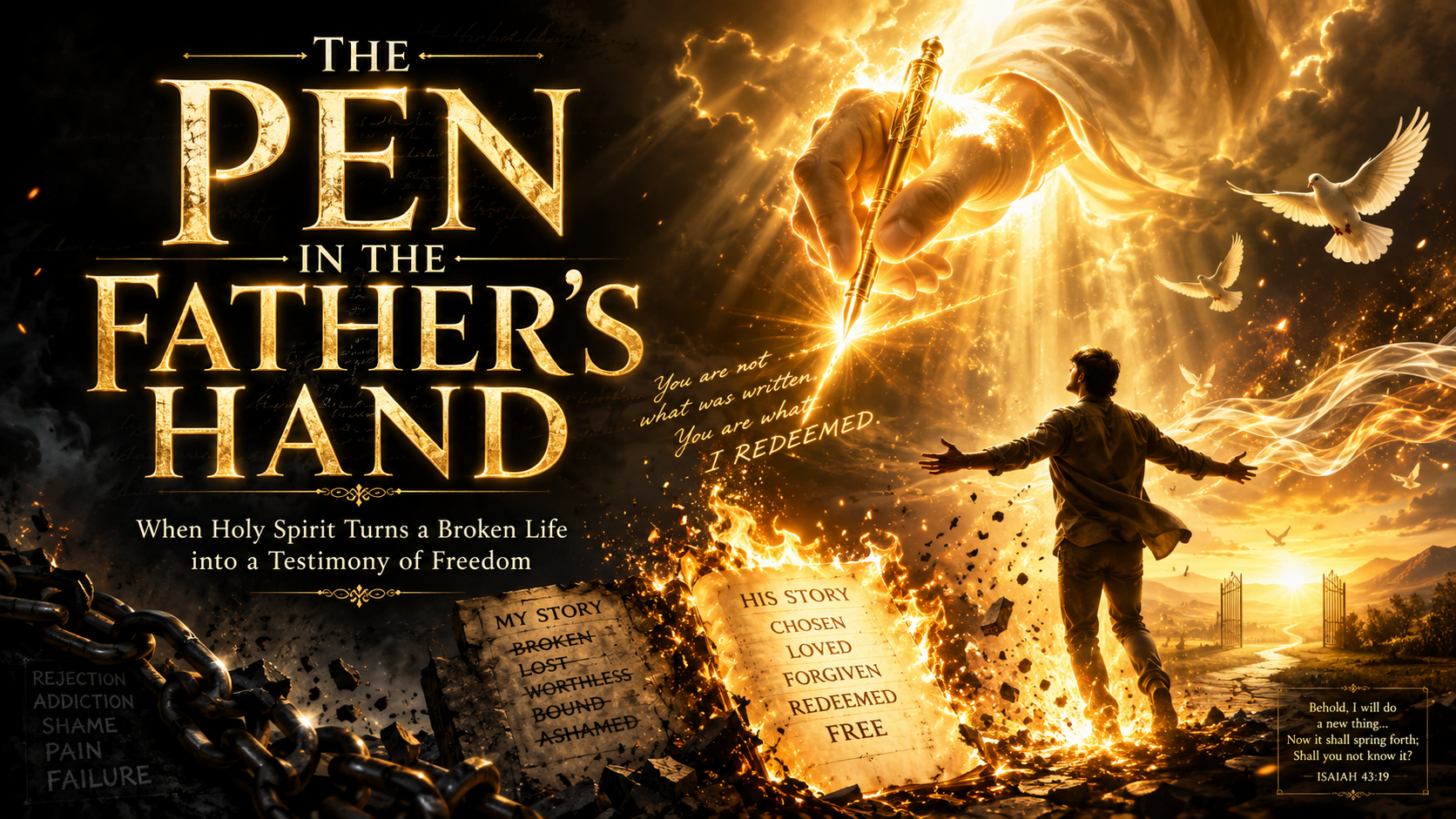
When Holy Spirit Turns a Broken Life into a Testimony of Freedom

A couple of weeks ago, Holy Spirit took me back to a prophetic word that had been released over my life years ago by the late Bill Johnson of Christian International, Restoration Life, and Synergy Church in Tallahassee, Florida. In that word, he said the Lord had called me to be one of His watchmen seers, and that the way Holy Spirit had been speaking to me for several years would begin to make sense. Then his wife, Linda, prophesied over me that she saw God using me like a pen in His hand.

At the time, I received it by faith. But after close to ten years passing, as Holy Spirit brought those words back before me, I can look back and clearly to see how the hand of the Father has been woven through my life in ways I could not fully understand when the words were first spoken. Sometimes a prophetic word does not explain your life immediately. Sometimes it waits until obedience, suffering, warfare, repentance, and surrender have prepared your heart to understand what Heaven already knew.

Jeremiah heard the Lord say, “Before I formed thee in the belly I knew thee; and before thou camest forth out of the womb I sanctified thee” (Jeremiah 1:5). Paul said we are “His workmanship, created in Christ Jesus unto good works, which God hath before ordained that we should walk in them” (Ephesians 2:10). That means your life is not an accident. Your scars are not wasted. Your history is not stronger than His calling. The enemy may have tried to write chapters of addiction, shame, confusion, failure, and delay, but he never owned the pen.

The Father did.

Most of the time, Holy Spirit speaks to me through pictures. There have been seasons when I did not understand that. I would see things, feel things, perceive things, and wonder why my spirit was interpreting life through images, impressions, and scenes. Even when watching a movie, Holy Spirit would often unveil something deeper. I remember watching Tron as a teenager, and at the end of the movie I saw something that struck me deeply: the Creator entering into the world He made to redeem what had been lost, even at the cost of His own life. I did not have the language for it then, but I can see it clearly now. Holy Spirit was training my eyes to see Christ in pictures before I ever knew how to preach it, teach it, or write it.

Jesus often taught in pictures. He spoke of seed and soil, sheep and shepherds, lamps and oil, bread and wine, rivers and vineyards, houses built on rock, and treasure hidden in a field. The prophets saw visions. Ezekiel saw wheels within wheels. Zechariah saw lampstands and olive trees. Daniel saw kingdoms rising and falling. John was caught up in the Spirit and saw a throne set in Heaven. The Bible is filled with men who did not merely hear words; they saw by the Spirit.

Heaven Is Restoring the Sight Religion Tried to Hide

And I believe this is one of the things the Lord is restoring to His people in this hour. Not imagination untethered from Scripture. Not fantasy. Not soulish dreams dressed up in prophetic language. But sanctified sight. Spirit-governed vision. The eyes of the heart enlightened, as Paul prayed in Ephesians 1:18, so that the people of God may know the hope of His calling, the riches of His inheritance, and the exceeding greatness of His power toward those who believe.

In this season, those visions have been coming more often. And there are moments when I sit down to write and understand, in my own measure, what many Spirit-filled writers and servants of God have described throughout history: the mystery of becoming a yielded vessel. Richard Baxter once prayed that he had nothing to do with his “Tongue and Pen” but to speak to God, speak for God, and publish His glory and will. That is the cry of every surrendered messenger. Not “look what I can write,” but “Father, take the pen.” Not “look what I have built,” but “Lord, let this life publish Your glory.”

That is exactly what happened when I sat down to write my testimony of freedom from addiction in my book, Beyond the Shadows: A Journey from the Life of Addiction to Absolute Freedom in Christ. It was my testimony, but it felt as though Heaven was helping me see my story from the Father’s perspective. I was not just remembering pain. I was watching redemption interpret pain. I was not merely recounting bondage. I was watching the Cross answer bondage. I was not writing as a victim trying to survive his past. I was writing as a son learning that the Father had been present even in the places where I once thought I was abandoned.

That is the grace of God.

Grace does not simply cover the past; grace confronts it, redeems it, heals it, and turns it into a weapon of testimony. Revelation 12:11 says, “And they overcame him by the blood of the Lamb, and by the word of their testimony.” The blood of Jesus destroys the legal claim of the accuser, and the testimony of the redeemed silences the narrative of hell. The enemy wants your story buried in shame. The Father wants it raised in glory.

David understood something of this mystery. When the Spirit of the Lord came upon him, he could take a harp in his hand and release a sound that drove torment from Saul. He could look at a giant and see not an impossible enemy, but an uncircumcised Philistine standing illegally before the armies of the living God. He could fall, repent, weep, worship, write, and rise again. David’s life was not perfect, but his heart belonged to God. And from that surrendered place came psalms that still carry fire thousands of years later.

There are times I feel that same holy assistance when I write books, blogs, teachings, and prophetic content. It is not that I am great. It is not that I am impressive. It is not that I possess some natural brilliance. The truth is, I know where I came from. I know what I was rescued from. I know what addiction did. I know what shame tried to do. I know what failure sounded like. I know what it feels like to look at your own life and wonder whether anything good could ever come out of it.

But I also know the Cross.

I know repentance.

I know mercy.

I know deliverance.

I know the Father who runs toward prodigals.

I know the Christ who breaks chains.

I know the Holy Spirit who teaches men what no classroom could ever give them.

I was not naturally educated in the way some people might expect. I struggled in school. I failed tests. I battled through things that made me feel unqualified. But somewhere along the way, I learned how to pray, “Lord, help me.” And He did. My GED, my pest control licensing, my doctorate in theology, my books, my preaching, my teaching, my ministry assignment, and my writing all stand as memorial stones of grace. They are not monuments to my ability. They are altars to His faithfulness.

James 1:5 says, “If any of you lack wisdom, let him ask of God, that giveth to all men liberally.” I lacked wisdom, and He gave it. I lacked discipline, and He formed it. I lacked understanding, and He taught me. I lacked purity, and He cleansed me. I lacked identity, and He called me son. I lacked freedom, and He brought me out.

This is why no man can take the glory.

Not even me.

Paul said, “By the grace of God I am what I am” (1 Corinthians 15:10). That is my testimony. That is my confession. That is the altar where every book, every message, every blog, every sermon, every podcast, and every prophetic word must bow. By the grace of God, I am what I am.

And this is the word I want to release to every captive, every recovering prodigal, every wounded vessel, every hidden writer, every rejected watchman, every misunderstood seer, every person who feels disqualified because of their past: the Father is not finished writing.

You may have been in addiction, but addiction is not the author.

You may have walked through shame, but shame is not the author.

You may have failed, fallen, wandered, rebelled, or wasted years, but failure is not the author.

Jesus is “the author and finisher of our faith” (Hebrews 12:2).

The enemy may have tried to stain the pages, but the blood of Jesus speaks a better word. The world may have labeled you. Religion may have dismissed you. People may have remembered only who you were before grace interrupted the story. But Heaven does not define a redeemed life by the chapter where the man was bound. Heaven defines it by the Lamb who broke the chains.

So hand Him the pen.

Hand Him the pain.

Hand Him the memory.

Hand Him the shame.

Hand Him the testimony.

Hand Him the gift.

Hand Him the unfinished pages.

Because when the Father takes the pen, He does not merely write information. He writes resurrection. He writes freedom. He writes sonship. He writes deliverance. He writes purpose. He writes fire.

And when Holy Spirit breathes upon a surrendered life, even the chapters hell tried to destroy become weapons in the hand of God.

— Dr. Russell Welch
A voice of fire to the Remnant, awakening warriors, restoring Kingdom identity, and calling the Ecclesia back under the government of Holy Spirit.


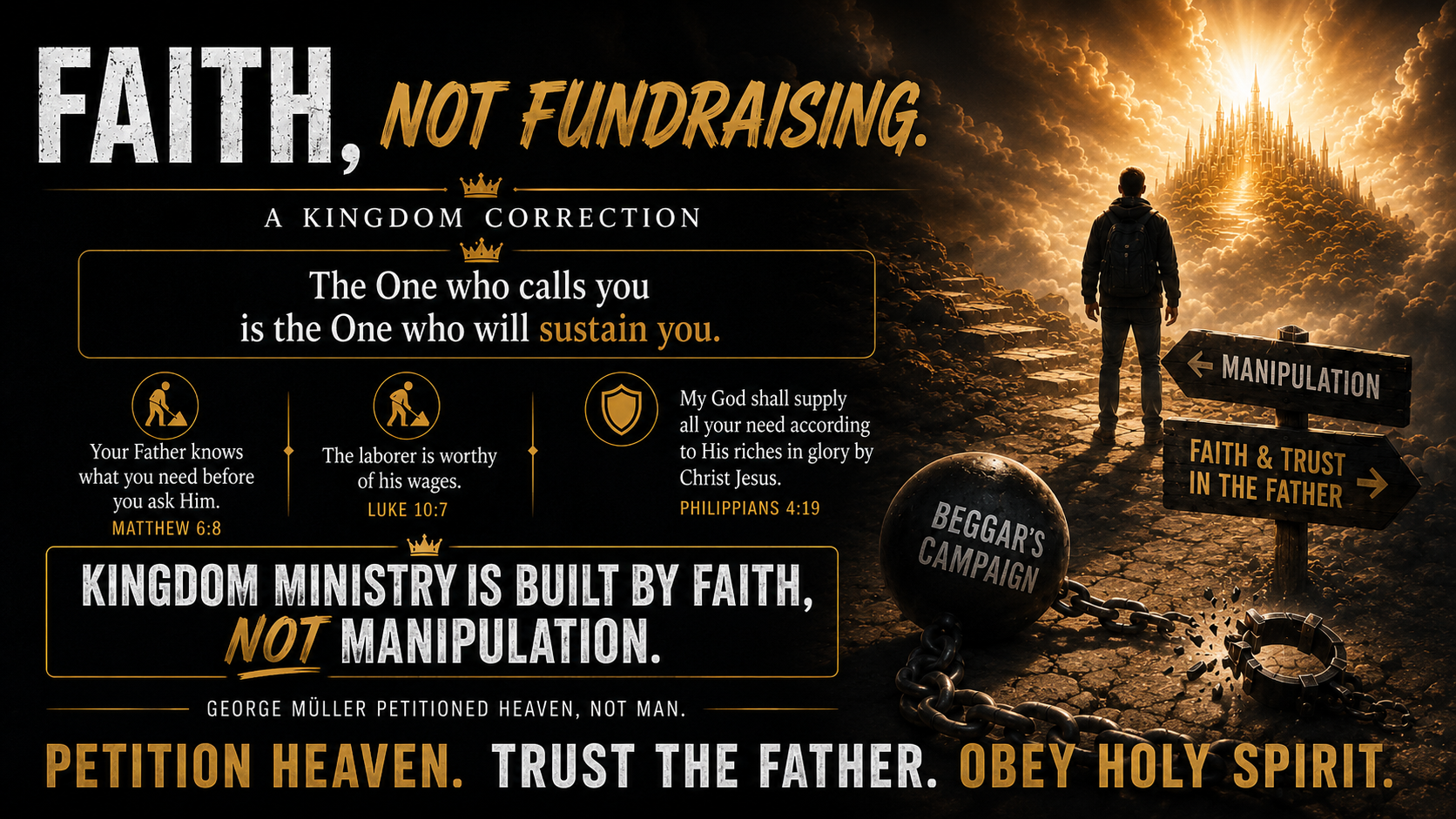
A prophetic call to restore Kingdom giving, expose religious manipulation, and return ministry provision back to faith in the Father.

It seems that every time I accept friend requests from many individuals outside the United States, I am quickly bombarded with requests for financial support. I want to say this with compassion, but also with Kingdom clarity: I am truly sorry for the message much of the American Church has exported concerning money, ministry, and provision.

Many have been taught that once they step into ministry, the sons and daughters of the Lord are automatically responsible to carry their personal needs. But this is not the true pattern of the Kingdom. The Father may move through people, but people are never to be treated as the source.

Jesus said, “Your Father knows what you need before you ask Him” (Matthew 6:8). He also commanded us to “seek first the Kingdom of God and His righteousness, and all these things shall be added to you” (Matthew 6:33). Paul declared, “My God shall supply all your need according to His riches in glory by Christ Jesus” (Philippians 4:19).

Yes, Scripture says, “The laborer is worthy of his wages” (Luke 10:7). But that verse was never meant to justify manipulation, pressure, guilt, emotional begging, or ongoing financial appeals disguised as ministry. A laborer being worthy of his wages is not the same thing as launching a beggar’s campaign against the saints.

When God calls a man or woman, He also takes responsibility for the assignment He gave them. The One who commissions also sustains. The One who sends also provides. The One who opens the door also knows how to furnish the room.

Abraham understood this when he told the king of Sodom, “I will take nothing… lest you should say, ‘I have made Abram rich’” (Genesis 14:23). Elijah learned this when God used ravens, a brook, and then a widow to sustain him (1 Kings 17:2–16). Jesus Himself taught us to pray, “Give us this day our daily bread” (Matthew 6:11), not “Teach us how to pressure people into meeting our needs.”

Sadly, the American Church has done a terrible job modeling this in many places. Too often, members have been treated more like personal ATM machines than sons and daughters of God. Instead of raising mature disciples who know how to hear God, trust God, and obey God, religious systems have trained people to respond to pressure, personality, crisis, fear, guilt, and emotional manipulation.

One of the most unbiblical forms of manipulation is tying the blessings of God and the promises of God to how much someone puts in an offering plate. That is not faith. That is religious control. Giving is holy when it flows from love, obedience, generosity, and a willing heart, but it becomes polluted when people are made to believe that God’s favor can be purchased.

Peter rebuked this spirit when he told Simon, “Your money perish with you, because you thought that the gift of God could be purchased with money” (Acts 8:20). Paul also made it clear that Kingdom giving must never be driven by pressure or compulsion: “Each one must give as he has decided in his heart, not reluctantly or under compulsion, for God loves a cheerful giver” (2 Corinthians 9:7).

The Father blesses according to covenant, obedience, faith, mercy, grace, and His own goodness. His promises are not merchandise. His blessing is not for sale. His favor is not unlocked by manipulation from a platform.

Any person can twist Scripture to defend a system, but twisting Scripture has never been the mark of truth. We know who is the father of lies, and we know the enemy’s ancient pattern is to distort what God has said. He did it in Eden. He did it in the wilderness when he tempted Jesus. And he still does it whenever Scripture is used to manipulate rather than liberate.

This is why we must return to the fear of the Lord. Provision is holy. Giving is holy. Stewardship is holy. Ministry is holy. And when holy things are handled with manipulation, Heaven takes notice.

The gift of faith is one of the most ignored gifts when it comes to finances. Many speak of miracles, healing, prophecy, and deliverance, but when money is involved, they immediately run to man before they petition Heaven. Yet Hebrews 11:6 says, “Without faith it is impossible to please Him.” If we trust God for souls, healing, deliverance, revival, and breakthrough, we must also learn to trust Him for provision.

George Müller modeled this beautifully. He cared for thousands of orphaned children in Bristol, England, yet he was known for not making financial appeals to man. He brought the needs before God in prayer and trusted the Father to move upon hearts as He desired. Müller’s life became a rebuke to religious striving and a testimony that Heaven still responds to faith.

Hudson Taylor, the great missionary to China, carried the same conviction. He taught that God’s work done in God’s way will not lack God’s supply. The principle is simple but powerful: if God truly sent the work, God is fully able to sustain the work.

This does not mean God never uses people. Of course He does. The Kingdom is generous. The book of Acts shows believers sharing, giving, and meeting needs as Holy Spirit led them. But Spirit-led generosity is not the same as religious pressure. Kingdom giving flows from obedience, not manipulation.

Holy Spirit is raising up Watchmen in this hour who are sounding the alarm and calling the Bride back into Kingdom alignment. The days of merchandising the saints, manipulating the vulnerable, and treating God’s people as financial machines are coming under the light of Heaven.

We do not petition people as our source. We petition Heaven.

We do not manipulate the Body. We trust the Father.

We do not build ministry on emotional appeals. We build by faith, obedience, purity, and surrender.

The One who called us is faithful. The One who commissioned us is able. And the One who gave the assignment will provide for what He has ordained.

Stay tuned, the journey continues…..

A voice of fire to the Remnant,

— Dr. Russell Welch

Dr. Russell Welch is a published author, prophetic teacher, apostolic builder, author, and founder of faith-driven publishing and media initiatives. He is known for crafting bold, Kingdom-centered messages that call the Ecclesia into maturity, doctrinal clarity, and governmental authority. With a passion for equipping the Remnant and honoring generational legacy, Dr. Welch writes and teaches at the intersection of Scripture, history, and spiritual governance, challenging believers to live as sons and daughters who legislate Heaven on earth through truth, holiness, and unwavering fidelity to Christ.

Be sure to check out his book: The Consecrated Firebrand: A Warrior’s Guide to Holy Living, available exclusively on Amazon … here

Amazon Author Page


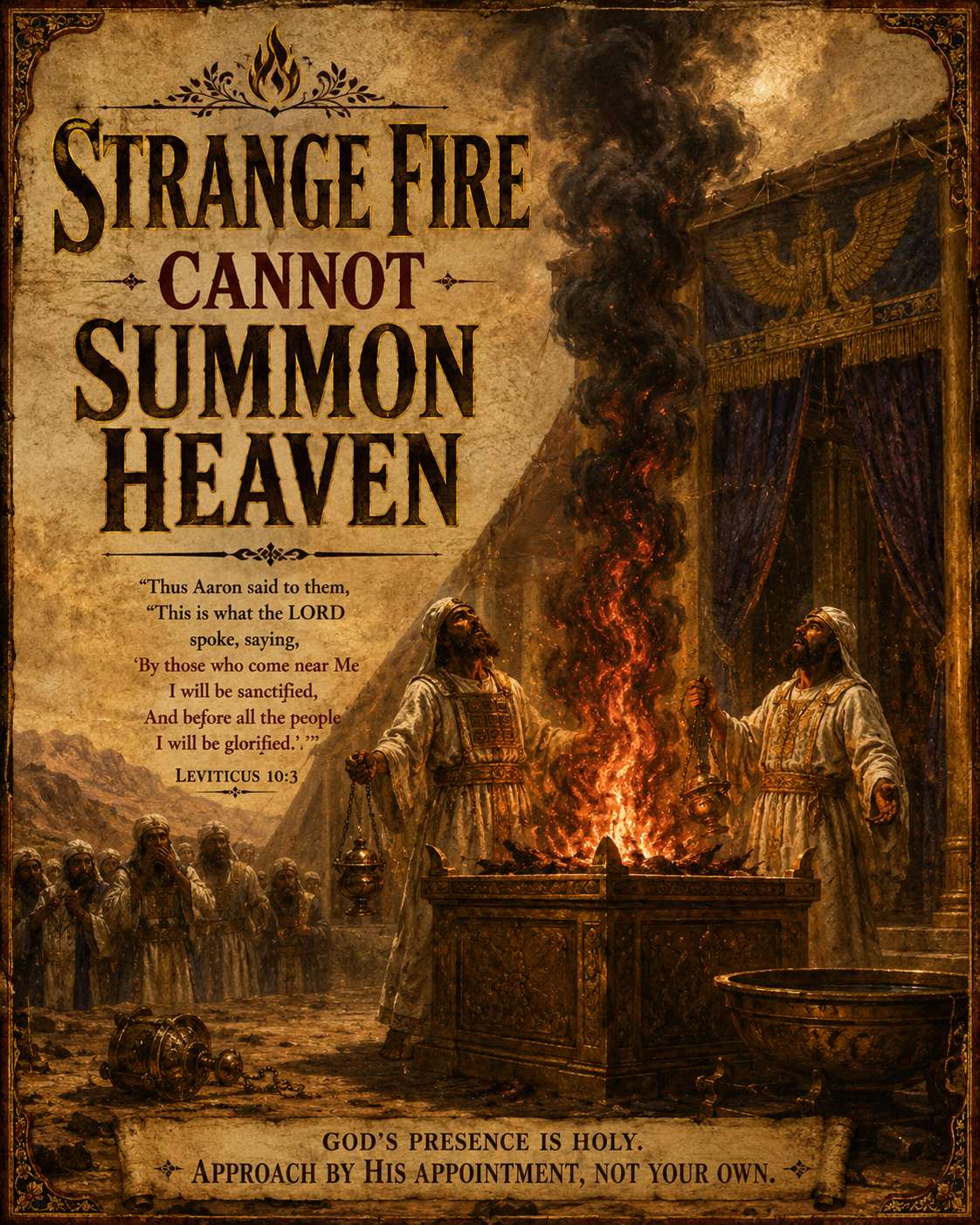
“Man can build the altar, schedule the event, and stir the crowd — but only Heaven can send the fire.”

Heaven does not respond to hype. Heaven does not bend because men built a stage, printed a flyer, gathered a crowd, named a movement, or declared a date God never spoke. The modern-day Church must learn again that fire from Heaven is not manufactured by human ambition. It is not produced by noise, branding, emotional pressure, or religious performance. Heaven responds to obedience, surrender, repentance, holiness, and broken hearts before the altar of the Lord.

One of the most sobering lessons in Scripture is found in Leviticus 10, when Nadab and Abihu, the sons of Aaron, offered “strange fire” before the Lord. They were not outsiders mocking the altar; they were priests standing near holy things. Yet nearness to sacred activity did not excuse unauthorized fire. They attempted to offer something God had not commanded, and the judgment of the Lord exposed the danger of imitation worship. This is a fearful warning to every generation that tries to substitute human flame for holy fire.

The Lord is not obligated to bless what He did not birth. Man may create an event, but only God can appoint a visitation. Man may schedule a gathering, but only Heaven can breathe upon it with glory. Man may stir emotion, but only Holy Spirit can pierce the heart with conviction. The difference between hype and holy fire is that hype moves the flesh for a moment, but holy fire produces repentance, transformation, and reverence before God.

Throughout history, the witness remains the same: Heaven responds to broken and repentant hearts. Psalm 51:17 declares, “The sacrifices of God are a broken spirit; a broken and a contrite heart, O God, You will not despise.” God does not despise the crushed heart that returns to Him in truth. He does not ignore the people who tremble at His Word. He does not turn away from the altar wet with repentance.

The problem with much of the modern Church is not that we lack activity. We have activity everywhere. We have conferences, campaigns, platforms, livestreams, strategies, and religious machinery moving at full speed. But the question is not whether we can gather people. The question is whether God has found a people low enough, clean enough, surrendered enough, and obedient enough to carry His fire.

Isaiah 66:2 gives us Heaven’s pattern: “But on this one will I look: on him who is poor and of a contrite spirit, and who trembles at My word.” The Lord tells us plainly where His eyes rest. Not first on the loudest room, the largest crowd, or the most polished production. His eyes rest on the one who trembles before Him. The Remnant must recover the holy tremble.

The early Church understood that repentance was not a side issue; it was part of the way of life. The Didache instructed believers to confess their sins and not come to prayer with an evil conscience. That is a far cry from a generation that often wants the blessing of God without the searching of God. The early believers knew that worship could not be pure while the heart remained unexamined. They understood that the altar of fellowship required clean hands and a surrendered conscience.

Tertullian wrote that repentance is “life,” because it is preferred to death. That is not religious gloom; that is Kingdom mercy. Repentance is not God trying to shame His people. Repentance is God throwing a rescue plank to the drowning soul. It is the doorway back into divine clemency, restored fellowship, and holy alignment with the King.

Ignatius of Antioch warned that where division and wrath are present, God does not dwell. That should make the modern Church tremble. We cannot produce Heaven’s fire while nurturing pride, bitterness, competition, jealousy, rebellion, and self-exaltation behind the scenes. Strange fire is not only false doctrine; it is also a wrong spirit trying to handle holy things. God will not endorse the flame of man’s ego and call it revival.

Revival is not proven by how many people attended. Revival is proven by how deeply hearts bowed. Revival is not proven by how loudly people shouted. Revival is proven by whether sin was confessed, idols were abandoned, forgiveness was released, holiness was restored, and Jesus was enthroned again. The true fire of God does not entertain the flesh. It consumes the sacrifice.

This is the hour for the Remnant to discern the difference between manufactured momentum and divine visitation. Not every flame is from the altar. Not every movement is birthed by Holy Spirit. Not every gathering carrying spiritual language has Heaven’s endorsement. The sons of Aaron teach us that holy things cannot be handled casually, and the altar must never be approached with imitation fire.

The Lord sets the dates. The Lord appoints the moments. The Lord decides when Heaven invades earth with glory, conviction, mercy, and awakening. Our assignment is not to hype the people into a moment, but to prepare the altar, humble our hearts, repent of our sins, tremble at His Word, and obey His voice. When the fire is truly from God, no man has to manufacture it, because Heaven itself will answer.

Stay tuned, the journey continues…..

— Dr. Russell Welch

Dr. Russell Welch is a published author, prophetic teacher, apostolic builder, author, and founder of faith-driven publishing and media initiatives. He is known for crafting bold, Kingdom-centered messages that call the Ecclesia into maturity, doctrinal clarity, and governmental authority. With a passion for equipping the Remnant and honoring generational legacy, Dr. Welch writes and teaches at the intersection of Scripture, history, and spiritual governance, challenging believers to live as sons and daughters who legislate Heaven on earth through truth, holiness, and unwavering fidelity to Christ.

Be sure to check out his book: The Consecrated Firebrand: A Warrior’s Guide to Holy Living, available exclusively on Amazon … here

Amazon Author Page


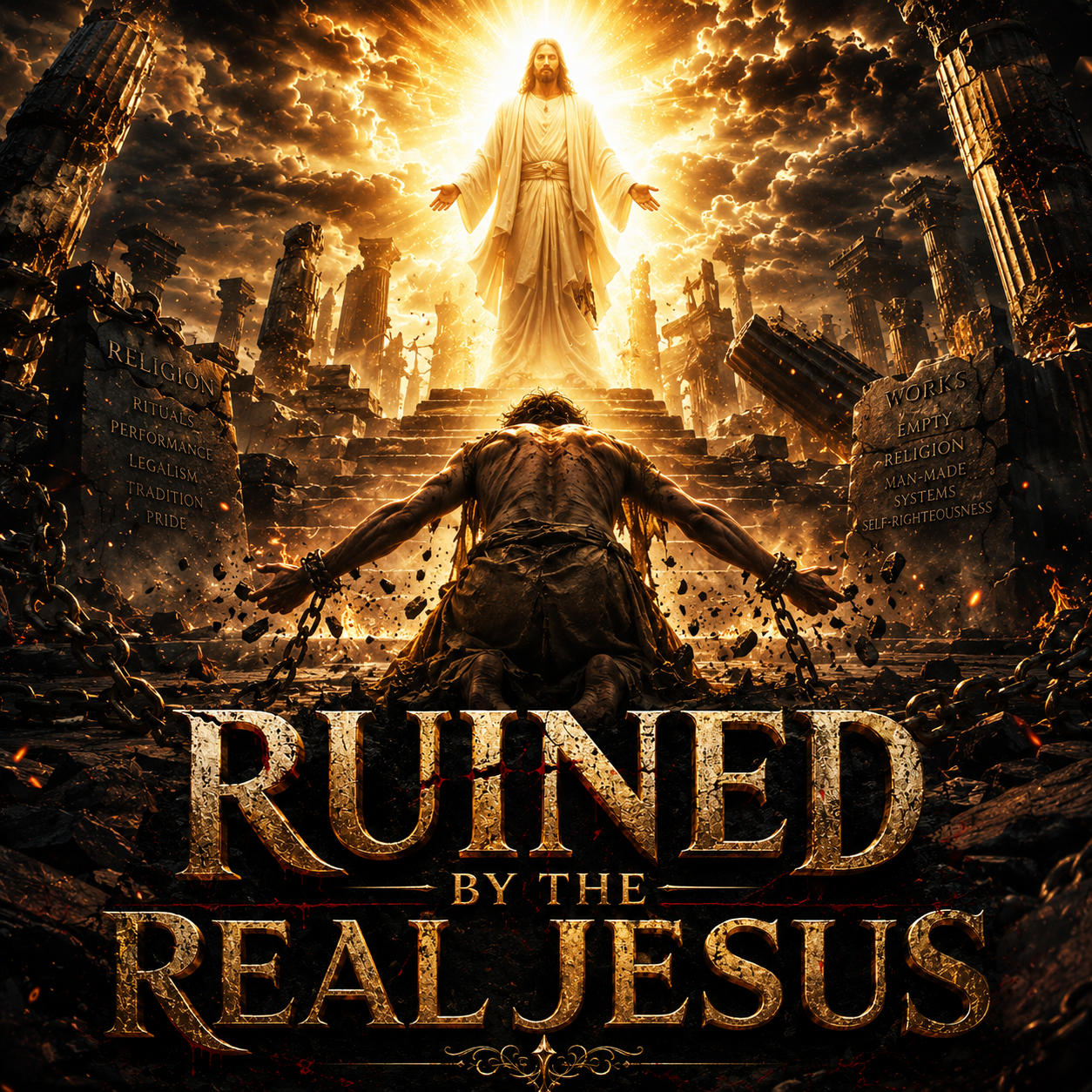
When the Real Jesus Ruins You for Religion

“If we do not have the Spirit of God, it were better to shut the churches, to nail up the doors, to put a black cross on them, and say, ‘God have mercy on us!” ~Charles Spurgeon

If Jesus Isn’t In It, I’m Not Interested

I have reached a place in my walk where I can say this without apology: if Jesus is not in it, I am not interested.

If He is not the center, I do not need the platform.
If He is not being exalted, I do not need the invitation.
If He is not being honored, I do not need the applause.
If His presence is not welcomed, I do not need the room.

Christ must be center stage.

Not the preacher.
Not the personality.
Not the movement.
Not the brand.
Not the building.
Not the denomination.
Not the religious machine.

Jesus.

The One crucified.
The One risen.
The One seated at the right hand of the Father.
The One whose eyes are like flames of fire.
The One whose voice still calls men out of darkness and into the Kingdom of His glorious light.

“The Church right now has more fashion than passion, is more pathetic than prophetic, is more superficial than supernatural.” ~Leonard Ravenhill

I spent too many years inside the religious system to be impressed by religious performance. I have seen enough church activity without Kingdom authority. I have heard enough sermons that mention Jesus but never surrender the room to Him. I have watched enough religious machinery keep moving while the presence of the Lord was standing outside the door knocking.

Then in 2016, my life was turned upside down.

I did not simply have a better church experience.
I did not simply learn a new theological concept.
I did not simply get excited about ministry again.

I encountered Jesus.

Not the polished American version.
Not the convenient version.
Not the marketable version.
Not the manageable version.
Not the version shaped by culture, politics, religion, or seeker-sensitive comfort.

I encountered the real Jesus.

The Jesus the Bible reveals.
The Jesus the prophets pointed toward.
The Jesus the apostles preached.
The Jesus demons trembled before.
The Jesus who rebuked religious hypocrisy, healed the broken, delivered the bound, cleansed the leper, overturned tables, called disciples, confronted systems, and announced the arrival of the Kingdom of God.

That encounter ruined me for anything less.

It ruined me for dead religion.
It ruined me for powerless Christianity.
It ruined me for celebrity ministry.
It ruined me for performance without presence.
It ruined me for platforms that celebrate man while treating Jesus like a sermon accessory.

“So many people get happy and blessed when they’re in an association or fellowship… [but] they’ve ‘lived on meetings’ instead of ‘living on Christ.’ ~Leonard Ravenhill

Beloved, Jesus is not a topic.

He is Lord.

He is not an add-on to our ministry plans.
He is not a brand enhancer.
He is not a religious slogan.
He is not a Sunday morning decoration.
He is not the mascot of American Christianity.

He is King.

And if the Church is going to be restored to Kingdom power, Jesus must be brought back to the center. Not verbally. Not symbolically. Not as a theological statement buried on a website.

Center stage.

Celebrated.
Exalted.
Obeyed.
Feared.
Loved.
Followed.
Preached.
Honored.
Enthroned.

The Remnant is not rising to build another religious empire. The Remnant is rising because the real Jesus is calling His people back to Himself. He is calling us out of mixture, out of compromise, out of man-centered ministry, out of religious ambition, and back into the fire of first love.

So let me say it again:

If Jesus is not in it, I am not interested.

Because once you encounter the real Jesus, nothing else can satisfy.

Stay tuned, the journey continues…..

— Dr. Russell Welch

Dr. Russell Welch is a published author, prophetic teacher, apostolic builder, author, and founder of faith-driven publishing and media initiatives. He is known for crafting bold, Kingdom-centered messages that call the Ecclesia into maturity, doctrinal clarity, and governmental authority. With a passion for equipping the Remnant and honoring generational legacy, Dr. Welch writes and teaches at the intersection of Scripture, history, and spiritual governance, challenging believers to live as sons and daughters who legislate Heaven on earth through truth, holiness, and unwavering fidelity to Christ.

Be sure to check out his book: Restoring God’s Watchmen: Modern-day Jeremiah’s walking in the authority & power of His Glory, available exclusively on Amazon … here

Amazon Author Page


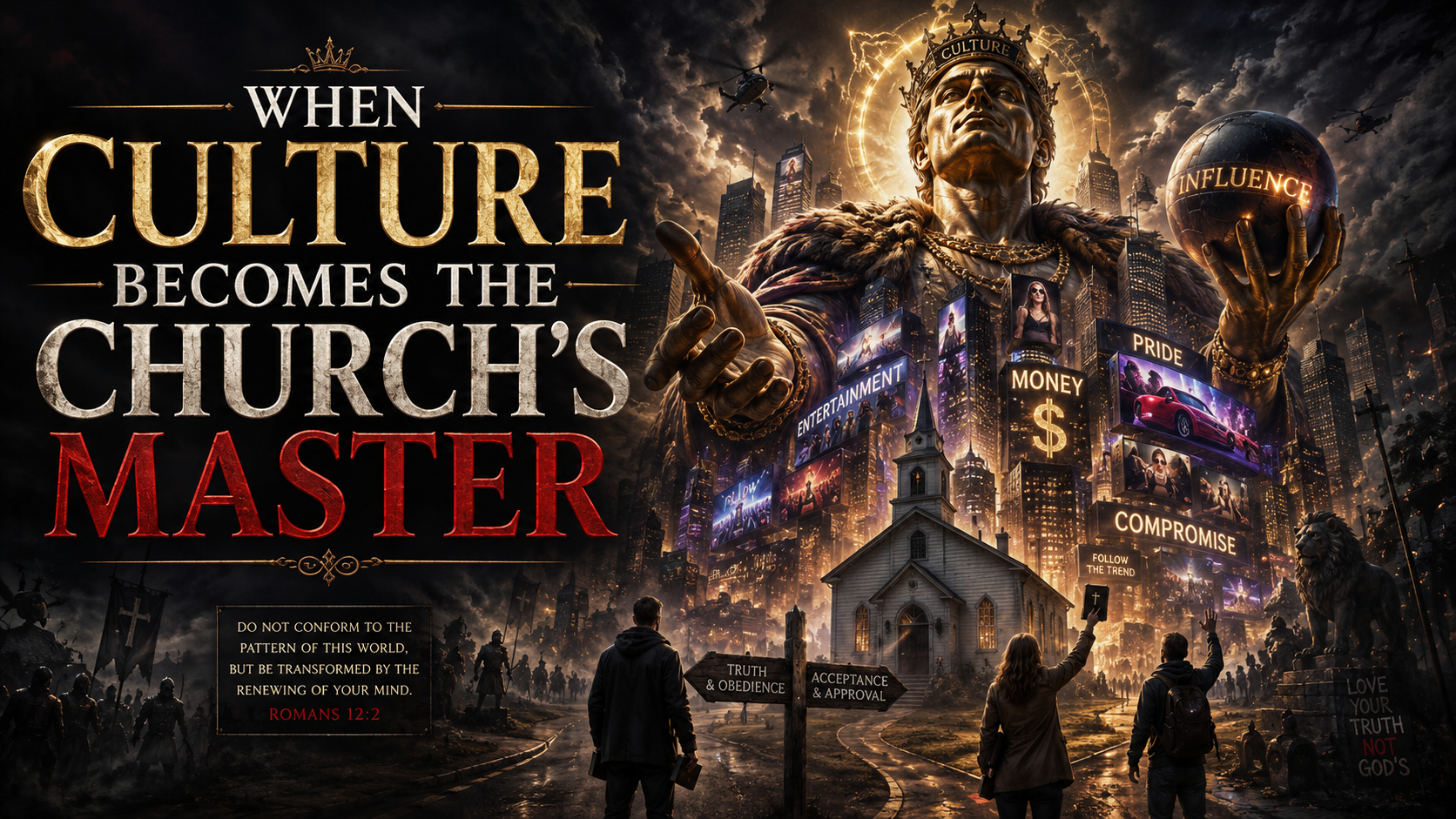
When the Church trades truth for approval, culture becomes the pulpit

We are living in a day when much of the Church has grown silent on issues that openly oppose the Word of God. In large part, this silence has been fueled by the fear of man, the desire to be accepted by mainstream culture, and the pressure to appear tolerant in a generation that has redefined compassion apart from truth. Yet Scripture never calls the people of God to be cruel, hateful, or arrogant — but neither does it call us to be silent, cowardly, or compromised.

Paul warned the Church, “Do not be conformed to this world, but be transformed by the renewing of your mind” (Romans 12:2). That word is not a suggestion for private spirituality only; it is a command to the Ecclesia not to take on the mold, values, language, approval systems, and moral confusion of the age. When the Church begins to measure truth by what culture permits, applauds, or celebrates, culture has become her master.

Because of this silence, many pulpits have unintentionally given permission to lifestyles, ideologies, and spiritual compromises that Scripture clearly confronts. What previous generations would have discerned as rebellion against God is now often celebrated under the banner of love, inclusion, and cultural progress. But biblical love does not rejoice in iniquity; it rejoices in the truth (1 Corinthians 13:6). Love without truth becomes sentiment. Truth without love becomes harshness. But the Kingdom carries both — mercy that reaches and holiness that transforms.

Jesus never taught His Church to seek acceptance from the world. He said, “If the world hates you, know that it has hated Me before it hated you” (John 15:18). He also warned, “Woe to you, when all people speak well of you, for so their fathers did to the false prophets” (Luke 6:26). The approval of culture has never been the evidence of faithfulness. Often, it is the first warning sign that the Church has softened the message until offense has been removed from the cross.

This is why the letters to the seven churches in Revelation are so urgent for our hour. Jesus did not only rebuke the lost world; He rebuked His own churches when they drifted from faithfulness. To Ephesus, He said they had abandoned their first love, even though they still had works, labor, and doctrine (Revelation 2:2–5). That means a church can be busy, active, structured, and even doctrinally aware, yet still lose the burning love that keeps obedience alive.

To Pergamum, the Lord rebuked the toleration of corrupt teaching and mixture, saying there were those among them who held to the teaching of Balaam, leading God’s people into compromise (Revelation 2:14–16). Pergamum reveals a terrifying truth: a church can dwell in a hostile culture and still survive persecution, yet begin tolerating mixture from within. External pressure is dangerous, but internal compromise is often deadlier.

To Thyatira, Jesus confronted the toleration of Jezebel, a spirit of seduction, false prophecy, and moral compromise that led His servants into defilement (Revelation 2:20–23). The issue was not merely that wickedness existed in the culture around them. The issue was that the church tolerated what the Lord commanded them to confront. Tolerance becomes treason when it protects what Jesus died to deliver people from.

To Sardis, the Lord said, “You have the reputation of being alive, but you are dead” (Revelation 3:1). That word should shake the modern Church. Reputation is not resurrection. Crowds are not necessarily life. Platforms are not necessarily presence. A church can have activity, branding, influence, buildings, music, and motion, yet be spiritually dead because it has lost the voice, fire, holiness, and government of Holy Spirit.

To Laodicea, Jesus rebuked lukewarmness, self-sufficiency, and spiritual blindness. They said, “I am rich, I have prospered, and I need nothing,” but the Lord said they were “wretched, pitiable, poor, blind, and naked” (Revelation 3:17). This is the danger of a Church that has become comfortable with cultural success. It can mistake wealth for favor, influence for authority, and self-confidence for spiritual maturity.

Yet the mercy of Jesus is seen in the fact that He rebukes because He loves. He said, “Those whom I love, I reprove and discipline, so be zealous and repent” (Revelation 3:19). The rebuke of the Lord is not the rejection of the Church; it is His call to awaken her before judgment hardens what mercy was sent to correct. The Lord does not expose compromise to destroy His people, but to purify them.

The tragedy of our hour is that while many in the Church are shaking hands with the very systems that oppose the Lord’s authority, the doors of persecution continue to open against those who still refuse to bow. The same culture that demands the Church’s silence will not be satisfied until the Church also gives its agreement. First it asks for tolerance. Then it demands celebration. Then it punishes refusal.

But the apostles already told us this day would come. Paul wrote that in the last days people would be “lovers of self, lovers of money, proud, arrogant,” and “lovers of pleasure rather than lovers of God,” while still having “the appearance of godliness” but denying its power (2 Timothy 3:1–5). That is not merely a description of the world; it is a warning about religious forms that remain visible after holiness has departed.

The Church must recover the courage to say what God has said. Not with hatred. Not with cruelty. Not with religious arrogance. But with tears, conviction, authority, and holy fear. “We must obey God rather than men” (Acts 5:29). When the fear of man governs the pulpit, the fear of the Lord departs from the house.

The Remnant must understand this clearly: silence in the face of deception is not wisdom. Compromise in the name of acceptance is not love. Agreement with culture at the expense of obedience to Christ is not ministry — it is surrender. The Church was never called to be mastered by Babylon, trained by Jezebel, celebrated by Rome, or shaped by the spirit of the age. She was called to be the Bride of Christ, washed by the Word, clothed in righteousness, and governed by Holy Spirit.

Now is the time for the Ecclesia to recover her voice, cleanse her garments, and stand once again as a witness to the truth, the holiness, and the government of the Kingdom of God. The Lord is still saying, “He who has an ear, let him hear what the Spirit says to the churches” (Revelation 2:7).

The question before us is not whether culture will approve of the Church. The question is whether Jesus will.

Stay tuned, the journey continues…..

— Dr. Russell Welch

Dr. Russell Welch is a published author, prophetic teacher, apostolic builder, author, and founder of faith-driven publishing and media initiatives. He is known for crafting bold, Kingdom-centered messages that call the Ecclesia into maturity, doctrinal clarity, and governmental authority. With a passion for equipping the Remnant and honoring generational legacy, Dr. Welch writes and teaches at the intersection of Scripture, history, and spiritual governance, challenging believers to live as sons and daughters who legislate Heaven on earth through truth, holiness, and unwavering fidelity to Christ.

Be sure to check out his book: Restoring God’s Watchmen: Modern-day Jeremiah’s walking in the authority & power of His Glory, available exclusively on Amazon … here

Amazon Author Page


The systems of men may tremble, but the Word of the Lord stands forever — and the Remnant is rising in the authority of Heaven

We are beginning to see the Remnant recognized, not first by applause, but by resistance. The religious spirit has started to discern what Heaven has been forming in hidden places, and now the institutional system is attempting to diminish their authenticity by calling them “out of order.” Yet the Lord has often raised His vessels outside the comfort of controlled religious environments, for John the Baptist did not emerge from polished platforms but from the wilderness, crying, “Prepare the way of the Lord” (Matthew 3:3). What men call disorder may, in fact, be Heaven disrupting what has long been out of alignment.

The sons and daughters of God are being summoned out of spiritual captivity, yet many systems continue to capture hearts through performance-driven programs that resemble entertainment more than encounter. There is a mystifying presentation in much of modern religion, polished with lights, sound, branding, charisma, and emotional momentum, but often lacking the weight of holy conviction. Paul warned that in the last days men would have “a form of godliness, but denying the power thereof” (2 Timothy 3:5). The danger is not excellence itself, but excellence without consecration, performance without Presence, and gatherings that impress the flesh while leaving the spirit asleep.

The Gospel of the Kingdom was never meant to be watered down into a soothing message that lulls hearers into compromised complacency. Jesus did not preach a gospel of comfort detached from repentance; He came saying, “Repent: for the kingdom of heaven is at hand” (Matthew 4:17). The Kingdom message confronts darkness, exposes mixture, heals the broken, delivers the captive, and brings the whole life under the government of God. Any message that removes the cross, silences holiness, avoids repentance, and entertains people into spiritual sleep is not the Gospel Jesus preached.

The early Church understood this with trembling clarity. Ignatius of Antioch warned believers to avoid strange doctrines and remain rooted in Jesus Christ, because the Church was always under threat from teaching that sounded spiritual but led hearts away from truth. Irenaeus contended against deception by calling the people of God back to the apostolic faith once delivered. The fathers did not guard doctrine because they loved argument; they guarded doctrine because they understood that corrupted truth produces corrupted disciples.

Now this religious machine has become a multi-billion-dollar enterprise, and systems built on influence, image, and institutional control will guard their territory fiercely. Jesus overturned tables in the temple because worship had been turned into merchandise, and what was meant to be a house of prayer had become a den of thieves (Matthew 21:13). When ministry becomes an industry, the prophetic voice becomes a threat because it interrupts the economy of compromise. The Remnant does not threaten true shepherds, but it does expose hirelings who have learned how to profit from the sheep.

Yet none of this is new under the sun. The spirit of religion has always sought to hijack the destinies of sons and daughters by replacing intimacy with control, obedience with ritual, and sonship with institutional dependency. Jesus said to the Pharisees, “Ye shut up the kingdom of heaven against men” (Matthew 23:13), revealing that religion can stand at the door of inheritance and block the very people God is calling in. This is why the Remnant must not only be bold, but discerning, because not every structure bearing the name of God is submitted to the heart of God.

Heaven is not surprised by this moment. The Lord Himself revealed to John on the island of Patmos that there would be systems, powers, beasts, false prophets, harlot structures, and counterfeit authorities that would attempt to seduce, intimidate, and govern the earth apart from God (Revelation 13; Revelation 17). Revelation is not merely a book about future crisis; it is an unveiling of spiritual realities that have always warred against the testimony of Jesus. The Lamb is not reacting to history; He is reigning over it.

There is something unique about the Remnant in this generation. The anointing they are walking in carries a familiar sound, almost as if the spirit of Elijah has touched the altar again and the testimony of the two witnesses has begun to echo through the earth. Malachi prophesied that Elijah would come before the great and dreadful day of the Lord, turning hearts back into alignment (Malachi 4:5–6). Revelation speaks of witnesses clothed in authority, standing before the Lord of the earth with power that cannot be explained by religious credentials (Revelation 11:3–6).

This is why the cosmos itself seems to recognize the weight of what is being released. Paul wrote that creation groans, waiting for the manifestation of the sons of God (Romans 8:19–22). The Remnant is not rising to become religious celebrities; they are rising as sons and daughters who carry the authority of surrender. Their emergence is not about platform, personality, or applause, but about Heaven’s government being demonstrated through yielded vessels.

The early fathers understood that the Church was never meant to live as a powerless institution. Athanasius contended that Christ came not merely to inspire men, but to restore humanity through union with Himself. Tertullian spoke of the Church as a people whose witness carried power even under persecution. The true Ecclesia has always been most dangerous to darkness when she is least dependent upon worldly validation.

Religion does not write the last chapter. The Father has already written it, and the Lamb has already secured it by His blood. Revelation does not end with Babylon seated in power; it ends with Babylon fallen, the Bride prepared, the King reigning, and the kingdoms of this world becoming the kingdoms of our Lord and of His Christ (Revelation 11:15; Revelation 19:7). The systems of man may rage, resist, mock, and accuse, but they cannot overturn what Heaven has decreed.

We are watching this unfold in real time before our eyes. The Remnant is being awakened, the Ecclesia is being summoned back to her governmental assignment, and the voice of the Father is calling His sons and daughters out of spiritual sleep. What religion tried to bury, Heaven is breathing upon again, and what systems tried to silence, Holy Spirit is setting on fire. The hour belongs not to the machine, not to the performer, not to the hireling, but to the Lamb and to the people who follow Him wherever He goes.

Stay tuned, the journey continues…..

— Dr. Russell Welch

Dr. Russell Welch is a published author, prophetic teacher, apostolic builder, author, and founder of faith-driven publishing and media initiatives. He is known for crafting bold, Kingdom-centered messages that call the Ecclesia into maturity, doctrinal clarity, and governmental authority. With a passion for equipping the Remnant and honoring generational legacy, Dr. Welch writes and teaches at the intersection of Scripture, history, and spiritual governance, challenging believers to live as sons and daughters who legislate Heaven on earth through truth, holiness, and unwavering fidelity to Christ.

Be sure to check out his book: Restoring God’s Watchmen: Modern-day Jeremiah’s walking in the authority & power of His Glory, available exclusively on Amazon … here

Amazon Author Page


A move of God often begins long before anyone realizes it. For me, it began with a holy disruption—a stirring in my spirit that refused to be quieted, a longing that no sermon outline, ministry routine, or theological framework could satisfy. I knew the Holy Spirit was calling me deeper, but I didn’t yet understand that He was also calling me to write. What I didn’t know then was that this stirring would become the book that launched my journey as a Christian author: God’s Wind Walkers: A Life Governed by the Wind of Holy Spirit.

The Moment Eveything Shifted

There comes a point in every believer’s life when the familiar rhythms of Christianity no longer carry the weight they once did. You can love God, serve faithfully, and still feel the ache of something missing—something Jesus promised but many never fully experience.

For me, that ache became a divine invitation.

I began to see that the Spirit‑filled life Jesus described in John 3:8 wasn’t poetic language. It was a blueprint. A calling. A way of life. A life where the wind of the Spirit becomes the governing force—unpredictable, undeniable, and beautifully disruptive.

As I surrendered to that call, the Holy Spirit began to teach, correct, awaken, and lead me in ways I had never known. And in the middle of that journey, He whispered something that changed everything:

“Write what I’m teaching you.”

When Obedience Turns Into Assignment

I didn’t set out to become an author. I set out to obey.

But obedience has a way of unlocking assignments you never imagined.

As I wrote, I realized the message wasn’t just for me. It was for every believer who longed for more than predictable Christianity. It was for those who felt stuck, stagnant, or spiritually numb. It was for those who sensed the Holy Spirit calling them into a life marked by clarity, intimacy, and supernatural leading.

That message became God’s Wind Walkers: A Life Governed by the Wind of Holy Spirit — a book rooted in Scripture, shaped by encounter, and forged in surrender.

Why Wind Walkers Resonated So Deeply

From the moment it released, something unusual happened. Messages began pouring in from Bible study groups, classrooms, pastors, and everyday believers who said the same thing in different words:

“This book brought me closer to the Lord.” “I’m hearing the Holy Spirit again.” “My walk with God feels alive.” “This unlocked something in me.”

People weren’t just reading it—they were encountering God through it.

And that’s when I realized: this wasn’t just a book. It was a doorway. A catalyst. A wind that carried people into the life Jesus always intended for them.

The Heart Behind the Message

Wind Walkers is built on three unshakable truths:

  • The Holy Spirit still leads His people with clarity.
  • Identity is discovered through surrender, not striving.
  • The supernatural life is not for the few—it’s the birthright of every believer.

Through Scripture-rich teaching and practical guidance, the book helps believers:

  • Recognize the voice of the Spirit
  • Break free from spiritual stagnation
  • Walk confidently as sons and daughters
  • Live in daily sensitivity to God’s movements
  • Experience the supernatural life Jesus promised

It’s not theory. It’s not hype. It’s the life Jesus modeled and the early Church lived.

A Book That Became a Beginning

Looking back, I see now that Wind Walkers didn’t just launch my writing career—it launched a movement in my own heart. It set the foundation for every book that followed, every message I’ve preached, and every assignment God has entrusted to me.

It taught me that when you yield to the Wind of the Spirit, He will take you places you never planned to go—yet always where you were created to be.

And for countless readers, it has become the beginning of their own Spirit‑governed journey.

If you’re longing for a deeper walk with the Holy Spirit… if you’re hungry for clarity, intimacy, and supernatural leading… if you know there is more to your faith than what you’ve experienced so far…

Your journey can begin today.

👉 Start your Wind Walker journey: https://www.amazon.com/dp/B0CR1WTJZN

— Dr. Russell Welch

Dr. Russell Welch is a published author, prophetic teacher, apostolic builder, author, and founder of faith-driven publishing and media initiatives. He is known for crafting bold, Kingdom-centered messages that call the Ecclesia into maturity, doctrinal clarity, and governmental authority. With a passion for equipping the Remnant and honoring generational legacy, Dr. Welch writes and teaches at the intersection of Scripture, history, and spiritual governance, challenging believers to live as sons and daughters who legislate Heaven on earth through truth, holiness, and unwavering fidelity to Christ.

Be sure to check out his book: The Consecrated Firebrand: A Warrior’s Guide to Holy Living, available exclusively on Amazon … here

Amazon Author Page