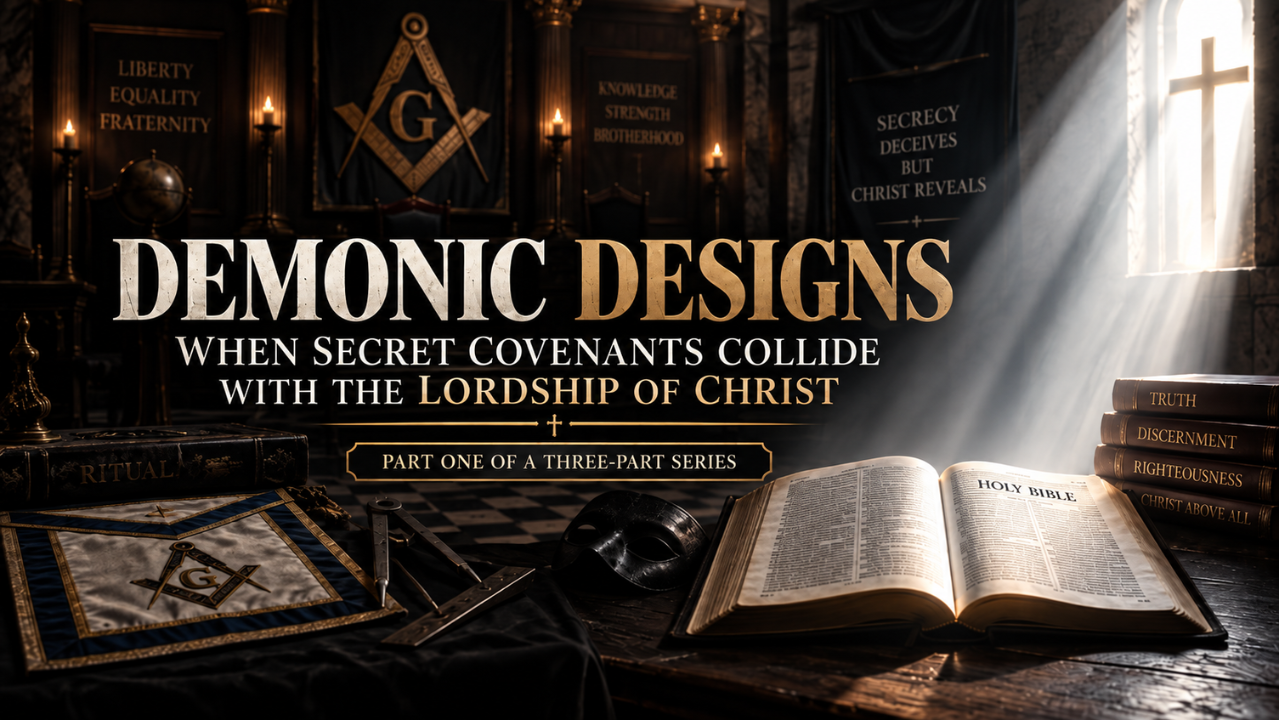
DEMONIC DESIGNS: THE CHRISTIAN’S GUIDE TO UNMASKING FREEMASONRY
There are subjects the modern Church often avoids because they are uncomfortable, controversial, or deeply rooted in family and community traditions. Freemasonry is one of those subjects. For generations it has presented itself as a respectable brotherhood built around morality, charity, self-improvement, civic responsibility, and mutual support. Many of its members are sincere men who love their families, serve their communities, support charitable causes, and may even identify strongly with the Christian faith. Yet the biblical question is not whether individual members can be good men. The deeper question is whether the spiritual structure, language, vows, symbols, rituals, and worldview of Freemasonry can stand in harmony with the exclusive Lordship of Jesus Christ.
That question deserves more than rumors, emotional accusations, or internet conspiracy theories. It deserves Scripture. It deserves careful examination. It deserves the kind of spiritual discernment that is willing to look beneath outward respectability and ask whether what is being presented as light actually agrees with the Light of Christ.
The Apostle John warned believers, “Beloved, believe not every spirit, but try the spirits whether they are of God” (1 John 4:1). That command has not expired. Christians are not called to accept every spiritual claim because it sounds moral, ancient, charitable, or religious. We are commanded to test what we encounter against the revealed truth of God’s Word and the person of Jesus Christ.
That is the purpose behind Demonic Designs: The Christian’s Guide to Unmasking Freemasonry. The book was written to help believers examine Freemasonry through a biblical lens without falling into either extreme. We do not need careless condemnation, but neither can we afford spiritual naivety. The Church must recover the ability to distinguish between biblical truth and religious mixture, because not everything that speaks about God is necessarily submitted to God.
THE QUESTION OF LORDSHIP
Christianity is not built around a vague belief in a Supreme Being. The Christian faith rests upon the revelation of the Father through His Son, Jesus Christ. Jesus did not present Himself as one spiritual path among many legitimate alternatives. He declared, “I am the way, the truth, and the life: no man cometh unto the Father, but by me” (John 14:6).
Peter carried that same message into the apostolic preaching of the early Church when he declared, “Neither is there salvation in any other: for there is none other name under heaven given among men, whereby we must be saved” (Acts 4:12). Those words leave very little room for religious ambiguity. Jesus is not simply important to the Christian. He is Lord.
This is where believers must begin when examining Freemasonry. The issue is not whether the Lodge allows a Christian to privately believe in Jesus. The issue is whether the spiritual framework itself confesses Jesus Christ as Lord. There is an enormous difference between allowing Jesus into the room and bowing the entire room before Him.
A system can acknowledge religion while refusing the exclusive claims of Christ. It can use sacred language while remaining intentionally broad concerning the identity of God. It can encourage morality while leaving the central question of salvation unresolved. From a biblical perspective, that should immediately cause believers to examine the foundation rather than merely admire the structure.
THE DANGER OF RELIGIOUS MIXTURE
One of the recurring battles throughout Scripture is the battle against mixture. Israel repeatedly fell into trouble when the people attempted to worship Yahweh while incorporating the practices, gods, and spiritual customs of surrounding nations. The problem was not that they completely abandoned all belief in God. The problem was that they attempted to combine devotion to Yahweh with other spiritual influences.
That temptation has never disappeared.
Modern culture often teaches that religious unity requires us to downplay the differences between competing claims about God. Scripture moves in the opposite direction. God continually calls His people into covenant faithfulness, purity, and undivided allegiance.
Paul asked the Corinthian believers, “What fellowship hath righteousness with unrighteousness? and what communion hath light with darkness?” He continued by asking, “And what concord hath Christ with Belial?” and “what agreement hath the temple of God with idols?” (2 Corinthians 6:14–16). These are not the words of a Church trying to blend every spiritual system together. They are the words of an apostle calling believers to understand that some spiritual foundations simply cannot be reconciled.
The problem with religious mixture is that it often does not look dangerous. It can sound enlightened, tolerant, charitable, and sophisticated. Paul warned that even Satan can transform himself into “an angel of light” (2 Corinthians 11:14). That means deception does not always arrive wearing darkness. Sometimes it arrives speaking about light.
Believers must therefore learn to discern the difference between true light and counterfeit illumination. Jesus Christ is not simply one expression of spiritual light. He is the Light of the world. Anything claiming enlightenment while diminishing His absolute Lordship deserves careful biblical examination.
OATHS, VOWS, AND SPIRITUAL ALLEGIANCE
Another area that Christians must examine seriously involves vows, obligations, and ceremonial commitments. Scripture treats words with far greater seriousness than modern culture often does. Jesus warned His followers against careless oath-taking and commanded them to let their yes be yes and their no be no (Matthew 5:33–37).
The issue is not that every vow automatically creates spiritual bondage. That conclusion would go beyond what Scripture teaches. The real concern is whether a believer is making promises, entering obligations, or participating in rituals that conflict with his or her already established covenant with Jesus Christ.
Paul reminded believers, “Ye are not your own. For ye are bought with a price” (1 Corinthians 6:19–20). That truth reaches far beyond personal morality. It establishes ownership. The Christian belongs to Christ.
Our worship belongs to Him. Our loyalty belongs to Him. Our identity belongs to Him. Our spiritual allegiance belongs to Him. Every commitment we make should therefore be examined in light of the covenant that has already been established through the Blood of Jesus Christ.
This is why Christians should never dismiss spiritual language, initiations, symbolic ceremonies, or solemn vows as harmless simply because they are traditional. Tradition does not remove spiritual significance. Age does not make a practice biblical. Respectability does not automatically make an organization spiritually safe.
Believers should be willing to ask difficult questions. What exactly am I promising? What authority am I recognizing? What spiritual language am I repeating? Does this ceremony align with Scripture? Does this obligation compete in any way with my allegiance to Christ?
Those questions are not rooted in fear. They are rooted in discipleship.
WHAT DOES “DEMONIC DESIGNS” MEAN?
The title Demonic Designs is intentionally strong, but it must be understood correctly. It does not mean that every Freemason is demonized, knowingly serving darkness, or participating in occult activity. Such sweeping accusations would be careless and unhelpful.
A demonic design can be understood as any spiritual structure that accomplishes purposes consistent with the enemy’s strategy revealed in Scripture. Satan has always worked through deception, mixture, divided allegiance, counterfeit revelation, pride, and the promise of knowledge separated from obedience to God.
The pattern appears as early as Genesis. The serpent did not begin by denying God’s existence. He questioned God’s Word. He then offered humanity another path to knowledge by declaring, “your eyes shall be opened” (Genesis 3:5). The temptation involved enlightenment, but it was enlightenment outside obedience to God.
That pattern continues throughout history. Whenever a spiritual system offers light while refusing the exclusive Lordship of Christ, believers should test it. Whenever a system presents progressive spiritual knowledge without making Christ supreme, believers should test it. Whenever sacred language is used in a way broad enough to accommodate contradictory understandings of God, believers should test it.
Testing is not hatred. Testing is obedience.
COMPLETE IN CHRIST
One of the most powerful answers to every form of spiritual mixture is found in Colossians 2. Paul warned the Church, “Beware lest any man spoil you through philosophy and vain deceit, after the tradition of men, after the rudiments of the world, and not after Christ.” He then declared, “For in him dwelleth all the fulness of the Godhead bodily. And ye are complete in him” (Colossians 2:8–10).
Those words should settle something in the heart of every believer. We are complete in Christ.
We do not need another source of spiritual identity. We do not need secret knowledge to become more complete. We do not need another covenant, another spiritual brotherhood, or another system of progressive illumination to supply what Christ has supposedly left unfinished.
The finished work of Jesus is exactly that. Finished.
The believer has been reconciled to the Father through Christ. The believer has been sealed by Holy Spirit. The believer has been brought into the household of God and made part of the Body of Christ. Nothing needs to be added to make the Christian spiritually acceptable before God.
This is why every system promising deeper light must ultimately be measured against Christ. Does it lead the believer into deeper submission to Jesus, or does it introduce another spiritual framework alongside Him? Does it exalt Scripture, or does it place additional traditions beside biblical authority? Does it call people to bow before Christ, or merely permit Christians to interpret the system through their own religious beliefs?
Those distinctions matter.
THE GREATER ISSUE IS ALLEGIANCE
Although this discussion focuses on Freemasonry, the principle reaches much further. The Church today desperately needs to recover the biblical doctrine of allegiance.
We live in a culture filled with overlapping identities, organizations, movements, traditions, networks, and philosophies. Believers are often connected to systems they have inherited without ever examining their spiritual implications.
Some things were passed down from parents or grandparents. Other things came through professional relationships, social organizations, denominational traditions, or community involvement. The simple fact that something has existed in our family for generations does not make it spiritually healthy.
Every believer should be willing to bring inherited traditions into the light of Scripture.
There comes a moment when every disciple must ask, “Does anything in my life compete with the Lordship of Jesus Christ?” That question can be uncomfortable, but it is necessary. Jesus does not call us to partial surrender. He calls us to follow Him.
The Remnant Church must recover this kind of spiritual courage. We cannot allow fear of offending people to prevent us from examining spiritual systems. At the same time, we cannot allow zeal to turn into reckless accusation.
Truth and grace are not enemies.
We can love people while questioning systems. We can honor individuals while examining theology. We can speak clearly without becoming cruel.
That is the maturity this hour requires.
WHAT IF FREEMASONRY IS PART OF YOUR FAMILY HISTORY?
For some readers, this subject is not theoretical. A father, grandfather, husband, brother, or another family member may have been involved in Freemasonry. Some readers may have personally participated in a Lodge.
The first response should not be fear.
The Gospel is stronger than anything in your past.
If Holy Spirit reveals that you made commitments, participated in ceremonies, or entered agreements that conflict with the Lordship of Christ, the answer is not panic. The answer is repentance, renunciation, and renewed allegiance to Jesus Christ.
Scripture does not call believers to live terrified of hidden spiritual consequences. It calls us to walk in the victory of the Cross.
Colossians 2:15 declares that Christ “spoiled principalities and powers” and made a public spectacle of them through His triumph. The authority of darkness has already been decisively defeated through the death and resurrection of Jesus Christ.
Believers should therefore respond to conviction with faith rather than fear. Confess what needs to be confessed. Renounce what needs to be renounced. Forgive where forgiveness is needed. Submit your life afresh to Jesus Christ and stand firmly upon His Word.
Freedom is not found in obsessing over darkness.
Freedom is found in Christ.
WHY THIS BOOK WAS WRITTEN
Demonic Designs: The Christian’s Guide to Unmasking Freemasonry was written for believers who want biblical clarity concerning Freemasonry and its spiritual implications. It is intended for Christians, pastors, ministry leaders, intercessors, and families who have wrestled with these questions but have often found either sensationalism on one side or complete silence on the other.
The goal is not to create fear. The goal is discernment.
The book examines areas including Masonic oaths, secrecy, symbolism, rituals, sacred language, universal brotherhood, spiritual allegiance, and the biblical call to walk in the light. It challenges believers to measure every practice against Scripture and the Lordship of Jesus Christ.
The hour we are living in requires believers who are not easily impressed by titles, ceremonies, secrecy, influence, tradition, or man-made claims of light. The Church must learn again how to test every spirit, examine every spiritual claim, and bring every hidden thing beneath the authority of Jesus Christ.
The Remnant cannot afford divided allegiance.
We are being called back to a faith where Jesus is not merely included but enthroned, where Scripture is not merely quoted but obeyed, and where spiritual discernment is not reserved for a few specialized ministries but becomes part of normal Christian discipleship.
We are not chasing shadows. We are turning on the Light. When everything is brought beneath the Light of Jesus Christ and the authority of His Word, darkness does not need to be feared. It simply needs to be exposed, rejected, and replaced with truth.
The Remnant was not refined merely to survive the changing world.
We were prepared to carry Heaven’s answer into it.
A voice of fire to the Remnant,
— Dr. Russell Welch
Dr. Russell Welch is a published author, prophetic teacher, apostolic builder, and founder of faith-driven publishing and media initiatives. He is known for crafting bold, Kingdom-centered messages that call the Ecclesia into maturity, doctrinal clarity, and governmental authority. With a passion for equipping the Remnant and honoring generational legacy, Dr. Welch writes and teaches at the intersection of Scripture, history, and spiritual governance, challenging believers to live as sons and daughters who legislate Heaven on earth through truth, holiness, and unwavering fidelity to Christ.
If you are ready to examine Freemasonry through the light of Scripture and seek greater biblical clarity concerning its spiritual implications, Demonic Designs: The Christian’s Guide to Unmasking Freemasonry is available now.
Get your copy here:
— Dr. Russell Welch
A Watchman & Voice to the Remnant