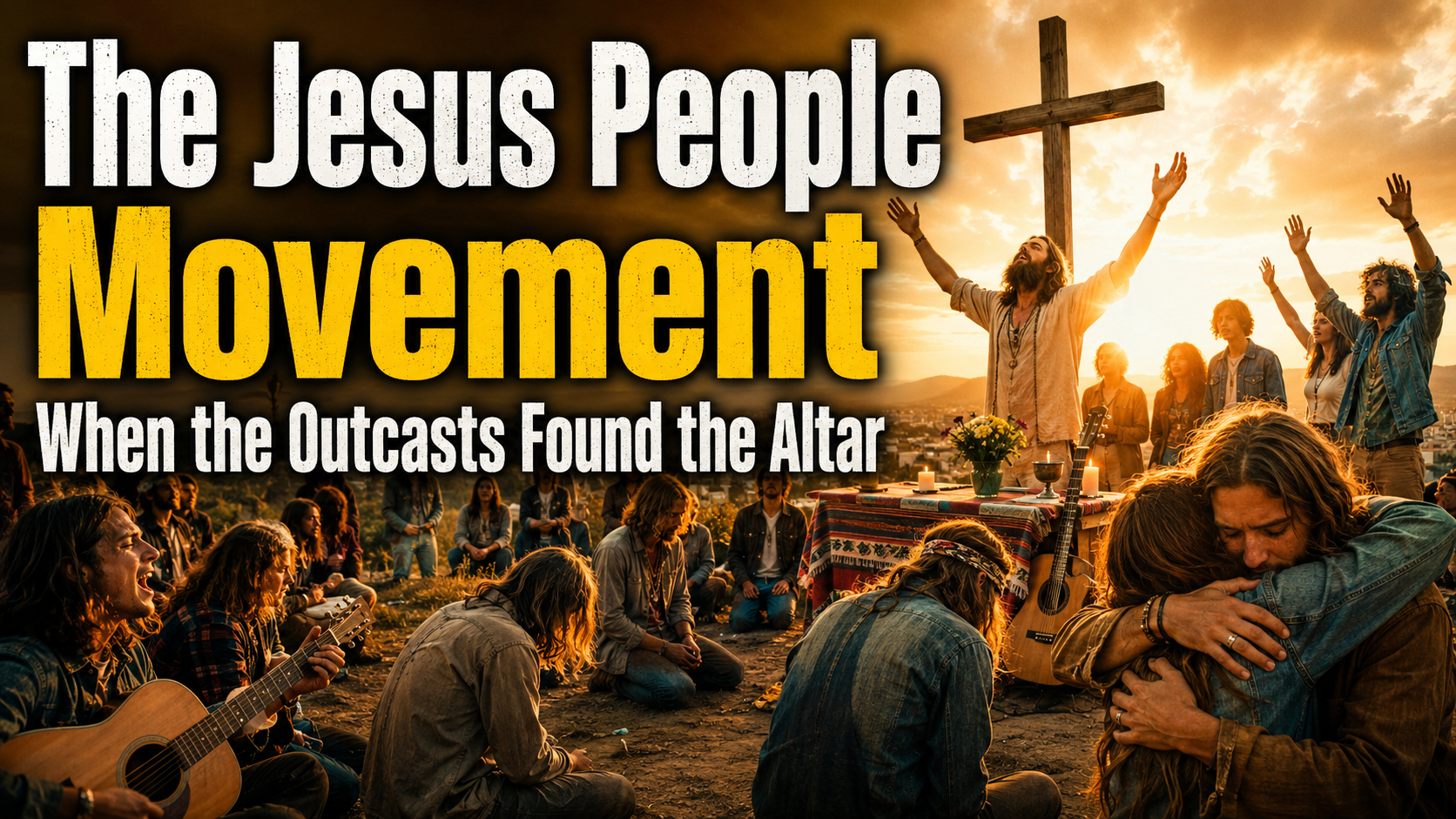
When the Outcasts Found the Altar
There are seasons in history when God refuses to move where religion expects Him to move. He steps outside the polished walls, beyond the managed platforms, past the respectable circles of religious comfort, and He begins breathing upon those the church has often misunderstood, ignored, rejected, or feared. The Jesus People Movement was one of those moments.
It did not begin in stained-glass respectability. It did not arrive dressed in the clothing of religious approval. It came in the middle of cultural shaking, generational confusion, rebellion, war protests, drug culture, broken families, spiritual hunger, and young people searching desperately for something real. America was trembling. A generation was asking questions the system could not answer. Many were running from the emptiness of materialism, the hypocrisy of dead religion, and the pain of homes that looked whole on the outside but were fractured within.
And into that chaos, Jesus stepped.
Not the religious caricature of Jesus. Not the domesticated Jesus of powerless tradition. Not the distant Jesus locked behind pulpits and programs. The living Christ walked into the highways and beaches, coffeehouses and street corners, communes and college campuses, and He began calling sons and daughters home. The outcasts found the altar, and the altar found them.
This is the scandal of revival. God often begins where the religious elite would never think to look.
The Jesus People Movement became a holy disruption. Hippies, seekers, musicians, addicts, runaways, intellectuals, broken youth, and spiritual wanderers began encountering the living Christ. Many had chased peace through drugs, freedom through rebellion, enlightenment through Eastern mysticism, and identity through counterculture. Yet when they met Jesus, they found what every false altar had failed to give them. They found forgiveness. They found deliverance. They found family. They found purpose. They found the burning reality of the Kingdom.
The world had called them lost. Religion had called them dangerous. Heaven called them beloved.
That is the heart of revival.
Jesus has always been drawn to those who know they are sick enough to need a Physician. In Matthew 9:12–13, Jesus said, “They that be whole need not a physician, but they that are sick.” Then He declared, “I will have mercy, and not sacrifice: for I am not come to call the righteous, but sinners to repentance.” That word shattered the religious arrogance of His day, and it still shatters ours.
The Jesus People Movement reminds us that revival is not born when the church becomes impressed with herself. Revival is born when the desperate cry out, the broken come near, the proud are humbled, and the altar becomes wet with repentance again. It is born when Jesus becomes more than a sermon topic. He becomes the obsession of a generation.
These young people were not looking for a better religious product. They were not asking for polished church branding, celebrity preachers, or spiritual entertainment. They were hungry for reality. They wanted the Jesus of the Gospels. They wanted the Christ who touched lepers, cast out devils, forgave prostitutes, confronted Pharisees, healed the sick, raised the dead, and announced a Kingdom that could not be shaken.
And when they found Him, they could not keep quiet.
Street evangelism became one of the sounds of the movement. Young converts took the Gospel into public spaces with boldness that embarrassed comfortable religion. They spoke of Jesus in parks, on sidewalks, on beaches, in coffeehouses, and in homes. They did not wait until they had a degree, a title, a platform, or a denominational endorsement. They had encountered Christ, and the fire of first love became their credential.
That does not mean everything was mature. It does not mean everything was balanced. It does not mean every stream that touched the movement remained pure. Every revival must be tested, shepherded, discipled, and brought under the lordship of Christ. Fire without formation can burn wildly. Zeal without truth can become unstable. Freedom without holiness can drift into deception. But we must never allow the imperfections of a move to blind us to the mercy of God within it.
The lesson is not that disorder should be celebrated. The lesson is that God is not afraid of messy beginnings.
The early church was messy. Corinth was messy. Peter was messy. The disciples were messy. The book of Acts was filled with glory, power, persecution, correction, conflict, miracles, deliverance, and apostolic order emerging in real time. God has never required polished people before He begins moving. He requires surrendered people.
The Jesus People Movement carried a sound of raw surrender. It helped renew worship in ways that still echo today. Songs became simpler, more intimate, more direct, and more accessible. Worship moved from performance into participation. Guitars, choruses, and heartfelt songs of devotion began rising from people who had once sung the anthems of rebellion but were now singing to the King.
The altar had taken their sound captive.
This is one of the great marks of true revival: the sound changes. When God moves upon a people, their language changes, their songs change, their desires change, their gatherings change, and their witness changes. What once glorified the flesh begins to glorify Christ. What once carried confusion begins to carry consecration. What once served rebellion becomes a weapon of worship.
That is redemption.
The enemy loves to convince people that their past disqualifies them. But the Gospel declares something far greater: whatever has been surrendered to Christ can become testimony. The very generation that had been labeled unreachable became a generation of witnesses. Those once enslaved by drugs began preaching freedom. Those once wandering through spiritual darkness began proclaiming the Light of the world. Those once looking for belonging in broken communities began forming households of faith.
The Father knows how to turn prodigals into preachers.
Luke 15 gives us the picture. The younger son wasted his inheritance, lost his dignity, and ended up in the pigpen. But when he came to himself and returned home, the father did not meet him with a lecture first. He met him with compassion. He ran. He embraced. He restored. The robe, the ring, the sandals, and the feast all testified that the son was not returning as a slave but as family.
That was the prophetic picture behind much of the Jesus People Movement. The Father was running toward a generation covered in the smell of the far country.
Religion often stands like the older brother, offended that mercy is being given to people who did not earn it. But revival never begins with what men think people deserve. Revival begins with the mercy of God breaking into places of despair and calling dead things back to life.
The outcasts found the altar because the Father had not forgotten their names.
This should shake the church in our hour. We are again living in a generation filled with confusion, addiction, anxiety, rebellion, spiritual hunger, identity crisis, broken homes, occult fascination, ideological deception, and deep distrust of institutions. Many young people are not rejecting the true Christ; they are rejecting the powerless version of Christianity they were shown. They are not always running from Jesus. Many are running from hypocrisy, dead religion, spiritual abuse, and a church culture that talked about power while living without presence.
The answer is not to entertain them into the Kingdom. The answer is not to dilute the Gospel until it becomes palatable to the flesh. The answer is not to replace holiness with relevance. The answer is to lift up the real Jesus again.
The Jesus People Movement reminds us that a generation can be swept into radical discipleship when Christ is preached with conviction, love, power, and authenticity. Not a Christ made in the image of culture. Not a Christ stripped of His demands. Not a Christ who saves without transforming. The real Jesus forgives sinners, but He also says, “Go, and sin no more.” He welcomes the broken, but He also calls them to take up the cross. He eats with outcasts, but He does not leave them bound.
True revival never excuses bondage. It breaks it.
This is where the church must recover both compassion and conviction. Compassion without conviction becomes sentimental weakness. Conviction without compassion becomes religious cruelty. Jesus carried both perfectly. He could weep over Jerusalem and still cleanse the temple. He could touch the leper and rebuke the Pharisee. He could forgive the woman caught in adultery and command her to leave her life of sin. He could welcome fishermen, tax collectors, zealots, and broken women into His company, then form them into witnesses of the Kingdom.
The Jesus People Movement carried this beautiful offense: Jesus was not ashamed to be found among the rejected.
That truth must burn in us again.
Some of the greatest harvest fields in our time are not sitting comfortably in pews. They are in recovery homes, college campuses, street corners, broken families, music scenes, prisons, homeless camps, online communities, and among young people who have been told by culture that they can invent themselves while their souls are collapsing under the weight of confusion. They do not need a religious system that simply condemns them from a distance. They need an Ecclesia filled with Holy Spirit, truth, mercy, deliverance, and fire.
They need fathers and mothers in the faith who will not compromise the Gospel, but also will not despise the broken when they come home smelling like the far country.
The altar must be ready.
The Jesus People Movement also confronts our obsession with appearances. Many churches of that era struggled to know what to do with long-haired, barefoot, unconventional converts. They did not look like church people. They did not speak the language of church culture. They brought questions, wounds, habits, and sounds that made religious people uncomfortable. Yet many of them were genuinely being saved, baptized, delivered, and discipled.
God was making sons and daughters out of those who did not fit the mold.
This is apostolic Christianity. The Kingdom does not advance by protecting religious comfort zones. It advances when Christ takes territory in human hearts, and then those transformed lives become living witnesses in the earth. The early church did not grow because it looked respectable to Rome. It grew because the dead were raised, demons were cast out, the poor were cared for, the Word of God spread, and believers loved not their lives unto death.
Radical discipleship is not a brand. It is the normal Christian life.
The tragedy of many revival movements is that the church celebrates the fire after history has made it safe, while resisting the same kind of fire when it appears in their own generation. We praise past revivals while rejecting the very kind of people those revivals reached. We speak fondly of transformed outcasts from decades ago while remaining suspicious of the outcasts standing in front of us today.
May God deliver us from romanticizing yesterday’s fire while refusing today’s harvest.
The Jesus People Movement should not merely make us nostalgic. It should provoke us. It should ask us hard questions. Where are the broken youth finding altars today? Where are the seekers encountering the real Jesus? Where are the saints carrying the Gospel outside the walls? Where are the worship sounds rising from redeemed lives instead of manufactured platforms? Where are the spiritual fathers and mothers willing to disciple messy converts into mature sons and daughters?
A movement becomes dangerous when converts are made but disciples are not formed. Jesus did not command us to gather crowds; He commanded us to make disciples. The fruit of revival must become formation, holiness, community, mission, and obedience. Fire must become faithfulness. Encounter must become endurance. Testimony must become transformation. Passion must become purity.
This is where the Jesus People Movement gives both inspiration and warning. It shows us what can happen when Jesus captures a generation, but it also reminds us that every move of God must be stewarded with truth, humility, accountability, and apostolic foundations. Revival is not a substitute for discipleship. Revival is the doorway into it.
The altar is not the finish line. It is the place of death and resurrection.
When the outcasts found the altar, they found more than emotional relief. They found a cross. They found a King. They found a Kingdom. They found a new life that demanded everything. The true Jesus does not simply add peace to our rebellion. He crucifies the old man and raises us into newness of life.
That is what our generation needs again.
We do not need a revival of religious excitement without repentance. We do not need gatherings that stir emotions but leave chains intact. We do not need another wave of spiritual language without holiness, deliverance, and obedience. We need a Jesus movement that is truly centered on Jesus: crucified, risen, reigning, and returning in glory.
We need the kind of move that finds the addict and makes him free. The kind that finds the runaway and brings her home. The kind that finds the seeker and fills him with truth. The kind that finds the worshiper buried beneath shame and releases a new song. The kind that finds the rebel and turns him into a witness. The kind that finds the broken youth and forms them into burning disciples.
The church must stop fearing the harvest because it does not arrive dressed for Sunday morning.
When Heaven moves, the nets often fill with fish that have not yet been cleaned. That is not a problem for the Kingdom. That is the work of discipleship. Fishermen catch the fish; the Lord cleanses, transforms, and prepares them for purpose. Too often, the church wants cleaned fish before it will cast the net. But Jesus said, “Follow me, and I will make you fishers of men.”
The Jesus People Movement was a net-casting moment.
It was a reminder that the Gospel still works in the streets. It was a reminder that worship can rise from the ashes of rebellion. It was a reminder that Christ can invade youth culture without surrendering His holiness to it. It was a reminder that the Spirit of God is not intimidated by chaos. He hovered over the waters in Genesis, and He still hovers over the deep places of human brokenness, ready to speak light into darkness.
Let there be light.
That is the cry for our hour.
Let there be light in the streets again. Let there be light in the schools again. Let there be light in the homes again. Let there be light in the churches again. Let there be light in the hearts of sons and daughters who have wandered into the far country. Let the altar be restored, not as a religious decoration, but as a place of surrender, repentance, fire, healing, and commissioning.
May the outcasts find the altar again.
May the church have enough love to receive them, enough truth to disciple them, enough holiness to confront what binds them, and enough fire to send them back into the world as witnesses of the risen King.
The Jesus People Movement was never meant to be a museum piece. It is a prophetic reminder. God can move among the unlikely. God can save the unreachable. God can turn seekers into saints. God can transform the sound of a generation. God can take what culture discarded and make it a vessel of glory.
The question is not whether God can do it again.
The question is whether the church is ready to carry the fire with clean hands, open arms, and uncompromising truth.
The altar is calling.
And somewhere, in the middle of the noise, the confusion, the rebellion, and the hunger of this generation, the Father is already watching the road for prodigals.
May they find the altar burning when they come home.
Stay tuned, the journey continues…..
A voice of fire to the Remnant,
— Dr. Russell Welch
Dr. Russell Welch is a published author, prophetic teacher, apostolic builder, and founder of faith-driven publishing and media initiatives. He is known for crafting bold, Kingdom-centered messages that call the Ecclesia into maturity, doctrinal clarity, and governmental authority. With a passion for equipping the Remnant and honoring generational legacy, Dr. Welch writes and teaches at the intersection of Scripture, history, and spiritual governance, challenging believers to live as sons and daughters who legislate Heaven on earth through truth, holiness, and unwavering fidelity to Christ.
Be sure to check out his book, Spirit Wind People: Those Who are Moved by the Impulses of Holy Spirit, available exclusively on Amazon.

