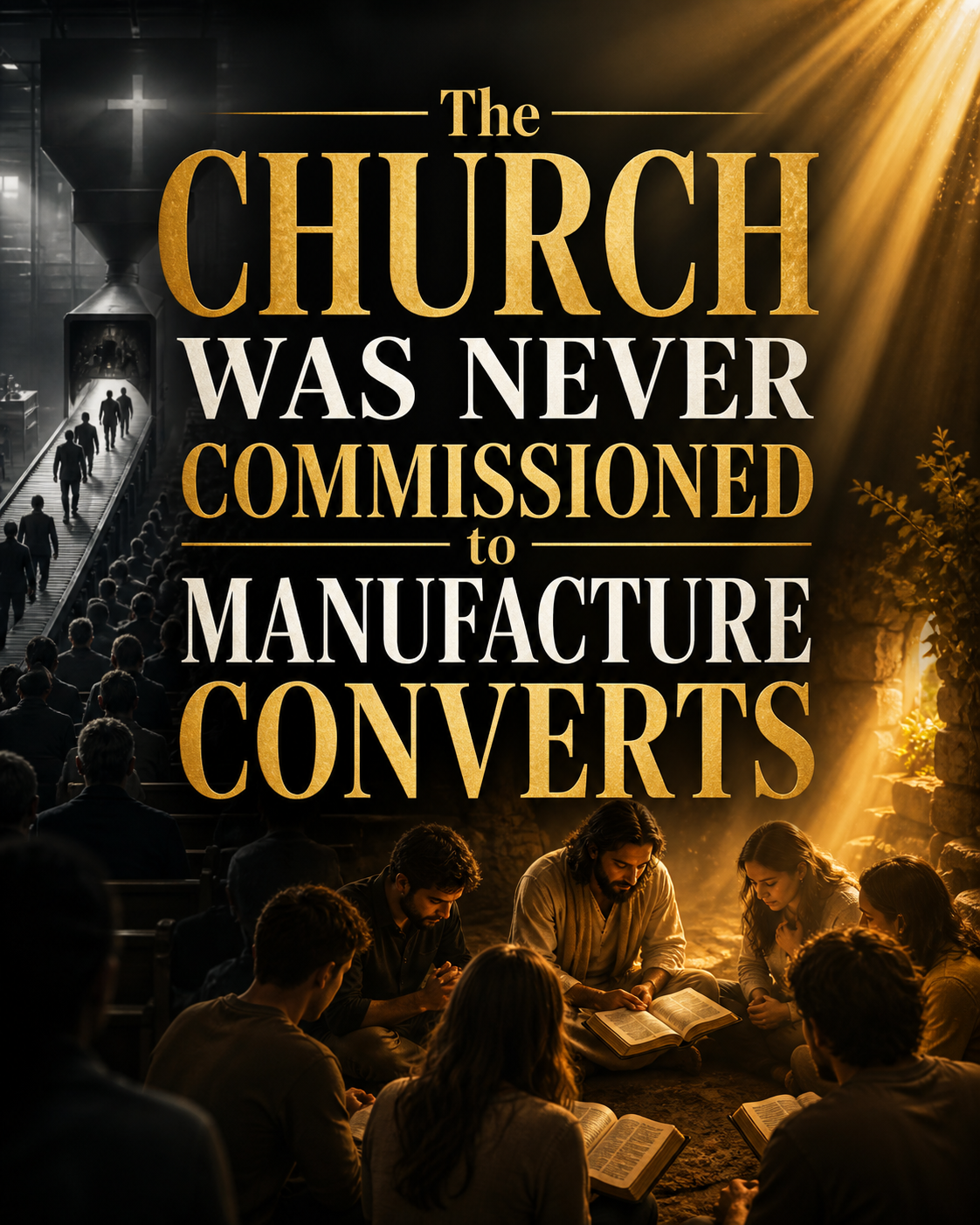
The Church does not need another system built around winning souls
Somewhere along the way, much of the modern evangelical Church began measuring success by how many souls it could “win,” while losing sight of the actual commission Christ gave. The language of “winning souls” may sound biblical, and Proverbs 11:30 certainly says, “The fruit of the righteous is a tree of life, and he who wins souls is wise.” Yet when that verse is detached from the whole counsel of Scripture, it can be twisted into a religious system of numbers, decisions, emotional responses, altar calls, and spiritual production lines. The Church was never commissioned to manufacture converts. The Church was commissioned to make disciples.
In the Hebrew, Proverbs 11:30 reads, “Peri-tsaddiq etz chayyim, ve-loqe’ach nefashot chakam.” The phrase “fruit of the righteous” speaks of the produce, outcome, and harvest of a life that has been brought into right order with God. The righteous person does not merely carry religious language; his life produces something that nourishes others. His walk becomes fruit-bearing. His obedience becomes life-giving. His nature becomes evidence that he is rooted in the Lord.
The phrase “tree of life” is etz chayyim, and the word chayyim carries the sense of lives, life, fullness, and ongoing vitality. This means the righteous life becomes a place where others can encounter the life of God. The fruit of the righteous is not manipulation. It is not pressure. It is not religious performance. It is not a spiritual sales pitch. It is a life so governed by God that it becomes a tree of life to those who are wounded, wandering, hungry, and searching.
Then the verse says, “he who wins souls is wise.” But the Hebrew phrase is deeper than the modern English expression. Loqe’ach nefashot comes from the idea of taking, receiving, gathering, laying hold of, or bringing in lives. Nefashot speaks of souls, lives, persons, inner beings. It does not present a man as the savior of another man’s soul. It speaks of wisdom that knows how to gather lives toward the way of God. It speaks of righteous influence, holy persuasion, rescue, shepherding, and life-giving formation.
That means Proverbs 11:30 must not be used to suggest that man has the power to save what only Christ can redeem. Only the Lord can win the soul in the deepest sense. Only Holy Spirit can convict the heart. Only the Father can draw men to the Son. Jesus said, “No one can come to Me unless the Father who sent Me draws him” (John 6:44). Paul said, “I planted, Apollos watered, but God gave the increase” (1 Corinthians 3:6). These Scriptures should humble every religious system that has tried to turn salvation into a humanly managed result.
The Church has a role, but it is not the role of Holy Spirit. We preach Christ. We proclaim the Gospel of the Kingdom. We bear witness to the resurrection. We call men to repentance. We teach the commands of Jesus. We pray, labor, warn, exhort, and model the life of the Kingdom. But we do not regenerate the dead heart. We do not give new birth. We do not transfer men from darkness into light by the strength of our programs. God alone gives life.
This is where much of the modern Church needs correction and redirection. We have spent enormous energy trying to produce converts while often neglecting the long, costly, holy labor of making disciples. We have celebrated decisions without always forming obedience. We have counted responses without always cultivating transformation. We have built systems that know how to gather crowds but often fail to raise sons and daughters who carry the nature of Christ. That is not apostolic Christianity. That is religious machinery dressed in spiritual language.
Jesus did not say, “Go therefore and collect converts.” He said, “Go therefore and make disciples of all the nations, baptizing them…and teaching them to observe all things that I have commanded you” (Matthew 28:19–20). The command is not merely to bring people to a moment of response, but to bring them into a life of surrender, baptism, teaching, obedience, formation, and Kingdom allegiance. The Great Commission is not complete when someone repeats a prayer. The commission moves toward maturity, fruitfulness, obedience, and Christlikeness.
This is why the Church must recover the difference between a convert and a disciple. A convert may acknowledge a message, but a disciple submits to a Master. A convert may be counted in a meeting, but a disciple is formed in the way. A convert may respond emotionally, but a disciple learns obedience when no crowd is watching. A convert may be attracted to blessing, but a disciple takes up the cross. Jesus said, “If anyone desires to come after Me, let him deny himself, and take up his cross daily, and follow Me” (Luke 9:23).
The early Ecclesia did not build itself around religious marketing, entertainment, or spiritual consumerism. Acts 2:42 says, “They continued steadfastly in the apostles’ doctrine and fellowship, in the breaking of bread, and in prayers.” That was not a shallow system of religious attendance. That was a discipling culture. Doctrine shaped them. Fellowship joined them. Prayer governed them. The table formed them. Their lives became a witness because the life of Christ was being reproduced among them.
This is the foundation we must return to. The Church does not need better machinery for producing outward responses. It needs a return to the ancient path of forming Christ in people. Paul said, “My little children, for whom I labor in birth again until Christ is formed in you” (Galatians 4:19). That is discipleship. It is not merely informing the mind. It is the travail of seeing the nature, obedience, humility, holiness, and love of Christ formed in the life of another person.
The tragedy of much modern evangelical culture is that it has often placed more emphasis on getting people into buildings than getting Christ formed in people. It has often become more skilled at building platforms than building altars. It has often become more committed to expanding visibility than cultivating spiritual maturity. But Jesus never told us to create religious spectators. He called us to form obedient followers who hear His voice, keep His Word, walk in His Spirit, love one another, and bear fruit that remains.
John 15:5 gives us the true foundation: “I am the vine, you are the branches. He who abides in Me, and I in him, bears much fruit; for without Me you can do nothing.” Fruit does not come from religious pressure. Fruit comes from abiding. The Church cannot disciple nations while detached from the Vine. We cannot produce Kingdom life through fleshly systems. We cannot manufacture what only abiding can bear. A Church that is disconnected from the presence and government of Christ may still gather crowds, but it cannot produce the fruit of the Kingdom.
This brings us back to Proverbs 11:30 with a clearer understanding. The wise do not try to replace God in the salvation of souls. The wise become trees of life through righteousness and then gather lives toward the Lord through truth, love, wisdom, witness, and discipleship. The wise understand that soul-winning is not religious conquest. It is not the triumph of human persuasion. It is the overflow of a righteous life cooperating with the drawing, convicting, saving, and sanctifying work of God.
The Church must repent where it has trusted systems more than Spirit, methods more than presence, decisions more than discipleship, and crowds more than formation. We must stop confusing numerical response with Kingdom fruit. We must stop believing that a moment of public agreement is the same as a life being brought under the Lordship of Jesus Christ. Christ did not die to create religious attenders. He died to redeem, restore, indwell, transform, and conform a people into His image.
This does not mean we stop preaching to the lost. God forbid. It means we preach with purity, without manipulation. It means we witness with boldness, without pretending we are the ones who save. It means we call men to repentance, while depending fully upon Holy Spirit to convict. It means we labor in the field, plant the seed, water with prayer and truth, and trust God for the increase. It means we understand our assignment without trespassing into the Lord’s office.
Only the Lord can truly win the soul.
Only Holy Spirit can convict the heart.
Only the Father can draw men to the Son.
Only Christ can redeem, regenerate, deliver, and make a dead man alive.
The correction is simple, but it is weighty: Christ wins the soul; the Ecclesia disciples the life. Christ saves; we witness. Holy Spirit draws; we shepherd those He brings. The Father gives the increase; we remain faithful in planting and watering. This is not a call to less evangelism. It is a call to purified evangelism that flows into real discipleship, real obedience, real formation, and real transformation.
The Church must return to the foundation of its calling.
Not religious systems.
Not spiritual production lines.
Not shallow altar-call Christianity.
Not numbers without transformation.
Not converts without discipleship.
The hour demands fathers and mothers in the faith, mature sons and daughters, households of prayer, tables of fellowship, altars of consecration, and believers who carry the nature of Christ in the ordinary places of life.
We must stop trying to mass-produce converts and return to forming disciples one life at a time, until the nature of Christ is seen in their character, obedience, love, holiness, and witness.. That means walking with people until the Word becomes flesh in their conduct, until prayer becomes breath in their home, until obedience becomes normal, until holiness becomes beautiful, until love becomes visible, until the government of Christ begins to order their thoughts, choices, relationships, and assignments. This is slower than religious machinery, but it is the way of the Kingdom. Jesus spent time with twelve. He formed men, not crowds.
The modern Church does not need another system built around manufacturing converts. It needs to recover the wisdom of Proverbs 11:30, the obedience of Matthew 28:19–20, the dependence of 1 Corinthians 3:6, the abiding of John 15:5, and the formation of Galatians 4:19. The fruit of the righteous is still a tree of life, and the wise still gather souls toward God. But only Christ saves the soul, and only Holy Spirit can draw the heart. Our commission is to preach the Kingdom, bear witness to the King, and disciple those whom God brings into the life of His Son.
Stay tuned, the journey continues…..
— Dr. Russell Welch
Dr. Russell Welch is a published author, prophetic teacher, apostolic builder, author, and founder of faith-driven publishing and media initiatives. He is known for crafting bold, Kingdom-centered messages that call the Ecclesia into maturity, doctrinal clarity, and governmental authority. With a passion for equipping the Remnant and honoring generational legacy, Dr. Welch writes and teaches at the intersection of Scripture, history, and spiritual governance, challenging believers to live as sons and daughters who legislate Heaven on earth through truth, holiness, and unwavering fidelity to Christ.
Be sure to check out his book: The Consecrated Firebrand: A Warrior’s Guide to Holy Living, available exclusively on Amazon … here

