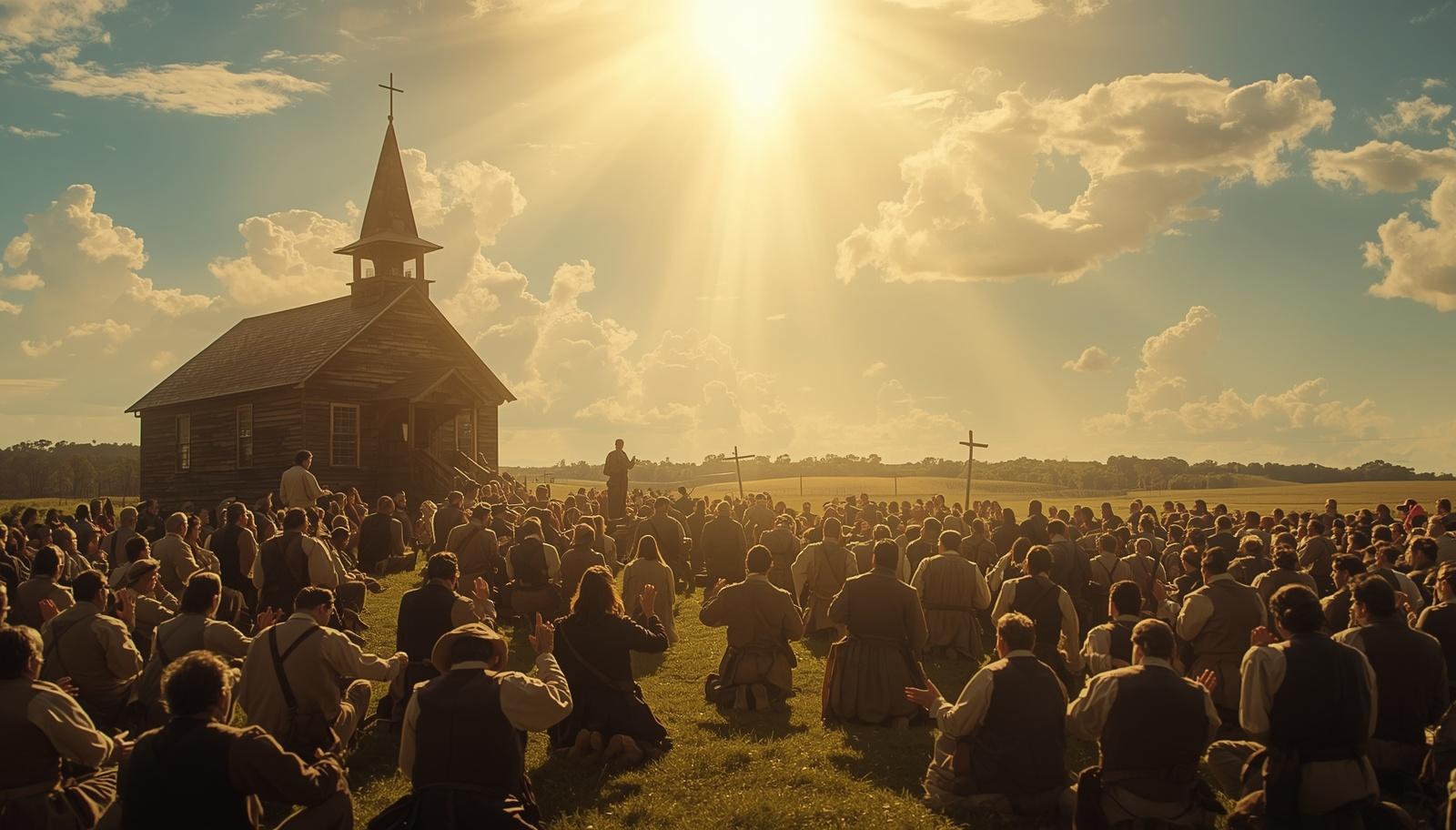
How spiritual decline, powerful preaching, and deep conviction prepared the ground for one of the greatest revivals in American history
Long before America became a republic, the colonies were already experiencing the kind of spiritual shaking that only Heaven can produce. In the early eighteenth century, much of colonial religious life had grown formal, predictable, and spiritually cold. Church attendance may have remained outwardly respectable in many places, but inward fire was often fading. Into that environment, God began to breathe again. What history now calls the First Great Awakening unfolded primarily in the 1730s and 1740s across the American colonies, and it became one of the earliest and most significant revival movements in American history.
A Climate of Spiritual Formality and Moral Drift
The First Great Awakening did not erupt because the colonies were spiritually healthy. It came because many communities had settled into religious routine without the power of living faith. Historians commonly describe the period as one marked by concerns over declining piety, increasing worldliness, and a religion that for many had become more formal than transformational. The outward structures of church life remained, but deep conviction, heartfelt repentance, and spiritual vitality were often lacking. That pattern should sound familiar to any generation that knows how easily religious form can remain while spiritual fire fades.
This is one of the enduring lessons of revival history: God often moves most powerfully where complacency has settled in. When truth becomes familiar but no longer burns, when worship becomes routine but no longer trembles with awe, and when people know religious language without living under the weight of divine reality, the stage is often being set for awakening. The colonies did not simply need better organization or more polished sermons. They needed visitation. They needed the Spirit of God to arrest hearts, confront sin, and awaken spiritual hunger once again.
Jonathan Edwards and the Awakening of Deep Conviction
One of the earliest and most influential figures in this awakening was Jonathan Edwards, the pastor-theologian from Northampton, Massachusetts. Edwards witnessed seasons of unusual spiritual response in his congregation and became one of the clearest interpreters of what was taking place. He emphasized the necessity of genuine conversion, the reality of sin, the beauty of Christ, and the transforming work of God in the soul. His preaching and writing helped frame revival not as emotional excitement for its own sake, but as a profound work of grace that brought people into deep conviction and living faith.
Edwards understood something the modern Church must recover: revival is not measured first by crowds, noise, or outward movement, but by whether hearts are truly being brought under the weight of God’s presence. Conviction is not the enemy of awakening. It is often one of its first signs. When Holy Spirit begins to move, He does not flatter the flesh. He confronts it. He brings men and women face to face with eternity, with their need for mercy, and with the majesty of Christ. That is what began happening in the colonies as revival fires spread.
George Whitefield and the Voice That Stirred the Colonies
If Edwards helped interpret the awakening, George Whitefield helped ignite it across the land. Whitefield, the powerful itinerant preacher from England, traveled widely through the American colonies in the late 1730s and 1740s, preaching to enormous crowds in cities, towns, and open fields. His preaching drew thousands, crossing colonial boundaries and stirring widespread response. Historians often point to Whitefield’s tours as a major catalyst in spreading revival consciousness throughout the colonies.
Whitefield’s ministry carried urgency, directness, and deep appeal to the new birth. He was not content to leave people resting in religious identity while lacking spiritual life. He pressed the necessity of regeneration, calling hearers to real conversion and living faith in Christ. Under such preaching, many were deeply moved, and communities across the colonies began experiencing unusual spiritual concern. The awakening spread not merely because Whitefield was gifted, but because Heaven had set its breath upon the land.
The Marks of the First Great Awakening
The First Great Awakening was not without controversy, but its central marks were unmistakable. There was renewed emphasis on the new birth, intensified preaching on sin and salvation, deep emotional and spiritual response among hearers, and a growing sense that religion must be heartfelt and personal rather than merely inherited or formal. It also helped break down some old denominational and regional barriers, creating a wider sense of shared spiritual experience across the colonies.
That is one of the striking things about real awakening: it reminds people that God is not confined to routine, tradition, or the comfortable structures men build around Him. When Holy Spirit begins to move, He disturbs the settled places. He awakens hunger where there was apathy. He brings tears where there had been indifference. He creates spiritual urgency where there had been delay. Revival reintroduces a people to the living reality of God.
Why the First Great Awakening Still Matters
The First Great Awakening matters because it established a pattern that would echo through American history. It showed that spiritual decline does not have to have the final word. It proved that when a people become cold, compromised, or complacent, God is still able to breathe upon dry ground and bring life where form alone had remained. It demonstrated that powerful preaching, deep conviction, repentance, and hunger for God can alter the course of communities and even shape the spiritual culture of a nation.
It also reminds us that revival is not born in comfort. It is born where the people of God become dissatisfied with dead form and begin to cry out for living fire. The same God who visited the colonies in the eighteenth century has not changed. The same Holy Spirit who confronted cold religion, awakened hearts, and brought men and women under the weight of eternity is still able to do so again. History is not merely something to admire. It is something to learn from. The fires of past awakening should not become museum pieces. They should become reminders that God still moves in desperate times through yielded people.
A Word for the Remnant Today
The lesson for the Remnant Ecclesia is clear. If the First Great Awakening teaches us anything, it is that spiritual decline is not the end of the story when God’s people begin to hunger again. The answer to cold religion is not better branding. It is burning altars. The answer to moral drift is not more polished performance. It is true repentance and renewed visitation. The answer to a sleeping church is not activity without presence, but the restoring breath of Holy Spirit moving again upon hearts, homes, and congregations.
So let this history do more than inform us. Let it search us. Let it ask whether we, too, have become too familiar with religious form while lacking spiritual fire. Let it awaken in us a fresh cry for real conversion, deep repentance, and holy visitation. The God who shook the colonies is still able to shake the land again.
Stay Tuned: Revival on the Frontier
In the next article, we will move forward into The Second Great Awakening: Revival Fires Across a Young Nation, where we will see how Holy Spirit moved again through camp meetings, frontier preaching, and widespread spiritual awakening in a growing America. If the First Great Awakening shook the colonies, the Second Great Awakening helped set the young nation ablaze. Stay tuned.
Stay tuned……
— Dr. Russell Welch
Dr. Russell Welch is a published author, prophetic teacher, apostolic builder, author, and founder of faith-driven publishing and media initiatives. He is known for crafting bold, Kingdom-centered messages that call the Ecclesia into maturity, doctrinal clarity, and governmental authority. With a passion for equipping the Remnant and honoring generational legacy, Dr. Welch writes and teaches at the intersection of Scripture, history, and spiritual governance, challenging believers to live as sons and daughters who legislate Heaven on earth through truth, holiness, and unwavering fidelity to Christ.
Be sure to check out his book: The Consecrated Firebrand: A Warrior’s Guide to Holy Living, available exclusively on Amazon … here

