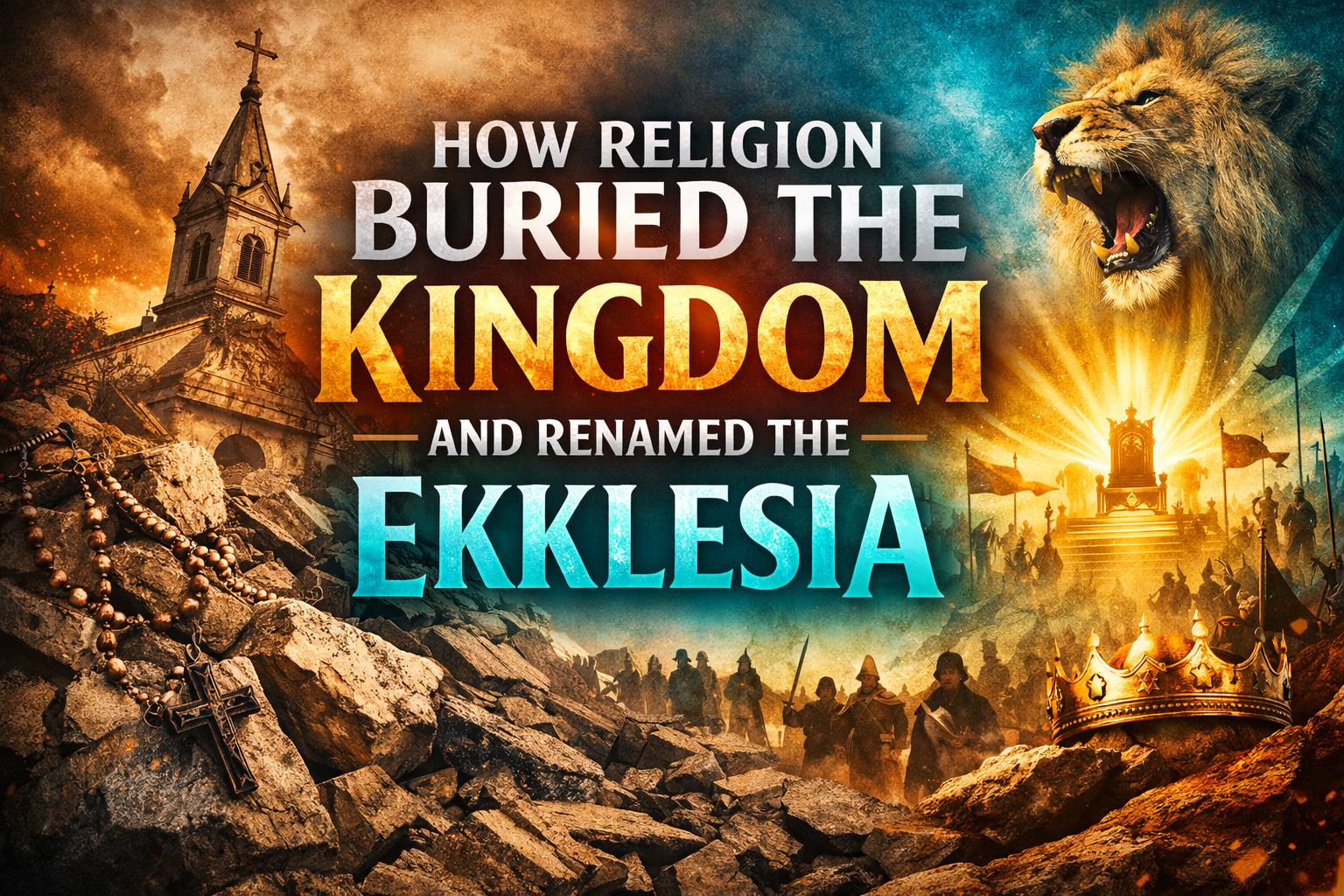
The Kingdom is roaring again. And no building can contain its sound.
The word ekklesia carries a meaning far deeper than what most modern believers imagine, because in the ancient world it described a governing assembly rather than a religious gathering. When Jesus used this word, He was intentionally drawing from the language of civic authority, not temple worship or ritual practice. His listeners would have immediately understood that He was speaking about a people called out to legislate, deliberate, and represent the will of a king. This means the identity of His followers was rooted in Kingdom function, not institutional membership or weekly attendance. The shift from ekklesia to “church” dramatically altered how generations interpreted their role in the world, creating a gap between what Jesus intended and what many believers experience today. Recovering this meaning is essential for restoring the authority Jesus entrusted to His people.
The English word “church” comes from a completely different linguistic stream, one tied to buildings, sacred spaces, and religious structures. This translation redirected the focus from a governing people to a physical location, which reshaped the imagination of the Christian world for centuries. Instead of seeing themselves as a Kingdom assembly with authority, many believers came to see themselves as attendees of a religious service or members of an organization. This shift weakened the sense of mission and responsibility Jesus intended for His followers, replacing Kingdom identity with institutional loyalty. It also contributed to a passive culture where the institution became central rather than the Kingdom itself. The result was a people who gathered faithfully but rarely governed spiritually.
When Jesus said, “I will build My ekklesia,” He was not describing a future network of buildings or denominations. He was announcing the formation of a ruling body that would operate under His authority to enforce the will of Heaven on the earth. This governing identity was meant to be active, engaged, and transformative in every sphere of society, not confined to religious spaces. The ekklesia was designed to carry the culture of the Kingdom into the world, influencing systems, structures, and environments with Heaven’s values. Understanding this restores the original power of Jesus’ words and reawakens the authority He entrusted to His followers. It calls the people of God back into their rightful place as Heaven’s representatives.
The Gospels reinforce this emphasis by highlighting the Kingdom far more than the concept of the church. Jesus spoke of the Kingdom over a hundred times, revealing it as the central theme of His message, His parables, and His mission. He described its nature, its power, its values, and its arrival in the midst of humanity, making it clear that the Kingdom was His primary focus. In contrast, He mentioned the ekklesia only twice, and both times in the context of authority, governance, and spiritual jurisdiction. This contrast shows that the Kingdom is the message, and the ekklesia is the instrument through which that message advances into the earth. The Kingdom is the foundation; the ekklesia is the expression.
When the word ekklesia was replaced with “church,” the mission of the people of God was unintentionally narrowed. Instead of functioning as ambassadors and representatives of a Kingdom, many believers were trained to become spectators in a religious system. This shift created a divide between sacred and secular, even though Jesus never taught such a separation or encouraged His followers to retreat from society. The ekklesia was meant to operate in the world, influencing culture, justice, economics, and community life with the authority of Heaven. The translation change contributed to a mindset that confined spiritual life to a building rather than a lifestyle of Kingdom engagement. This misunderstanding weakened the impact of the Gospel for generations.
The early believers understood themselves as a Kingdom assembly empowered to carry out the will of their King. They gathered to strengthen one another, but they scattered to govern, influence, and transform their environments with the authority Jesus gave them. Their identity was rooted in authority, not attendance, and they saw themselves as participants in a divine mission rather than consumers of spiritual content. This understanding fueled the explosive growth and impact of the early movement, which spread rapidly despite persecution and opposition. Their power came from alignment with the Kingdom, not from institutional structures. They lived as citizens of Heaven, not members of an organization.
Recovering the meaning of ekklesia is essential for the Remnant rising in this generation. It restores the sense of divine assignment that Jesus intended for His followers and reawakens the authority that has been dormant in many believers. It calls disciples out of passive religion and into active Kingdom engagement, where their presence carries weight and influence. It awakens the understanding that every believer carries governmental authority in the spiritual realm and is called to enforce Heaven’s agenda. This revelation shifts the church from maintenance mode to mission mode and prepares the Remnant for effective Kingdom advancement. It is a call to rise, govern, and occupy.
The Remnant is rediscovering that the ekklesia is not a place you go but a people you become. It is not defined by architecture but by authority, and it is not measured by attendance but by influence. It is not centered on programs but on purpose, and it is not limited to Sunday gatherings but expressed in daily Kingdom living. This restoration is bringing clarity to the identity and assignment of God’s people in a time of global shaking and transition. As this understanding spreads, the Remnant is stepping into its rightful place with boldness and clarity. They are reclaiming what religion buried and what the Spirit is now resurrecting.
Understanding the difference between ekklesia and church helps believers reclaim their original mandate. It breaks the limitations imposed by centuries of institutional thinking and restores the boldness of Kingdom identity that Jesus intended. It empowers disciples to step into their roles as ambassadors, legislators, and representatives of Heaven, carrying divine authority into every sphere of influence. It also aligns the modern movement with the message Jesus actually preached, which was the Gospel of the Kingdom. This alignment is essential for advancing the purposes of God with power, accuracy, and spiritual authority. It is the restoration of the original blueprint.
As this revelation spreads, the people of God are awakening to their true calling and stepping into a higher dimension of purpose. They are recognizing that Jesus never intended a passive religious system but a powerful governing assembly that would represent Heaven on earth. They are stepping into their authority with renewed confidence and clarity, understanding that they are part of a divine strategy. They are embracing the Kingdom as their message and the ekklesia as their identity, which brings strength and unity to their mission. This restoration is preparing the Remnant to advance the purposes of God with precision, courage, and unstoppable momentum. The days of passive Christianity are ending.
As this restoration continues, the Holy Spirit is unveiling a Remnant that has been hidden in plain sight, concealed from the eyes of the religious spirit that has long sought to domesticate the people of God. This Remnant has not been shaped by institutional expectations but by the refining fire of consecration, obedience, and secret history with God. They carry a watchman anointing that discerns the times, exposes deception, and guards the gates of the Kingdom with clarity and courage. Their ears are tuned to the voice of the Spirit, not the noise of religious tradition, and they move with a precision that comes only from intimacy with the King. As the Gospel of the Kingdom is being revived in this hour, these hidden ones are emerging with authority to confront the systems that diluted the meaning of ekklesia and reduced it to something Jesus never intended. They rise not by permission of man but by commissioning of Heaven.
The Spirit of God is now dismantling layer after layer of the religious interpretations that buried the original power of the ekklesia. What once seemed immovable is being toppled, not by human strategy but by the breath of the Lord awakening His people to their true identity. The Remnant is rising with boldness, carrying a revelation that cannot be contained within old wineskins or institutional frameworks. They are stepping into their assignment as watchmen, reformers, and Kingdom ambassadors who will not bow to the traditions of men. This is the hour when the true ekklesia stands up, shakes off the dust of religion, and walks in the authority Jesus declared from the beginning — a governing people advancing the Gospel of the Kingdom with fire, clarity, and unstoppable momentum. The river is rising, and nothing built on the sand of religion will withstand its flow.
Stay tuned, the journey continues…..
— Dr. Russell Welch
Dr. Russell Welch is a published author, prophetic teacher, apostolic builder, author, and founder of faith-driven publishing and media initiatives. He is known for crafting bold, Kingdom-centered messages that call the Ecclesia into maturity, doctrinal clarity, and governmental authority. With a passion for equipping the Remnant and honoring generational legacy, Dr. Welch writes and teaches at the intersection of Scripture, history, and spiritual governance, challenging believers to live as sons and daughters who legislate Heaven on earth through truth, holiness, and unwavering fidelity to Christ.
Be sure to check out his book: The Consecrated Firebrand: A Warrior’s Guide to Holy Living, available exclusively on Amazon … here

