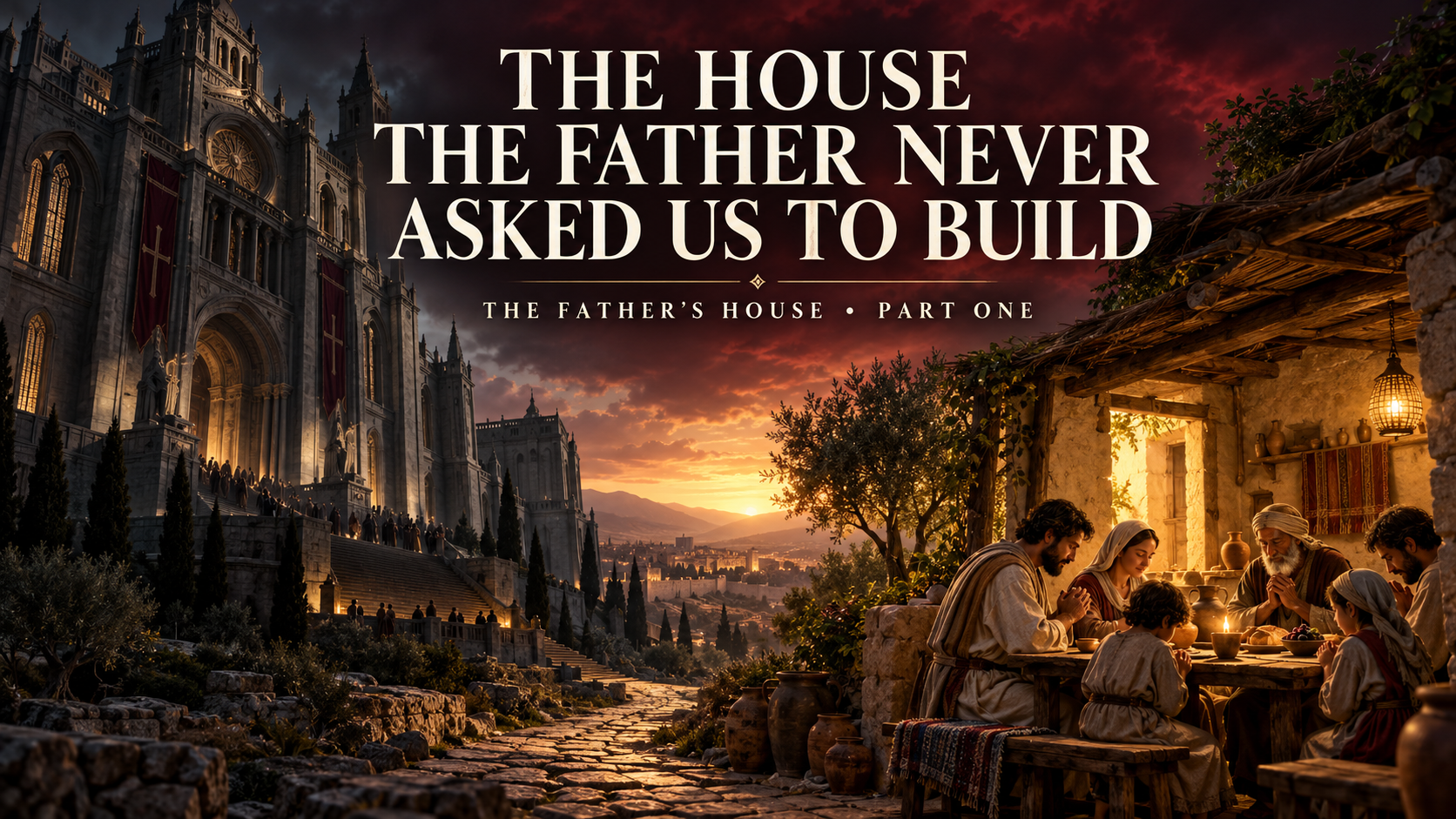
Part One of Three — The Father’s House
There is a question that has been stirring in my spirit for several years, one that I believe the Body of Christ must be willing to confront honestly. Have we become so occupied with building something for God that we have gradually lost sight of the spiritual house He has been building for Himself?
For centuries, Christianity has invested enormous resources in buildings, institutions, religious programs, and organizational structures. We have constructed magnificent sanctuaries, established impressive ministries, and developed systems designed to accommodate thousands of people. Yet somewhere along this journey, we must ask whether the success of our religious organizations has become the measure of something Jesus never intended us to measure that way.
When Stephen stood before the religious council in Acts 7:48–50, he reminded them that the Most High does not dwell in temples made with hands. Drawing from Isaiah 66:1–2, he declared that heaven is God’s throne and the earth His footstool. The prophet then reveals something remarkable about the Father’s heart: His attention rests upon those who are humble, contrite in spirit, and who tremble at His Word.
Consider what the Lord is revealing. The Creator of heaven and earth is not impressed by the magnificence of structures constructed in His name. What He desires is a people whose hearts have become a dwelling place for His presence, whose lives are surrendered to His government, and whose obedience reveals His nature.
Now, let me be clear. The Scriptures do not condemn believers for gathering in buildings, nor do they suggest that every organized expression of Christian fellowship is contrary to the Father’s will. The early believers themselves continued meeting in the temple courts while also gathering from house to house. The issue is not where we assemble, but whether our assemblies are producing the spiritual life, relationships, and maturity that Jesus intended.
In Matthew 16:18, Jesus made a declaration that should govern our entire understanding of the Ekklesia: “I will build my church.” Notice that He did not commission His disciples to establish another religious institution modeled after the systems surrounding them. He declared that He Himself would build His Ekklesia, and the gates of hell would not prevail against it.
The Greek word ekklesia describes an assembly or gathering of people. In the New Testament, it identifies those belonging to Christ who have been called into His Kingdom and brought under His Lordship. They are not merely individuals attending religious services. They are members of His Body, joined together in relationship with Him and with one another.
This understanding becomes even more significant when we examine the historical development of Christianity. During the first centuries, believers gathered in homes and other available places, sharing meals, praying, receiving apostolic instruction, and caring for one another. As Christianity spread and eventually received imperial recognition in the fourth century, its public expression underwent substantial changes. Larger buildings, increasingly formal leadership structures, and elaborate religious ceremonies became more prominent.
Not every development was inherently wrong, and we must remember that faithful believers continued serving Christ throughout these centuries. Nevertheless, the growing institutional character of Christianity created conditions in which the simplicity of spiritual family and the responsibility of every believer could become overshadowed by religious hierarchy and formal observance.
And this brings us to the heart of the matter. We can fill buildings without making disciples. We can develop successful programs without producing spiritual maturity. We can gather thousands for worship and still fail to cultivate the relationships, accountability, and daily obedience that characterized the life of the early Ekklesia.
Acts 2:42–47 presents a remarkable picture of believers continuing steadfastly in the apostles’ doctrine, fellowship, breaking of bread, and prayers. Their spiritual life was not confined to a weekly gathering. They shared their lives, cared for those in need, worshiped together, and carried the testimony of Jesus into their communities. Their fellowship was not built around religious entertainment but around the living presence and Lordship of Jesus Christ.
I believe this is one of the great areas of restoration the Holy Spirit is bringing before the Lord’s Remnant today. The Father is calling us to examine whether we have substituted religious participation for genuine discipleship and institutional success for the maturity of His sons and daughters.
The ultimate purpose of the Ekklesia is not to preserve an organization or perpetuate a religious tradition. It is to become the people through whom the life, character, wisdom, and authority of Jesus Christ are revealed in the earth. This requires more than attending services. It requires surrender, transformation, spiritual relationships, and a daily walk under the government of the Holy Spirit.
The Father is not searching for a more impressive religious institution. He is forming a dwelling place for His presence among a people surrendered to His Son.
Perhaps the question we should be asking is not how much larger our churches can become, but how much more fully Christ is being formed in the people who gather within them.
And if we are willing to confront that question honestly, we must be prepared to consider another.
If the buildings and institutions we have constructed are not the Father’s ultimate objective, then what exactly is the house Jesus came to build?
That is where our journey will take us next.
COMING NEXT — PART TWO: THE HOUSE JESUS BUILT FOR HIS FATHER
This teaching is drawn from the central themes of my book, The Father’s House: Returning to the Ancient Path as the Lord’s Ecclesia.
Available on Amazon:
https://www.amazon.com/dp/1964155290
Stay tuned, the journey continues…..
A voice of fire to the Remnant,
— Dr. Russell Welch
Dr. Russell Welch is an apostolic teacher, author, and founder of Remnant Warrior Ministries and Kingdom War College. His teaching focuses on restoring biblical foundations, equipping the Lord’s Remnant, and raising mature sons and daughters who live under the government of the Holy Spirit.

