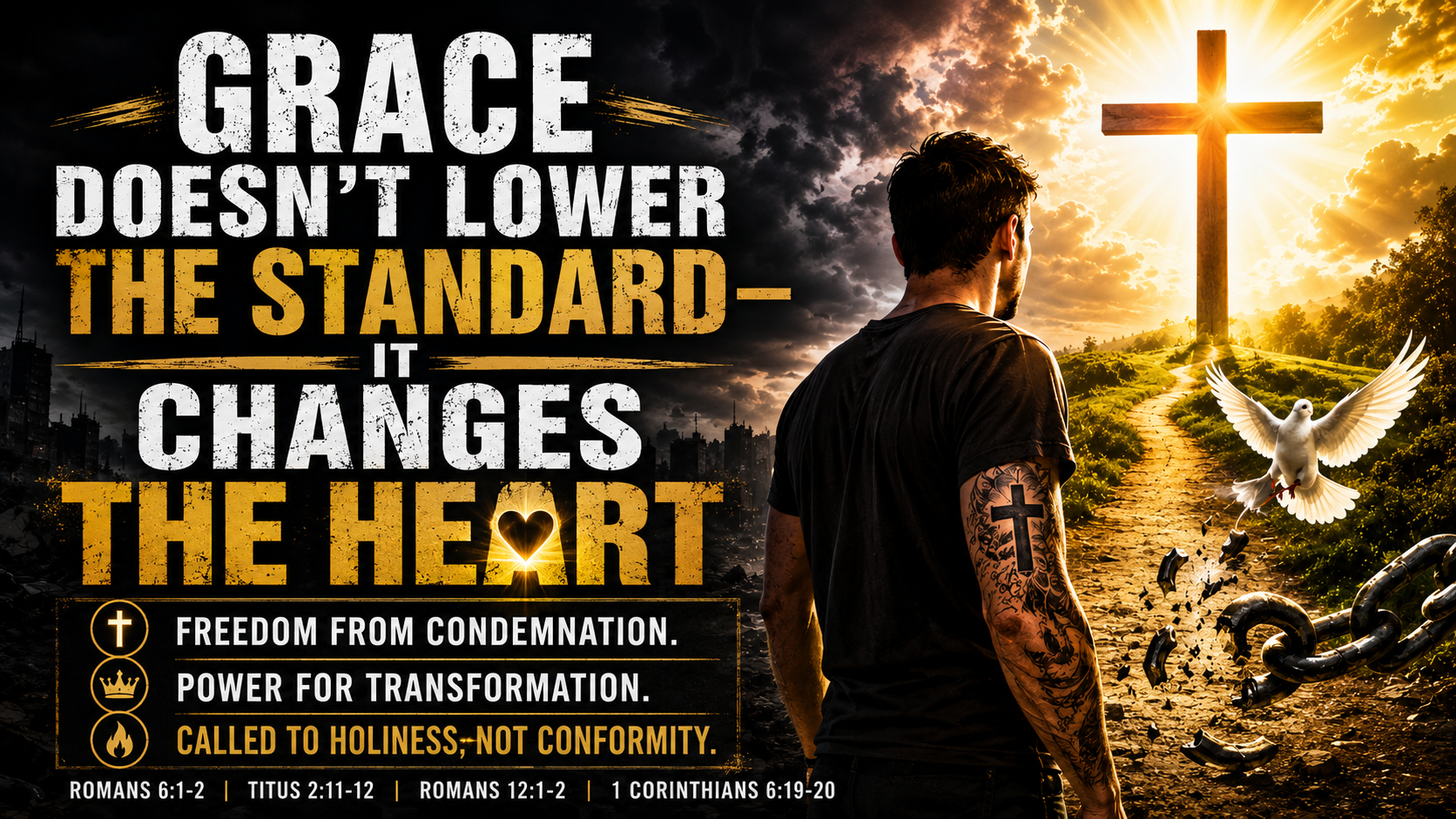
The Church must recover the courage to preach grace without weakening holiness, and holiness without drifting into legalism. Legalism says, “Clean yourself up so God will accept you.” The Gospel says, “In Christ you have been accepted, forgiven, washed, and made new—now live like someone who belongs to Him.” Scripture leaves no room for self-righteous condemnation, but it also leaves no room for using grace as permission to keep embracing the patterns of the fallen world.
Paul asked the question plainly: “Shall we continue in sin, that grace may abound? God forbid” (Romans 6:1–2). Grace does not excuse the old nature; grace breaks its dominion. Titus 2:11–12 tells us that the grace of God teaches us to deny ungodliness and worldly lusts and to live soberly, righteously, and godly in this present age. Biblical grace does not merely forgive where we have been—it trains us to live differently because we now belong to Christ.
This is where mercy must remain central. Many people come to Jesus carrying visible reminders of who they once were: tattoos, scars, addictions, broken relationships, destructive choices, and years lived without Christ. We do not shame people for what mercy has already covered. “Such were some of you,” Paul wrote, “but ye are washed, but ye are sanctified, but ye are justified” (1 Corinthians 6:11). The blood of Jesus is greater than our past, and the Church should never make a person feel permanently disqualified because of decisions made before they encountered the transforming power of Christ.
But mercy toward our past must never become permission for our future. Salvation changes the question. We no longer ask only, “Is this technically forbidden?” We begin asking, “Does this glorify God? Does this reflect my new identity? Does this conform me to Christ or to the spirit of the age?” Romans 12:1–2 commands believers to present their bodies as living sacrifices and not to be conformed to this world. First Corinthians 6:19–20 reminds us that our bodies are temples of the Holy Spirit and that we have been bought with a price; therefore, we are commanded to glorify God in our bodies.
Even Leviticus 19:28, while given within the covenant context of ancient Israel and connected to pagan mourning practices, reveals an enduring biblical principle: God cared about His people refusing bodily practices associated with the surrounding pagan culture. The New Testament does not place Gentile believers under the Mosaic ceremonial law, but neither does it erase the deeper call to consecration. We are still commanded to come out from the spirit of the world, to refuse conformity, and to recognize that our bodies now belong to the Lord.
The danger is not merely ink on skin. The deeper issue is the heart asking whether transformation means anything visible at all. When the Church continually baptizes every cultural trend with the language of grace, grace becomes emptied of its transforming power. Jesus did not save us so that we could become more comfortable looking, thinking, desiring, and living exactly like the world around us. He saved us to make us a holy people, a peculiar people, a people who reveal another Kingdom.
At the same time, holiness must never become arrogance. A believer without tattoos has no biblical basis for looking down upon a believer who has them. Outward appearance is not the measure of spiritual maturity, and tattoos are certainly not the unforgivable sin. The issue is not building another religious measuring stick. The issue is recovering the surrendered heart that says, “Lord, my body, my choices, my appearance, my appetites, my ambitions, and my future belong to You.”
That is the balance of Scripture: no condemnation for the redeemed past, no legalistic superiority in the present, and no cheap grace that excuses conformity to the fallen nature. Grace welcomes us exactly where Christ finds us, but grace loves us far too much to leave us there. The Cross does more than pardon the old life—it crucifies it, and resurrection life calls us to walk as men and women who have been bought with blood, filled with the Spirit, and set apart for the glory of God.
Tattoos are not, and never have been, biblical evidence of anointing. In a culturally driven Church, some leaders have confused looking “cool” with carrying spiritual weight, but Heaven is not impressed by image, branding, or outward style; the true mark of an anointed life is holiness, obedience, the fruit of the Spirit, and a presence that resembles the burning bush in the wilderness, set apart, consumed by God, yet not destroyed (Exodus 3:2–5; Galatians 5:22–25).
The Church does not need leaders who merely resemble the culture; it needs men and women who have been with God long enough to carry His fire without turning that fire into a fashion statement.
Stay tuned, the journey continues…..
A voice of fire to the Remnant,
— Dr. Russell Welch
Dr. Russell Welch is a published author, prophetic teacher, apostolic builder, and founder of faith-driven publishing and media initiatives. He is known for crafting bold, Kingdom-centered messages that call the Ecclesia into maturity, doctrinal clarity, and governmental authority. With a passion for equipping the Remnant and honoring generational legacy, Dr. Welch writes and teaches at the intersection of Scripture, history, and spiritual governance, challenging believers to live as sons and daughters who legislate Heaven on earth through truth, holiness, and unwavering fidelity to Christ.
Be sure to check out his book, America at War: The Spiritual Battle for a Nation’s Soul, available exclusively on Amazon

