Before America Had a Name, God Was Pouring Out His Spirit — Part Two
The Hidden River of Holy Ghost Fire and the Call of the Remnant
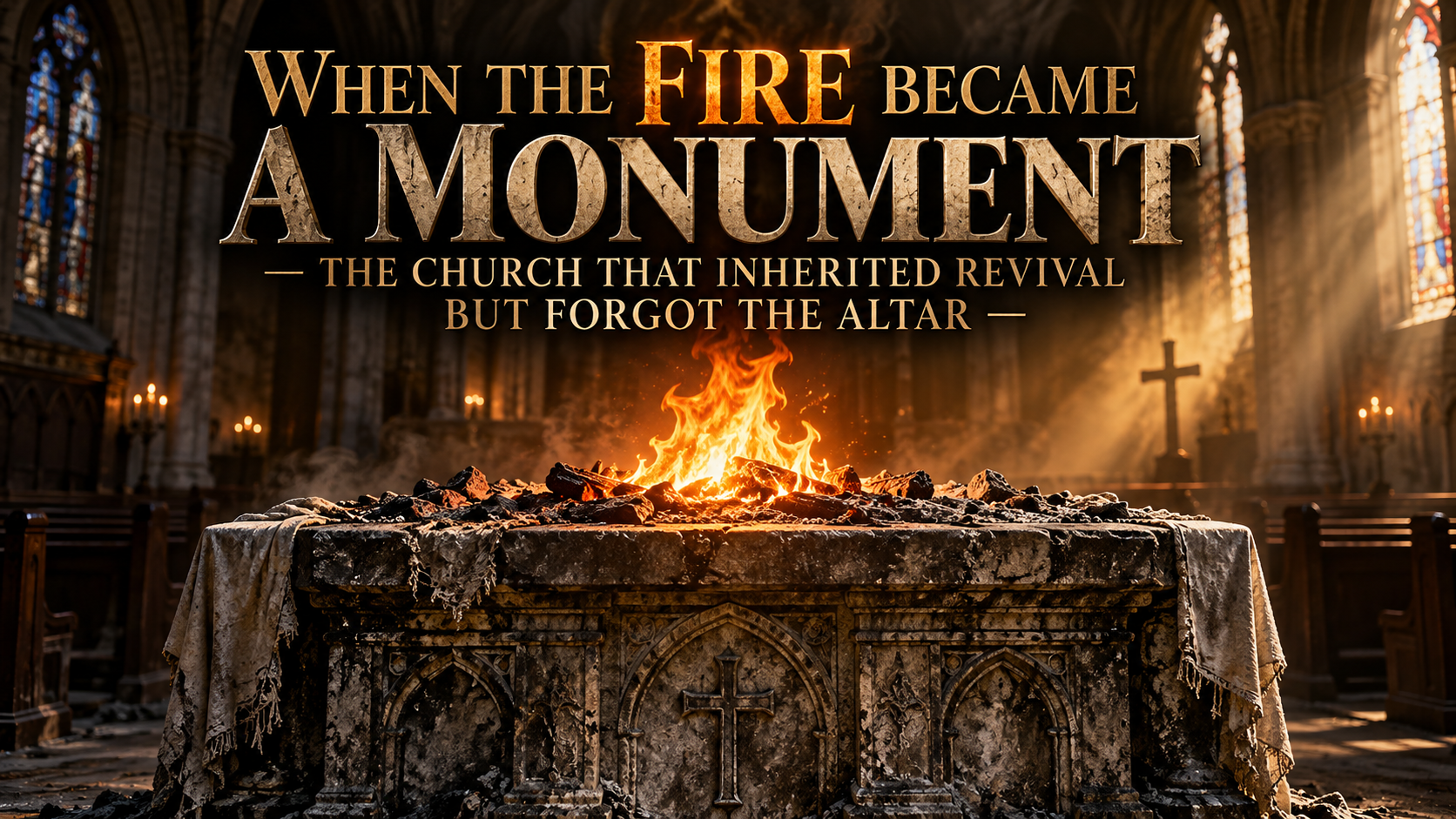
There is a tragedy woven throughout the history of spiritual awakening that should cause every generation of believers to examine itself before the Lord. Again and again, men and women have encountered the transforming power of Holy Spirit, surrendered themselves to the authority of Jesus Christ, and witnessed extraordinary movements of repentance, healing, restoration, and spiritual renewal. Yet within a generation or two, what began as a living encounter often became an institution devoted to preserving the memory of that encounter. The fire that once confronted religious complacency was eventually surrounded by structures, traditions, and carefully maintained expectations that sometimes resisted the very spiritual freedom from which they had emerged. Somewhere along the journey, the altar that had once demanded surrender became a monument that required maintenance.
This is not an indictment against every denomination, congregation, or institution that emerged from the great awakenings. Many preserved biblical truth, trained faithful ministers, established missionary works, educated generations, and carried the Gospel into places that otherwise might never have heard the name of Jesus Christ. Nevertheless, history presents a sobering distinction between preserving the testimony of what God has done and continuing to walk in living obedience to what He is doing. One preserves a witness; the other requires an ongoing relationship of surrender, discernment, and spiritual responsiveness. When the Church begins defending its historical identity more passionately than it pursues the presence and purposes of God, it has already entered dangerous territory.
The question confronting the modern Ecclesia is therefore far more serious than whether another great awakening might occur in America. We must ask whether the very people praying for revival are willing to surrender the structures, ambitions, compromises, and inherited assumptions that may be standing in the way of genuine spiritual renewal. We cannot claim to desire the fire of God while insisting that He leave untouched everything we have constructed in His name. The same Holy Spirit who awakened previous generations has never surrendered His authority to religious tradition, institutional reputation, or ecclesiastical ambition. If the Lord is calling His people into another season of awakening, then His first work may not be to enlarge what we possess, but to purify what we have become.
WHEN A MOVEMENT BECOMES A RELIGIOUS SYSTEM
The spiritual history of America reveals a recurring tension between divine awakening and human organization. The First Great Awakening challenged inherited religion by insisting that genuine conversion could not be reduced to church membership, family heritage, or intellectual agreement with Christian doctrine. The frontier revivals confronted established expectations concerning where, how, and through whom God might work. The holiness and Pentecostal movements later emphasized personal consecration, the active ministry of Holy Spirit, and the expectation that the Church should experience more than theological correctness without spiritual vitality. Although these movements differed in doctrine, practice, and historical circumstances, each confronted particular expressions of religious complacency.
Yet the challenge did not disappear when the movements became established. As revival communities expanded, they faced legitimate questions concerning leadership, doctrinal accountability, property, training, mission, and continuity. Organization itself was not the enemy, and Scripture certainly does not endorse spiritual disorder as evidence of divine freedom. Paul instructed the Corinthian believers that everything should be done decently and in order (1 Corinthians 14:40), while also warning them not to quench the Spirit (1 Thessalonians 5:19). The danger emerges when necessary administration becomes an instrument of control, when spiritual discernment is replaced by institutional self-preservation, and when maintaining the machinery of ministry becomes more important than the maturity of the people being served.
Consider the extraordinary legacy of the Azusa Street Revival, which began in Los Angeles in 1906 under the leadership of William J. Seymour. That movement emerged amid the deeply entrenched racial divisions of early twentieth-century America, yet its gatherings brought together people across racial and social boundaries in ways that challenged the prevailing culture. The revival helped shape global Pentecostal Christianity, sending missionaries and witnesses into numerous nations while renewing emphasis upon prayer, spiritual gifts, holiness, and Spirit-empowered witness. Nevertheless, the subsequent development of Pentecostal denominations also exposed tensions involving race, doctrine, leadership, and organizational authority. The movement’s extraordinary reach did not prevent later divisions, reminding us that those who experience genuine spiritual renewal must still submit their relationships, ambitions, and institutions to the continuing lordship of Christ.
History does not allow us to pretend that every movement claiming revival was pure, nor does it permit us to conclude that every organized expression of Christianity became spiritually lifeless. The proper lesson is more demanding than either extreme. Every generation must examine whether its structures are serving the purposes of Christ or whether the people of Christ have become servants of those structures. The moment a denomination, ministry, or congregation begins measuring faithfulness primarily through institutional survival, expansion, or public recognition, it risks confusing the vessel with the treasure. The Church was never commissioned to preserve religious machinery at the expense of forming mature sons and daughters of God.
THE GENERATION THAT INHERITED THE TESTIMONY BUT NOT THE CONSECRATION
One of the most revealing warnings in Scripture appears in Judges 2:10, where the biblical record describes another generation arising after Joshua and his contemporaries, a generation that did not know the Lord or the works He had accomplished for Israel. This did not mean the people lacked access to the historical accounts of their fathers. They inherited the land, the covenant history, and the testimony of divine deliverance, yet something essential had failed to become a living reality within their own generation. They possessed an inheritance whose spiritual significance they had not embraced. What their fathers had experienced through obedience and divine intervention had become, for many of their descendants, little more than the background of their existence.
The same danger confronts those who inherit the legacy of revival without embracing the consecration that accompanied it. A generation may inherit churches, doctrinal statements, ministry networks, historical testimonies, and celebrated names while remaining unfamiliar with the personal surrender that made earlier witnesses available to God. We can speak eloquently about Azusa Street without developing a life of prayer, admire the courage of persecuted believers without being willing to endure rejection, and celebrate the holiness movements while privately accommodating the very compromises they confronted. We can even become experts in the history of spiritual awakening while remaining strangers to the daily discipline of abiding in Christ. Religious knowledge may preserve the record of yesterday’s obedience, but it cannot substitute for obedience today.
This is why the warning to the church at Ephesus in Revelation 2:1–7 remains so urgently relevant. The risen Christ commended their labor, endurance, discernment, and refusal to tolerate false apostles, yet confronted them because they had abandoned their first love. Their theological vigilance and religious activity were not sufficient to excuse the deterioration of their devotion. Christ did not instruct them to establish a more impressive ministry calendar or strengthen their public reputation, but to remember, repent, and return to the works that had characterized their earlier love. His warning concerning the removal of their lampstand demonstrated that a congregation could remain active while standing in danger of losing its place as a faithful witness.
Could this be one of the great contradictions of modern American Christianity? We possess unprecedented access to Scripture, theological education, historical records, digital libraries, preaching platforms, and ministry resources. Yet access to biblical information has not guaranteed biblical maturity, and the multiplication of Christian activity has not automatically produced a corresponding increase in holiness, humility, or spiritual discernment. The question is not whether our generation knows more about the movements of God than previous generations could have known. The question is whether all this knowledge has brought us into deeper obedience to the One whose movements we claim to understand.
BEFORE THE FIRE FALLS UPON THE NATION, IT MUST SEARCH THE HOUSE
Peter’s declaration that judgment must begin at the house of God (1 Peter 4:17) was given in the context of Christian suffering and accountability, yet its underlying warning remains deeply serious. Those who bear the name of Christ are not exempt from His searching examination. They are accountable to the Lord whose holiness they proclaim, whose Gospel they preach, and whose authority they claim to represent. We cannot demand righteousness from a nation while treating unrighteousness within the Church as a matter of convenience or public relations. Neither can we confront darkness in the culture while defending compromises that have taken root within our own assemblies.
This is where the prophetic responsibility of the Remnant must be understood correctly. The Remnant is not established by superior religious vocabulary, louder declarations, unusual titles, or the ability to identify every failure occurring outside the Church. Throughout Scripture, God preserved faithful people who refused to bow before prevailing idolatry and whose lives bore witness to covenant loyalty. Elijah discovered that the Lord had preserved seven thousand in Israel who had not bowed to Baal, demonstrating that divine faithfulness was not limited to the prophet’s understanding of his own isolation (1 Kings 19:18). A genuine remnant identity is therefore not permission for spiritual arrogance; it is a summons to deeper humility, faithfulness, and obedience.
When Isaiah encountered the holiness of the Lord, his first response was not a declaration concerning the wickedness of the nation surrounding him. He cried, “Woe is me! for I am undone” (Isaiah 6:5, KJV), recognizing his own uncleanness in the presence of divine holiness. Only after the burning coal touched his lips and his iniquity was addressed did he respond to the divine commission with readiness to be sent. The prophet who would carry the Word of the Lord to a resistant people first underwent a personal encounter that exposed and purified the messenger. That sequence reveals a principle the modern prophetic movement must never abandon: before we can faithfully carry the Word that confronts others, we must permit that same Word to confront us.
There is a profound difference between conviction that leads to repentance and condemnation that drives people away from the mercy of God. Paul teaches in 2 Timothy 3:16 that Scripture is God-breathed and profitable for doctrine, reproof, correction, and instruction in righteousness. The Word does not expose sin merely to humiliate the sinner; it reveals what must be corrected so that restoration and godly formation can occur. Second Corinthians 7:10 likewise distinguishes godly sorrow that produces repentance from worldly sorrow that leads toward death. When Holy Spirit confronts the Church, His purpose is not to produce a generation imprisoned beneath shame, but a people liberated from compromise and conformed to the image of Christ.
THE RECOVERY OF THE ALTAR AND THE SECRET PLACE
Perhaps one of the greatest losses in the institutional development of modern Christianity has been the gradual replacement of personal spiritual formation with the expectation that attending religious activities is itself sufficient evidence of discipleship. Corporate worship, biblical teaching, pastoral leadership, and fellowship remain essential expressions of Christian life, but none can substitute for the believer’s own communion with the Father. Jesus did not call His disciples merely to become dependable participants in organized gatherings. He called them to follow Him, abide in Him, obey His commandments, and bear fruit that would glorify the Father. The life of the Ecclesia was intended to flow from communion with Christ rather than from the exhausting attempt to manufacture spiritual life through continual programming.
In John 15:4–5, Jesus establishes the governing principle of genuine Kingdom fruitfulness through the imagery of the vine and branches. A branch does not manufacture life through determination, religious discipline, or institutional association; it receives life through its connection to the vine. Apart from Christ, the disciples could accomplish nothing of the enduring spiritual fruitfulness He was describing. The consequence is unavoidable: ministries may become increasingly sophisticated while the people directing them become progressively depleted if their activities are no longer rooted in abiding communion. A church may possess effective communication, sound equipment, financial resources, and carefully coordinated programs while neglecting the very relationship through which genuine spiritual fruit is produced.
This is why Psalm 91:1 carries such extraordinary significance for the present hour. The psalmist describes the one who dwells in the secret place of the Most High and abides beneath the shadow of the Almighty. This is not merely the language of an occasional spiritual experience, but the testimony of a life established in nearness, dependence, and trust. The secret place is not a retreat from Kingdom responsibility; it is where the inward life is formed for the responsibilities that await beyond the place of prayer. Believers who have learned to dwell before the Father are being prepared to stand faithfully when public applause disappears, cultural pressure intensifies, and obedience becomes costly.
If the Church desires a fresh outpouring of Holy Spirit, perhaps the first evidence of awakening will not be a crowded auditorium but the restoration of prayer within ordinary homes. Perhaps fathers and mothers will begin opening Scripture with their children, believers will recover the discipline of listening before speaking, and leaders will refuse to enter pulpits without first allowing the Word to examine their own hearts. Perhaps the next generation of faithful witnesses will be formed around kitchen tables, in small gatherings, through covenant fellowship, and in hidden rooms where no audience can reward their surrender. None of these practices guarantees revival, because the Spirit of God is never manipulated by human performance. Yet they represent the ordinary pathways of obedience through which believers cultivate a life available to His direction.
FROM REVIVAL SPECTATORS TO A CHRIST-FORMED ECCLESIA
The outpouring recorded in Acts 2 was never intended to produce a generation whose highest aspiration was to attend extraordinary meetings. When the day of Pentecost had fully come, Holy Spirit empowered the gathered disciples for witness, and the proclamation of the risen Christ pierced the hearts of those who heard Peter’s message. The response included repentance, baptism, devotion to apostolic teaching, fellowship, breaking bread, and prayer. Acts 2:42–47 reveals a community whose spiritual life was expressed through shared commitment, generosity, worship, and visible concern for one another. Pentecost did not merely create a memorable spiritual event; it marked the empowerment of a people called to embody the life and witness of Jesus Christ.
That distinction must govern our understanding of revival in the twenty-first century. If spiritual awakening produces powerful meetings but does not form faithful disciples, something essential has been neglected. If thousands respond emotionally to preaching yet remain unequipped to understand Scripture, resist temptation, love their neighbors, endure suffering, and exercise spiritual discernment, the work of formation remains unfinished. The Great Commission does not instruct the Church simply to gather converts or accumulate religious audiences. Jesus commanded His followers to make disciples of all nations, teaching them to observe everything He had commanded (Matthew 28:18–20).
The restoration of the Ecclesia therefore requires more than changing terminology from church to assembly or replacing conventional services with less formal gatherings. The Greek word ekklēsia refers to an assembly or congregation, and in the New Testament its significance is established by the people belonging to Christ rather than by any supposed inherent power in the word itself. A Christ-formed Ecclesia is distinguished by devotion to apostolic truth, the ministry of Holy Spirit, mutual responsibility, mature leadership, holiness, worship, and the faithful exercise of the gifts God supplies. Ephesians 4:11–16 makes clear that Christ gives ministry gifts for the equipping of the saints, the work of ministry, and the building up of His body toward maturity. The goal is not dependence upon a handful of gifted personalities, but a people growing together into the fullness of Christ.
For too long, portions of the Church have celebrated spiritual personalities while neglecting the formation of spiritually mature believers. We have sometimes treated gifted preachers as though their ministry could replace our own obedience, and we have mistaken emotional participation for enduring transformation. Yet the New Testament vision is one in which every member of the body has a meaningful place beneath the authority of its Head, Jesus Christ. Apostolic ministry should build foundations rather than personal empires, prophetic ministry should strengthen fidelity to Christ rather than cultivate dependence upon personalities, and pastoral ministry should shepherd people toward maturity rather than perpetual spiritual infancy. The measure of healthy ministry is not merely how many people gather to hear a leader, but whether those people are becoming more like Jesus.
AMERICA DOES NOT NEED ANOTHER RELIGIOUS MONUMENT
The United States stands within a long and complicated religious history, one that includes genuine seasons of awakening alongside grave contradictions involving slavery, racial injustice, religious coercion, cultural accommodation, and the pursuit of power. To acknowledge the authentic work of God among earlier generations does not require us to sanctify every action undertaken beneath the banner of Christianity. Neither does recognizing those failures require us to dismiss the faithful witness of believers who sacrificed greatly to preach the Gospel, establish communities, serve the poor, oppose injustice, and carry the message of Christ across the world. Mature historical discernment must be willing to honor what was righteous while honestly examining what contradicted the character and commandments of Jesus. Otherwise, history becomes propaganda rather than a witness from which the Church may learn.
This is especially important as America approaches the 250th anniversary of the Declaration of Independence in 2026. National anniversaries naturally invite reflection upon the nation’s beginnings, its achievements, its conflicts, and the convictions that shaped its development. Yet the Ecclesia must resist the temptation to confuse devotion to Jesus Christ with uncritical loyalty to any earthly nation. The Kingdom of God cannot be reduced to an American political project, and the authority of Christ does not depend upon the success of a particular government, party, or cultural movement. Believers may rightly pray for their country, serve their communities, and seek justice in public life while remembering that their supreme allegiance belongs to the King whose Kingdom transcends every national boundary.
America’s deepest need cannot be met by religious nostalgia or the recovery of an idealized historical moment. Political reform may address legitimate civic problems, and social institutions may accomplish considerable good, but neither possesses the power to regenerate the human heart. The Church must therefore refuse the false choice between withdrawing from society and attempting to secure spiritual transformation through political control. Our commission remains to proclaim Christ, make disciples, pray for those in authority, demonstrate righteousness, contend for justice, and bear faithful witness in every sphere where the Lord has placed us. The nation does not need a Church intoxicated with influence while neglecting holiness; it needs believers whose lives demonstrate that Jesus Christ truly reigns.
WILL WE CARRY THE FIRE OR MERELY PRESERVE ITS MEMORY?
The testimony of revival history ultimately returns us to a deeply personal question. What will our generation do with the spiritual inheritance entrusted to us? We can build libraries describing awakening, establish museums commemorating extraordinary movements, organize conferences around historic names, and preserve the records of men and women who encountered God in remarkable ways. All these activities may have legitimate value when they preserve truth and strengthen faith. Yet none can release us from the responsibility to follow Jesus Christ in our own generation, under our own circumstances, with the same willingness to surrender that characterized the most faithful witnesses of the past.
Perhaps we have been asking the wrong question when we cry out for another Azusa Street, another Cane Ridge, or another Great Awakening. Perhaps the greater cry should be that the Father would raise a generation unwilling to settle for the reputation of being alive while possessing no genuine spiritual vitality. Revelation 3:1 records Christ’s searching assessment of Sardis, a congregation that had a name suggesting life but was spiritually dead. Reputation could not conceal its true condition from the One who walks among the lampstands. Neither can the religious reputation of a nation, denomination, or ministry conceal the inward condition of its people from the eyes of the Lord.
The hour demands something far greater than improved religious presentation. It calls for repentance without theatrical manipulation, holiness without legalistic bondage, spiritual authority without arrogance, prophetic clarity without sensationalism, and apostolic building without the ambition to construct personal kingdoms. It calls for fathers and mothers who know the secret place, ministers who rightly divide the Word of truth, intercessors whose hidden faithfulness exceeds their public declarations, and disciples who understand that consecration is not punishment but preparation. Most importantly, it calls for a people who have allowed the sword of the Word to search their own hearts before attempting to wield that same Word in confrontation with the darkness around them.
The fire that marked the great awakenings did not originate in human greatness, historical importance, or religious innovation. Its true source was the living God, who continues to call people out of darkness and into the marvelous light of His Son. The same Lord who sustained faithful witnesses through persecution, stirred repentance during the awakenings, and empowered missionary movements across generations has not abandoned His purposes for the earth. Yet we must never presume that historical inheritance entitles us to spiritual authority without present obedience. Heaven is not searching for a generation capable of reproducing the appearance of yesterday’s awakening, but for people willing to surrender themselves to the transforming work of God today.
And so the challenge before the Remnant is unmistakable. We must cease being content merely to discuss the fire, defend the history of the fire, or identify the places where the fire once burned. We must return to the altar of personal surrender, abide in the secret place, recover the fear of the Lord, and allow Holy Spirit to establish within us the character necessary to carry what we have been praying to receive. The next chapter of this story will not ultimately be written by those who possess the most impressive religious platforms, but by the lives of faithful witnesses who refuse to exchange the presence of God for the applause of men. The question is no longer whether we can remember the fire of previous generations, but whether we are willing to become a people through whom the light of Christ burns brightly in our own.
A Prayer for the Remnant
Father, in the mighty name of Jesus Christ, search the hidden chambers of our hearts and expose everything that has taken the place of our first love. Forgive us for the times we have honored religious activity above obedience, protected reputation above truth, and celebrated the testimony of former generations while neglecting the altar of surrender in our own lives. Restore within Your Ecclesia a holy hunger for Your presence, a steadfast devotion to Your Word, and a genuine love for righteousness that produces lasting transformation. Raise up mature sons and daughters who will not be governed by the fear of man, the seduction of platforms, or the spirit of this age, but who will walk faithfully beneath the government of Holy Spirit. Let the fire of Your refining presence begin within us, so that everything we carry into the world bears witness to the glory and lordship of Your Son.
Stay tuned—the journey continues.
A voice of fire to the Remnant,
— Dr. Russell Welch
Continue the Journey
For a deeper exploration of the historical movements, spiritual conflicts, and extraordinary testimonies that helped shape Christianity in America, I invite you to read my book:
Flames of Faith: From Persecution to Pentecost — The Hidden River of Holy Ghost Fire and the Call of the Remnant
History is not merely a record of where God has moved. Properly understood, it challenges us to examine whether we are prepared to obey Him in the hour entrusted to us.

