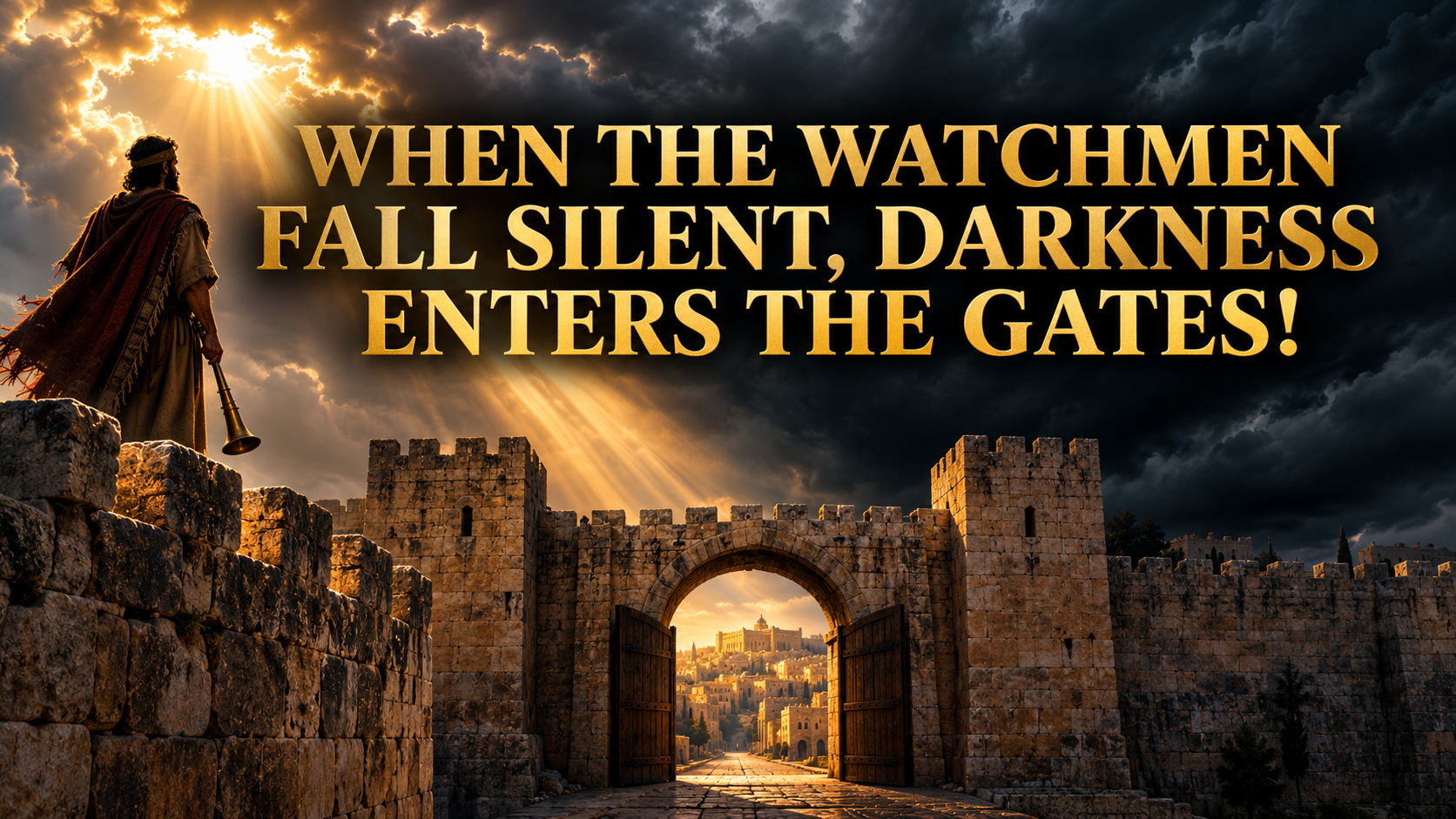
PART ONE — THE WARNING
Scripture Foundations: Jeremiah 6:16–17 | Ezekiel 33:1–9 | Isaiah 56:10–11 | Hebrews 5:14
Dr. Russell Welch — A Watchman & Voice to the Remnant
THE DANGEROUS SILENCE OF A COMPROMISED GENERATION
There is a dangerous silence spreading through portions of the American Church, and it is not the silence of prayer, reverence, or waiting upon the Lord. It is the silence that emerges when spiritual compromise becomes acceptable, when the fear of offending people becomes greater than the fear of grieving Holy Spirit, and when maintaining religious influence takes precedence over obedience to the Word of God. The tragedy confronting this generation is not simply that darkness continues to advance through society, but that some who were entrusted with spiritual responsibility have gradually abandoned their positions upon the walls. Their voices have grown faint, their discernment has become clouded, and the unmistakable sound of biblical conviction has too often been replaced by carefully managed messages designed to preserve acceptance. Yet the Lord has never commissioned His servants to become guardians of cultural approval. He has called them to remain faithful to His Word, regardless of the consequences.
Throughout biblical history, seasons of national and spiritual decline were frequently accompanied by the rejection of divine correction. Israel did not experience covenant judgment because Yahweh had neglected to speak, but because His people repeatedly refused to listen. The prophets were sent to expose idolatry, injustice, false worship, and covenant unfaithfulness, often confronting religious leaders who had convinced themselves that their institutions remained secure despite their disobedience. Jeremiah ministered during such a season, when outward religious activity continued even as the nation’s covenant faithfulness deteriorated. The temple remained standing, the sacrifices continued, and the language of devotion had not disappeared, yet the hearts of many had turned away from the Lord. This historical setting should cause the contemporary Ecclesia to examine whether visible religious activity has become an inadequate substitute for spiritual obedience.
We must recognize that the existence of religious institutions, impressive gatherings, expanding ministries, and influential personalities does not necessarily testify to the approval of Heaven. The risen Christ confronted the congregation in Sardis with a devastating assessment: they possessed a reputation for being alive while spiritually they were dead (Revelation 3:1). Such a warning was not directed toward a pagan nation but toward an assembly identified with His name. The significance should not escape us. It is possible to maintain an appearance of spiritual vitality while neglecting the very obedience that gives authentic Christian witness its substance. If the American Church desires genuine awakening, the first question cannot merely concern what is happening in Washington, Hollywood, universities, or the surrounding culture. We must first ask what is happening within the household of God.
1. THE WATCHMAN WAS APPOINTED TO RECOGNIZE DANGER AND SOUND THE WARNING
In Ezekiel 33:1–9, Yahweh presents the prophet with the familiar image of a watchman stationed over a city. In the ancient world, fortified cities depended upon vigilant observers who could recognize approaching threats before those threats reached the gates. A watchman who recognized danger but refused to sound the trumpet endangered the people entrusted to his warning. The responsibility was not to defeat an invading army single-handedly, nor was it to guarantee that everyone would respond appropriately. His assigned duty was to remain attentive, recognize the approaching danger, and communicate the warning faithfully. Yahweh then applies this illustration directly to Ezekiel’s prophetic commission, establishing the seriousness of delivering His message to a rebellious people.
The Hebrew word tsōp̄eh, commonly translated as watchman, carries the idea of one who observes, watches, or looks out from a position of responsibility. The imagery emphasizes attentiveness and accountability rather than the possession of some independent spiritual authority. Ezekiel was not authorized to manufacture warnings according to personal suspicion, political preference, or emotional reaction. His commission was explicitly connected to hearing the word from Yahweh and communicating what he had received (Ezekiel 33:7). This distinction is essential for contemporary prophetic ministry, particularly in a generation where speculation, sensationalism, and personal opinion are frequently presented as divine revelation. Authentic spiritual discernment must remain submitted to the revealed character of God, the authority of Scripture, and the government of Holy Spirit.
We should also recognize the immediate historical context of Ezekiel’s calling. The prophet ministered among the exiles during the crisis surrounding Jerusalem’s downfall, and his warnings addressed the covenant rebellion that had brought the nation toward catastrophe. The passage was not originally delivered as a general commission empowering every believer to pronounce judgment upon whatever cultural development they dislike. Nevertheless, its underlying principle of spiritual responsibility remains profoundly instructive. Those entrusted with teaching, shepherding, and spiritual oversight must never knowingly conceal biblical truth simply because its proclamation might produce opposition. James 3:1 reminds us that teachers face stricter judgment, while Acts 20:26–28 demonstrates Paul’s conviction that faithful ministry requires declaring the counsel of God and carefully guarding the flock purchased through Christ’s blood.
Here we discover something frequently misunderstood about the ministry of the watchman: a biblical warning is an expression of covenant love, not an opportunity for personal condemnation. Yahweh declares in Ezekiel 33:11 that He takes no pleasure in the death of the wicked, but desires that the wicked turn from their ways and live. The warning therefore reveals the mercy of God even while confronting the seriousness of sin. A watchman who delights in announcing destruction while showing no compassion for those endangered has misunderstood the heart of the One who commissioned him. We are not called to celebrate the failures of the Church or rejoice over the spiritual blindness of others. We are called to proclaim truth with tears when necessary, remembering that the ultimate purpose of divine correction is repentance, restoration, and reconciliation with God.
2. WHEN SPIRITUAL LEADERS FALL ASLEEP, THE FLOCK BECOMES VULNERABLE
Isaiah 56:10–11 contains one of Scripture’s most sobering indictments of negligent spiritual leadership. The prophet describes Israel’s watchmen as blind, lacking knowledge, and resembling sleeping dogs that cannot bark. He then exposes their insatiable appetites and their pursuit of personal advantage, showing that the problem was not merely insufficient information but a deeper corruption of spiritual responsibility. Those who should have been attentive to the condition of the people had become preoccupied with their own interests. The imagery is intentionally disturbing because a sleeping guardian provides little protection to those who assume he remains alert. When those responsible for recognizing danger become spiritually indifferent, the vulnerability extends beyond their individual lives to the people who trust their leadership.
This prophetic indictment raises a necessary question concerning the contemporary Church: Have we allowed measurable religious success to become our primary evidence of spiritual faithfulness? Attendance figures, financial resources, social media influence, building projects, and public recognition may reveal organizational effectiveness, but none of these measurements establishes that a ministry is faithfully representing Jesus Christ. Scripture identifies spiritual fruit through qualities such as love, holiness, faithfulness, humility, obedience, and transformed lives (Galatians 5:22–23; John 15:8). The early Ecclesia devoted itself to apostolic teaching, fellowship, breaking bread, and prayer, while the Lord Himself added those who were being saved (Acts 2:42–47). Their identity was rooted in belonging to Christ and living under His government, not in preserving an institution or constructing a religious reputation.
There is a profound difference between shepherding the flock of God and managing a religious audience. The shepherd carries responsibility for the spiritual welfare of those entrusted to his care, while the institutionally driven leader may gradually measure success according to loyalty, attendance, financial support, or public approval. These dangers are not confined to large congregations; they can corrupt small fellowships, independent ministries, and even those who identify themselves as the Remnant. Whenever the protection of a ministry’s reputation becomes more important than truthfulness, accountability, and repentance, spiritual leadership has begun to drift from its biblical foundation. Peter’s instruction to elders remains unmistakable: they are to shepherd God’s flock willingly, without greed or domineering control, becoming examples to those entrusted to them (1 Peter 5:2–4).
Yet we must be equally careful not to mistake constant criticism for spiritual vigilance. A person can spend years exposing the failures of religious institutions while neglecting the condition of his own heart. Some become so consumed with identifying compromise in others that bitterness, pride, suspicion, and spiritual superiority gradually take root within them. Biblical discernment does not grant permission to abandon the fruit of Holy Spirit, nor does prophetic responsibility excuse reckless accusations against fellow believers. Jesus warned against hypocrisy when correcting others, directing His disciples to address the obstruction in their own vision before attempting to assist their brother (Matthew 7:3–5). A watchman who cannot receive correction has become vulnerable to the very deception he claims to oppose.
3. THE TRAGEDY OF A PEOPLE WHO REFUSE THE ANCIENT PATHS
Jeremiah 6:16–17 records Yahweh’s appeal to a people approaching devastating consequences because of their persistent covenant rebellion. They were instructed to stand at the crossroads, examine the ancient paths, and walk in the good way where they would find rest for their souls. Their response was tragically direct: they refused to walk in that way. Yahweh also appointed watchmen who called them to heed the sound of the trumpet, yet the people declared that they would not listen. The issue was therefore not an absence of divine instruction but a settled resistance to the instruction already given. They possessed sufficient warning to recognize the direction of their spiritual decline, but they remained determined to continue along the path of their choosing.
The expression ancient paths must be understood within Jeremiah’s covenant setting. It does not mean that every older religious custom is automatically biblical or that returning to a previous generation’s church culture will necessarily produce spiritual restoration. Yahweh was calling His people back to covenant faithfulness, righteousness, justice, and obedience to the revelation they had already received. For the New Covenant Ecclesia, faithfulness to this principle requires returning continually to the Lord Jesus Christ, the testimony of the apostles, and the authoritative witness of Scripture. We cannot restore the ancient paths merely by changing the location of our gatherings, adopting Hebrew terminology, rejecting denominational labels, or replacing traditional structures with house fellowships. Genuine restoration occurs when a people surrender themselves to the Lordship of Christ and allow His Word and Spirit to govern their lives.
Jeremiah’s generation also demonstrates how religious confidence can become a dangerous substitute for genuine repentance. In Jeremiah 7, the prophet confronts those who placed their confidence in the temple while continuing practices that violated the covenant. They assumed that the presence of a sacred institution offered security even while their conduct contradicted the holiness of the God they claimed to worship. The warning is especially relevant wherever Christians become convinced that affiliation with a particular church, movement, denomination, or ministry guarantees spiritual legitimacy. The presence of biblical language does not establish biblical obedience, and the ability to proclaim correct doctrine does not excuse an unwillingness to practice it. Jesus Himself confronted this contradiction by asking why people called Him Lord while refusing to do what He commanded (Luke 6:46).
America is not ancient covenant Israel, and we must resist careless attempts to transfer every prophetic judgment pronounced upon Jerusalem directly onto the United States. Nevertheless, the moral and spiritual principles revealed in these passages demand serious consideration from believers in every nation. When Christians normalize what Scripture identifies as sin, excuse exploitation because the offender possesses religious influence, or surrender biblical conviction to maintain cultural acceptance, they demonstrate the same dangerous willingness to place something above obedience to God. The proper response is neither nationalistic triumphalism nor the presumption that we can announce a specific divine timetable for America’s judgment. It is humble repentance, renewed holiness, courageous witness, and an unwavering commitment to the Gospel of the Kingdom.
The question facing the American Ecclesia is therefore much deeper than whether society is becoming increasingly hostile to biblical Christianity. The question is whether those who claim allegiance to Jesus Christ are willing to remain faithful when obedience produces rejection, misunderstanding, or personal loss. The apostles understood this conflict when religious authorities commanded them to stop speaking in the name of Jesus. Peter and John answered that they could not remain silent concerning what they had seen and heard (Acts 4:18–20). Their courage did not emerge from a desire for confrontation or a campaign to establish religious dominance. It arose from their encounter with the resurrected Christ, their submission to His authority, and the empowering presence of Holy Spirit.
4. RESTORING BIBLICAL DISCERNMENT TO THE SPIRIT-GOVERNED ECCLESIA
Hebrews 5:14 teaches that mature believers develop their powers of discernment through consistent practice in distinguishing good from evil. The surrounding passage rebukes spiritual immaturity among those who should have progressed beyond elementary instruction, revealing that discernment is closely connected to growth in understanding and obedience. The Greek term aisthētēria, translated as faculties or senses, conveys the capacity for perception, while gegymnasmena, describing their trained condition, emphasizes discipline through use. Spiritual maturity does not develop simply because a believer has accumulated years of religious experience or acquired an impressive vocabulary of prophetic terminology. Discernment is cultivated as the believer becomes increasingly grounded in the Word, responsive to Holy Spirit, and practiced in applying divine truth to actual decisions and circumstances.
This understanding challenges a dangerous tendency within contemporary prophetic culture: the assumption that confidence, intensity, emotional expression, or extraordinary spiritual claims automatically demonstrate divine authority. Scripture repeatedly instructs believers to test what they hear. First John 4:1 warns against believing every spirit, while 1 Thessalonians 5:19–22 holds together two responsibilities that must never be separated: believers must not despise prophetic utterances, yet they must test everything and hold firmly to what is good. The solution to spiritual deception is neither unquestioning acceptance nor wholesale rejection of the supernatural ministry of Holy Spirit. The biblical solution is mature discernment exercised within a community governed by Scripture, humility, accountability, and the Lordship of Jesus Christ.
We must also recover the distinction between spiritual warfare and cultural hostility. Paul declares that our struggle is not against flesh and blood but against spiritual powers of darkness (Ephesians 6:12). Consequently, the unbeliever, political opponent, struggling Christian, or deceived religious leader must never become the ultimate object of our hostility. Our assignment is to stand against the schemes of the devil while proclaiming the reconciling Gospel of Jesus Christ. Paul instructs Timothy that the Lord’s servant must not be quarrelsome but must correct opponents with gentleness, hoping that God will grant repentance leading to the knowledge of truth (2 Timothy 2:24–26). Such instruction does not weaken prophetic courage; it purifies the motives through which that courage operates.
If discernment is to be restored to the Ecclesia, repentance must begin among those who teach, lead, and claim to speak on behalf of God. We cannot demand holiness from the congregation while excusing pride, greed, manipulation, immorality, or spiritual abuse among its leaders. Neither can we call the Church out of religious systems while secretly reproducing the same patterns of control under different names. The New Testament reveals an Ecclesia composed of living stones being built together into a spiritual house, with Jesus Christ Himself as the cornerstone (Ephesians 2:19–22; 1 Peter 2:4–5). This dwelling place of God is not sustained by celebrity personalities, financial dependency, institutional intimidation, or unquestioning allegiance to human authority. Its life flows from union with Christ through Holy Spirit, and its members are called to grow together into maturity under the authority of their risen Lord.
There is genuine hope for a generation willing to return to this foundation. Jesus has not surrendered His Ecclesia to the schemes of darkness, nor has the failure of human leadership diminished His authority as the Head of the Church. He continues to call His people to repentance, holiness, faithfulness, and the work of making disciples among the nations. The answer to compromised Christianity is not another movement built around human dissatisfaction but a people increasingly conformed to the image of Jesus Christ. When Scripture once again becomes the governing authority, prayer becomes communion rather than performance, spiritual gifts operate in love and accountability, and discipleship produces obedient followers rather than religious spectators, the Ecclesia begins to demonstrate the life she was created to carry.
THE CHARGE TO THE REMNANT — RETURN TO YOUR ASSIGNED POSITION
Remnant of the Lord, this is not the hour to become consumed with outrage while neglecting the altar of personal surrender. We do not need another generation of self-appointed critics who can identify every failure of the institutional Church while remaining unwilling to submit their own lives to the searching work of Holy Spirit. We need men and women whose convictions have been formed in Scripture, whose motives have been purified through repentance, and whose courage emerges from communion with Jesus Christ. We need shepherds who love the flock more than their reputations, teachers who treasure truth above applause, and watchmen who understand that the purpose of sounding the alarm is to awaken people to the mercy and righteousness of God.
The responsibility of the watchman has never been permission to abandon compassion, humility, or accountability. Ezekiel’s commission reminds us that speaking truth carries responsibility, while the life of Jesus demonstrates what perfect faithfulness looks like when truth and grace are fully revealed together. Our Lord confronted hypocrisy, exposed religious corruption, and refused to compromise the Father’s will, yet He also wept over Jerusalem and willingly gave His life for sinners. He did not merely warn humanity about the consequences of darkness; He entered our broken condition, bore our sins upon the cross, and rose victorious over death. Every authentic Christian warning must ultimately direct people toward this glorious Savior, because without Christ our strongest declarations possess no power to redeem.
Therefore, let the awakening begin in the household of God, and let it begin with us. Let every leader examine whether he has exchanged spiritual responsibility for personal security, and let every believer consider whether fear of rejection has silenced his testimony. Let those who claim prophetic insight submit their words to the Scriptures, and let those who have been wounded by religious hypocrisy resist the temptation to allow bitterness to become their new identity. We are not called to establish another religious empire upon the ruins of a previous one. We are called to bear witness to the Kingdom that cannot be shaken, to make disciples who obey Jesus Christ, and to become a holy people among whom the Father is pleased to dwell by His Spirit.
The question before us is no longer simply whether the American Church can recognize the darkness advancing around her. The more searching question is whether we have become so accustomed to compromise that we are unwilling to confront what the light of God’s Word has already exposed.
May the Lord restore our spiritual sight, purify our motives, strengthen our obedience, and awaken faithful watchmen who will speak His truth without surrendering His heart. May we never confuse popularity with divine approval, religious activity with spiritual maturity, or prophetic intensity with the authority that comes from abiding in Christ. Above every warning, every ministry, every movement, and every human voice stands Jesus Christ, the faithful and true Witness, the Chief Shepherd, and the only Head of His Ecclesia.
To Him alone belong the glory, the honor, the dominion, and the praise.
COMING NEXT — PART TWO: THE CALLING
HEAVEN IS RAISING MODERN-DAY JEREMIAHS WHO WILL NOT BOW TO RELIGIOUS COMPROMISE!
Before a watchman can faithfully confront the darkness gathering outside the walls, Heaven must first deal with what is happening inside the watchman. Jeremiah’s calling reveals that genuine prophetic ministry begins not with public recognition but with divine initiative, personal surrender, costly obedience, and an encounter with the Word of the Lord that cannot be silenced by human opposition. In Part Two, we will examine the formation of authentic watchmen, the burden of speaking truth in an age of compromise, and the holiness required of those who claim to represent the voice of God.
Jeremiah 1:4–10 | Jeremiah 20:7–9 | Acts 4:18–20
GO DEEPER — RESTORING GOD’S WATCHMEN
The burden of restoring biblical watchmen is not merely a subject I teach; it is a conviction the Lord has cultivated within me through years of studying His Word, examining the prophetic ministry of Jeremiah, and witnessing the growing need for spiritual discernment within the contemporary Church. We are living in a generation that desperately needs men and women who will recognize the voice of the Shepherd, discern the schemes of darkness, and possess the courage to stand faithfully upon the walls without surrendering to religious compromise or cultural pressure. Yet before we can faithfully carry such responsibility, we must understand the character, calling, preparation, and spiritual accountability required of those who claim to speak on behalf of the Lord.
In my book, Restoring God’s Watchmen: Modern-day Jeremiah’s Walking in the Authority & Power of His Glory, I examine the biblical foundations of the watchman’s calling and the urgent necessity of restoring this responsibility within Christ’s Ecclesia. Drawing upon the lives of Jeremiah and other biblical witnesses, this work challenges believers to move beyond passive Christianity, religious conformity, and spiritual complacency into a life governed by Holy Spirit and surrendered to Jesus Christ. My prayer is that its pages will not simply increase your understanding of prophetic ministry but stir within you a deeper hunger for holiness, a greater love for the truth, and an unwavering commitment to faithfully represent the King and His Kingdom.
Available on Amazon:
Restoring God’s Watchmen: Modern-day Jeremiah’s Walking in the Authority & Power of His Glory
Dr. Russell Welch
A Watchman & Voice to the Remnant
Remnant Warrior Ministries
Kingdom War College
Radical Disciples
All glory, honor, and praise belong to Jesus Christ, our Lord and King!

