Part Two of the Demonic Designs Series
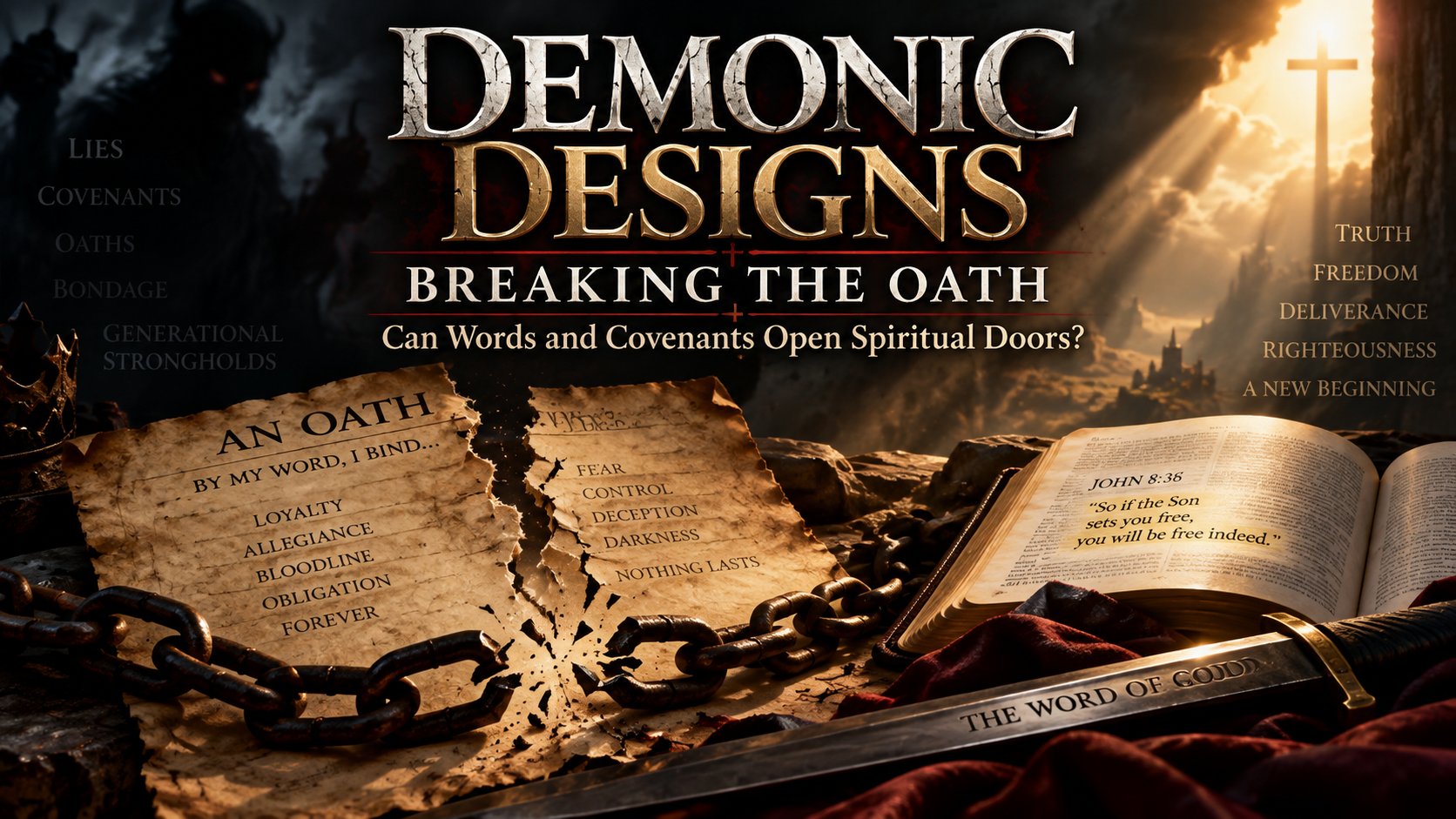
There are moments when the Church becomes so determined to avoid sensationalism that it begins dismissing things Scripture clearly treats as serious. Oaths, vows, covenants, agreements, and spoken allegiances fall into that category. Modern culture often treats words as ceremonial or symbolic, but Scripture repeatedly presents words as expressions of agreement, responsibility, identity, and allegiance.
That does not mean every careless statement creates some kind of spiritual contract. Scripture does not teach believers to live in fear of accidentally speaking themselves into bondage. It does, however, show that deliberate vows, sworn loyalties, covenantal language, spiritual invocations, and formal pledges should never be treated casually. When a person knowingly binds himself through an oath, especially one connected to secrecy, spiritual symbolism, or divided allegiance, the matter deserves biblical examination.
Jesus addressed the seriousness of speech when He warned that people would give account for careless words in Matthew 12:36–37. James later instructed believers not to swear casually, but to let their yes be yes and their no be no. Ecclesiastes 5:4–5 also warns against making vows lightly. These passages are not teaching superstition. They are revealing that words carry moral and spiritual weight because words reveal the heart and often establish agreement.
THE BIBLE DOES NOT TREAT COVENANT LANGUAGE AS EMPTY SPEECH
Covenant runs throughout the entire biblical story. God established covenants with Noah, Abraham, Israel, David, and ultimately with His people through Jesus Christ. Biblical covenant is not merely a promise. It establishes relationship, obligation, belonging, identity, and authority.
That is why any ritual involving vows, sworn loyalty, hidden knowledge, penalties, spiritual witnesses, or binding secrecy should concern a follower of Christ. The issue is not whether the participant personally considers the ceremony meaningful. The issue is whether the language and structure of the ceremony carry the kind of covenantal weight Scripture warns believers to handle carefully.
Exodus 23:32 warned Israel not to make covenants with pagan nations or their gods. The danger was not merely political association. God understood that covenant could become a pathway into compromise, participation, and eventually worship. Israel’s history repeatedly demonstrates this pattern. What began as accommodation often became agreement, and agreement eventually reshaped obedience.
The same principle still matters. Believers should not assume that participation becomes spiritually harmless simply because a ritual is ancient, respected, symbolic, charitable, or socially accepted. Scripture teaches us to examine what we are agreeing with, what we are affirming, and where our allegiance is being directed.
AGREEMENT HAS SPIRITUAL CONSEQUENCES
Amos 3:3 asks, “Can two walk together, except they be agreed?” The immediate context concerns agreement between God and His prophet, but the principle remains clear. Agreement influences direction. What a person repeatedly agrees with will eventually shape the path he walks.
Paul makes a similar distinction in 1 Corinthians 10 when addressing pagan sacrificial systems. He explains that believers could not drink the cup of the Lord and the cup associated with demons. Paul was not claiming that meat itself possessed supernatural power, because elsewhere he makes clear that an idol is nothing. His concern was participation, fellowship, identification, and divided spiritual allegiance.
That distinction is important. Christians should not fear objects, symbols, buildings, or ceremonies as though they possess independent authority. At the same time, believers should not ignore the spiritual meaning of willingly entering fellowship with systems that use religious language, invoke spiritual ideas, or demand allegiance that conflicts with Christ.
Paul asks in 2 Corinthians 6:15–16 what agreement the temple of God has with idols. His language is relational and covenantal. The believer belongs to Christ, has been bought with a price, and is the temple of the Holy Spirit. Because of that, the believer should not seek spiritual identity through competing oaths, secret rites, mystical brotherhoods, or religious systems.
THE LORDSHIP OF CHRIST DOES NOT SHARE THE THRONE
Romans 10:9 declares that salvation includes confessing Jesus as Lord. That confession is far more than a conversion formula. It is a declaration of government. Jesus Christ becomes the believer’s highest authority, deepest allegiance, and final standard of truth.
This is why the early Christians faced persecution when they refused to confess Caesar as lord. Rome was willing to tolerate many religions, but the Christian confession created a collision of authority. The issue was not merely private belief. The issue was ultimate allegiance.
The same principle must govern believers today. Anything that asks for an allegiance that competes with Christ should be examined carefully. Any ceremony that requires secrecy, loyalty, spiritual submission, brotherhood, or obedience that cannot be brought openly beneath Scripture deserves scrutiny.
Jesus said in Matthew 6:24 that no one can serve two masters. His immediate subject was God and wealth, but the principle of divided mastery is unmistakable. Christ does not negotiate His lordship. A believer may belong to civic organizations, professional associations, clubs, fraternities, or other forms of community without automatically violating Scripture, but the moment participation requires spiritual compromise, the issue changes.
WHY SECRET OATHS SHOULD CONCERN BELIEVERS
Secrecy by itself is not automatically sinful. Governments protect confidential information, pastoral counseling requires discretion, and private matters do not always belong in public view. The biblical concern begins when secrecy is enforced through spiritual obligation, sworn loyalty, symbolic penalty, or a demand for obedience that supersedes truth.
Jesus consistently brought darkness into the light. John 3:20–21 describes evil as avoiding the light because exposure reveals its deeds. Paul similarly instructed believers in Ephesians 5:11 to have no fellowship with the unfruitful works of darkness, but rather to expose them.
Christianity is fundamentally open in its proclamation. The Gospel is preached publicly. Scripture is available for examination. Baptism publicly identifies the believer with Christ. Communion openly proclaims the Lord’s death. Christian doctrine is not reserved for progressively initiated elites who gain hidden truth through secret levels of spiritual advancement.
That does not mean every organization with private ceremonies is automatically demonic. It does mean secrecy becomes spiritually dangerous when increasing allegiance is demanded while increasing truth is withheld. No believer should be asked to bind himself to something before fully understanding what he is being asked to affirm.
WHAT ABOUT OATHS ALREADY TAKEN?
This is where balance matters. One error says that because Jesus defeated Satan at the Cross, a believer never needs to address former spiritual agreements. The opposite error teaches that Christians remain trapped until they identify and verbally cancel every possible curse, vow, ancestral covenant, symbolic act, or forgotten spiritual association.
Neither extreme reflects the emphasis of the New Testament.
The Cross is completely sufficient. Colossians 2:13–15 declares that Christ forgave us, canceled the record against us, and disarmed principalities and powers. The believer does not defeat darkness through superior ritual language. Jesus Christ has already triumphed.
At the same time, Scripture repeatedly shows believers making practical breaks with their former way of life. Acts 19 records believers in Ephesus publicly destroying books associated with magical practices. Their freedom did not come from the fire consuming the books. Their freedom came from Christ, but their repentance produced a visible separation from the system they had left behind.
That is an important distinction. Repentance is not merely feeling regret. Biblical repentance changes direction. When someone recognizes that a former oath, ritual, organization, or allegiance contradicted the Lordship of Christ, renouncing that agreement can become a clear expression of repentance and renewed obedience.
RENUNCIATION IS NOT MAGIC
Some deliverance teaching has made renunciation unnecessarily complicated. People are sometimes told that unless they identify every hidden ancestral oath, every generational agreement, every forgotten declaration, and every spiritual technicality, demons still retain legal rights over their lives. That kind of teaching can create fear, introspection, and obsession instead of freedom.
The New Testament does not teach believers to spend their lives searching family histories for hidden curses. Its emphasis is on repentance, faith, truth, obedience, renewal of the mind, and submission to Christ. Renunciation is not a magic formula. It is simply the verbal expression of a changed allegiance.
A person who practiced witchcraft may openly reject witchcraft because Jesus Christ is now Lord. Someone who belonged to an occult group may renounce the vows and spiritual practices associated with that group. Someone who participated in a secret fraternity may reject any oath, doctrine, ritual, or spiritual allegiance that contradicts Scripture.
The power is not in the wording. The power is in Christ. The declaration matters because it gives voice to repentance, truth, and renewed allegiance.
THE BLOOD OF JESUS SPEAKS A BETTER WORD
Hebrews 12:24 says that the blood of Jesus speaks better things than the blood of Abel. Abel’s blood cried out concerning injustice, while the blood of Christ proclaims redemption, reconciliation, forgiveness, and covenant.
This truth should completely change the way believers think about former spiritual agreements. A Christian does not renounce a past oath because Satan possesses equal authority to Christ. A Christian renounces it because Jesus has established a greater covenant.
At the Last Supper, Jesus declared that the cup represented the New Covenant in His blood. That means the believer’s identity is not finally defined by old agreements, former affiliations, sinful vows, secret ceremonies, or past deception. The believer is defined by the covenant established through Christ.
No secret oath outranks the blood of Jesus. No ritual allegiance possesses greater authority than the Lordship of Christ. No former agreement is stronger than Calvary.
BREAKING AGREEMENT BEGINS WITH TRUTH
Jesus said in John 8:31–32 that those who continue in His word will know the truth, and the truth will make them free. Spiritual freedom is not built upon fear of demons. It grows through agreement with truth.
That is why anyone examining former participation in a questionable spiritual system should begin with Scripture rather than sensational stories. The important questions are straightforward. Did the organization require an oath? Did it require sworn secrecy or allegiance? Did it invoke spiritual language, penalties, religious symbols, other gods, spiritual intermediaries, or concepts contrary to biblical Christianity? Did participation require affirming something that conflicted with the Lordship of Christ?
If the answer is yes, the response does not need to become complicated. Confess the compromise before God, renounce the agreement, withdraw from ongoing participation, affirm the Lordship of Jesus Christ, and remove anything that still represents intentional spiritual allegiance to the former system.
Then move forward in freedom.
Believers should not spend years wondering whether some forgotten word or overlooked technicality still holds them captive. Christ did not save His people into a new form of bondage where they live terrified of their past. Jesus said that if the Son makes you free, you are free indeed.
CHRISTIANS SHOULD NOT LIVE TERRIFIED OF CURSES
Fear-based teaching often gives curses more attention than Christ. It can leave believers more conscious of demons, bloodlines, rituals, symbols, and hidden agreements than they are of the finished work of Jesus.
That is not healthy spiritual warfare.
Galatians 3:13 declares that Christ redeemed us from the curse of the law by becoming a curse for us. Colossians 1:13 says that God has delivered believers from the power of darkness and transferred them into the kingdom of His Son. These passages establish the believer’s position.
This does not mean Christians should deliberately participate in darkness because grace will protect them. Paul rejected that kind of reasoning in Romans 6. Grace calls believers into holiness and obedience. Freedom in Christ is not permission to compromise.
At the same time, Christians should refuse to live as though every symbol, handshake, ceremony, ancestor, word, or former mistake possesses more authority than Jesus. Christ is Lord, and that confession must remain the center of Christian spiritual warfare.
THE REAL BATTLE IS OVER ALLEGIANCE
The deeper issue behind spiritual oaths is not merely vocabulary. The deeper issue is allegiance.
Throughout Scripture, the enemy continually seeks to redirect worship, loyalty, identity, and obedience away from God. Sometimes that comes through obvious idolatry. At other times it comes through power, secrecy, ambition, spiritual curiosity, brotherhood, ideology, tradition, or the desire to belong.
The appearance changes, but the strategy remains consistent. Darkness seeks agreement.
That is why spiritual warfare cannot be reduced to shouting at demons or performing deliverance rituals. Paul writes in 2 Corinthians 10:4–5 that the weapons of our warfare are mighty through God for pulling down strongholds, casting down arguments, and bringing thoughts into obedience to Christ. The battlefield includes beliefs, arguments, knowledge, imagination, agreement, and obedience.
Many strongholds survive because people continue agreeing with lies. Freedom begins when those lies are exposed, rejected, and replaced with truth.
SECRET SYSTEMS MUST BE TESTED BY SCRIPTURE
Christians should not become conspiracy-driven, but neither should they become spiritually naive. Scripture gives believers a clear standard for examination.
First John 4:1 instructs believers not to believe every spirit, but to test the spirits. First Thessalonians 5:21 says to test all things and hold fast what is good. Biblical discernment requires examination rather than assumption.
That means every spiritual claim should be tested. Every ceremony should be tested. Every oath should be tested. Every doctrine should be tested. Every demand for allegiance should be tested.
Discernment is not paranoia. Discernment asks whether something agrees with Scripture, exalts Jesus Christ, produces righteous fruit, and keeps the believer’s allegiance undivided.
An organization may possess respected members, impressive buildings, charitable programs, historical prestige, and elaborate ceremonies. None of those things prove spiritual truth. Appearance has never been the final biblical standard.
Truth is.
BREAKING THE OATH
If you have participated in a ritual, organization, spiritual practice, or secret system that required vows contrary to your allegiance to Jesus Christ, you do not need to respond with fear. You need to respond with truth.
Bring the matter honestly before the Lord. Repent of any compromise. Renounce what contradicted Scripture. Withdraw from any continuing participation that divides your allegiance. Forgive anyone who misled or pressured you. Then stand confidently in the covenant established through the blood of Jesus.
Your identity is not determined by an old oath. Your future is not controlled by a past ritual. Your spiritual standing is not defined by a former organization. You were bought with a price, and if you belong to Jesus Christ, your highest allegiance now belongs to Him.
A PRAYER OF RENUNCIATION
Father, I come before You in the name of Jesus Christ, acknowledging Jesus as my Lord, my Savior, and my highest authority. I repent of every oath, agreement, vow, ritual, or spiritual allegiance I knowingly entered that contradicted Your Word or divided my loyalty to Christ.
I renounce every agreement that competes with my covenant relationship with Jesus. I reject every former declaration, spiritual association, or act of allegiance that was contrary to His Lordship. I do not place my confidence in a formula, but in the finished work of Jesus Christ.
Thank You that through the blood of Jesus I have been forgiven, redeemed, and brought into the New Covenant. My identity, loyalty, worship, and obedience belong to Christ. Holy Spirit, expose anything in my life that remains out of alignment with Your truth, and give me the courage to walk away from anything that dishonors Jesus.
I declare that Jesus Christ is Lord over my life, my home, my family, and my future. I choose truth, obedience, and undivided allegiance to Him. In Jesus’ name, amen.
COMING IN PART THREE
The final article in this series will move from the biblical principles of covenant, agreement, and allegiance into a direct examination of Freemasonry itself. We will look more closely at its rituals, symbols, degrees, spiritual language, secrecy, and theological claims, and we will compare those elements with the exclusive Lordship of Jesus Christ.
The question at the center of Part Three will be simple but unavoidable: Can a follower of Jesus Christ participate in Freemasonry without compromising biblical allegiance to Christ?
That question should not be answered through rumor, emotional reaction, family tradition, cultural respectability, or conspiracy theories. It should be answered by bringing the system into the light of Scripture and allowing truth to speak for itself.
The Remnant was not refined merely to survive the changing world.
We were prepared to carry Heaven’s answer into it.
— Dr. Russell Welch
A Watchman & Voice to the Remnant
Dr. Russell Welch is a published author, prophetic teacher, apostolic builder, and founder of faith-driven publishing and media initiatives. He is known for crafting bold, Kingdom-centered messages that call the Ecclesia into maturity, doctrinal clarity, and governmental authority. With a passion for equipping the Remnant and honoring generational legacy, Dr. Welch writes and teaches at the intersection of Scripture, history, and spiritual governance, challenging believers to live as sons and daughters who legislate Heaven on earth through truth, holiness, and unwavering fidelity to Christ.
If you are ready to examine Freemasonry through the light of Scripture and seek greater biblical clarity concerning its spiritual implications, Demonic Designs: The Christian’s Guide to Unmasking Freemasonry is available now.
When allegiance is divided, freedom begins by bringing every oath into the light of Christ.
Get your copy here: https://www.amazon.com/dp/1964155215
 Radical Disciples - A Remnant Revolution