RADICAL DISCIPLES — A REMNANT REVOLUTION
Revival Series
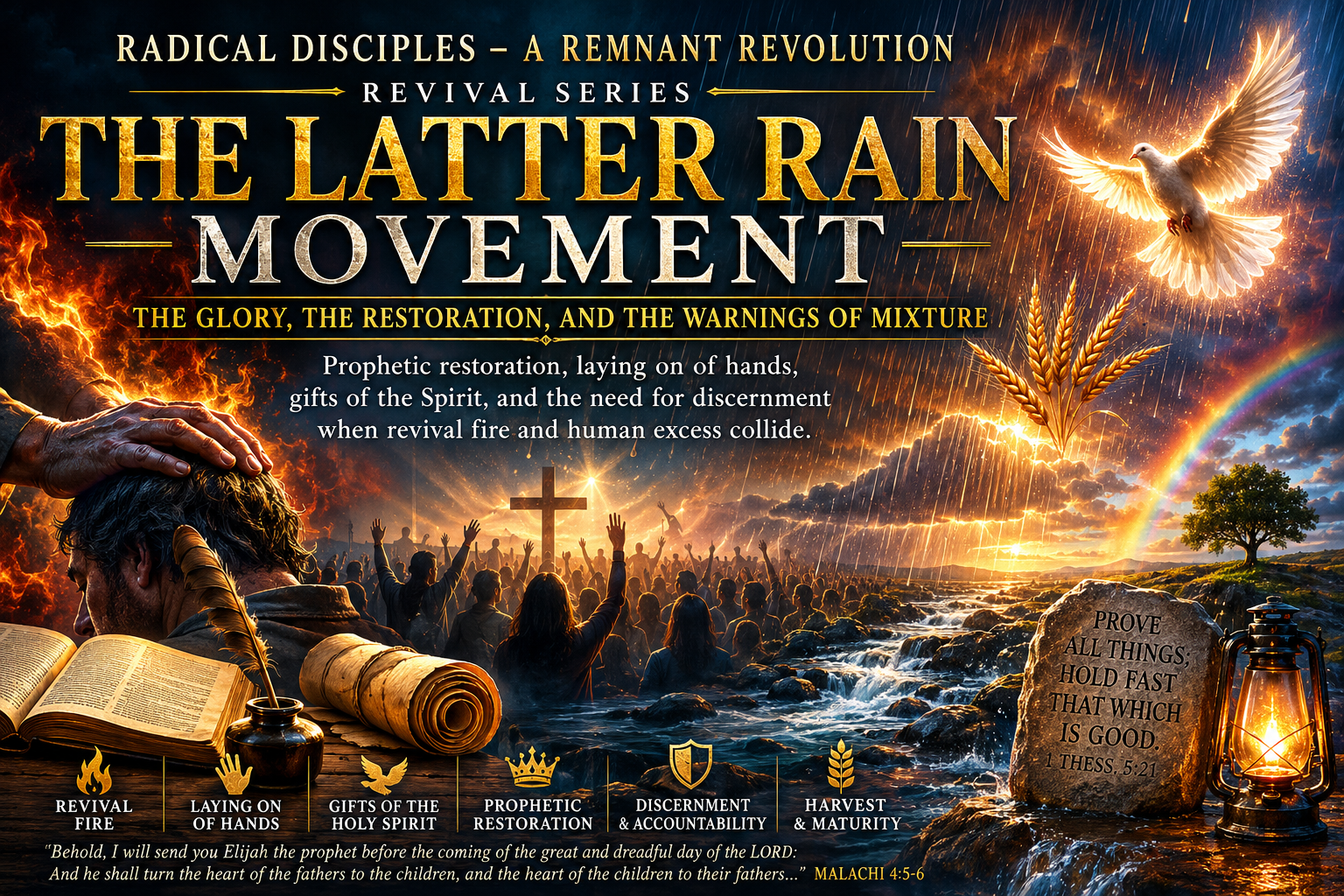
The Glory, the Restoration, and the Warnings of Mixture
Prophetic restoration, laying on of hands, gifts of the Spirit, and the need for discernment when revival fire and human excess collide.
INTRODUCTION: WHEN HUNGER AND DISCERNMENT MUST WALK TOGETHER
Revival history must be approached with both hunger and sobriety. It is possible to honor what God restored through a movement without defending everything that eventually became associated with it. It is equally possible to identify doctrinal errors and human excesses without denying that sincere believers were seeking the presence and power of God. Mature discernment refuses the easy extremes of either romanticizing every manifestation or dismissing every spiritual experience. It asks where the Holy Spirit was genuinely at work, where biblical truth was recovered, where human ambition entered, and what the Church must learn from the mixture.
The Latter Rain Movement remains one of the clearest examples of this tension. Emerging in the aftermath of the Second World War, it carried a passionate expectation that God was restoring neglected dimensions of New Testament Christianity before the return of Jesus Christ. Its adherents emphasized prophecy, spiritual gifts, healing, the laying on of hands, spontaneous worship, the equipping of the saints, and the restoration of apostolic and prophetic ministry. Many of these subjects had either been neglected or confined within narrow denominational structures. The movement therefore appeared to many spiritually hungry believers as a fresh wind of restoration.
Yet the same movement also became associated with serious problems. Prophetic words were sometimes treated as unquestionable divine decrees. Leaders could exercise authority without sufficient accountability. Biblical truths concerning spiritual maturity were occasionally expanded into exaggerated teachings concerning perfected end-time believers. The laying on of hands could be treated as though gifts and offices were mechanically transmitted by human decree. The language of restoration sometimes produced elitism, and the expectation of supernatural power sometimes outran the formation of Christlike character.
The history of the Latter Rain Movement must therefore be studied as both a testimony and a warning. It reminds the Church that God does restore neglected truth, but it also demonstrates that genuine spiritual hunger does not eliminate the possibility of error. Revival fire must burn upon a biblical altar. The Holy Spirit never asks the Church to choose between power and truth, for He is the Spirit of both.
THE POSTWAR PENTECOSTAL SETTING
The Latter Rain Movement arose during a period of profound cultural and spiritual transition. The Second World War had left nations devastated, societies disoriented, and millions of people searching for meaning in the aftermath of extraordinary human suffering. Within the Church, Pentecostalism had already moved beyond its early beginnings and had developed denominations, educational institutions, missionary organizations, and established patterns of church government. This growth brought stability and legitimacy, but some believers feared that Pentecostal institutions were beginning to preserve the memory of revival more faithfully than the living experience of it.
Early Pentecostalism had been marked by prayer, spiritual hunger, expectation, sacrifice, missionary zeal, and an intense conviction that the gifts recorded in the New Testament remained available to the Church. By the 1940s, however, some younger ministers believed that institutional Pentecostalism had become cautious, predictable, and resistant to further restoration. They did not necessarily reject the earlier Pentecostal movement. Rather, they believed that Pentecostalism had stopped short of everything God intended to restore.
This dissatisfaction must be understood within the larger restorationist impulse that has repeatedly appeared throughout Church history. Restorationist movements begin with the conviction that some dimension of apostolic Christianity has been obscured, neglected, or lost and must therefore be recovered. Such movements can call the Church back to biblical truth, but they can also become dangerous when their leaders assume that they alone represent the final or complete work of God.
In February 1948, a revival emerged among teachers and students associated with Sharon Orphanage and Schools in North Battleford, Saskatchewan. The atmosphere had been prepared through prayer, fasting, Bible study, and exposure to the healing revival then taking place in North America. Participants reported prophetic utterances, healings, spiritual gifts, and intense experiences of the presence of God. The meetings soon drew ministers and seekers from outside the immediate community, and the teachings associated with the revival began spreading through independent Pentecostal congregations and ministerial networks.
The movement came to be called the “Latter Rain,” drawing upon the agricultural imagery found in the prophets. Its leaders and supporters believed that the outpouring at Pentecost had been an early rain connected to the planting of the Church, while a latter rain would prepare the Church for maturity and the final harvest at the end of the age. This interpretation produced a powerful sense of eschatological urgency. Participants believed they were not merely experiencing another local awakening but were witnessing the beginning of a divine restoration that would prepare the Body of Christ for the consummation of God’s purposes.
THE BIBLICAL IMAGERY OF THE LATTER RAIN
The expression “latter rain” arises from the agricultural rhythms of ancient Israel. The early rain softened the ground for planting, while the latter rain helped bring the crop toward maturity before harvest. Because Israel’s life depended upon these seasonal rains, the prophets could use the imagery to describe divine blessing, restoration, and covenant faithfulness.
Joel declared:
“Be glad then, ye children of Zion, and rejoice in the LORD your God: for he hath given you the former rain moderately, and he will cause to come down for you the rain, the former rain, and the latter rain.”
— Joel 2:23
The prophecy continues with the promise that God would pour out His Spirit upon all flesh, producing prophetic speech, dreams, and visions among sons and daughters, young and old, servants and handmaidens. On the Day of Pentecost, Peter interpreted the outpouring of the Holy Spirit through Joel’s prophetic language, declaring that the extraordinary events occurring in Jerusalem were connected to what the prophet had spoken.
The Latter Rain Movement correctly recognized that the Church must remain expectant for the activity of the Holy Spirit. Scripture does not present the Spirit as a theological concept to be confessed while His gifts, voice, and power are functionally excluded from congregational life. The New Testament Church was born in an atmosphere of divine visitation and remained dependent upon the Spirit for witness, direction, sanctification, ministry, and mission.
Nevertheless, great caution is required when turning biblical imagery into a rigid historical timetable. Joel’s prophecy found a decisive fulfillment at Pentecost, as Peter explicitly declared. While Scripture certainly teaches continued outpouring, refreshing, awakening, and spiritual empowerment, the distinction between an apostolic “early rain” and a separate end-time “latter rain” should not be treated as though every detail of that framework were plainly stated in the biblical text. Theological systems must be built upon careful exegesis rather than spiritual excitement.
The central truth remains secure: God pours out His Spirit, restores His people, and prepares a harvest. Yet the Church must resist constructing speculative doctrines that go beyond what Scripture clearly establishes. Biblical imagery may illuminate the activity of God, but it must not become a foundation for claims that cannot withstand careful examination.
THE RECOVERY OF THE MINISTRY OF THE BODY
One of the most important contributions associated with the Latter Rain Movement was its renewed emphasis upon the active participation of the whole Body of Christ. In many congregations, ministry had gradually become concentrated in the hands of a few ordained leaders. The pastor preached, prayed, counseled, visited, administered, and carried nearly every visible responsibility, while the congregation gathered primarily to listen and receive.
The New Testament presents a much broader vision. Paul taught that manifestations of the Spirit are given to believers for the common good and that every member of the Body has a function. The gathered Church was intended to be more than an audience watching a gifted minister. Believers were to bring psalms, teachings, revelations, tongues, interpretations, prayers, encouragement, service, and spiritual gifts under the ordered government of the Holy Spirit.
Paul wrote:
“But the manifestation of the Spirit is given to every man to profit withal.”
— 1 Corinthians 12:7
This principle challenged passive Christianity. The Latter Rain emphasis helped awaken believers to the conviction that the Holy Spirit desired to operate through the whole congregation. Prophecy was not restricted to the pulpit. Prayer for healing did not belong exclusively to a recognized evangelist. Worship was not merely a preliminary exercise before the sermon. The saints themselves were to be equipped and activated for the work of ministry.
This recovery would influence later charismatic and independent church movements, many of which embraced participatory worship, small-group ministry, healing prayer, prophetic encouragement, and the equipping of ordinary believers. The underlying biblical principle was sound: every believer has been called into the life and mission of Christ, and the gifts of the Spirit are distributed according to the sovereign will of God rather than human rank.
However, the recovery of participation must remain joined to order, maturity, and accountability. Paul’s correction of the Corinthian church demonstrates that spiritual participation can become chaotic when personal expression is not governed by love. The apostle did not silence spiritual gifts, but neither did he permit believers to exercise them without restraint. His instruction was that everything should be done unto edification and that the spirits of the prophets were subject to the prophets.
The Spirit does not produce disorder under the excuse of spontaneity. A genuine manifestation of God does not remove personal responsibility. The believer remains accountable for how, when, and why a gift is exercised. The recovery of congregational ministry is therefore not permission for every impulse to be presented as revelation. It is an invitation for the Body to mature in discerning and stewarding what the Holy Spirit gives.
PROPHECY AND THE RESTORATION OF THE VOICE OF GOD
Prophetic ministry occupied a central place within the Latter Rain Movement. Its advocates believed that God was restoring prophecy as a normal expression of the Spirit’s work within the Church. This challenged theological traditions that had either confined prophecy to the writing of Scripture or reduced it to inspired preaching.
The New Testament plainly teaches that prophecy continued within the apostolic Church. Prophets ministered in Antioch, Agabus foretold a coming famine, Philip’s daughters prophesied, and Paul devoted substantial attention to the proper exercise of prophetic gifts in Corinth. He wrote that prophecy speaks unto people for “edification, and exhortation, and comfort,” and he instructed believers not to despise prophetic utterances.
At the same time, Paul immediately joined openness to testing:
“Despise not prophesyings. Prove all things; hold fast that which is good.”
— 1 Thessalonians 5:20–21
These instructions establish the necessary balance. Prophecy must not be despised, but neither must it be accepted indiscriminately. The Church is not permitted to choose between spiritual receptivity and biblical discernment. Every prophetic word remains subject to evaluation.
The Latter Rain Movement helped recover the expectation that God could speak through prophetic ministry, bringing encouragement, conviction, direction, and confirmation. Many believers testified that prophetic words strengthened their faith and awakened a clearer sense of calling. Such ministry, when practiced humbly and biblically, can serve the Church by drawing attention to what the Holy Spirit is emphasizing.
The danger developed when prophetic utterance was allowed to carry more authority than Scripture permits. In some settings, prophets became functionally unchallengeable. A prophetic word could determine a person’s ministry, geographical assignment, marriage, church membership, or future direction. Those who questioned the word risked being accused of rebellion, unbelief, or resistance to the Holy Spirit.
This was not biblical prophetic ministry but spiritual control clothed in prophetic vocabulary. New Testament prophecy does not establish an alternative magisterium through which leaders rule the consciences of believers. Prophecy may confirm, warn, strengthen, or illuminate, but it must never replace the believer’s responsibility to know God, search Scripture, seek wisdom, and follow the inward witness of the Holy Spirit.
Furthermore, prophetic revelation must be distinguished from prophetic interpretation and application. A person may receive a genuine impression yet misunderstand its meaning. He may interpret the revelation correctly but apply it prematurely or to the wrong situation. Mature prophetic ministry recognizes these distinctions and therefore speaks with humility rather than presumption.
Those who prophesy must be willing to have their words judged. They must also accept responsibility when a public prediction fails. Prophetic accountability is not an attack upon the gifts of the Spirit; it is a defense of their integrity. Refusing correction does greater damage to prophetic ministry than admitting error ever could.
THE LAYING ON OF HANDS AND PROPHETIC PRESBYTERY
The laying on of hands became another prominent practice within the movement. Scripture provides substantial precedent for the practice. Hands were laid upon individuals in connection with blessing, healing, the reception of the Holy Spirit, commissioning, and the recognition of ministry.
Paul reminded Timothy:
“Neglect not the gift that is in thee, which was given thee by prophecy, with the laying on of the hands of the presbytery.”
— 1 Timothy 4:14
He later wrote:
“Wherefore I put thee in remembrance that thou stir up the gift of God, which is in thee by the putting on of my hands.”
— 2 Timothy 1:6
These texts demonstrate that prophetic ministry and the laying on of hands played a meaningful role in Timothy’s commissioning. The Latter Rain Movement therefore did not invent the practice. It recovered an element of apostolic ministry that had become unfamiliar in many portions of the Church.
Prophetic presbyteries prayed over believers, identified gifts, confirmed callings, and commissioned ministers. Many individuals experienced genuine encouragement and clarity as mature leaders prayed over them. The practice reinforced the biblical truth that ministry is recognized within the Body and that calling is not merely a matter of private ambition.
Problems arose when the laying on of hands was treated as an automatic mechanism through which spiritual gifts or ministerial offices could be transferred at human discretion. Some leaders appeared to assign gifts, titles, and destinies as though they possessed sovereign authority over the distribution of the Spirit. The biblical teaching that the Spirit distributes gifts “severally as he will” was sometimes overshadowed by the perceived authority of the presbytery.
The laying on of hands does not make human leaders the source of spiritual gifts. God may use prayer, prophecy, and commissioning as instruments of impartation, but the Holy Spirit remains sovereign. No apostle, prophet, bishop, pastor, or presbytery possesses the authority to manufacture a divine calling.
Paul’s caution to Timothy must also be remembered:
“Lay hands suddenly on no man, neither be partaker of other men’s sins: keep thyself pure.”
— 1 Timothy 5:22
Biblical ministry therefore includes both faith and restraint. It recognizes spiritual gifts while examining character. It commissions people without elevating them prematurely. It welcomes prophecy while refusing manipulation. The laying on of hands should confirm the work of God rather than create dependence upon the person performing the ceremony.
FIVEFOLD MINISTRY AND THE RESTORATION OF APOSTLES AND PROPHETS
The Latter Rain Movement placed particular emphasis upon Ephesians 4 and the ministries of apostles, prophets, evangelists, pastors, and teachers. Its advocates argued that Christ had given these ministries to equip the saints and that Scripture never explicitly declared that apostles and prophets would disappear from the Church.
Paul wrote:
“And he gave some, apostles; and some, prophets; and some, evangelists; and some, pastors and teachers;
“For the perfecting of the saints, for the work of the ministry, for the edifying of the body of Christ.”
— Ephesians 4:11–12
The recovery of fivefold language challenged church structures in which the pastor had become the single dominant office. It also emphasized that the purpose of ministry leadership was not to perform all ministry personally but to equip the saints. This was a necessary and biblical correction.
The apostolic and prophetic ministries contribute essential dimensions to the Church. Apostolic ministry establishes foundations, advances mission, confronts territorial limitations, and builds according to heavenly patterns. Prophetic ministry calls the Church into alignment, reveals the heart of God, brings warning and encouragement, and sharpens spiritual perception. Evangelists gather the lost, pastors care for the flock, and teachers establish believers in truth.
Yet titles can be restored more quickly than character. When apostolic language returned, some leaders claimed authority that their lives and ministries did not substantiate. Networks could become centered upon dominant personalities rather than mutual submission to Christ. The concept of spiritual covering was sometimes used to create hierarchical systems in which believers feared questioning or leaving a leader.
True apostolic ministry is recognized by foundation, sacrifice, endurance, fatherly care, sound doctrine, missionary fruit, and conformity to Christ. Paul did not establish his apostleship through ceremonial clothing, organizational rank, public admiration, or demands for honor. His apostolic life was marked by suffering, labor, tears, persecution, humility, and a consuming concern that Christ be formed within the churches.
Apostolic restoration without apostolic character produces religious empire. Prophetic restoration without prophetic accountability produces spiritual confusion. The offices of Christ cannot be separated from the nature of Christ.
WORSHIP, THE SONG OF THE LORD, AND THE PRESENCE OF GOD
The Latter Rain Movement also contributed to the development of spontaneous and participatory worship. Congregations began embracing prophetic songs, singing in the Spirit, extended seasons of praise, and musical expressions that moved beyond predetermined hymn selections. Worship was increasingly understood as ministry unto the Lord rather than merely preparation for preaching.
This emphasis drew upon passages concerning psalms, hymns, spiritual songs, and the worship patterns associated with David. The Church in Antioch was ministering to the Lord when the Holy Spirit spoke concerning the commissioning of Barnabas and Saul. Worship can therefore become a setting in which believers become attentive to God’s presence and responsive to His direction.
The recovery of spontaneous worship helped many congregations move beyond rigid formality. Musicians learned to listen rather than merely perform. Believers participated rather than observed. Scripture was sung, prophetic songs emerged, and worship became an extended encounter with God.
Nevertheless, worship is especially vulnerable to emotional manipulation. Music possesses tremendous power to affect the human soul. Repetition, volume, musical progression, lighting, and group expectation can produce intense emotional responses. Such responses are not necessarily false, but neither do they automatically prove that the Holy Spirit is moving.
The biblical test of worship is not simply what people feel during a service but what they become afterward. True worship produces surrender, obedience, holiness, reconciliation, humility, and love. If people fall to the floor but rise unchanged, the physical manifestation alone proves very little. If a congregation sings of total surrender while tolerating pride, exploitation, immorality, or injustice, the language of worship has not yet become the life of worship.
The Father seeks worshipers who worship in spirit and in truth. Spirit without truth can become emotional mysticism. Truth without the Spirit can become lifeless formality. Biblical worship requires both the transforming presence of God and obedience to His revealed Word.
THE MANIFEST SONS OF GOD AND THE DANGER OF EXAGGERATED RESTORATION
One of the most controversial developments associated with portions of the wider Latter Rain stream concerned teachings often identified with the “Manifest Sons of God.” These teachings drew heavily upon Romans 8, where creation is described as waiting for the manifestation of the sons of God.
The biblical doctrine of sonship is glorious. Believers have received the Spirit of adoption, are being conformed to the image of Christ, and will participate in the liberty of resurrection life. The Church must indeed mature beyond spiritual infancy. God intends His people to reveal the nature of His Son through holiness, love, authority, and obedience.
However, some expressions of the teaching moved beyond biblical maturity into speculation concerning an elite end-time company. Certain teachers anticipated a corporate body of perfected believers who would attain extraordinary spiritual power, overcome death, or exercise dominion before the bodily return of Jesus Christ.
Such claims shifted the center of eschatological hope away from the triumphant return of Christ and toward the spiritual attainment of a select company. The biblical promise of resurrection was in danger of being reconstructed as the achievement of superior revelation, impartation, or corporate maturity.
The sons of God reveal Christ; they do not replace Him. The Church participates in His victory; it does not become the independent source of that victory. Believers are being transformed into His image, but they do not become additional messiahs. The distinction between the Head and the Body must always remain clear.
Paul located the transformation of the saints within the victorious action of Christ:
“For the trumpet shall sound, and the dead shall be raised incorruptible, and we shall be changed.”
— 1 Corinthians 15:52
Christian maturity should therefore be pursued passionately, but it must not be confused with speculative claims of perfected immortality before the coming of the Lord. Every doctrine of sonship must remain centered upon union with Christ, dependence upon Christ, and submission to Christ.
WHEN RESTORATION PRODUCES ELITISM
Every restoration movement faces the temptation of spiritual superiority. Once believers become convinced that God is restoring truth through them, they may begin to view the wider Church with contempt. They no longer see themselves as servants called to strengthen the Body but as an advanced spiritual order possessing revelation others cannot understand.
This tendency can be reinforced by language concerning the elect, the overcomers, mature sons, the apostolic company, the remnant, or the final generation. Such biblical concepts can be used properly, but they become dangerous when they create a spiritual caste system.
The faithful are not identified by contempt for less mature believers. They are known by loyalty to Christ, endurance under pressure, obedience to Scripture, love for the brethren, and refusal to compromise. A true remnant does not boast in possessing hidden truth. It trembles before the responsibility of carrying truth faithfully.
Encounters with the glory of God should produce humility. Isaiah saw the Lord and became conscious of his uncleanness. Peter encountered the authority of Jesus and became aware of his sinfulness. John saw the glorified Christ and fell at His feet as dead. Scripture does not present divine glory as a means of enlarging human self-importance.
When revelation produces arrogance, something has become corrupted in its reception or interpretation. The closer believers come to the holiness of God, the less interested they become in advertising their spiritual rank.
PERSONALITY, POWER, AND THE LOSS OF ACCOUNTABILITY
Revival movements frequently grow around powerful personalities. God genuinely uses leaders, evangelists, teachers, prophets, intercessors, and apostolic pioneers. Biblical honor should be given to those who labor faithfully. The danger arises when honor becomes adoration and influence becomes immunity from correction.
Spiritual hunger can make people vulnerable to charismatic leaders. Believers may travel long distances to receive a touch, impartation, mantle, prophecy, or commissioning from a celebrated minister while neglecting prayer, Scripture, obedience, family responsibility, and service within their local congregation. They may come to believe that proximity to the gifted vessel guarantees spiritual advancement.
This personality-centered culture creates the conditions for abuse. A leader’s moral failures may be excused because of apparent miracles. Financial secrecy may be overlooked because the ministry appears fruitful. Manipulation may be defended as spiritual authority. Critics may be labeled rebellious, religious, or demonized.
The New Testament does not allow giftedness to excuse ungodliness. The qualifications for leadership recorded in the pastoral epistles focus primarily upon character, family life, self-control, reputation, doctrinal stability, and faithfulness. A person may possess a powerful gift while remaining immature, proud, or morally compromised.
The Corinthian church possessed abundant spiritual gifts, yet Paul still described its members as carnal. This distinction is indispensable. Giftedness is not maturity, manifestation is not character, and public power is not proof of divine approval.
THE CHURCH’S RESPONSE AND THE NEED FOR CAREFUL JUDGMENT
By 1949, concerns about Latter Rain teaching had become serious enough for established Pentecostal denominations to respond formally. Critics objected to what they considered unbiblical extremes involving personal prophecy, the impartation of gifts through laying on of hands, the restoration of apostolic offices, and practices that could undermine congregational and denominational order.
Some institutional opposition may have reflected legitimate concern for doctrine and accountability. Some may also have reflected the natural resistance of established organizations toward movements they could not control. Revival history demonstrates that institutions can condemn genuine renewal, while renewal movements can dismiss necessary correction as persecution.
The presence of institutional opposition therefore proves neither that a movement is false nor that it is true. Every criticism must be evaluated on its merits. Likewise, a movement cannot defend every error by claiming that religious systems always persecute revival.
The mature response is to examine doctrine, practice, fruit, leadership, and long-term consequences. Where biblical truth was restored, it should be received. Where excess entered, it should be rejected. Where people were wounded, the damage should be acknowledged. Where institutions responded out of fear, that should also be recognized.
Discernment is not strengthened by rewriting history into a simple conflict between heroes and villains. Human beings are more complicated, and revival movements often contain sincere faith, genuine anointing, theological error, personal ambition, and institutional reaction at the same time.
SEVEN TESTS FOR REVIVAL FIRE
The Latter Rain Movement provides the contemporary Church with essential tests for evaluating revival.
First, every doctrine and manifestation must remain subject to Scripture. The Holy Spirit does not contradict the written Word He inspired. No dream, prophecy, angelic visitation, vision, miracle, or spiritual experience possesses authority to overturn the testimony of Scripture.
Second, Jesus Christ must remain central. The Holy Spirit glorifies Christ. When the conversation becomes dominated by mantles, impartations, titles, angels, portals, prophetic personalities, hidden mysteries, or spiritual ranks while the cross and lordship of Jesus become secondary, the movement is drifting from its center.
Third, the fruit must be examined. Jesus taught that trees are known by their fruit. The relevant questions are not merely whether meetings are exciting or manifestations unusual. Does the movement produce holiness, humility, love, reconciliation, justice, compassion, fidelity, and obedience?
Fourth, leaders must remain accountable. A leader who cannot be questioned has become spiritually dangerous, regardless of how impressive his gift may appear. Biblical authority is not threatened by accountability because true authority remains under the government of Christ.
Fifth, prophetic words must be judged. The Church must resist both unbelief and gullibility. Prophecy should not be despised, but every word should be weighed, tested, and interpreted within the boundaries of Scripture.
Sixth, the vulnerable must be protected. The quality of a revival is revealed not only by what happens upon the platform but by how people are treated away from it. Financial integrity, moral accountability, care for wounded people, and protection from manipulation are spiritual matters.
Seventh, encounters must lead to discipleship. Revival is not sustained through endless meetings alone. Its lasting fruit is formed through repentance, obedience, doctrine, prayer, community, mission, and conformity to Christ.
CONCLUSION: WE NEED THE FIRE, BUT WE ALSO NEED THE ALTAR
The Latter Rain Movement cannot be understood responsibly as either an entirely pure revival or an entirely counterfeit movement. It arose from genuine spiritual hunger and helped recover important biblical emphases concerning the gifts of the Spirit, prophetic ministry, congregational participation, laying on of hands, worship, and the equipping of the saints. Its influence continued far beyond the original centers of the movement and contributed to later charismatic and apostolic expressions.
At the same time, its history reveals the dangers that arise when experience outruns exegesis, when revelation is not tested, when leaders become unaccountable, and when restoration produces elitism. Genuine fire can become mixed with human ambition. A true gift can be administered immaturely. A biblical truth can be extended into an unbiblical system.
The Church must not respond by extinguishing the Spirit. Fear of excess has often produced congregations that are doctrinally cautious but spiritually lifeless. The answer to false prophecy is not the rejection of prophecy. The answer to abusive authority is not the rejection of all authority. The answer to manipulated worship is not cold formalism. The answer to counterfeit fire is holy fire burning upon a biblical altar.
Paul’s command remains essential:
“Quench not the Spirit.
“Despise not prophesyings.
“Prove all things; hold fast that which is good.”
— 1 Thessalonians 5:19–21
These instructions belong together. The Church must not quench the Spirit, but it must test everything. It must remain open without becoming gullible, discerning without becoming cynical, and hungry without becoming careless.
The lesson of the Latter Rain is therefore not that the Church should retreat from the supernatural. It is that the supernatural must remain under the lordship of Jesus Christ, the authority of Scripture, and the government of holy character.
We need the rain.
We need the fire.
We need the gifts.
We need the prophetic voice.
We need apostolic foundations.
But above all, we need Jesus Christ enthroned over everything that bears His name.
When the fire falls, the altar must already belong to God.
Stay tuned, the journey continues…..
A voice of fire to the Remnant,
— Dr. Russell Welch
Dr. Russell Welch is a published author, prophetic teacher, apostolic builder, and founder of faith-driven publishing and media initiatives. He is known for crafting bold, Kingdom-centered messages that call the Ecclesia into maturity, doctrinal clarity, and governmental authority. With a passion for equipping the Remnant and honoring generational legacy, Dr. Welch writes and teaches at the intersection of Scripture, history, and spiritual governance, challenging believers to live as sons and daughters who legislate Heaven on earth through truth, holiness, and unwavering fidelity to Christ.
Be sure to check out his book, Spirit Wind People: Those Who are Moved by the Impulses of Holy Spirit, available exclusively on Amazon.

