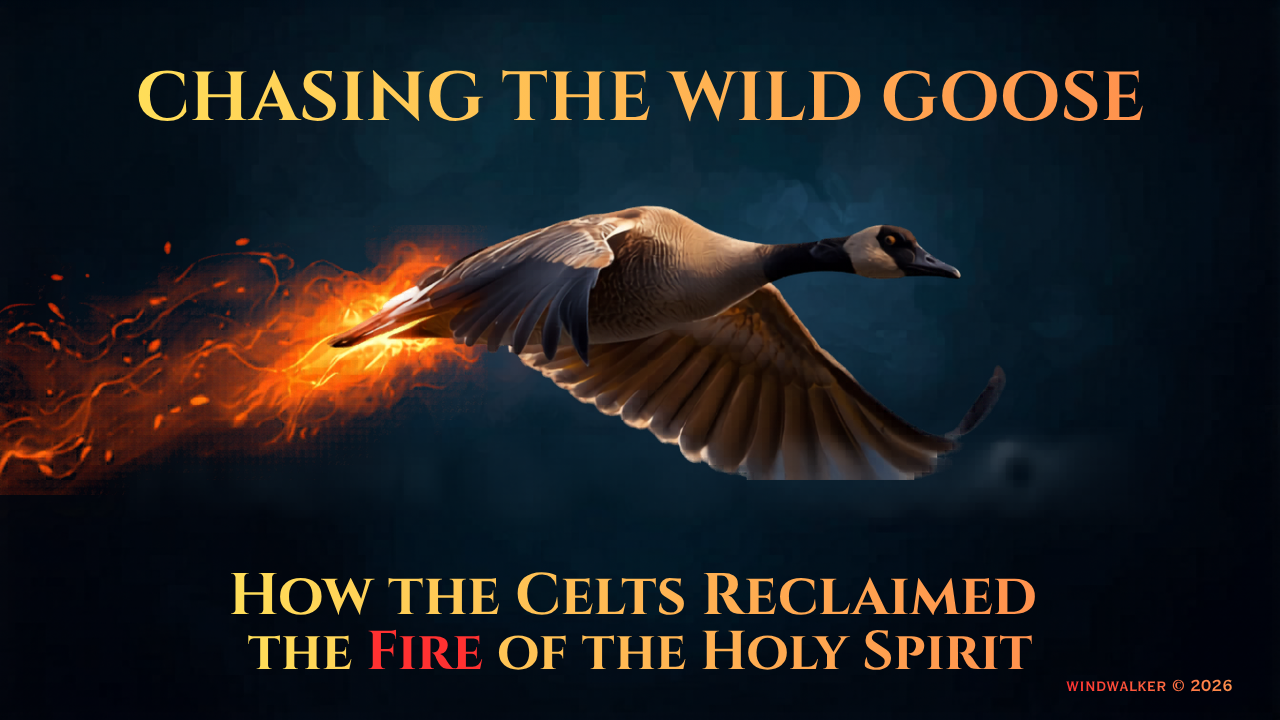
“Holy Spirit is Reclaiming the Church – With Fire”
The early Celtic believers, especially in Ireland and later in Scotland, carried a revelation of the Holy Spirit that burned far beyond the boundaries of institutional religion. They refused to reduce Him to a doctrine, a ritual, or a polite dove perched quietly on the shoulder of the Church. To them, He was the Wild Goose—untamable, unpredictable, fiercely free, and impossible to domesticate. This imagery was not born from superstition but from deep encounters with the God who moves “wherever He wills,” just as Jesus told Nicodemus in John 3:8. The Celts understood that the Spirit of God is not confined to human order but breaks into human history with holy disruption.
These Celtic followers of Christ lived in a rugged land where the wind could shift without warning, and they saw in that wildness a picture of the Spirit’s leading. They believed that following God meant embracing risk, pilgrimage, and obedience without a map. Their missionaries would literally set sail in small coracles without oars, trusting the Spirit to carry them to the place of their assignment. This embodied the truth of Acts 1:8, where Jesus promised power to be His witnesses “to the ends of the earth,” even when those ends were unknown. Their faith was not built on comfort but on the conviction that the Spirit leads boldly, not safely.
The Wild Goose became a symbol of a faith that refused to be tamed by religious systems. A goose is loud, bold, and impossible to ignore—much like the Spirit who descended in Acts 2 with the sound “of a rushing mighty wind.” The Celts saw this as a divine affirmation that the Spirit does not come quietly into human structures but arrives with force, fire, and holy interruption. They believed that when the Spirit moves, He overturns the tables of tradition and awakens the slumbering hearts of God’s people. Their spirituality was marked by a fierce expectation that God would break in suddenly.
This stands in stark contrast to the later religious systems that sought to confine the Spirit to ceremony and liturgy. The Celts read the Scriptures and saw a God who led Abraham into the unknown, who called Moses through a burning bush, and who empowered David with supernatural courage. They saw a pattern of divine unpredictability that aligned perfectly with their Wild Goose imagery. They believed that the Spirit’s leading was not meant to be controlled but embraced with reverent fear and joyful surrender. Their writings reflect a deep awareness that God’s presence disrupts before it transforms.
The Celtic believers also understood that the Spirit’s fire was not optional but essential for victorious Christian living. They pointed to John the Baptist’s declaration in Matthew 3:11 that Jesus would baptize His people “with the Holy Spirit and with fire.” This fire was not symbolic but experiential, igniting courage, purity, and supernatural power in the hearts of believers. They believed that without this baptism of fire, the Church would drift into cold religion and powerless ritual. Their communities were marked by signs, wonders, and a deep sense of God’s nearness.
Historically, the Celtic Church operated outside the influence of Rome for centuries, which allowed them to cultivate a raw, Spirit‑led Christianity. Their monasteries were not centers of academic detachment but hubs of prayer, mission, and supernatural encounter. They trained believers to listen for the voice of the Spirit in the wind, the waves, and the quiet places of solitude. Their leaders, like St. Columba and St. Brigid, were known for prophetic insight, healing, and bold evangelism. They lived out the reality of Galatians 5:25—“If we live by the Spirit, let us also walk by the Spirit.”
This Wild Goose revelation also shaped their understanding of spiritual warfare. They believed the Spirit led them into dark places not to survive but to conquer. Their missionaries confronted pagan strongholds, demonic oppression, and cultural darkness with fearless authority. They saw the Spirit as the One who empowers believers to tear down strongholds, echoing Paul’s words in 2 Corinthians 10:4. Their victories were not won through strategy alone but through surrender to the unpredictable leading of the Spirit.
Today, this ancient Celtic revelation speaks prophetically to a modern Church that often prefers order over obedience and structure over surrender. The Wild Goose reminds us that the Holy Spirit is not a tame dove but the fierce, holy presence of God who leads us into the unknown with fire in His wings. He is calling this generation back to a faith that is alive, risky, Spirit‑driven, and uncontainable. He is awakening the Remnant to the baptism of fire that Jesus promised and the early Church experienced. And He is inviting us to follow Him—not with fear, but with the boldness of those who know the wind of Heaven is at their back.
— Dr. Russell Welch
Dr. Russell Welch is a published author, prophetic teacher, apostolic builder, author, and founder of faith-driven publishing and media initiatives. He is known for crafting bold, Kingdom-centered messages that call the Ecclesia into maturity, doctrinal clarity, and governmental authority. With a passion for equipping the Remnant and honoring generational legacy, Dr. Welch writes and teaches at the intersection of Scripture, history, and spiritual governance, challenging believers to live as sons and daughters who legislate Heaven on earth through truth, holiness, and unwavering fidelity to Christ.
Be sure to check out his book: The Consecrated Firebrand: A Warrior’s Guide to Holy Living, available exclusively on Amazon … here
 Radical Disciples - A Remnant Revolution