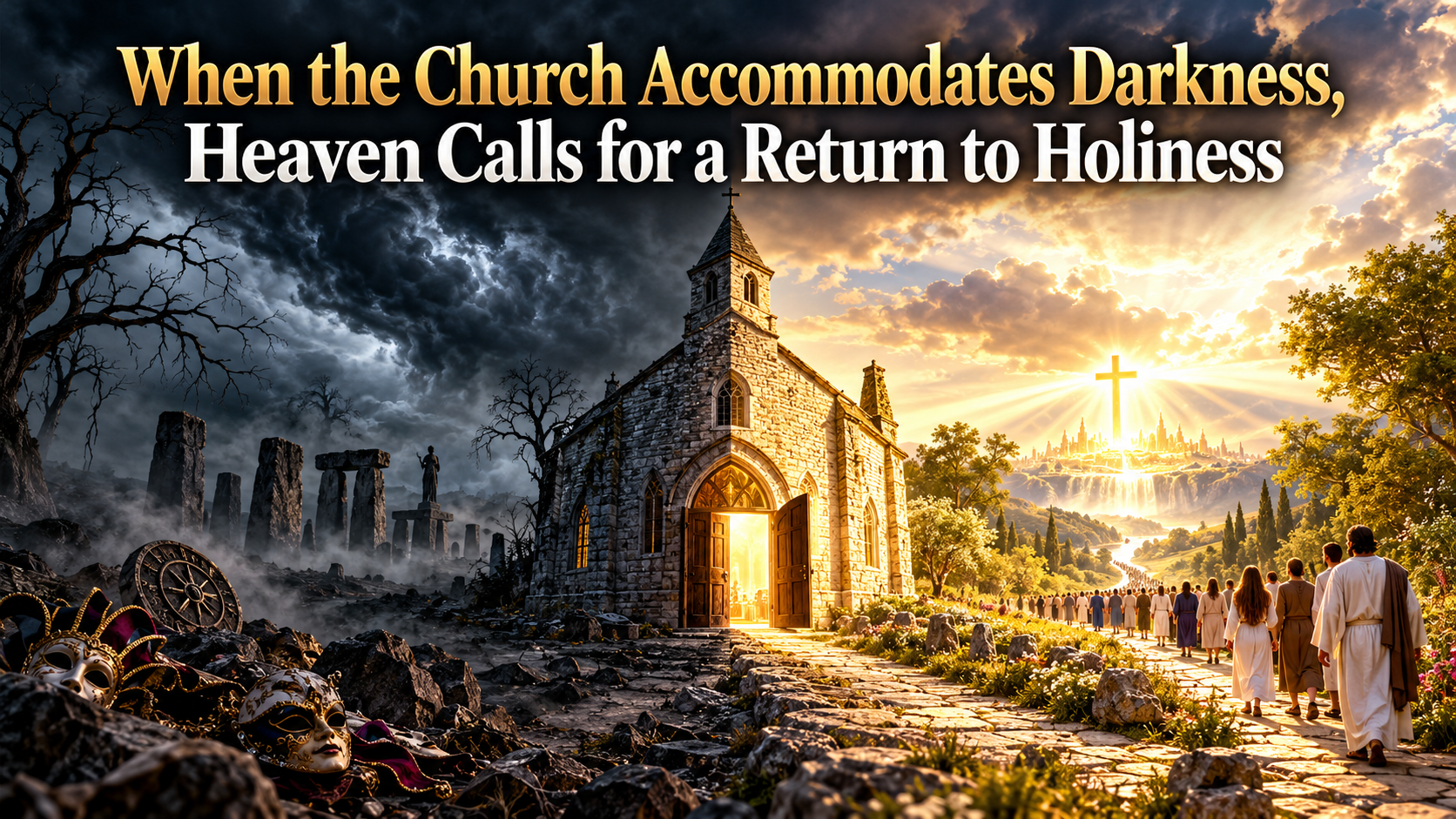
There is a sound flowing from Heaven in this hour, a sound carrying the authority to awaken the sleeping, open prison doors, and shatter chains of spiritual oppression. I believe the Holy Spirit is placing words of reformation in the mouths of His watchmen, calling the Lord’s Ecclesia to return to her first love, recover the holiness of His presence, and remove everything that has been permitted to occupy the place that belongs to Jesus Christ alone.
This is not another invitation to religious activity, denominational expansion, or the construction of more impressive ministries. It is a summons to repentance, consecration, and the recovery of the Father’s eternal purpose. The Lord is calling His sons and daughters beyond the boundaries of religious tradition into the maturity of a people governed by His Spirit, established in His Word, and wholly surrendered to His Son.
The question before the Church is no longer whether our programs are successful, our gatherings are entertaining, or our traditions are accepted by the surrounding culture. The question is whether what we have built, practiced, and celebrated truly reflects the character, holiness, and government of Jesus Christ.
And that question becomes particularly relevant as October 31 approaches.
WHEN THE CHURCH ACCOMMODATES WHAT SHE WAS CALLED TO DISCERN
Across America, churches are preparing their annual Halloween celebrations. Some will openly embrace the holiday, while others will organize what they describe as Christian alternatives, changing the names, replacing certain decorations, and presenting activities intended to provide a safer environment for families.
I understand that many of these gatherings are organized by sincere believers who desire to serve their communities. I do not question every individual’s motives, nor do I suggest that every family participating in an October 31 activity is engaging in pagan worship. Nevertheless, sincerity does not remove our responsibility to examine what we practice, celebrate, and introduce into the household of God.
Let me speak plainly: Just because the Church changes the name of a pagan practice does not mean Heaven has sanctified it. We can rename it, decorate it with Christian language, and surround it with religious activities, but changing the label does not necessarily change its nature. As the old saying goes, you can put lipstick on a pig, but at the end of the day, it is still a pig!
The question is not whether we can make something appear acceptable to the Christian community, but whether the Lord has called us to participate in it in the first place. We must stop confusing religious adaptation with spiritual transformation. The Kingdom of God does not need darkness repackaged in Christian wrapping. It needs a people willing to walk in the light of His truth, regardless of what the surrounding culture chooses to celebrate.
Let us also distinguish between reaching people with the Gospel and participating in practices that contradict it. Jesus sent His disciples into the world, but He never instructed them to become governed by the world’s spiritual values. Genuine evangelism does not require us to abandon holiness, and genuine holiness does not require us to abandon compassion for those who do not yet know Christ.
The Ecclesia must learn the difference.
THE HISTORICAL ROOTS: WHAT ARE WE ACTUALLY CELEBRATING?
To understand the concerns surrounding Halloween, we must examine its history carefully.
One important historical influence is the ancient Celtic festival of Samhain, associated with the conclusion of the harvest season and the beginning of winter. In Celtic tradition, this seasonal transition carried spiritual significance, including beliefs concerning the relationship between the living and the dead.
Historical accounts describe observances involving communal fires, feasting, and customs associated with supernatural beliefs. Later folklore connected this season with disguises, wandering spirits, and the mysterious boundary between the visible and unseen worlds.
However, the history is more complicated than the popular claim that every modern Halloween custom came directly from an ancient pagan ritual. Traditions developed and changed over many centuries, and some of the practices familiar today arose much later.
As Christianity spread through Celtic regions, Christian observances became associated with the same season. November 1 came to be observed as All Saints’ Day in Western Christianity, and the preceding evening became known as All Hallows’ Eve, from which the name Halloween developed.
Over time, Christian commemorations, older seasonal customs, regional folklore, and eventually modern commercial practices became intertwined.
This history matters, but we must use it responsibly. Not every contemporary activity can automatically be identified as an ancient pagan rite merely because it occurs on October 31. At the same time, Christians should not dismiss legitimate concerns about occult symbolism, fascination with death, spiritual deception, or practices that glorify darkness.
The biblical question reaches beyond historical origin: Does this activity honor Christ, promote what is good, and remain consistent with the Word of God?
The Ecclesia cannot surrender that examination to popular opinion.
WHEN THE CHURCH RENAMES WHAT GOD HAS CALLED US TO EXAMINE
Throughout Scripture, the Lord repeatedly warned His covenant people against adopting the worship practices of surrounding nations. Israel was commanded to remain faithful to the God who had delivered them, yet repeatedly incorporated foreign religious influences into its national and spiritual life.
The danger was not merely that Israel learned something about neighboring cultures. It was that the people gradually became willing to accommodate forms of worship that displaced their exclusive allegiance to the Lord.
Deuteronomy 12:30–31 warns against adopting the worship practices of other nations and attempting to redirect those practices toward the worship of the Lord. The passage concerns Israel’s covenant obligations and the idolatrous worship of the surrounding peoples, but its warning invites serious reflection concerning the manner in which God’s people approach worship.
The principle is not that every cultural custom is automatically forbidden. The issue is whether something contradicts God’s revealed character or encourages allegiance to spiritual powers, beliefs, or practices opposed to Him.
Consider how easily religious language can conceal spiritual compromise. A gathering may carry the name of Christ while its priorities remain governed by entertainment, popularity, and cultural acceptance. A ministry may proclaim biblical authority while refusing to examine traditions that have become too comfortable to challenge.
There is a difference between using familiar cultural settings to communicate the Gospel and allowing cultural values to determine the substance of our worship.
When the Holy Spirit exposes that difference, reformation requires obedience.
THE CALL TO COME OUT AND BE SEPARATE
The Apostle Paul declared in 2 Corinthians 6:17:
“Wherefore come out from among them, and be ye separate, saith the Lord, and touch not the unclean thing; and I will receive you.”
In its context, Paul’s instruction addresses the believer’s relationship to unbelief and idolatry. It is a call to covenant faithfulness, not a command to avoid every relationship with people outside the Christian faith.
Indeed, Jesus Himself ate with sinners, confronted religious hypocrisy, and extended mercy to those who were far from God. Yet His compassion never required Him to affirm darkness as light.
The holiness of the Ecclesia is not measured by her withdrawal from humanity, but by her faithfulness to Christ while carrying His light into a fallen world.
Ephesians 5:11 instructs believers not to participate in the unfruitful works of darkness, but to expose them. Romans 12:2 calls us away from conformity to the present age and into transformation through the renewing of our minds.
These passages demand more than an outward adjustment of religious appearances. They call for a transformed understanding, a renewed conscience, and a life responsive to the government of the Holy Spirit.
We should therefore examine our practices honestly. Are we teaching our children spiritual discernment? Are we explaining why certain images, customs, and messages conflict with Christian convictions? Are we helping believers understand the difference between entertainment, superstition, occult practice, and genuine spiritual authority?
Or have we become so concerned with maintaining cultural relevance that we hesitate to ask difficult questions?
The Lord has not called His household to live in fear of darkness. He has called us to walk confidently in the light of Jesus Christ.
THE GREATER CRISIS: THE CHURCH HAS LEFT HER FIRST LOVE
Yet I want to turn our attention to something even more serious than the observance of a cultural holiday.
A church can reject Halloween entirely and still be spiritually compromised.
We can refuse costumes, condemn paganism, and carefully distinguish ourselves from surrounding customs while remaining governed by pride, bitterness, religious ambition, or the traditions of men.
This is why the message of reformation must reach deeper than the examination of one particular celebration.
In Revelation 2:1–7, Jesus addressed the Ecclesia at Ephesus. He acknowledged her works, perseverance, and ability to identify false apostles. This was not a congregation without biblical knowledge or spiritual activity. Yet the Lord confronted her with a devastating accusation.
“Nevertheless I have somewhat against thee, because thou hast left thy first love.” — Revelation 2:4
Consider the weight of those words. The assembly had discernment, labor, and perseverance, yet something foundational had been lost. Her outward activity continued, but the Lord called her to remember, repent, and return.
This is the danger facing the modern Church. We may possess buildings, programs, conferences, theological language, and impressive platforms while gradually losing the intimacy, surrender, and simplicity of devotion to Jesus Christ.
We may become skilled at defending our traditions while remaining unwilling to examine whether those traditions are consistent with the Father’s original intention.
The answer is not another program.
The answer is repentance.
The Lord’s Ecclesia was never intended to become a religious institution sustained by human ambition. She is the household of God, established upon Jesus Christ and called to become a dwelling place of His Spirit.
The Father’s purpose has always been a people who know Him, love Him, obey Him, and reveal the character of His Son.
That is the heart of genuine reformation.
THE WHEAT AND THE TARES: WHEN THE HARVEST REVEALS THE DIFFERENCE
In Matthew 13:24–30, Jesus described a man who sowed good seed in his field. While men slept, an enemy entered and sowed tares among the wheat. As the plants grew, both appeared together, and the servants questioned whether they should immediately remove the tares.
The master instructed them to allow both to grow until the harvest.
Later, in Matthew 13:36–43, Jesus explained the parable. The good seed represents the children of the Kingdom, the tares represent the children of the wicked one, and the harvest represents the end of the age. The final separation belongs to the Son of Man and His angels.
We must be careful not to distort this teaching into permission for believers to pronounce final judgment upon those with whom they disagree. Jesus reserved that authority for Himself.
Nevertheless, the parable should awaken us to the reality that outward resemblance does not guarantee inward identity.
Something may grow alongside the wheat without possessing the nature of the wheat. Religious familiarity does not establish spiritual maturity, and outward association with Christianity does not replace the transforming work of the Holy Spirit.
The appropriate response is not suspicion toward everyone around us. It is humility before the Lord and a willingness to examine our own fruit.
Are we becoming more like Jesus Christ? Is our love increasing? Are we demonstrating holiness, righteousness, mercy, truth, and obedience? Is the Holy Spirit governing our decisions, or are we simply maintaining the religious patterns we inherited?
The approaching harvest should not fill the sons and daughters of God with panic. It should awaken holy reverence, spiritual maturity, and renewed devotion to the One who has called us by His grace.
REFORMATION MUST BEGIN IN THE HOUSEHOLD OF GOD
Before we challenge the traditions of others, we must be willing to place our own traditions upon the altar. Before we call the Church to repentance, we must allow the Holy Spirit to search our own hearts.
This is where true reformation begins.
It begins when leaders stop defending practices merely because they have become familiar. It begins when believers allow Scripture to examine their assumptions. It begins when ministry ceases to revolve around personalities and platforms and returns to the government of Jesus Christ through the Holy Spirit.
The Lord is not raising a Remnant to become another religious elite, standing above the rest of His people with an attitude of superiority. He is forming a people who carry His character, walk in humility, and remain surrendered to His will.
A genuine watchman does not sound the alarm to prove that he possesses greater revelation than those around him. He sounds the alarm because he loves the people he has been called to serve.
The purpose of the warning is restoration.
The burden of the watchman must never become an excuse for condemnation, and the pursuit of holiness must never become detached from the love of the Father.
Truth without love becomes a weapon in the hands of religious pride. Love without truth becomes permission to remain unchanged. But truth and love, governed by the Holy Spirit, become instruments through which the Lord restores His household.
This is the sound of reformation I believe Heaven is releasing.
WATCHMEN, SOUND THE ALARM!
I believe the Lord is raising a holy Remnant that will not be purchased by popularity, intimidated by rejection, or governed by cultural acceptance. These sons and daughters will not build kingdoms around personalities, surrender their convictions to preserve religious influence, or confuse spiritual authority with independence from the Father.
They will follow the Lamb wherever He leads.
Their strength will not come from hostility toward the world but from intimacy with Jesus Christ. Their authority will not be established through religious titles but through surrender to the government of the Holy Spirit. Their message will not merely identify what is wrong with the modern Church; it will reveal the beauty and power of the household the Father has always desired.
So let the sound of reformation awaken the Ecclesia!
Let every tradition be tested by Scripture. Let every heart return to its first love. Let every ministry examine whether it is serving the Father’s eternal purpose or preserving the ambitions of men. Let every believer rediscover the privilege of walking as a mature son or daughter, led by the Holy Spirit and established in the truth of Jesus Christ.
May the Holy Spirit begin this work in us before we demand it of anyone else.
The hour is not calling for a more entertaining Church. It is calling for a holy, surrendered, Spirit-governed Ecclesia.
And the call is not to reinvent the Church.
It is to return to our first love.
Jesus Christ is King!
CONTINUE THE JOURNEY: BREAKING ANCIENT CHAINS
The call to reformation does not end with recognizing what has been permitted into the household of God. It calls us to examine the spiritual agreements, inherited patterns, and strongholds that may have influenced our lives, families, and communities for generations.
True freedom begins with surrender to Jesus Christ, continues through the renewing of our minds, and bears fruit as we learn to walk under the government of the Holy Spirit.
For those who desire to examine these matters more deeply, I invite you to explore my book:
Breaking Ancient Chains: A Comprehensive Biblical Guide to Spiritual Warfare, Generational Strongholds, and Territorial Breakthrough.
This work examines spiritual warfare through the authority of Scripture, equipping believers to recognize deception, confront strongholds, and stand firmly in the victory of Jesus Christ.
The purpose is not to magnify the works of darkness, but to establish believers in the truth, authority, and freedom found in Christ alone.
Explore Breaking Ancient Chains:
Stay tuned, the journey continues…..
A voice of fire to the Remnant,
— Dr. Russell Welch
ABOUT THE AUTHOR
Dr. Russell Welch is a published author, prophetic teacher, apostolic builder, and founder of faith-driven publishing and media initiatives. His ministry carries a strong call to equip the Ecclesia for maturity, biblical clarity, spiritual discernment, and Kingdom assignment. Through his writing and teaching, he brings together Scripture, Church history, theology, and spiritual governance while challenging believers to move beyond religious tradition and into the mature life of sons and daughters who are led by Holy Spirit, established in truth, and wholly surrendered to Jesus Christ.
At the heart of this ministry is a burden to prepare and equip the Lord’s Remnant—to awaken identity, restore biblical order, strengthen spiritual maturity, and help believers recognize the assignments God has placed before them. The vision is not simply to produce messages, books, or media, but to help form a people who carry the character of Christ, hear the voice of Holy Spirit, and faithfully advance the Kingdom of God wherever the Father sends them.
To learn more about Remnant Warrior Ministries, the vision, and the assignment of the Remnant, visit:

