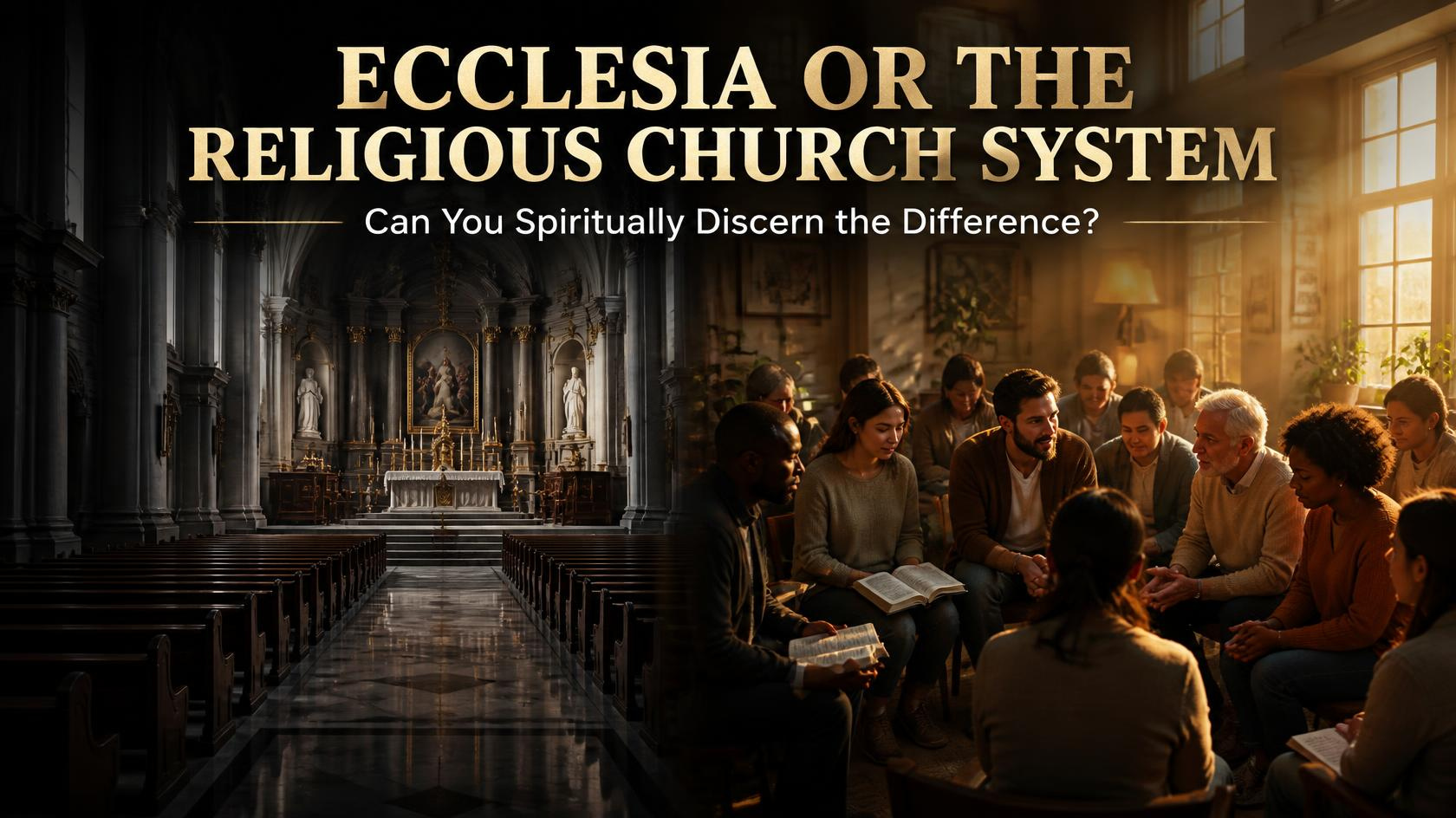
Jesus is not calling us to preserve a religious system, but to become the Spirit-governed, Christ-centered Ecclesia He intended from the beginning.
There is a question rising in the hearts of serious believers across the Body of Christ, and it is not a small one. Can we actually discern the difference between the Ecclesia Jesus is building and a religious system that bears His Name, uses Christian language, gathers people in church buildings, and yet no longer functions under His true headship? Scripture gives us every reason to believe that we can, and more than that, that mature believers should be able to recognize the difference.
Hebrews 5:14 says that “strong meat belongeth to them that are of full age, even those who by reason of use have their senses exercised to discern both good and evil.” The Greek word translated “exercised” is gymnazō, a word that speaks of training through repeated use. Discernment is therefore not spiritual suspicion, emotional reaction, or a mystical impression that is never tested. It is a developed spiritual capacity formed through Scripture, obedience, intimacy with Christ, and sensitivity to the Holy Spirit. Mature believers learn to distinguish truth from error, spiritual life from religious imitation, and the government of Christ from structures that may speak His Name while resisting His rule.
This question lies close to the heart of my book, The Father’s House: Restoring the Church to Her Apostolic Blueprint. The burden of that book is not simply that the modern Church needs improvement, better programs, stronger leadership, or more effective methods. The deeper issue is one of identity and order. What did Jesus actually intend His Church to be, and how far have we drifted from that design?
The Ecclesia Jesus Said He Would Build
Jesus declared in Matthew 16:18, “I will build my church; and the gates of hell shall not prevail against it.” The Greek word translated “church” is ekklēsia. In the broader Greek-speaking world, the word referred to an assembly or gathering of people who had been called together. It could even describe a civic assembly, as Acts 19 demonstrates. We should therefore be careful not to force every modern governmental concept into the lexical meaning of the word itself, but the context in which Jesus used it is profoundly significant.
Jesus was not announcing the creation of another religious institution. He was declaring that He would build a people who belonged to Him, confessed Him as Messiah, lived under His Lordship, received His authority, and represented His Kingdom in the earth. Matthew 16:19 immediately moves into the language of the keys of the Kingdom and binding and loosing, showing us that whatever authority the Ecclesia possesses flows from Christ Himself. He builds it, He defines it, He governs it, and He remains its living Head.
That is the first major line of discernment between the Ecclesia and a religious system. Buildings are not the problem, organization is not the problem, and leadership structure is not automatically the problem. The New Testament demonstrates order, recognized leadership, financial stewardship, discipline, teaching, mission, and accountability. The problem begins when the structure stops serving the life of Christ and begins demanding that the life of Christ serve the structure.
That is where a church can remain active while becoming spiritually hollow. It can continue to hold services, raise money, operate ministries, produce media, and maintain a recognizable Christian identity while slowly shifting from the headship of Christ to the preservation of the institution. From the outside, the difference may not always be obvious. Spiritually, however, the difference is profound.
Life, Fruit, and the Headship of Christ
Paul warned Timothy of those who would have “a form of godliness” while denying its power. His warning does not mean that every form is wrong. Every congregation develops habits, traditions, rhythms, and patterns of worship. The issue is whether spiritual life still fills the form or whether the outward shell remains after the substance has departed.
A congregation can possess excellent music, beautiful facilities, polished branding, sophisticated media, gifted speakers, and strong programming while failing to form people into mature disciples of Jesus Christ. In the same way, informality, emotional intensity, or rejection of traditional structure does not automatically prove that the Holy Spirit is present. The real question is whether Christ is forming His people. Are believers growing in holiness, repentance, prayer, biblical understanding, love, obedience, and spiritual maturity? Are the wounded being restored? Are believers learning how to minister rather than merely consume ministry? Is the presence of God producing transformation?
Jesus gave us another important measure when He said, “Ye shall know them by their fruits.” Biblical fruit includes transformed character, faithfulness, repentance, generosity, reconciliation, endurance, obedience, compassion, and mature disciples who become capable of strengthening others. A religious system can produce consumers who continually require another service, another conference, another message, and another experience. The Ecclesia, however, equips believers to walk with Christ, discern truth, pray, minister, resist evil, serve others, endure hardship, and function as mature members of the Body.
This is one of the central recoveries emphasized in The Father’s House. The Church was never designed to become a perpetual audience gathered around a gifted personality. The apostolic pattern is one of equipping, formation, spiritual family, and participation. Leaders serve the maturity of the Body, and the Body grows as every part functions under Christ.
Colossians 1:18 declares that Christ “is the head of the body, the church.” That is not ceremonial language. Jesus is not merely the founder whose Name remains on the institution while others control its actual direction. He is the living Head of His Body. Healthy spiritual leadership therefore never replaces His headship but serves it.
One of the most revealing questions any ministry can ask is whether Scripture is still permitted to correct the institution. Can the Word confront long-standing traditions? Can the Holy Spirit interrupt established plans? Can leadership acknowledge that a direction needs to change? When titles, reputations, finances, or institutional survival become untouchable, the structure begins to protect itself from the very Lord it claims to serve.
The Ecclesia must always remain correctable by the Word and governable by Christ.
Truth, Equipping, and Holy Spirit Governance
Paul warned Timothy that a time would come when people would no longer endure sound doctrine but would gather teachers who told them what they wanted to hear. That warning remains deeply relevant because there is constant pressure upon spiritual leaders to preach what keeps people comfortable rather than what brings them into maturity.
Grace must be preached, but repentance must also be preached. Love must be preached, but so must holiness. Identity in Christ must be taught, but so must obedience. The goodness of God must be proclaimed, but His righteousness and judgment cannot be removed from the message without distorting the Gospel.
A faithful Church cannot edit Jesus in order to retain an audience. Christianity becomes spiritually hollow when it is reduced to motivational encouragement supported by selected Bible verses. A religious system asks what message will preserve the crowd. The Ecclesia asks what the Lord has said and then seeks to proclaim it with courage, love, and integrity.
Ephesians 4:11–13 further reveals the difference. Christ gave apostles, prophets, evangelists, pastors, and teachers for the equipping of the saints, the work of ministry, and the building up of the Body of Christ. The ministry gifts were never intended to create a permanent divide between a gifted few and a passive congregation. Their purpose is to equip the saints so that the whole Body matures and functions.
The biblical pattern is therefore participatory. Leaders equip, believers mature, the saints minister, and Christ is glorified. When Christianity becomes little more than a weekly performance produced by professionals for spectators, we have moved far from the pattern described in Ephesians 4.
Ephesians 2:20 says that the household of God is built upon the foundation of the apostles and prophets, with Jesus Christ Himself as the chief cornerstone. In its immediate New Testament setting, this speaks especially to the foundational apostolic and prophetic witness through which the Gospel of Christ was established. Christians may differ over how apostolic and prophetic ministry should function today, but the central principle is unmistakable: the Church must remain grounded in the apostolic Gospel, prophetic Scripture, and Christ as the cornerstone.
This is also where Holy Spirit governance becomes more than a slogan. First John teaches that believers have received an anointing from the Holy One and that this anointing abides in them. These verses do not eliminate teachers, because John himself was teaching the believers to whom he wrote. His concern was deception, and his message was that believers who possess the Spirit of God are not spiritually helpless before falsehood.
At the same time, spiritual discernment cannot simply become a matter of saying, “I felt something was wrong.” Feelings can mislead us, personal wounds can distort our perception, and preferences can masquerade as revelation. The inner witness of the Spirit must remain anchored to Scripture, the character of Christ, and fruit that can be observed over time. Yet believers must not be trained to ignore the Holy Spirit simply because an institution appears respectable.
A church that speaks often about the Holy Spirit but never permits Him to convict, correct, direct, equip, or interrupt may acknowledge Him doctrinally while resisting Him functionally. A Father’s House cannot merely hold correct beliefs about the Spirit. It must remain responsive to His activity.
Religious Corruption and the Call to Restoration
Revelation 17 and 18 present one of Scripture’s most sobering portraits of corrupted power in the image of Babylon the Great. Throughout Church history, interpreters have understood Babylon in different ways. Some have emphasized imperial Rome, others have seen a broader picture of political, economic, and religious systems opposed to God, while still others understand the passage primarily in an eschatological sense.
For that reason, it is unwise to reduce Babylon to a simplistic label for every church structure we dislike. Nevertheless, the spiritual principle remains clear. Systems can become so corrupted by power, greed, idolatry, compromise, and opposition to God that His people must refuse participation in their sins.
Revelation 18:4 says, “Come out of her, my people, that ye be not partakers of her sins.” Separation from corruption is not abandonment of Christ’s Church. There are times when faithfulness to Christ requires refusing participation in structures that have repeatedly chosen self-preservation over obedience.
There is a profound difference between rejecting the Body of Christ and rejecting religious corruption. The answer, however, is not bitterness, isolation, rebellion, or the rejection of all spiritual authority. Those reactions simply create another form of disorder. The answer is restoration. The answer is biblical order. The answer is a return to the Father’s design for His household.
This is where The Father’s House becomes more than a title. The biblical Church is not merely an organization with religious branding. It is a household in which Christ is Head, the Holy Spirit governs, leaders equip, sons and daughters mature, gifts are activated, and every believer is called into participation.
Acts gives us glimpses of that life. Believers devoted themselves to the apostles’ teaching, fellowship, breaking of bread, and prayer. They cared for one another, shared generously, worshiped together, bore witness to Christ, and lived with a strong awareness of the Holy Spirit’s activity among them. Their life was not perfect, and the New Testament itself records conflict, immaturity, error, and correction, but the pattern still reveals a Church that functioned as a living spiritual community rather than a religious corporation.
The twenty-first-century Church does not need to reproduce every cultural feature of first-century Jerusalem, but it desperately needs to recover the spiritual DNA. The Church must again become a family rather than merely an audience, a people of presence rather than performance, a place of equipping rather than perpetual dependency, and a community governed by Christ rather than institutional preservation.
That is the heart of The Father’s House: Restoring the Church to Her Apostolic Blueprint. It is a call back to intimacy, holiness, spiritual family, biblical order, Holy Spirit governance, Kingdom authority, and the active participation of every believer.
The Discernment Begins With Us
Jesus said in John 10:27, “My sheep hear my voice, and I know them, and they follow me.” That statement takes us back to the heart of discernment because discernment grows through relationship. The more deeply believers know Scripture, the more readily they recognize distortion. The more intimately they know Christ, the more clearly they recognize what contradicts His character. The more consistently they obey the Holy Spirit, the more sensitive they become to His leading.
Spiritual maturity also frees believers from being overly impressed by appearances. A large crowd proves nothing, but neither does a small one. A beautiful building proves nothing, but neither does meeting in a home. A title proves nothing, but rejecting all titles proves nothing either. Signs and wonders alone are not the final test, and intellectual orthodoxy without spiritual life is not enough. The real issue is whether Christ is functioning as Lord, His Word is honored as truth, the Holy Spirit is accomplishing His work, biblical leadership is equipping rather than controlling, and believers are being transformed into mature disciples who bear the character and carry the mission of Jesus.
The question, therefore, is not simply whether we attend church. The deeper question is whether we are being formed as part of the Ecclesia Jesus Christ is building. That is a question that requires humility because true discernment must first examine us before it examines everyone else.
We should ask the Lord to train our spiritual senses and expose religious habits we may have mistaken for biblical Christianity. We should ask Him to reveal where tradition has replaced truth, where personality has replaced headship, where performance has replaced equipping, where control has replaced spiritual fathering, and where institutional preservation has replaced obedience. We must also be willing to ask what needs to change within us.
It is easy to identify religious systems when we are only looking outward. True reformation begins when the Holy Spirit is permitted to search the heart first.
Jesus is still building His Ecclesia, and the gates of Hades will not prevail against it. The great need of this hour is not merely for believers who can identify what is wrong with religious systems. It is for mature sons and daughters who are willing to become what Christ intended His Church to be: a living people under His headship, formed by His Word, governed by His Spirit, rooted in spiritual family, and equipped to carry His Kingdom into the world.
For those who sense that same burden, The Father’s House: Restoring the Church to Her Apostolic Blueprint develops this call much further. It examines the need for reformation, Holy Spirit governance, biblical leadership, spiritual family, the equipping of believers, and the recovery of divine order within the Church. It is not a call to abandon the Church, but to recover her.
The Father’s House: Restoring the Church to Her Apostolic Blueprint
A Prophetic Call to Reformation, Revival, and the Return of Divine Order
Go Deeper: The Father’s House
The Father’s House: Restoring the Church to Her Apostolic Blueprint
A Prophetic Call to Reformation, Revival, and the Return of Divine Order
The Father’s House is a call to believers, pastors, intercessors, reformers, and Kingdom builders who recognize that the Church cannot be restored merely through better programs or stronger institutions. It must recover the headship of Christ, the government of the Holy Spirit, biblical spiritual order, genuine family, the equipping of the saints, and the active participation of every believer in the life and mission of the Ecclesia.
This is not a call to abandon the Church. It is a call to recover her.
Read The Father’s House here:
The Father’s House
— Dr. Russell Welch
A Watchman & Voice to the Remnant
About Dr. Russell Welch
Dr. Russell Welch, widely known as “Doc. Russ,” is an author, pastor, apostolic teacher, and founder of Remnant Warrior Ministries and Kingdom War College. He serves as Senior Pastor of Highway to Heaven Church in Jacksonville, Florida, where his ministry centers on the recovery of the biblical Ecclesia, spiritual formation, discipleship, prayer, spiritual warfare, and equipping believers for Kingdom service.
He is the author of numerous books and teaching resources addressing Scripture, theology, Christian discipleship, spiritual warfare, the Ecclesia, and the recovery of biblical Christianity. Through his writing, teaching, and ministry, Dr. Welch carries a continuing burden to call believers beyond religious Christianity into mature discipleship, deeper biblical understanding, intimacy with Christ, and active participation in the life and mission of His Ecclesia.

