RADICAL DISCIPLES — A REMNANT REVOLUTION
Thursday, November 19, 2026
Foundational Scriptures: 1 Corinthians 12:7–27; 1 Corinthians 14:26; Ephesians 4:11–16
There is a troubling contradiction within much of modern Christianity. We have constructed magnificent buildings, developed impressive worship productions, established sophisticated ministry organizations, and mastered the ability to gather thousands beneath one roof. Yet a question continues to confront my spirit: Have we become so skilled at gathering spectators that we have forgotten how to make disciples who actually function as the Ecclesia of Jesus Christ?
The Lord Jesus Christ never commanded His disciples to build religious audiences. He commanded them to make disciples of all nations, teaching them to observe everything He had commanded (Matthew 28:19–20). His assignment was never limited to filling buildings, increasing attendance, or developing religious programs. He came to establish His Kingdom, reconcile humanity to the Father, and raise up a people through whom His life, character, authority, and power would be revealed upon the earth.
And yet, in far too many places, the modern church has reduced the participation of God’s people to three simple activities: arrive, observe, and leave. The pastor ministers, the worship team performs, the professionals carry the responsibility, and the congregation is expected to sit quietly and receive. Week after week, believers hear messages about spiritual gifts, Kingdom authority, and the power of Holy Spirit, but many are never equipped or encouraged to exercise what the Father has placed within them.
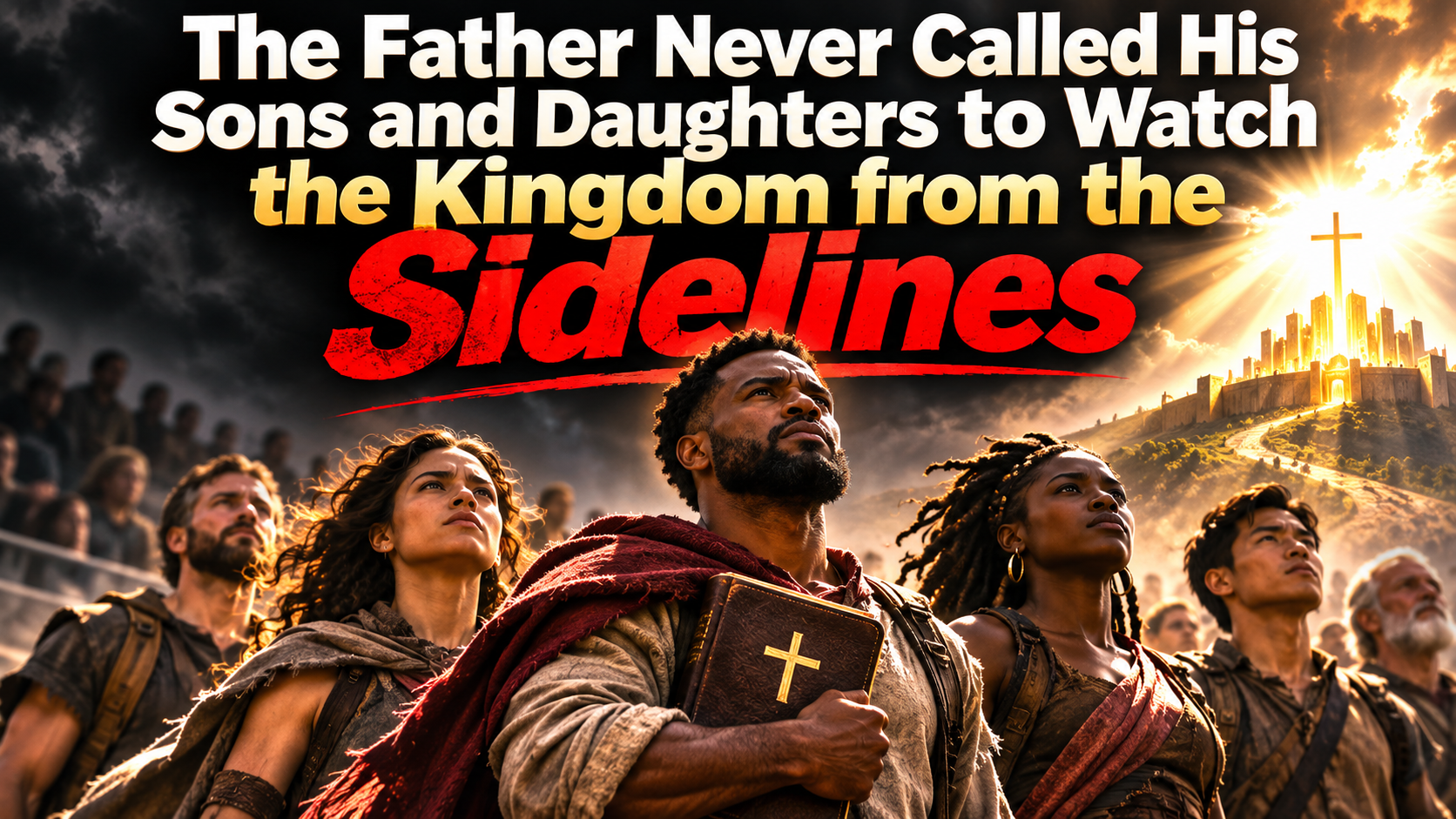
Brothers and sisters, the Ecclesia was never intended to become a spectator sport!
THE BODY OF CHRIST WAS CREATED TO FUNCTION, NOT MERELY TO GATHER
1 Corinthians 12:7 (KJV): “But the manifestation of the Spirit is given to every man to profit withal.”
Consider what the apostle Paul is revealing. The manifestation of the Spirit is not presented as the exclusive possession of a particular class of ministers. It is given for the common good of the Body. Paul continues by explaining the diversity of spiritual gifts and the sovereign work of Holy Spirit in distributing them according to His will.
The same Spirit who empowers the preacher also indwells the believer sitting in the congregation. The same Holy Ghost who equips an apostolic leader also works through the intercessor, the encourager, the servant, the teacher, and the disciple who has quietly surrendered everything to Christ.
Nowhere does Paul suggest that the majority of believers should spend their spiritual lives as passive observers while a select few perform the work of ministry. On the contrary, he compares the Ecclesia to a living body, composed of many members, each possessing a necessary function.
1 Corinthians 12:18 (KJV): “But now hath God set the members every one of them in the body, as it hath pleased him.”
Notice those words: as it hath pleased Him.
The Father determines the placement and function of each member. The Body does not belong to a religious personality, denomination, or institution. It belongs to Christ, who is its Head.
A hand that refuses to function weakens the body. An eye that remains closed cannot contribute its sight. A foot that will not move prevents the body from advancing as it should. Likewise, when God’s people are trained only to attend services rather than mature into their God-given assignments, the entire Body suffers.
This is not an argument against gathering together. Scripture commands believers not to forsake assembling themselves together (Hebrews 10:25). It is a challenge to recover the biblical purpose of gathering.
We do not assemble merely to hear what one person has received from God. We gather to worship the Father, submit ourselves to Christ, receive His Word, encourage one another, exercise spiritual gifts in biblical order, and strengthen the entire Body for the work of the Kingdom.
Attendance may fill a room, but spiritual maturity equips a people to carry the presence and testimony of Christ beyond its walls.
WHEN THE PLATFORM REPLACES THE PARTICIPATION OF THE BODY
1 Corinthians 14:26 (KJV): “How is it then, brethren? when ye come together, every one of you hath a psalm, hath a doctrine, hath a tongue, hath a revelation, hath an interpretation. Let all things be done unto edifying.”
This passage should cause every spiritual leader to examine the manner in which God’s people are being equipped and encouraged to function.
Paul describes a gathering in which different members contribute to the edification of the assembly. He does not describe an audience assembled around a religious celebrity, nor does he present spiritual ministry as entertainment for those who have purchased a seat or developed an attachment to a particular personality.
However, we must also recognize that Paul immediately establishes boundaries for orderly participation. In the remainder of 1 Corinthians 14, he insists that spiritual contributions must be governed by love, discernment, peace, and the edification of the entire assembly. Biblical participation is not disorder, competition, or an invitation for every person to speak whenever they please.
The answer to religious control is not spiritual chaos. It is a people governed by Holy Spirit and submitted to the Word of God.
There is a profound difference between apostolic leadership that equips the Body and religious leadership that makes the Body dependent upon itself. One develops mature disciples who learn to recognize the voice of the Shepherd and faithfully serve under His authority. The other can unintentionally produce generations of believers who never discover their spiritual responsibilities because they have been conditioned to believe that ministry belongs exclusively to those standing behind a pulpit.
We should ask ourselves some uncomfortable questions. Are our gatherings producing men and women who know how to pray, disciple others, minister compassionately, exercise discernment, and stand upon the authority of Scripture? Are spiritual gifts being taught, tested, and exercised with accountability? Are the wounded being restored, the immature being equipped, and the seasoned believers being released into meaningful service?
Or have we created religious environments where people can remain spectators for twenty years and still be considered successful Christians simply because they faithfully occupy a seat?
The presence of a crowd does not establish the presence of spiritual maturity. An impressive program does not necessarily reveal the government of Holy Spirit. And numerical growth, though it can be a blessing, must never become our substitute for measuring conformity to Christ.
THE FIVEFOLD MINISTRY WAS GIVEN TO EQUIP, NOT TO ENTERTAIN
Ephesians 4:11–12 (KJV): “And he gave some, apostles; and some, prophets; and some, evangelists; and some, pastors and teachers; For the perfecting of the saints, for the work of the ministry, for the edifying of the body of Christ:”
Here we discover one of the clearest explanations of leadership’s responsibility within the Ecclesia. Christ gives ministry gifts for the equipping of His people, so that the Body may be built up and brought toward maturity.
The Greek word translated perfecting is katartismos, conveying the idea of equipping or preparing for proper function. Paul is not describing the development of religious spectators. He is describing the preparation of God’s people for the ministry to which they have been called.
The apostle, prophet, evangelist, pastor, and teacher are not presented as celebrities elevated above the Body. They are gifts given by the ascended Christ to serve His purpose in the Body. Genuine spiritual authority carries a responsibility to cultivate maturity, strengthen sound doctrine, guard the flock, and prepare others to serve faithfully.
A shepherd who never equips the sheep to follow the voice of Christ has not fulfilled the whole responsibility of shepherding. A teacher who produces permanent dependence upon himself rather than maturity in the Scriptures has missed the destination of biblical teaching. And an apostolic leader who measures success only by the expansion of his personal organization must return to the pattern established by Christ.
Jesus poured His life into His disciples. He taught them, corrected them, demonstrated the Kingdom before them, and sent them out to minister under His authority. He did not train them merely to admire His ministry from a comfortable distance.
The ministry of Christ was never designed to end with the minister. It was designed to multiply the life of Christ through disciples who would make disciples.
This is why Ephesians 4 does not conclude with the establishment of impressive leadership structures. It moves toward a mature Body, growing together in truth and love, with every part contributing according to its proper working.
The destination is not a more impressive platform. The destination is a mature people reflecting the fullness of Christ.
WHEN THE ECCLESIA FORGETS WHO SHE IS
The Greek word ekklēsia refers to an assembly or congregation of people called together. In the New Testament, the significance of Christ’s Ecclesia is found not merely in the act of assembling, but in belonging to Jesus Christ, the One who declared, “I will build my church” (Matthew 16:18).
He did not say that He would build an organization around the ambitions of men. He declared that He would build His Church.
We must be careful not to confuse the instruments used in ministry with the substance of the Ecclesia itself. A building may provide shelter for a gathering, but the building is not the Body of Christ. A microphone can amplify a preacher’s voice, but it cannot replace the voice of Holy Spirit. A well-organized ministry can serve the Kingdom, but no organizational structure possesses the authority to displace Christ as Head of His people.
The first-century believers gathered in homes, shared fellowship, devoted themselves to the apostles’ teaching, broke bread, prayed, and cared for one another (Acts 2:42–47). They also gathered in larger settings when circumstances permitted. The issue was never simply the size or location of their meetings. It was the life of Christ being expressed through a people who belonged to Him.
When persecution scattered believers from Jerusalem, the Gospel did not cease because a central meeting place had been disrupted. According to Acts 8:4, those who were scattered went everywhere preaching the Word.
Think about the implications of that passage. The spreading of the Gospel was not entirely dependent upon the continued presence of the apostles in one location. Ordinary believers carried the Word wherever they went.
That is the kind of discipleship we must recover.
What would happen if every believer understood that spiritual ministry did not begin when someone handed them a microphone? What would happen if fathers began discipling their children, mothers became confident in the Scriptures, young believers learned to pray for one another, and mature disciples opened their homes for biblical fellowship and encouragement?
What would happen if Sunday gatherings became places of genuine equipping, and the rest of the week became the demonstration of what had been received?
The Ecclesia would stop waiting for someone else to do the work of the Kingdom and begin functioning as the Body Christ has called her to be.
THE HOLY REMNANT MUST RECOVER THE ANCIENT PATH
Jeremiah 6:16 (KJV): “Thus saith the LORD, Stand ye in the ways, and see, and ask for the old paths, where is the good way, and walk therein, and ye shall find rest for your souls.”
The call to return to the ancient path is not a demand to recreate every cultural feature of the first century. It is a summons to recover the enduring truths of God’s Word: holiness, obedience, covenant faithfulness, Christ-centered discipleship, and complete dependence upon the power of Holy Spirit.
The Remnant of the Lord cannot simply become another movement criticizing the failures of organized religion while reproducing the same failures under a different name. We cannot condemn celebrity Christianity and then create our own celebrities. We cannot challenge religious control while refusing accountability ourselves. And we cannot proclaim the restoration of the Ecclesia while neglecting genuine love, humility, sound doctrine, and the discipline of making disciples.
True restoration begins with surrender to the Lordship of Jesus Christ.
Before we ask what is wrong with the modern church, we must ask what the Father desires to restore within us. Have we become consumers of spiritual experiences rather than faithful students of His Word? Have we mistaken emotional excitement for spiritual transformation? Have we allowed years of religious attendance to replace the daily discipline of following Christ?
The Father is not searching for spectators who will applaud the work of His Kingdom from a distance. He is raising sons and daughters who will walk in obedience, carry His presence with humility, confront darkness through the authority of Christ, and demonstrate His Kingdom through righteousness, truth, and love.
This is not a call for every believer to claim an office or title. It is a call for every member of Christ’s Body to discover their responsibility, submit their gifts to His government, and faithfully serve wherever He has placed them.
A FINAL WORD TO THE REMNANT
Brothers and sisters, imagine standing before the Lord Jesus Christ and attempting to explain that we spent our lives faithfully observing the ministry of others but never embraced the responsibilities He entrusted to us.
The question is not whether we enjoyed the worship service, admired the preacher, or appreciated the organization. The deeper question is whether we obeyed the King.
Did we grow in the knowledge of His Word? Did we love one another as He commanded? Did we make disciples? Did we minister to the hurting, strengthen the weak, proclaim the Gospel, and faithfully steward the gifts He entrusted to us?
The time has come to move beyond spiritual spectatorship. Not through rebellion against biblical leadership, but through the restoration of biblical discipleship. Not through abandoning fellowship, but through recovering its purpose. Not through replacing the written Word with uncontrolled spiritual experiences, but through becoming a people who are filled with Holy Ghost and firmly established in the Scriptures.
The Father is not building an audience for religious celebrities. He is building a dwelling place for His Spirit, a holy people under the government of His Son, and a mature Ecclesia through whom His Kingdom will be made known.
The question remains: Will we continue watching from the sidelines, or will we take our rightful place as functioning members of the Body of Christ?
The King is calling His people to maturity. It is time for the Ecclesia to arise and function as He intended.
GO DEEPER: THE FATHER’S HOUSE
The Father’s House: Returning to the Ancient Path as the Lord’s Ecclesia
If this message has stirred something within your spirit, I invite you to explore The Father’s House, a book written to challenge the religious assumptions that have shaped much of modern Christianity and call believers back to the biblical foundations of Christ’s Ecclesia. Through the Scriptures, we examine the Father’s purpose for His people, the difference between religious institutions and the living Body of Christ, the responsibility of spiritual leadership, and the restoration of genuine discipleship and Holy Spirit-governed fellowship. This is not simply about changing where we meet; it is about recovering who we are in Christ and learning to function as the people He is building.
Find The Father’s House on Amazon: View Here
Dr. Russell Welch
A Watchman & Voice to the Remnant
Radical Disciples — A Remnant Revolution
A question for our readers
If your church building were unavailable tomorrow, would you and those you fellowship with know how to function as the Ecclesia of Jesus Christ? What would need to change?

