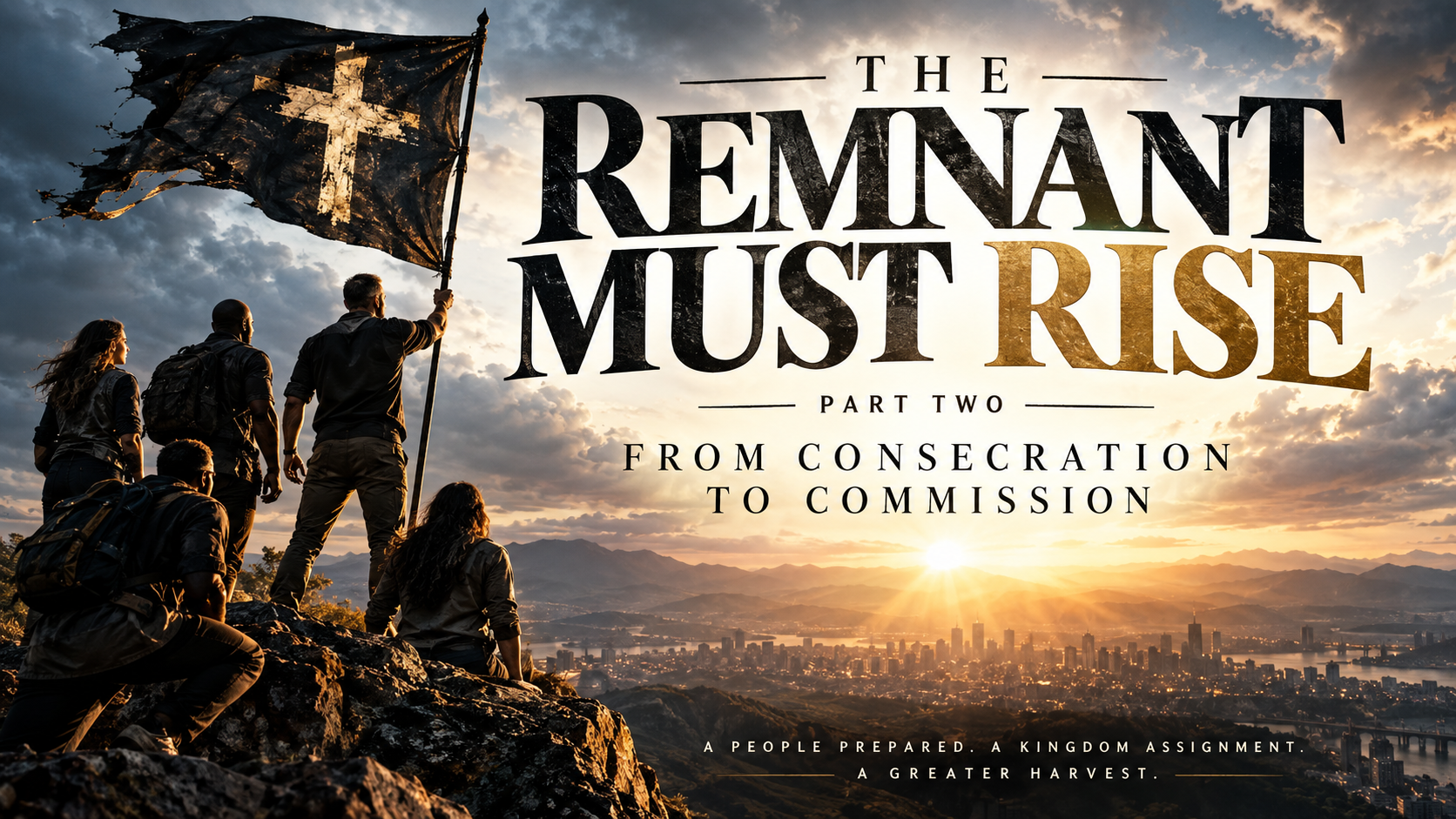
FROM CONSECRATION TO COMMISSION
“As My Father hath sent Me, even so send I you.” — John 20:21
In Part One, the trumpet sounded with a necessary warning: before the Remnant confronts the darkness around us, Holy Spirit must be permitted to confront everything within us that does not belong beneath the Lordship of Jesus Christ. Consecration must precede confrontation because spiritual authority cannot be safely carried by an ungoverned vessel. Purity, surrender, repentance, and obedience are not secondary matters for those who desire to stand in Kingdom authority; they are the foundation upon which that authority rests.
Yet consecration is not the destination. God does not cleanse a people merely so they can remain separated from the battle, nor does He sanctify them so they can become a spiritual class set apart from everyone else. He purifies them because He intends to send them, and He forms them because they must be capable of carrying His nature, His Word, and His authority into the places where darkness has established influence.
There is a danger in discussing the Remnant only in terms of separation, preservation, or distinction. Scripture certainly reveals that God preserves a faithful people in seasons of compromise. Elijah discovered that God had preserved seven thousand who had not bowed the knee to Baal, Isaiah spoke repeatedly of a remnant that would return, and Paul carried the principle into the New Testament when he declared that there remained a remnant according to the election of grace. However, biblical remnant theology never presents God’s faithful people as an isolated religious club congratulating itself for seeing what everyone else has missed.
The Remnant is preserved for purpose. God preserves a people because He intends to demonstrate His faithfulness through them, and He separates them from corruption so they can become useful to His Kingdom. He refines them because unrefined vessels cannot faithfully represent a holy King, and He awakens them because sleeping believers cannot fulfill active assignments in the earth.
The Remnant must therefore move beyond simply recognizing that something is wrong with the present condition of the Church. Discernment that never matures into obedience eventually becomes criticism, and revelation that produces no response becomes spiritual information rather than Kingdom transformation. If Holy Spirit truly allows us to see where compromise, weakness, confusion, or religious structure has displaced the government of Christ, then the question can no longer remain only, “What is wrong?” The greater question must become, “Lord, what are You requiring of us?”
That question moves us from consecration to commission.
A REMNANT UNDER GOVERNMENT
The greatest need of this hour is not louder Christianity, but governed Christianity. Jesus never commissioned His disciples to operate independently of Him, nor did He hand them spiritual authority and instruct them to use it according to personal instinct, anger, ambition, political frustration, or religious tradition. Authority in the Kingdom always remains under authority because all legitimate Kingdom authority flows from the rule of the King.
Jesus Himself demonstrated this pattern perfectly. He declared that the Son could do nothing of Himself except what He saw the Father doing, and He testified that He always did those things that pleased the Father. The One who possessed all authority lived in perfect submission, which immediately exposes the weakness of any understanding of spiritual authority that separates power from surrender.
Authority is not primarily demonstrated by how forcefully someone speaks, how many declarations they issue, how frequently they confront demonic powers, or how large their platform becomes. Kingdom authority is revealed through alignment with Christ. It is possible to speak loudly and still be ungoverned, to possess gifting and still lack maturity, or to carry revelation and still operate from pride, offense, insecurity, or self-will.
The centurion in Matthew 8 understood something many believers still fail to grasp. Before he spoke about exercising authority, he spoke about being under authority. He understood that legitimate authority functions because it is connected to a greater government, and Jesus marveled at his faith because the man recognized the operating structure of the Kingdom.
The Remnant cannot rise through spiritual independence. We do not need another generation of self-appointed apostles, unsubmitted prophets, angry watchmen, isolated intercessors, or believers who assume that receiving revelation removes their need for accountability, fellowship, humility, correction, and submission to Christ. Genuine authority never produces lawlessness because the deeper our authority becomes, the deeper our surrender must become.
The Remnant that rises in this hour must therefore be a governed people. The Word of God must govern our beliefs, Holy Spirit must govern our direction, the character of Christ must govern our conduct, and the Lordship of Jesus must reach into our speech, motives, relationships, finances, sexuality, ambitions, priorities, and assignments. If Jesus is truly Lord, His government cannot be confined to the portions of our lives we are comfortable surrendering.
THE REMNANT MUST RECOVER THE ECCLESIA
For too long, many believers have understood church primarily as a place they attend rather than a people Christ governs. The New Testament reveals something far deeper, because when Jesus declared, “I will build My church; and the gates of hell shall not prevail against it,” He was not describing a religious building, a weekly service, a denominational organization, or a Christian entertainment system. He was declaring His intention to build His Ecclesia, a covenant people gathered beneath His Lordship and entrusted with the witness and administration of His Kingdom.
This distinction matters because spectators attend religious events, while disciples receive assignments. Consumers evaluate whether the service satisfied them, whether the preaching held their attention, whether the music moved them, or whether the programs met their needs. Disciples ask different questions because their primary concern is whether Christ was obeyed, whether His people were equipped, and whether the Body is functioning according to the purposes of the Head.
Paul presents this clearly in Ephesians 4, where apostles, prophets, evangelists, pastors, and teachers are given for the equipping of the saints for the work of ministry and for the building up of the Body of Christ. The objective was never to create a few professional ministers surrounded by passive believers. The purpose was to mature the saints until the Body became capable of functioning according to Christ, who remains the Head of His Church.
The recovery of the Remnant must therefore include the recovery of the Ecclesia. We must rediscover that every believer is called into the life of the Body, that every genuine gift exists for the strengthening and maturity of others, and that no member was designed to function permanently in isolation. The Church was never intended to become a collection of independent personalities gathering periodically in the same room; it is a spiritual body whose members are joined together beneath the authority of Christ.
This is especially important in an age that celebrates individual platforms and digital influence. Technology can carry the Gospel across nations, and it has created extraordinary opportunities to teach, evangelize, encourage, and equip believers who might otherwise never encounter sound biblical instruction. However, technology can also create the illusion that consuming Christian content is equivalent to covenant fellowship.
Watching sermons is not the same as being joined relationally to believers who know us, walk with us, pray with us, challenge us, forgive us, correct us, encourage us, and stand beside us. The enemy understands the danger of a properly functioning Body, which is one reason isolation remains such an effective strategy. Separated believers are easier to discourage, easier to deceive, easier to offend, and easier to pull away from active assignment.
The rising Remnant must reject the lie that spiritual maturity means needing nobody. Mature believers understand precisely the opposite because they recognize that Christ intentionally joined His people together, not out of weakness, but because His fullness is revealed corporately through His Body.
FROM DISCERNMENT TO DEPLOYMENT
Many within the Remnant possess strong discernment. They recognize compromise, theological drift, cultural deception, manipulation, spiritual mixture, and the gradual erosion of biblical conviction. Such discernment is necessary, but discernment alone does not fulfill the Great Commission.
A watchman who identifies the enemy but never warns or prepares the people has not completed the assignment. In the same manner, a believer who continually identifies what is broken within the Church but never participates in rebuilding what has been damaged has confused observation with obedience.
Nehemiah provides a powerful pattern. When he learned that Jerusalem was in ruins, he did not merely analyze the destruction or develop a theology of broken walls. He wept, fasted, prayed, sought God, obtained permission, traveled to Jerusalem, examined the damage, gathered the people, organized the work, and rebuilt what had been destroyed. His response combined prayer with action, warfare with construction, and discernment with deployment.
This is where portions of the modern Remnant conversation must mature. We cannot become known primarily for cataloging everything that is wrong with the Church because Christ has called us to participate in what He is building. If discipleship has weakened, then disciples must be formed. If prayer has disappeared, the altar of prayer must be rebuilt. If biblical literacy has collapsed, the Word must be taught with clarity, depth, and faithfulness.
Where families are fractured, mature believers must help strengthen homes. Where young Christians have never learned spiritual warfare, they must be trained carefully and biblically rather than sensationally. Where wounded people have been neglected, the Church must become a place where truth, healing, accountability, forgiveness, and restoration are allowed to work together.
The same applies to communities marked by addiction, poverty, violence, fatherlessness, despair, and spiritual oppression. The Remnant cannot simply announce that darkness exists; we must seek Holy Spirit for the form obedience should take in those places and then begin walking it out with wisdom, courage, and compassion.
The Book of Acts did not advance because the apostles continually discussed the darkness of Rome. They proclaimed Christ, made disciples, healed the sick, confronted demonic oppression, cared for the vulnerable, planted communities of believers, appointed elders, corrected error, endured persecution, and continued carrying the Gospel wherever Holy Spirit sent them. They understood that darkness is displaced when the Kingdom of God becomes visibly present through obedient people.
The Remnant must recover that conviction.
THE BATTLE IS FOR PEOPLE, NOT AGAINST THEM
One of the most important corrections the Remnant must recover concerns the identity of the enemy. Paul makes the distinction unmistakable when he writes that we wrestle not against flesh and blood, but against principalities, powers, rulers of darkness, and spiritual wickedness in high places.
People are not the enemy. The deceived, the addicted, the prodigal, the atheist, the person trapped within false religion, the political opponent, the broken family member, and even those who ridicule, reject, or persecute believers remain human beings for whom Christ died. Spiritual warfare becomes dangerous when we forget that distinction.
This does not require the Church to become passive toward error. Jesus confronted hypocrisy, exposed deception, rebuked religious corruption, cast out demons, called sinners to repentance, and refused to compromise truth for the sake of public approval. Yet the same Jesus who confronted Jerusalem also wept over it, which means His confrontation was never separated from His redemptive purpose.
The moment spiritual warfare produces hatred toward people, contempt for the lost, enjoyment in another person’s downfall, or an appetite for condemnation, we have moved outside the character of the One whose authority we claim to represent. The weapons of our warfare are not carnal because the Kingdom we represent does not advance through fleshly hostility.
The Remnant must therefore learn how to confront darkness without becoming dark in the process. We must speak truth without surrendering love, exercise discernment without becoming suspicious of everyone, expose deception without celebrating another person’s collapse, and contend for righteousness without allowing anger to become our identity.
Jesus did not send us into the world merely to win arguments. He sent us to make disciples, which means even our confrontation must remain governed by the redemptive heart of God.
THE POWER OF GOD MUST RETURN TO THE CENTER
Paul warned Timothy about those who would possess a form of godliness while denying its power. That warning should trouble a Church that can conduct thousands of services every week while expecting very little supernatural intervention from God.
The early Ecclesia expected Holy Spirit to act because they understood that Christianity was not merely a theological system, but life under the active rule of the risen Christ. They prayed until buildings shook, laid hands upon the sick and expected healing, confronted demonic spirits and expected deliverance, asked for boldness under persecution and received it, and received prophetic direction concerning mission and ministry.
Holy Spirit interrupted plans, redirected journeys, exposed deception, distributed gifts, appointed leaders, and demonstrated the risen Christ through ordinary men and women who had yielded themselves completely to Him. None of this made Scripture unnecessary, because Holy Spirit inspired the Word and never contradicts what He has spoken. Neither did supernatural activity eliminate wisdom, doctrine, character, accountability, or order.
Power and truth were never intended to become enemies. The false choice between biblical depth and Holy Spirit power has weakened the Church for generations because we do not need powerless scholarship, nor do we need undisciplined spirituality detached from sound doctrine. We need the Word and the Spirit functioning together beneath the Lordship of Christ.
The Remnant must therefore refuse counterfeit manifestations while also refusing a Christianity that has explained away everything it cannot control. Paul declared that the Kingdom of God is not in word only, but in power, because the Gospel is not merely a message concerning a historical teacher; it is the proclamation of a risen, enthroned, and reigning King.
Jesus Christ is alive, and Holy Spirit is still empowering surrendered believers. Where Christ is genuinely present among His people, bondage is broken, lies are exposed, conviction produces repentance, wounds begin to heal, identity is restored, gifts awaken, callings become clear, families experience reconciliation, and people who once lived beneath the domination of darkness discover what it means to come under the government of another Kingdom.
THIS RISING WILL COST US SOMETHING
We must also reject romantic ideas about awakening because genuine reformation is rarely comfortable. When God restores truth, cherished traditions are challenged. When He restores holiness, compromise becomes uncomfortable. When He restores spiritual authority, false authority becomes threatened, and when He restores the priesthood of believers, spectators must become participants.
The restoration of prayer affects schedules, the restoration of discipleship demands relationships, and the restoration of Christ’s government requires personal ambition to die. This is why many desire revival until revival begins touching the structures, habits, preferences, and identities they intended to preserve.
We often want fire so long as the fire warms us but does not consume anything we wanted to keep. Yet the God who answered Elijah by fire did not send fire merely to create an impressive spiritual experience. The fire consumed the sacrifice and turned the hearts of the people back toward the Lord.
Every genuine awakening eventually confronts lordship because the central question is always the same: who governs us? Revival forces that question into every area of life because Christ does not come merely to inspire His people; He comes to rule them.
John the Baptist articulated the posture that must govern every genuine move of God when he declared that Christ must increase while he decreased. That is more than a statement about personal humility; it is the architecture of Kingdom advancement. Christ increases where self-government decreases, and His authority becomes visible where our ambition, pride, control, and hunger for recognition are brought beneath His Lordship.
The Remnant that rises in this hour cannot become obsessed with being called the Remnant. It must become obsessed with Jesus Christ.
FROM THE SECRET PLACE INTO THE HARVEST
There is a movement within genuine spiritual formation that must be understood correctly. God calls His people inward before He sends them outward because the secret place is where motives are purified, identity is established, hearing is sharpened, wounds are exposed, pride is confronted, and dependence upon Him becomes more than theological language.
Prayer must precede proclamation, and presence must precede deployment. Yet preparation was never intended to become a hiding place from assignment. Jesus called the disciples first to be with Him, but He also sent them out, which means both formation and mission belong within the pattern of discipleship.
Those who are sent without learning His presence often attempt Kingdom work through human strength, while those who continually remain in preparation without accepting assignment misunderstand why they were trained. The secret place is not an escape from the harvest; it is the place where we are prepared to enter it correctly.
The harvest requires laborers because there are homes waiting for reconciliation, addicts waiting to discover freedom, children growing up without spiritual fathers and mothers, believers starving for the Word while surrounded by religious noise, and entire communities where despair has become normal. There are prodigals who believe they have traveled beyond the reach of grace and nations filled with people who have heard Christianity discussed but have never encountered the transforming reality of Jesus Christ.
This is why the Remnant must rise. We do not rise to prove that we were right, demonstrate that we were more discerning, or construct another religious movement around ourselves. We rise because the King has given His people an assignment, and that assignment remains rooted in His compassion for those who are weary, scattered, deceived, wounded, and lost.
Jesus looked upon the multitudes and was moved with compassion because they were like sheep without a shepherd. His response was not contempt for their condition but a declaration that the harvest was plentiful and the laborers were few. The same harvest remains before us, and the question facing the Remnant is whether we will merely recognize the hour or become obedient within it.
Consecration must therefore lead to commission. Those who have been awakened must become available, those who have been trained must become deployable, and those who have received from God must be willing to pour themselves out for the sake of others. The teacher must teach, the evangelist must go, the shepherd must protect and nurture, the watchman must faithfully sound the alarm, and apostolic builders must build according to Heaven’s pattern rather than personal ambition.
The believer must mature into a disciple, and the disciple must eventually learn to make disciples. This is how the Remnant rises correctly: not through self-exaltation, isolation, anger, religious performance, or fascination with darkness, but through surrendered obedience beneath the Lordship of Jesus Christ.
Part One called the Remnant back to consecration. Part Two calls that consecrated people into commission. The King is still building His Ecclesia, the harvest remains plentiful, and the gates of hell have not received new authority over what Christ has determined to establish.
Jesus Christ still possesses all authority in heaven and earth, Holy Spirit still empowers surrendered believers, and the Gospel of the Kingdom still carries the power to transform human lives. The Remnant must rise under His authority, filled with His Spirit, governed by His Word, joined to His Body, formed in His presence, and sent into His harvest.
The trumpet has sounded, and now the Ecclesia must move. We were prepared to carry Heaven’s answer into it.
— Dr. Russell Welch
A Watchman & Voice to the Remnant
Dr. Russell Welch is a published author, prophetic teacher, apostolic builder, and founder of faith-driven publishing and media initiatives. He is known for crafting bold, Kingdom-centered messages that call the Ecclesia into maturity, doctrinal clarity, and governmental authority. With a passion for equipping the Remnant and honoring generational legacy, Dr. Welch writes and teaches at the intersection of Scripture, history, and spiritual governance, challenging believers to live as sons and daughters who legislate Heaven on earth through truth, holiness, and unwavering fidelity to Christ.
The Lord’s Remnant Warriors: Awakened and Rising As God’s Chosen in the Final Harvest

