RESTORING THE WATCHMEN
PART TWO — THE CALLING
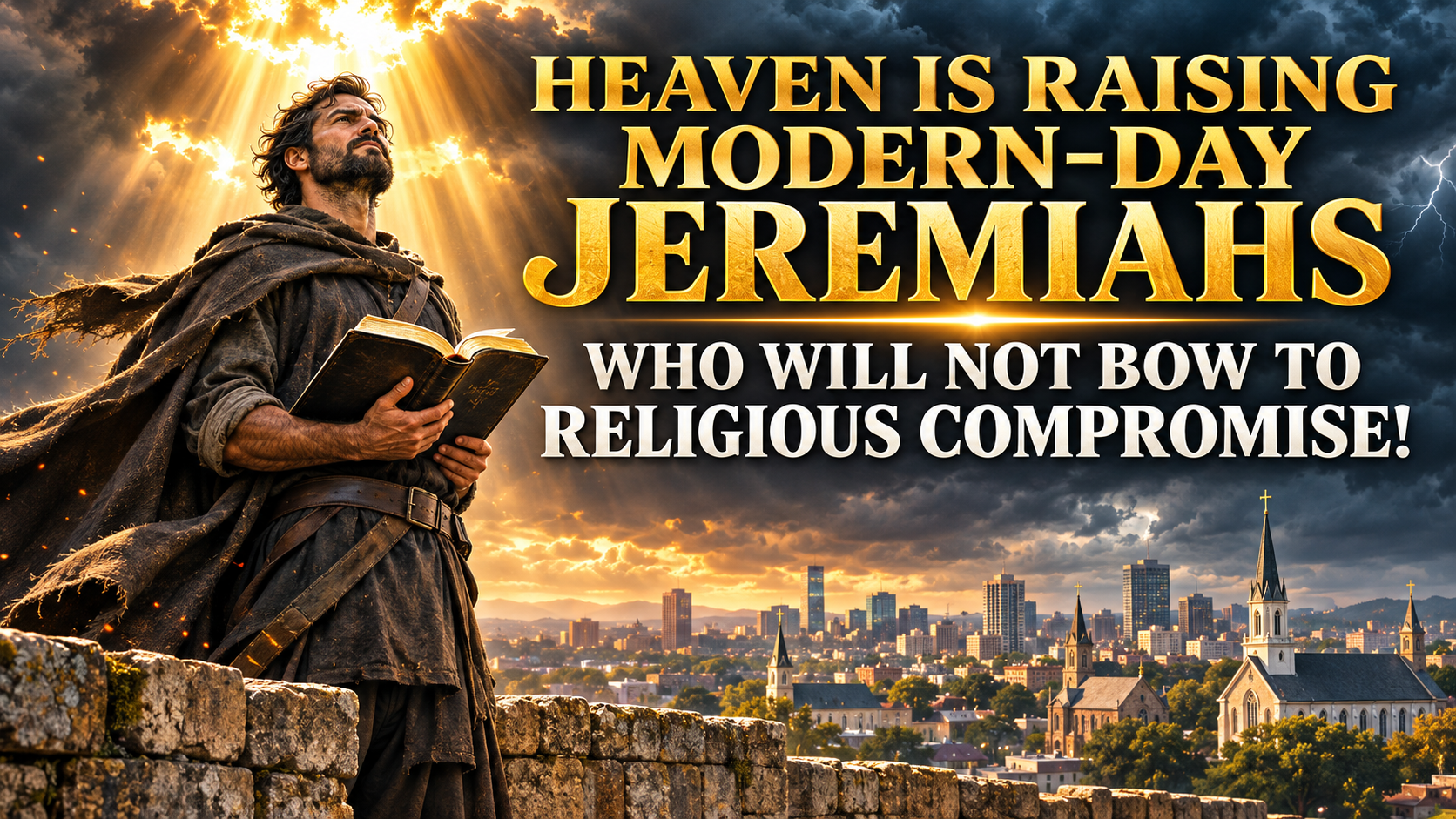
HEAVEN IS RAISING MODERN-DAY JEREMIAHS WHO WILL NOT BOW TO RELIGIOUS COMPROMISE!
Scripture Foundations: Jeremiah 1:4–10 | Jeremiah 20:7–9 | Jeremiah 26:7–15 | John 15:4–7 | Jeremiah 31:31–34
WHEN HEAVEN’S CALLING BECOMES MORE IMPORTANT THAN MAN’S APPROVAL
Jeremiah was not called to build a following, establish a religious platform, cultivate influential relationships, or become a celebrated voice among the powerful. He was appointed by Yahweh to proclaim what Heaven commanded, even when that message brought rejection, public humiliation, imprisonment, and personal suffering. His ministry stands as an enduring testimony that divine approval and human acceptance are not always found walking together. In an age when popularity, institutional recognition, and public influence have become widely accepted measurements of ministerial success, the life of Jeremiah exposes the dangerous difference between being celebrated by religious institutions and being entrusted with the Word of the Lord. The prophet’s authority did not originate in his ability to attract an audience but in his willingness to remain faithful to the God who commissioned him.
We are witnessing a generation in which spiritual authority is too frequently confused with visibility, religious influence, academic credentials, and the ability to move large audiences emotionally. While education, effective communication, and organizational leadership can serve legitimate purposes within the Kingdom, none of these qualities independently establishes a divine commission. A person may possess considerable biblical knowledge and still resist the transforming authority of Scripture over his own life. Another may demonstrate extraordinary charisma while remaining unwilling to submit to correction, accountability, or the discipline of Holy Spirit. Jeremiah’s life confronts these contradictions because his calling required him to speak truth when doing so threatened every ordinary measurement of personal success.
The deeper question confronting those who believe they carry a prophetic responsibility is not whether they possess sufficient courage to confront the condition of the American Church. It is whether their hearts have been sufficiently surrendered to Jesus Christ that they can remain obedient when recognition disappears, relationships deteriorate, and influential voices turn against them. The desire to be accepted is deeply embedded within the human condition, and religious environments are not immune to its influence. Ministers can become dependent upon the approval of congregations, financial supporters, denominational authorities, and social media audiences without recognizing how gradually that dependency begins to shape their messages. When the fear of losing acceptance becomes greater than the fear of disobeying God, the voice entrusted with proclaiming truth is already moving toward compromise.
The Lord is calling His people to examine this condition with sobriety, humility, and genuine repentance. We must never imagine that identifying compromise in others automatically qualifies us to speak on behalf of Heaven. Nor should we assume that rejection, opposition, or controversy confirms the authenticity of our calling. Jeremiah’s authority was established by God’s commission, and his faithfulness was demonstrated through obedience to the Word he received. The restoration of biblical watchmen must therefore begin with the restoration of surrendered hearts, because the person who cannot endure the loss of human approval will eventually be tempted to negotiate the truth entrusted to his care.
1. THE WATCHMAN’S CALLING BEGINS WITH GOD, NOT PERSONAL AMBITION
Jeremiah 1:4–10 introduces one of the most significant prophetic commissions recorded in the Old Testament. Yahweh declares that He knew Jeremiah before his formation in the womb and had appointed him to serve as a prophet to the nations. The Hebrew verb yādaʿ, translated as knowing, frequently communicates more than intellectual awareness, carrying the significance of personal recognition and relationship within appropriate contexts. In Jeremiah’s commission, the surrounding language of consecration and appointment reveals God’s sovereign initiative in establishing the prophet’s assignment. Jeremiah did not present himself as a candidate for prophetic office, nor did he attempt to secure the position through religious ambition. The initiative belonged entirely to Yahweh, who determined the calling and established the authority necessary for its fulfillment.
Jeremiah’s response is equally revealing because he does not greet the commission with self-confidence or an eagerness for public recognition. Instead, he protests that he lacks the ability to speak and identifies his youth as a reason for inadequacy. Yahweh’s answer does not celebrate Jeremiah’s natural qualifications or encourage him to develop a more impressive personal image. He commands Jeremiah to go wherever he is sent and speak whatever he is commanded, assuring him of divine presence amid the difficulties ahead. The Lord then touches Jeremiah’s mouth, symbolizing the divine authorization of the words he is commissioned to proclaim. The sequence is profoundly important: God calls, God sends, God supplies the message, and God remains the ultimate authority over the messenger.
This pattern challenges the contemporary tendency toward self-appointment within prophetic ministry. In some Christian environments, individuals adopt the titles of prophet, apostle, or watchman without demonstrating the biblical character, spiritual maturity, and accountability associated with such responsibilities. Others mistakenly assume that an unusual spiritual experience, an accurate impression, or the ability to recognize social and religious problems automatically establishes a governing ministry. Scripture provides no basis for treating spiritual titles as personal achievements or granting individuals unquestionable authority over the lives of other believers. The New Testament instructs the Ecclesia to examine spiritual claims carefully, discern the fruit of ministry, and recognize that all legitimate authority remains subordinate to Jesus Christ, the Head of His Church.
Jeremiah 1:10 also reveals the seriousness of his assignment through six verbs describing the scope of his prophetic ministry: uprooting, tearing down, destroying, overthrowing, building, and planting. Four expressions describe the removal of what stands under divine judgment, while two anticipate the restoration that Yahweh intends to accomplish. These words were spoken within Jeremiah’s historical commission concerning nations and kingdoms and should not be carelessly transferred into a personal license for modern ministers to dominate communities or pronounce destruction according to their own preferences. Nevertheless, the passage reveals an enduring principle: divine correction is never an end in itself, because God’s redemptive purposes extend beyond exposing what is corrupt to establishing what reflects His righteousness. The watchman must therefore understand that biblical authority is not permission to destroy people but a responsibility to proclaim the truth through which God calls people to repentance and restoration.
For the New Covenant believer, every ministry assignment must remain submitted to the revelation of Jesus Christ and the apostolic witness preserved in Scripture. No prophetic claim can supersede the authority of the Gospel, and no spiritual leader possesses independent jurisdiction over the conscience of another believer. Paul reminds the Corinthians that ministry is not an opportunity to proclaim ourselves but to proclaim Jesus Christ as Lord, acknowledging that we are servants for His sake (2 Corinthians 4:5). This is where the restoration of authentic spiritual responsibility must begin. A watchman who desires authority more than obedience has already misunderstood the calling, while one who treasures obedience above recognition has begun to understand the weight of serving the King.
2. THE FIRE OF GOD’S WORD CANNOT BE MANUFACTURED
Jeremiah 20:7–9 opens a window into the emotional and spiritual struggle of a prophet whose obedience repeatedly brought suffering. Following his confrontation with Pashhur, a priest and temple official, Jeremiah experienced physical punishment and public humiliation because of the message he proclaimed. The prophet’s response reveals not the detached confidence of a man untouched by rejection but the anguish of someone struggling beneath the weight of his assignment. He laments the ridicule that accompanies his ministry and considers withholding further proclamation. Yet he discovers that the Word entrusted to him has become like a consuming fire within his heart, something he cannot successfully restrain despite his desire to escape the consequences of speaking.
This passage has frequently been used to describe the passionate intensity associated with preaching and prophetic ministry, but its historical context demands a more careful understanding. Jeremiah’s burning conviction was not a temporary emotional experience produced by music, atmosphere, personality, or religious excitement. It emerged from the tension between his desire to avoid suffering and his inability to abandon the divine message entrusted to him. The Hebrew imagery of fire enclosed within his bones communicates the overwhelming pressure of a word that could not remain suppressed. Jeremiah was not describing an appetite for public attention or the exhilaration of confronting opponents. He was revealing the costly internal conflict of a servant whose faithfulness to Yahweh continued even when that faithfulness produced anguish.
There is an important distinction between spiritual conviction and emotional intensity, particularly in a generation where powerful presentations can be mistaken for the authentic movement of Holy Spirit. A preacher may raise his voice, stir an audience, and create an atmosphere of extraordinary excitement without accurately communicating the Scriptures. Likewise, a prophetic personality may express great certainty about current events while possessing insufficient biblical foundation for the conclusions being announced. Strong emotions are not inherently evidence of spiritual deception, for Scripture contains numerous examples of servants whose encounters with God produced profound emotional responses. However, emotion cannot independently establish the truthfulness of a message, and intensity must never become a substitute for careful interpretation, spiritual maturity, and submission to the Word of God.
The fire that sustained Jeremiah was inseparable from the truth of the message Yahweh commanded him to proclaim. This should produce humility among contemporary believers who claim prophetic responsibility, especially when addressing matters involving nations, governments, spiritual opposition, or the condition of the Church. We must learn to distinguish between what Scripture plainly declares, what we responsibly discern through its principles, and what remains a personal impression requiring careful examination. The language of divine authority should never be employed to protect speculation from correction or to pressure others into accepting conclusions that cannot be adequately tested. Paul commands the Thessalonians not to despise prophetic utterances, yet he immediately instructs them to examine everything carefully and hold firmly to what is good (1 Thessalonians 5:19–22).
Authentic prophetic ministry therefore requires both conviction and restraint. The individual who genuinely fears the Lord will be careful not to attribute personal anger, disappointment, political preference, or wounded emotions to the voice of Holy Spirit. Such a person will understand that silence can sometimes reflect obedience just as surely as proclamation, because the authority to speak belongs to the One who sends the messenger. Jesus declared that He did not speak independently of the Father but communicated what the Father commanded Him to say (John 12:49–50). If the sinless Son demonstrated perfect submission in His words and actions, how much more should those who claim to represent Him approach their responsibilities with reverence? The greatest evidence of prophetic maturity is not the inability to remain quiet, but the willingness to speak only with the authority that truth, love, and obedience permit.
3. RELIGIOUS OPPOSITION DOES NOT NECESSARILY INVALIDATE A DIVINE CALLING
Jeremiah 26:7–15 recounts a confrontation that exposes the dangerous relationship between religious self-preservation and resistance to divine correction. Jeremiah had been instructed to stand in the court of Yahweh’s house and proclaim a warning concerning the consequences of continued covenant disobedience. His message confronted the assumption that Jerusalem and its temple could remain secure regardless of the people’s conduct. Rather than examining the substance of the warning, priests, prophets, and members of the gathered community seized Jeremiah and demanded his death. The confrontation demonstrates how religious leaders may interpret correction as an attack upon the institutions they have become determined to protect, even when the warning itself originates from the God they profess to worship.
Jeremiah’s response is particularly significant because he neither withdraws his message nor responds through personal retaliation. He declares that Yahweh sent him to speak the words they had heard and calls the people to amend their ways and obey the voice of the Lord. Although he recognizes their ability to sentence him, he warns them of the moral responsibility they would bear for shedding innocent blood. His defense remains grounded in the legitimacy of his commission and the necessity of covenant obedience rather than a demand for personal recognition. The prophet does not attempt to establish a following against his opponents, nor does he modify the warning to secure a more favorable reception. He remains faithful while acknowledging the seriousness of the consequences before him.
The history of the Church provides repeated reminders that religious institutions can resist correction when their established patterns of authority, influence, or accepted doctrine are challenged. Yet we must avoid turning every disagreement with organized Christianity into evidence of persecution. Religious opposition does not automatically invalidate a calling, but neither does it automatically confirm one. A minister may experience rejection because he faithfully proclaims biblical truth, or he may encounter resistance because he has acted irresponsibly, misrepresented Scripture, treated people harshly, or refused legitimate accountability. Peter makes this distinction unmistakable when he instructs believers not to confuse suffering caused by wrongdoing with suffering endured for righteousness (1 Peter 4:14–16). Authentic spiritual maturity requires the humility to examine which of these circumstances is actually present.
This distinction is especially important for those who identify with the Remnant and have become disillusioned with the condition of institutional Christianity. Some have endured genuine spiritual abuse, manipulation, financial exploitation, or the suppression of legitimate biblical correction, and such experiences must never be dismissed or minimized. Others have left established congregations because they became convinced that disagreement itself demonstrated spiritual corruption, eventually carrying unresolved offenses into new fellowships and ministries. Neither institutional membership nor separation from an institution guarantees obedience to Christ. A house fellowship can become as controlling as a large congregation, while a congregation meeting in a traditional building can demonstrate sincere biblical faithfulness. The question is not ultimately the location, size, or organizational form of the gathering, but whether the people are genuinely surrendered to Jesus Christ and walking according to His Word.
Heaven is not raising a generation of watchmen merely to replace one expression of religious pride with another. The restoration of biblical discernment requires believers who can recognize falsehood without becoming consumed by suspicion, confront manipulation without seeking control, and resist compromise without abandoning love for the brethren. The prophet who cannot recognize his own limitations remains vulnerable to deception, regardless of how accurately he identifies the weaknesses of others. Jeremiah’s faithfulness was demonstrated through obedience to Yahweh, not through the simple fact that powerful religious figures opposed him. We must therefore measure ministry by Scripture, character, spiritual fruit, and faithfulness to Christ rather than by popularity or controversy.
4. THE WATCHMAN’S AUTHORITY FLOWS FROM INTIMACY AND OBEDIENCE
In John 15:4–7, Jesus presents His disciples with the image of the vine and its branches, declaring that genuine spiritual fruitfulness depends upon their continued union with Him. The Greek verb menō, translated as abiding or remaining, communicates the necessity of continuing in an established relationship rather than treating communion with Christ as an occasional religious experience. The branch possesses no independent capacity to produce fruit apart from the vine, just as the disciple cannot accomplish the purposes of God through personal ability separated from the life of Christ. This teaching provides an essential foundation for understanding spiritual authority within the New Covenant. Authority does not originate in the strength of human personality, the possession of a religious office, or the ability to command the attention of an audience. Authentic Christian ministry flows from dependence upon the risen Lord and submission to His Word.
Jesus continues by connecting abiding in Him with the abiding presence of His words within His disciples. This relationship between communion and obedience protects us from reducing intimacy with God to subjective spiritual experiences disconnected from biblical truth. A person may claim extraordinary encounters with the supernatural while resisting the plain instructions of Scripture concerning humility, forgiveness, holiness, and love. Another may possess impressive theological knowledge while demonstrating little evidence of genuine dependence upon Holy Spirit. Neither condition represents the mature discipleship described by Jesus. The Spirit-governed believer is one whose understanding, desires, conduct, and ministry are increasingly shaped by the life and teaching of Christ.
This is why authority without surrender becomes presumption. The New Testament records the account of the sons of Sceva, who attempted to employ the name of Jesus as a formula for exercising spiritual power without possessing the relationship and authority they presumed to invoke (Acts 19:13–16). Their failure provides a sobering reminder that the name of Jesus is not a religious technique through which individuals can manufacture spiritual authority. Similarly, Jesus warns in Matthew 7:21–23 that extraordinary religious claims and activities do not independently establish a person’s genuine relationship with Him. The defining issue is not whether someone can describe impressive spiritual experiences, but whether that person belongs to Christ and lives in obedience to the Father’s will.
A genuine watchman must therefore become intimately familiar with the voice of the Shepherd before attempting to interpret the spiritual condition of the surrounding world. Jesus declares that His sheep hear His voice, that He knows them, and that they follow Him (John 10:27). Hearing and following belong together, because spiritual recognition without obedience cannot produce mature discipleship. The one who desires to speak truth must first become willing to receive truth, including correction that confronts personal ambition, bitterness, pride, and hidden compromise. The individual who demands accountability from religious institutions while refusing accountability in his own life has misunderstood the very spiritual responsibility he claims to defend. We cannot faithfully call others to repentance while protecting areas of disobedience within ourselves.
There is also a necessary place for community discernment and spiritual accountability within the Ecclesia. Paul instructs believers in 1 Corinthians 14:29 to weigh prophetic speech, demonstrating that spiritual impressions and prophetic declarations are not intended to operate beyond examination. The same apostle who encountered the risen Christ also recognized the importance of fellowship and accountability among the other apostles, as demonstrated in Galatians 2. No authentic servant of Christ should interpret spiritual authority as personal immunity from correction. The mature watchman welcomes examination because his ultimate concern is that the truth of God be faithfully represented, even when such examination exposes weaknesses requiring repentance. This humility does not diminish spiritual authority; it demonstrates the character necessary to exercise responsibility without abusing it.
The restoration of watchmen must begin in the secret place before it becomes visible upon the walls. Prayer, meditation upon Scripture, personal repentance, worship, and obedience are not preliminary activities that can be abandoned once a person develops a recognized ministry. They remain the essential expressions of dependence through which believers continue to abide in Christ. We do not seek intimacy with the Lord merely to obtain messages, receive assignments, or increase spiritual influence. We seek Him because He is worthy of our love, worship, and complete surrender. When the pursuit of spiritual experiences becomes more important than knowing Jesus Christ, even prophetic ministry can become another form of religious ambition.
5. MODERN-DAY JEREMIAHS MUST PROCLAIM RESTORATION AS WELL AS WARNING
One of the most serious misunderstandings concerning Jeremiah’s ministry is the tendency to remember only his warnings of judgment while overlooking the extraordinary promises of restoration contained within his prophetic writings. Jeremiah 31:31–34 announces Yahweh’s intention to establish a New Covenant with the house of Israel and the house of Judah, distinguishing it from the covenant their ancestors had broken. The promised restoration reaches beyond the reconstruction of external religious structures to the transformation of the people’s relationship with God. His instruction would be written upon their hearts, they would know Him, and their sins would be forgiven. The promise reveals that Yahweh’s ultimate purpose was not merely to expose covenant rebellion but to bring about a deeper work of redemption through which His people would belong to Him in genuine faithfulness.
The New Testament identifies Jesus Christ as the mediator through whom the promised New Covenant has been inaugurated. At the Last Supper, Jesus connected the covenant promise with His own blood, revealing that its fulfillment would be secured through His sacrificial death (Luke 22:20). The writer of Hebrews draws directly upon Jeremiah 31 to explain the superiority of the New Covenant established through Christ’s priestly ministry and once-for-all sacrifice (Hebrews 8:6–13; 10:11–18). This connection is profoundly important for anyone claiming to carry a watchman’s responsibility in the present generation. We are not commissioned to proclaim judgment while neglecting the cross, nor are we authorized to expose the sins of others while withholding the glorious invitation to repentance and reconciliation. The center of our message must remain Jesus Christ, crucified, risen, exalted, and reigning as Lord.
Jeremiah’s original commission included both uprooting and planting, and this dual responsibility provides an important framework for understanding the constructive purpose of biblical correction. The prophet’s warnings were necessary because covenant rebellion could not be reconciled with the holiness of Yahweh. Yet the announcement of the New Covenant demonstrates that divine judgment did not represent the final word concerning God’s redemptive purposes. The Lord would accomplish what His people’s unfaithfulness could never produce through human religious effort alone. This does not mean that every prophetic warning must be immediately followed by a promise of earthly prosperity or institutional restoration. It means that Christian proclamation must remain faithful to the whole counsel of God, including the mercy, righteousness, redemption, and transforming power revealed in Jesus Christ.
The contemporary Ecclesia desperately needs this balance. We have heard enough religious voices describing the failures of Christianity without providing a clear biblical vision of the life Christ has called His people to demonstrate. Exposure alone cannot produce mature disciples, and identifying spiritual compromise does not automatically cultivate communities governed by holiness, love, truth, and the presence of Holy Spirit. The Lord is not merely calling believers away from corrupt religious patterns; He is calling them into a deeper participation in the life of His Kingdom. This requires the restoration of genuine discipleship, Spirit-governed fellowship, accountable leadership, fervent intercession, and a commitment to proclaiming the Gospel among those who have yet to know the Savior.
Paul describes the Ecclesia as a household being built upon the foundation of the apostles and prophets, with Jesus Christ Himself as the chief cornerstone (Ephesians 2:19–22). The passage culminates in the revelation that believers are being joined together into a holy dwelling place for God by His Spirit. This is the glorious destination toward which every authentic ministry must ultimately direct the people of God. The Father is not building an audience for religious personalities or a network of institutions competing for influence. He is building a redeemed people who belong to His Son, walk together in the truth, and manifest His presence through lives of obedience and love. If our warnings do not ultimately serve this redemptive purpose, we must carefully examine whether we have allowed confrontation itself to become more important than the Kingdom we claim to represent.
Modern-day Jeremiahs must therefore possess the courage to confront what is corrupt and the spiritual maturity to cultivate what is righteous. They must be prepared to expose false teaching while faithfully teaching sound doctrine, identify spiritual deception while discipling believers into discernment, and challenge religious control while demonstrating servant leadership. Their responsibility is not fulfilled when they successfully convince people to abandon an institution, because leaving one gathering does not necessarily mean entering into authentic Christian maturity. Genuine restoration requires believers to become rooted in Christ, established in His Word, united in love, and equipped for the work of ministry. The true measure of watchman responsibility is not simply the number of people awakened by a warning but whether those who respond are directed toward deeper obedience to Jesus Christ.
THE CHARGE TO THE REMNANT — WILL YOU OBEY WHEN APPROVAL DISAPPEARS?
Remnant of the Lord, the restoration of biblical watchmen will not be accomplished through louder declarations, increasingly dramatic predictions, or another generation of religious personalities competing for recognition. It requires men and women who have surrendered their desire for approval to the Lordship of Jesus Christ and who understand that spiritual responsibility carries a weight far greater than public influence. Jeremiah’s life reminds us that the servant of God may experience rejection without being abandoned by the Lord, and that faithful obedience may require tremendous personal sacrifice. Yet we must never glorify suffering for its own sake or mistake unnecessary conflict for spiritual courage. The objective is not to become controversial but to remain faithful to Christ regardless of whether obedience produces acceptance or opposition.
Before we can faithfully confront the compromise surrounding us, we must allow Holy Spirit to expose the compromise remaining within us. Have we become dependent upon the recognition of others to validate our calling? Do we secretly measure our spiritual effectiveness according to the size of our audience, the influence of our relationships, or the approval of those who occupy positions of religious authority? Are we willing to receive correction when our interpretation of Scripture is challenged, or have we developed a spiritual identity that depends upon always being right? These questions are not intended to weaken the courage of those whom the Lord has called. They are intended to strengthen the integrity of our obedience, because the watchman who remains accountable to Christ is far less likely to become captive to personal ambition.
The American Church does not need another movement constructed upon dissatisfaction with the failures of previous movements. She needs a genuine return to the supremacy of Jesus Christ, the authority of Scripture, and the government of Holy Spirit. We need watchmen who will pray before they proclaim, examine themselves before correcting others, and remember that every person standing before them possesses eternal significance in the sight of God. We need voices capable of confronting darkness without becoming consumed by anger, exposing falsehood without abandoning humility, and proclaiming repentance without forgetting the mercy extended to sinners through the cross. Above all, we need servants who understand that the glory belongs neither to the messenger nor to the ministry, but entirely to the risen King.
Jeremiah’s generation was confronted with the responsibility of responding to the Word of the Lord in the midst of tremendous spiritual and national upheaval. Our generation faces its own responsibilities, and while our historical circumstances differ, the necessity of faithfulness remains unchanged. The question is not whether we can reproduce Jeremiah’s unique prophetic office or claim his personal commission as our own. The question is whether we will demonstrate the same willingness to obey God when doing so challenges the expectations of the people around us. Every believer has been called to bear witness to Jesus Christ, and those entrusted with teaching and spiritual oversight carry an especially serious responsibility to handle His Word faithfully.
Are we willing to carry the truth of God’s Word when obedience costs us the very approval we once desired? Or have we become so dependent upon recognition that we are willing to surrender our convictions to preserve our place within the religious establishment?
May the Lord raise faithful servants whose words are governed by Scripture, whose motives are purified through surrender, and whose lives testify to the transforming presence of Holy Spirit. May He deliver us from the ambition that seeks authority without accountability, the pride that resists correction, and the fear of man that produces compromise. May our greatest desire never be to become influential voices within Christianity, but to become obedient sons and daughters who faithfully represent the character and authority of our heavenly Father.
For the glory belongs to Jesus Christ alone, the faithful and true Witness, the Chief Shepherd of His people, and the everlasting King whose Kingdom shall never end.
COMING NEXT — PART THREE: THE COMMISSION
THE WATCHMEN ARE RETURNING TO THE WALLS — AND THE GATES OF HELL SHALL NOT PREVAIL!
Isaiah 62:6–7 | Nehemiah 4:14–20 | Matthew 16:18–19
Heaven does not restore watchmen merely to expose darkness, confront religious compromise, or identify the spiritual failures of a generation. He restores faithful servants to participate in His redemptive purposes through intercession, truth, discipleship, and obedient Kingdom action. In Part Three, we will examine the responsibility of Spirit-governed watchmen within Christ’s Ecclesia, the necessity of rebuilding what compromise has weakened, and the authority entrusted to a people who understand that Jesus Christ alone is the Builder and Head of His Church. The watchman’s assignment does not end when the trumpet has sounded; it continues as the people of God respond through prayer, repentance, spiritual maturity, and faithful service to the King.
GO DEEPER — RESTORING GOD’S WATCHMEN
The calling of Jeremiah and the restoration of biblical watchmen represent far more than subjects for theological discussion. They confront the condition of our hearts, challenge the motives behind our ministries, and compel us to examine whether we have truly surrendered ourselves to the authority of Jesus Christ. Throughout my years of studying the Scriptures and examining the prophetic responsibilities entrusted to God’s servants, I have become increasingly convinced that this generation does not merely need more people willing to announce warnings. We need spiritually mature believers who have been formed through obedience, purified through repentance, and established in the Word of God so that they can faithfully carry the responsibility entrusted to them. The restoration of authentic watchmen must begin with the restoration of the relationship between the servant and the Lord who calls him.
In my book, Restoring God’s Watchmen: Modern-day Jeremiah’s Walking in the Authority & Power of His Glory, I examine the biblical foundation of the watchman’s calling, the spiritual preparation required for prophetic responsibility, and the urgent necessity of restoring discernment within Christ’s Ecclesia. Drawing upon the lives of Jeremiah and other biblical witnesses, this work challenges believers to move beyond religious conformity, personal ambition, and passive Christianity into a life surrendered to Holy Spirit and governed by the Word of God. My prayer is that these teachings will awaken a generation of faithful servants who desire neither recognition nor religious influence above the privilege of knowing Jesus Christ and representing His Kingdom. For the hour demands more than the ability to recognize darkness; it requires believers who have learned to walk faithfully in the Light.
Available on Amazon:
Restoring God’s Watchmen: Modern-day Jeremiah’s Walking in the Authority & Power of His Glory
Dr. Russell Welch
A Watchman & Voice to the Remnant
Remnant Warrior Ministries
Kingdom War College
Radical Disciples
All glory, honor, and praise belong to Jesus Christ, our Lord and King!

