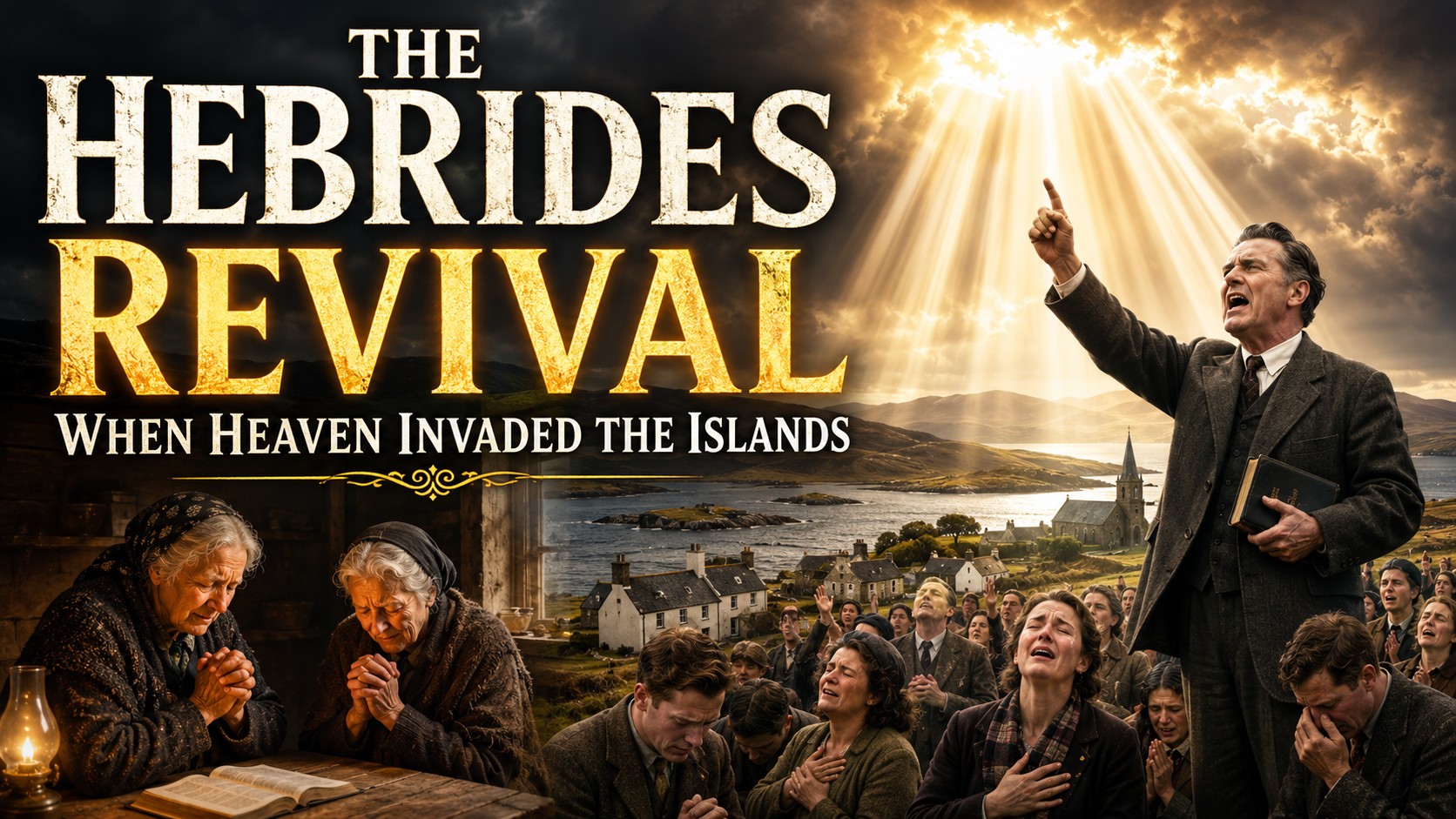
When Heaven Invaded the Islands
There are moments in history when Heaven does not merely visit a people with encouragement, but invades a territory with the weight of divine presence. The Hebrides Revival of 1949–1952 was one of those moments, when the Isle of Lewis in the Outer Hebrides of Scotland became a trembling altar before the Lord. It was not built on entertainment, personality, or religious machinery, but on desperate intercession, deep conviction, and the sovereign movement of Holy Spirit. What happened there reminds us that when God truly comes, communities do not merely attend meetings; they come under the government of His presence.
The Scripture declares, “Wilt thou not revive us again: that thy people may rejoice in thee?” (Psalm 85:6, KJV). Revival is not man awakening God, but God awakening man. It is not the Church persuading Heaven to become interested in earth, but Heaven finding vessels on earth who are finally surrendered enough to carry what has always been in the heart of the Father. The Hebrides Revival teaches us that revival does not begin with crowds; it begins with hunger.
In the village of Barvas, two elderly sisters, Peggy and Christine Smith, became hidden instruments in the hand of God. Peggy was blind, Christine was severely afflicted with arthritis, and neither one stood on a public platform; yet their cottage became a throne-room chamber of intercession. Historical accounts repeatedly connect their prayer burden with Isaiah 44:3: “I will pour water upon him that is thirsty, and floods upon the dry ground.” Peggy and Christine Smith prayed in their cottage while ministers and others gathered for prayer in other places, crying out for God to come upon the island.
This is the kind of intercession Hell fears: not performance prayer, not polished prayer, not prayer that tries to impress men, but prayer that lays hold of the promise of God until the atmosphere begins to bend. James 5:16 says, “The effectual fervent prayer of a righteous man availeth much.” The Hebrides reminds us that Heaven does not need celebrities to birth revival; Heaven needs surrendered vessels who will not let go until the promise becomes manifestation. A hidden cottage can become more dangerous to darkness than a thousand decorated platforms.
Duncan Campbell would later become one of the most recognized voices connected to the revival, but he was not the source of the fire. He was an instrument who stepped into a field already plowed by travail. Campbell himself emphasized the seriousness of genuine revival, declaring, “If you want revival, get right with God.” That line carries the sharp edge of the Hebrides testimony, because this was not a movement of religious excitement but a movement of holy confrontation.
When Duncan Campbell arrived, he did not bring revival in a suitcase; he walked into a divine disturbance already underway. The people had been crying out, the elders had been searching their own hearts, and the intercessors had been wrestling with God for an outpouring. Acts 2:2 says, “Suddenly there came a sound from heaven as of a rushing mighty wind.” In the Hebrides, that sudden sound did not come to entertain a people; it came to arrest a people.
The accounts of the Hebrides Revival are marked by a holy conviction that fell upon entire communities. Men and women were not simply moved emotionally; they were pierced in conscience. John 16:8 says Holy Spirit will “reprove the world of sin, and of righteousness, and of judgment.” When Heaven invaded those islands, people became aware that God was not an idea to be discussed, but a holy King before whom every soul must answer.
This is what makes true revival different from religious enthusiasm. Enthusiasm can fill a room, but conviction can empty a heart of compromise. Enthusiasm can make people shout, but conviction makes people repent. Second Corinthians 7:10 says, “For godly sorrow worketh repentance to salvation not to be repented of.” The Hebrides Revival carried that kind of sorrow, the kind that does not lead to despair, but to cleansing, surrender, and life.
One of the remarkable features of this move of God was how far beyond the church building the presence of God seemed to reach. Historical accounts describe fishermen, young people, villagers, and entire communities being overtaken by the reality of God’s nearness. Campbell’s own testimony included accounts of people being drawn by the Spirit of God outside the normal structure of a meeting. This is what happens when the manifest presence of the Lord rests upon a region: the atmosphere becomes evangelistic.
We must understand this with spiritual clarity: revival is not merely God blessing church activity; revival is God reclaiming territory. Psalm 24:1 says, “The earth is the LORD’S, and the fulness thereof; the world, and they that dwell therein.” When Heaven came upon the Hebrides, it was as if the Lord reminded the islands that they belonged to Him. The pubs, the roads, the homes, the villages, the youth, the families, and the fields all came under the awareness that Jesus Christ is Lord.
This is why the Hebrides Revival remains such a needed prophetic witness for our own hour. We have learned how to build programs, brand ministries, market movements, and engineer religious momentum, but only God can send holy invasion. Zechariah 4:6 says, “Not by might, nor by power, but by my spirit, saith the LORD of hosts.” The Hebrides stands as a rebuke to man-made revival and a summons back to altar-born awakening.
There is also a warning in this revival: the fire of God does not come to decorate mixture. Holy Spirit does not descend to endorse compromise, carnality, and religious pride. Malachi 3:2 asks, “But who may abide the day of his coming? and who shall stand when he appeareth?” When the Lord comes as refining fire, He comes to purify the sons and daughters of covenant so they can carry His glory without corrupting His name.
The Hebrides Revival was deeply connected to prayer, but it was also connected to obedience. Intercession opened the heavens, but surrender gave Heaven room to remain. Jesus said in John 14:23, “If a man love me, he will keep my words: and my Father will love him, and we will come unto him, and make our abode with him.” Revival is not proven by how powerfully God visits; it is proven by whether His people make room for Him to dwell.
This is the word for the Remnant today: stop asking for revival while protecting the very altars that grieve Holy Spirit. If we want Heaven to invade our cities, we must let Heaven first invade our hearts. If we want conviction in the streets, we must welcome conviction in the sanctuary. If we want communities shaken, we must become a people who tremble at His Word again.
The Hebrides Revival cries across history like a trumpet: when hidden intercessors travail, when leaders humble themselves, when the Church returns to holiness, and when a people become desperate for God, Heaven can still invade a region. The same God who moved upon the islands has not lost His power, His holiness, His mercy, or His desire to pour water upon thirsty ground. May the Lord raise up Peggys and Christines again, hidden ones who shake regions from the place of prayer. May He raise up surrendered voices like Duncan Campbell, not to manufacture fire, but to steward what Heaven has already ignited.
And may we never forget this: revival is not an event we schedule; it is a holy invasion we must prepare for. When Heaven invaded the Hebrides, it did not come to entertain the islands, but to bring them under the weight of God’s presence. Let that same cry rise again in our generation: “Lord, rend the heavens and come down.” Let the islands testify, let the nations remember, and let the Remnant cry until our cities become altars beneath the feet of the King.
Stay tuned, the journey continues…..
A voice of fire to the Remnant,
— Dr. Russell Welch
Dr. Russell Welch is a published author, prophetic teacher, apostolic builder, author, and founder of faith-driven publishing and media initiatives. He is known for crafting bold, Kingdom-centered messages that call the Ecclesia into maturity, doctrinal clarity, and governmental authority. With a passion for equipping the Remnant and honoring generational legacy, Dr. Welch writes and teaches at the intersection of Scripture, history, and spiritual governance, challenging believers to live as sons and daughters who legislate Heaven on earth through truth, holiness, and unwavering fidelity to Christ.
Be sure to check out his book: Restoring God’s Prophetic Voice: Unleashing the Watchman’s Power in the Church’s Guide to Holy Living, available exclusively on Amazon … here

