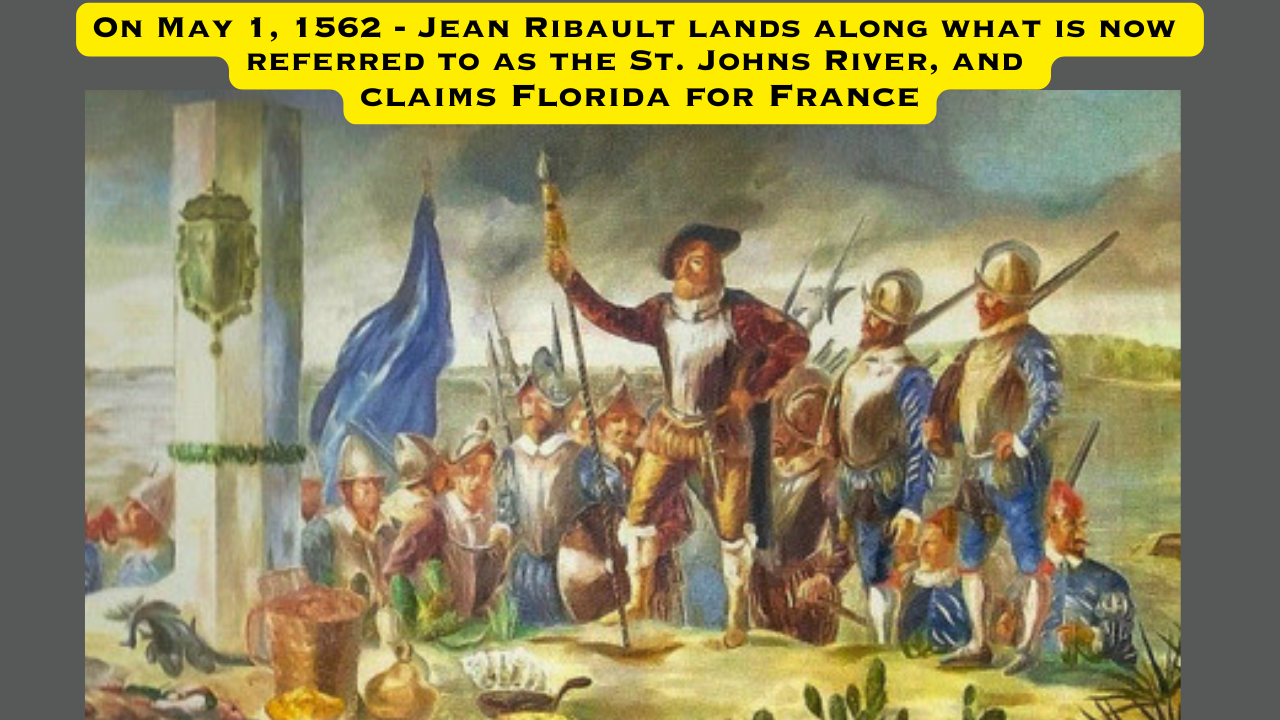
May 1, 2025 will be the 463rd Anniversary of the French Huguenots arriving in America, more specifically, right here in Jacksonville Florida in a park resting at the head of the St. Johns River, called Huguenot Park.
I was first introduced to the history of the Huguenots while attending Heritage School of Ministry located here in Jacksonville back in 2003, through a man that would go onto to be my spiritual father, Dr. Don Lynch.
For some reason, the story resonated within me, compelling me to study their history. Then in and around 2014, I met a man that I would later start a ministry called the RiverHouse which was a prophetic and Healing ministry, which included the North Florida healing rooms. He had been studying them for a number of years, and offered a great wealth of knowledge pertaining to them.
In 2018, we were blessed to have Ana Mendez Ferrell join us and lead us in a meeting of repentance, and reconciliation with regard to the slaughter of these precious followers of Jesus Christ, whose only desire was to establish a land (country) where Christ could be worshipped freely and in truth.
In celebration of this anniversary, I would like to share a bit about the Huguenot history, especially with the historical records of the flames of revival that they carried and brought here to North America.
But also to prayerfully light a flame in the prayer warriors in this region that read this and encourage them to join me is asking the Father to “Do it again Abba, do it again” …. For I know the Lord is about to do something here in Jacksonville and the State of Florida, as I can feel the intensity that is stirring in the spiritual realm and considering this is a “Open Door” year, let our decrees be heard on Earth and in Heaven…
The Unexpected Vessels
The dawn of the Huguenot revival unveiled a phenomenon that defied conventional understanding. Children, some barely able to form complete sentences in everyday conversation, stood before congregations delivering impassioned sermons with eloquence that stunned witnesses.
Records from the early 18th century document hundreds of cases where young children, between the ages of three and twelve, spontaneously began to preach with a depth of theological understanding that seemed impossible given their limited education and life experience.
These children emerged primarily in the Cévennes region of France, where Huguenot communities faced increasing persecution following the revocation of the Edict of Nantes in 1685.
Like morning dew collecting on the smallest, most overlooked blades of grass, divine inspiration settled upon the least expected members of the Huguenot community.
These tiny vessels, overlooked by authorities and often dismissed even by their own families, suddenly became conduits for messages that both comforted the faithful and challenged the religious establishment.
Their small frames would tremble, their eyes would close, and from their lips would flow words carrying the weight of centuries of theological tradition, yet delivered with a freshness that reinvigorated waning faith.
Historical accounts reveal that these child preachers typically entered trance-like states before delivering their messages. Witnesses described physical manifestations accompanying these episodes: trembling, falling to the ground, and speaking with altered voices that carried unusual power and resonance.
Jean Cavalier, who later became a military leader in the Camisard rebellion, recorded seeing his young cousin “taken by the Spirit” at age six, delivering a sermon on repentance that moved hardened adults to tears.
The child had no recollection of the event afterward, supporting the community’s belief that these were genuine divine interventions rather than rehearsed performances. The phenomenon spread rapidly through the Protestant communities of southern France.
Contemporary accounts suggest that by 1701, in some villages, nearly every child from certain families exhibited these preaching abilities at some point. Catholic authorities and skeptics attributed the occurrences to mass hysteria, parental coaching, or even demonic possession.
However, the consistency of theological content across sermons delivered by children who had never met, combined with the impossibility of such young minds comprehending the complex biblical allusions they referenced, convinced many observers that something extraordinary was occurring.
These child preachers offered hope during a period of intense persecution. Following Louis XIV’s campaign to eliminate Protestantism from France, Huguenot pastors were exiled or executed, churches demolished, and religious gatherings forbidden. Into this spiritual vacuum stepped children who could not possibly have been formally trained in theology, yet who spoke with authority on matters of faith.
Their messages typically focused on themes of perseverance, divine justice, and the importance of maintaining faith despite persecution. One particularly remarkable case involved a four-year-old girl named Marie Dalière who, in 1702, delivered a series of sermons warning of impending judgment against persecutors while offering comfort to the faithful.
The physical toll of these preaching episodes was evident. Children often collapsed afterward, exhausted and unable to remember what they had said. Parents reported that their children maintained ordinary childlike behavior before and after these episodes, showing no special religious inclination in their day-to-day lives.
This stark contrast between their normal childish behavior and their transformed state during preaching sessions reinforced the community’s belief that these were genuine instances of divine inspiration rather than practiced performances.
What makes this phenomenon particularly remarkable is the sharp contrast between these children’s limited cognitive development and the sophisticated content of their preaching. Developmental psychology tells us that children at ages three to seven typically struggle with abstract concepts and complex language.
Their thinking remains concrete, their vocabulary limited, and their grasp of metaphorical language minimal. Yet these young Huguenot preachers employed complex theological concepts, referenced obscure biblical passages, and used rhetorical devices that would challenge educated adults.
Like uncarved blocks of marble suddenly revealing masterful sculptures without the touch of a human chisel, these children displayed abilities that transcended ordinary developmental processes. Their messages emerged fully formed, articulate and profound, without the gradual learning curve that characterizes normal skill acquisition.
This inexplicable leap in capability convinced witnesses they were observing something beyond natural explanation—a divine intervention that purposefully used the weakest members of society to deliver the strongest messages.
If God could speak profound truths through the mouths of three-year-olds who could barely form sentences in everyday conversation, what does this reveal about our fundamental assumptions regarding who is qualified to convey divine wisdom?
Tongues of Fire
Among the most extraordinary aspects of the child prophets’ phenomenon was their apparent ability to speak in languages they had never learned. Historical records document numerous instances of young Huguenot children suddenly able to deliver messages in languages including Latin, Greek, Hebrew, and various dialects they had never been exposed to.
This manifestation, reminiscent of the biblical account of Pentecost, became known as xenoglossia—speaking in actual, identifiable languages unknown to the speaker.
Antoine Court, a Huguenot pastor who initially approached the child prophet phenomenon with skepticism, documented several verified cases where children with no educational background suddenly spoke in perfect Latin or Greek, languages that even most adults in their communities could not understand.
The significance of these unlearned languages extended far beyond mere linguistic curiosity. In an era when Latin remained the language of scholarship and Greek and Hebrew were considered essential for serious biblical study, the sudden ability of uneducated children to speak these languages carried profound theological implications.
The educated elite had long maintained their religious authority partly through their exclusive access to these sacred languages. When illiterate children suddenly began quoting Hebrew scripture with perfect pronunciation and explaining Greek theological concepts with precision, the boundaries between the learned and unlearned dramatically collapsed.
Witnesses frequently documented their amazement at this linguistic phenomenon. Jean-Pierre Maurice, a Swiss pastor who visited the Cévennes region in 1707 to investigate reports of child prophets, recorded hearing an eight-year-old shepherd boy deliver a complex theological argument in flawless Latin, then switch to what appeared to be ancient Hebrew for several minutes of prophetic utterance.
Maurice, who was himself educated in classical languages, wrote: “Having tested the boy afterward, I can attest he has no knowledge of Latin in his normal state, nor can he recognize even the most basic Hebrew characters. Yet in his inspired condition, his command of these tongues exceeds that of many university scholars.”
Imagine a butterfly emerging from its chrysalis with the ability to navigate precisely to a destination it has never seen, guided by instincts it cannot explain.
Similarly, these children emerged from their ordinary consciousness into prophetic states carrying linguistic abilities that transcended their natural capacities, speaking with a fluency and depth that suggested access to knowledge beyond their personal experience or education.
Let us peition Heaven to pour this powerful anointing out upon His faithful in this generation in the mighty name of Yeshua
~Dr. Russell Welch
Elder / Apostolic Teacher: Highway to Heaven Church and Founder and Shepherd of Remnant Warrior Ministries / Remnant Warrior School of Spiritual Warfare.
 Radical Disciples - A Remnant Revolution