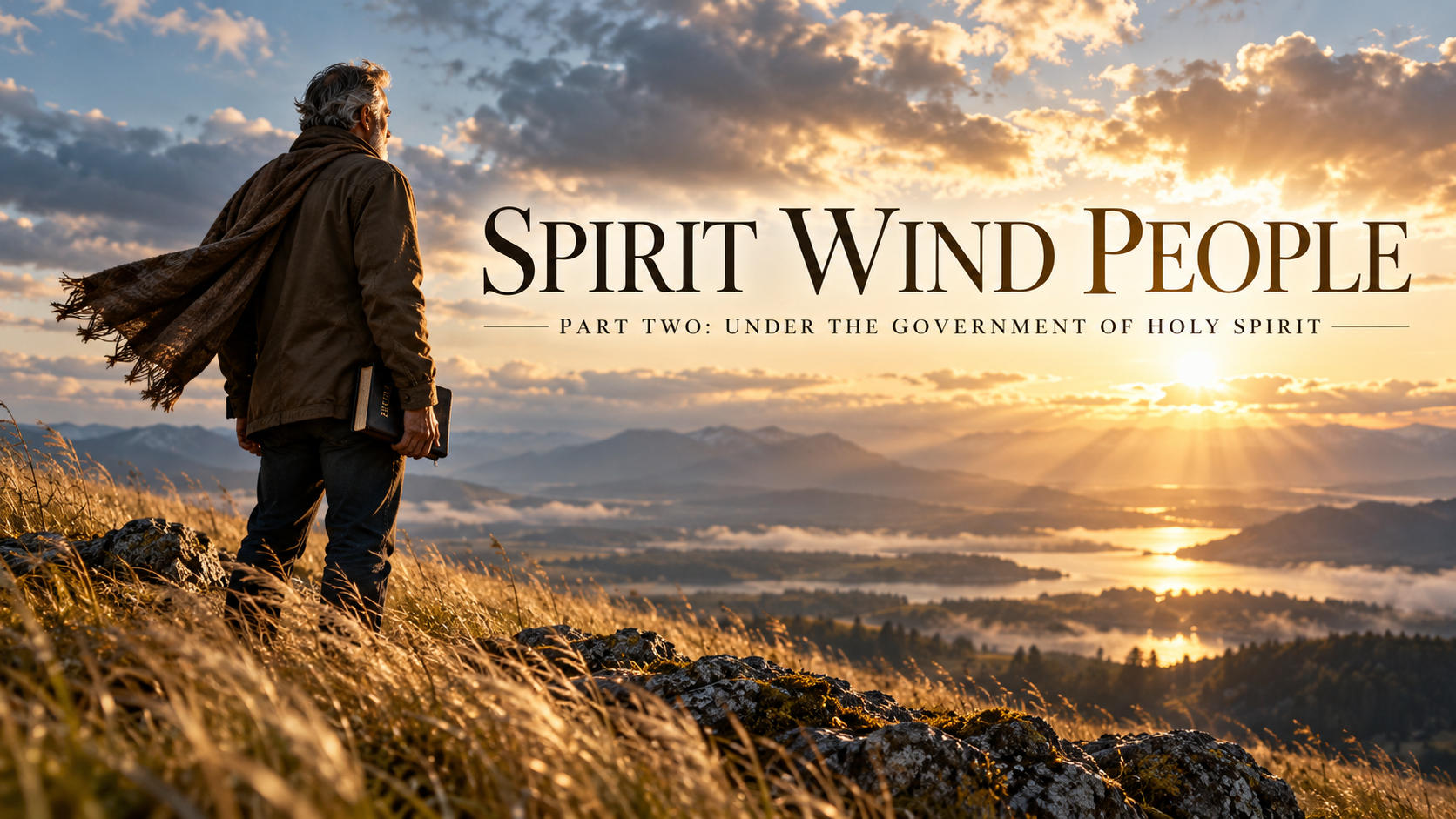
There is a profound difference between experiencing the presence of Holy Spirit and living under the government of Holy Spirit. Many believers can recall moments when the presence of God became unmistakable, when a service shifted, when prayer became unusually weighty, or when a word from the Lord pierced through confusion and brought clarity. Those moments matter, and they should never be dismissed. Yet visitation is not the highest expression of Spirit-led life. The deeper call is to become a people whose direction, timing, priorities, decisions, and obedience are governed by Holy Spirit.
Romans 8:14 declares, “For as many as are led by the Spirit of God, they are the sons of God.” Paul does not describe mature sons and daughters as those who are occasionally moved upon by the Spirit, but as those who are led by Him. That language points to government, not merely encounter. It speaks of movement, direction, submission, and continual responsiveness. The mature believer does not simply recognize the presence of Holy Spirit when He manifests; the mature believer learns to organize life around His leadership.
This is where the language of “Spirit Wind People” becomes more than poetic imagery. In John 3:8, Jesus compared the movement of the Spirit to the wind, saying that the wind blows where it wills and that its movement cannot be controlled by human hands. The implication is not instability or spiritual randomness. The implication is that Holy Spirit remains sovereign, and those who are born of the Spirit must learn to move with Him rather than demand that He conform to their plans. A Spirit Wind person is not merely someone who enjoys spiritual movement. A Spirit Wind person is someone who has surrendered the right to govern the direction.
The Church has often celebrated visitation while resisting government. We welcome moments of refreshing, revival language, powerful worship, prophetic utterance, and manifestations of the Spirit, yet we are not always as eager when Holy Spirit challenges our structures, exposes our traditions, interrupts our calendars, or requires us to abandon something that once worked well. It is possible to hunger for His presence while still protecting our own preferences. It is possible to ask Him to move while quietly setting the boundaries around where and how He is permitted to do so. Yet genuine surrender requires more than inviting Holy Spirit into what we have already decided; it requires allowing Him to decide.
Israel’s wilderness journey provides a powerful picture of this principle. The cloud of the Lord was not simply something to admire above the tabernacle. The cloud governed movement. Exodus 40:36 says, “And when the cloud was taken up from over the tabernacle, the children of Israel went onward in all their journeys.” When the cloud moved, they moved. When the cloud remained, they remained. Their lives were ordered around the presence of God rather than around convenience, preference, or human timing.
That remains a needed pattern for the Ecclesia today. We have become skilled at building programs, calendars, conferences, preaching schedules, ministry systems, and institutional rhythms, but the question must always remain whether the cloud is still there. What God breathed upon in one season can become an idol in the next if we refuse to release it after He has moved on. Methods are not sacred merely because they once produced fruit. A Spirit-governed people must always be willing to ask whether Holy Spirit is still breathing upon what they are doing.
This does not mean rejecting order, planning, wisdom, or structure. Scripture never presents Holy Spirit as the author of chaos. The issue is not whether we plan, but whether our plans remain submitted. The issue is not whether we build, but whether we build what Heaven is breathing upon. The issue is not whether we use strategy, but whether strategy remains subordinate to revelation. The danger comes when the structure becomes more important than the Spirit who originally inspired it.
This is where self-government must die. Humanity’s fall in Eden was not simply about eating forbidden fruit; it was an act of autonomous rule. The temptation was to determine good and evil apart from God. That impulse toward self-rule remains deeply embedded in fallen human nature. We want God close enough to bless us, but not always close enough to govern us.
Jesus confronted this directly when He said, “If any man will come after me, let him deny himself, and take up his cross daily, and follow me” (Luke 9:23). Self-denial is not self-hatred. It is the surrender of autonomous rule. To take up the cross is to acknowledge that our lives are no longer self-owned and self-directed. Paul reinforced this in 1 Corinthians 6:19–20 when he wrote, “Ye are not your own. For ye are bought with a price.”
That truth becomes extremely practical for anyone who desires to live as a Spirit Wind person. Holy Spirit may interrupt a plan that appears perfectly reasonable. He may redirect a ministry assignment that seemed certain. He may require waiting when every natural instinct says to move, or movement when comfort says to remain. He may forbid something that appears outwardly good because it is not His present assignment. Spirit-led living therefore demands a surrender deeper than emotional enthusiasm; it requires the willingness to obey when His direction conflicts with our preference.
Acts 16 gives one of the clearest examples of this kind of divine interruption. Paul and his companions attempted to preach the Word in Asia, yet Scripture says they were forbidden by Holy Spirit. They then attempted to enter Bithynia, and again “the Spirit suffered them not” (Acts 16:7). Their desire was righteous, their mission was biblical, and their intention was honorable, yet Holy Spirit still said no. Only after those closed doors came the Macedonian vision that redirected the mission.
This reveals an essential principle for mature spiritual leadership. A good idea is not always a God assignment. Something can be biblical in principle and still not be the present instruction of Holy Spirit. Mature sons and daughters must learn to ask not merely whether something is good, but whether it is obedience. This distinction is one of the dividing lines between religious activity and Spirit-governed ministry.
The ability to follow Holy Spirit also requires that we learn to recognize His voice. Jesus said in John 10:27, “My sheep hear my voice, and I know them, and they follow me.” Hearing is connected to knowing. The more deeply we know the character of God through Scripture, prayer, communion, and obedience, the more clearly we recognize what is consistent with Him. This is why spiritual sensitivity can never be separated from biblical grounding.
Holy Spirit will never contradict the Word He inspired. Impressions must be tested, prophetic words must be weighed, desires must be examined, and open doors must be discerned. Not every opportunity is an assignment, not every emotional impulse is revelation, and not every internal voice is Holy Spirit. First John 4:1 instructs believers to “try the spirits whether they are of God.” Discernment is not unbelief; it is spiritual stewardship.
Samuel provides an instructive example of how discernment develops over time. When the Lord first called him, he assumed Eli was speaking. Samuel was not rebellious; he simply had not yet learned to distinguish the voice of God. With instruction and repeated encounter, he learned to respond, “Speak, LORD; for thy servant heareth” (1 Samuel 3:9). That posture is central to Spirit-governed life because it places hearing before action and surrender before interpretation.
The secret place is where this kind of hearing is formed. Public authority is usually born in private communion. Jesus repeatedly withdrew from crowds and activity to pray, and Luke 5:16 records that “he withdrew himself into the wilderness, and prayed.” If Jesus guarded the secret place, then those who claim to follow His pattern cannot afford to live continually surrounded by noise. The ear of the spirit is sharpened in the place where competing voices grow quiet.
Many believers struggle to discern Holy Spirit because their inner world is never still. The mind is constantly being filled with opinions, notifications, crises, conversations, social media, news, and the expectations of others. Yet Elijah discovered that God was not always speaking through the spectacular. There was wind, earthquake, and fire, but then came the still small voice. The lesson is not that God never moves dramatically, but that intimacy requires attentiveness.
The secret place also trains obedience. Every time Holy Spirit convicts and we repent, sensitivity grows. Every time He redirects and we follow, sensitivity grows. Every time He says wait and we refuse to force the outcome, sensitivity grows. Every act of obedience strengthens the inner capacity to recognize His leadership.
This has enormous implications for the Ecclesia. If individual believers are called to live under the government of Holy Spirit, then congregations must also learn to function under that same government. Holy Spirit is not an invited guest whose role is to bless what leadership has already determined. Christ remains the Head of the Church, and Holy Spirit is the living presence of God among His people. A Spirit-governed Ecclesia must therefore retain the ability to hear, adjust, respond, and obey.
Acts 13 gives a compelling picture of this. As the believers ministered to the Lord and fasted, Holy Spirit said, “Separate me Barnabas and Saul for the work whereunto I have called them” (Acts 13:2). The gathering created space to hear, and when Holy Spirit spoke, the community responded. This is fundamentally different from constructing a ministry agenda and then asking God to bless it afterward.
The restoration of the Ecclesia will therefore require more than structural reform. It will require recovered submission. We must once again become a people capable of hearing when Holy Spirit says, “Send them,” “Wait,” “Go,” “Do not enter there,” “Turn aside,” “Speak,” or “Be silent.” The issue is not merely whether we believe Holy Spirit still speaks. The issue is whether we are prepared to obey when He does.
There is also a critical distinction between stability and predictability. Some believers become uncomfortable with language about being led by Holy Spirit because they associate it with emotionalism, chaos, or impulsive behavior. Yet Scripture presents the opposite. Holy Spirit produces love, joy, peace, longsuffering, gentleness, goodness, faith, meekness, and temperance. His government forms mature, grounded, stable people.
What His government disrupts is not biblical stability, but human control. Jesus Himself was perfectly stable in identity, mission, and obedience, yet His ministry could not be reduced to a formula. Sometimes He healed with a word, sometimes with touch, sometimes through unusual means, sometimes immediately, and sometimes after delay. He was not inconsistent. He was responsive to the Father.
That is the kind of stability Spirit Wind people must recover. We are not anchored to methods; we are anchored to Christ. We are not committed to maintaining yesterday’s pattern simply because it worked yesterday. We are committed to obeying the present direction of Holy Spirit while remaining firmly rooted in the truth of Scripture.
The question before us, then, is not whether we enjoy the wind of the Spirit. The question is whether we will allow the wind to lead us. Are we willing to change direction when Holy Spirit changes the assignment? Are we willing to release what He says has ended? Are we willing to walk away from something successful if His presence is no longer upon it? Are we willing to move toward an assignment we did not choose, or wait when we do not understand why He has said no?
This is where Spirit Wind people are formed. They are formed in the tension between revelation and obedience, between calling and surrender, between movement and stillness. They are not defined merely by spiritual experiences, but by sustained submission to the government of Holy Spirit. The next generation of mature sons and daughters will not simply know how to talk about the wind. They will know how to move when the wind moves.
Stay tuned—the journey continues.
A voice of fire to the Remnant,
— Dr. Russell Welch
Dr. Russell Welch is a published author, prophetic teacher, apostolic builder, and founder of faith-driven publishing and media initiatives. His ministry carries a strong call to equip the Ecclesia for maturity, biblical clarity, spiritual discernment, and Kingdom assignment. Through his writing and teaching, he brings together Scripture, Church history, theology, and spiritual governance while challenging believers to move beyond religious tradition and into the mature life of sons and daughters who are led by Holy Spirit, established in truth, and wholly surrendered to Jesus Christ.
At the heart of this ministry is a burden to prepare and equip the Lord’s Remnant—to awaken identity, restore biblical order, strengthen spiritual maturity, and help believers recognize the assignments God has placed before them. The vision is not simply to produce messages, books, or media, but to help form a people who carry the character of Christ, hear the voice of Holy Spirit, and faithfully advance the Kingdom of God wherever the Father sends them.
To learn more about Remnant Warrior Ministries, the vision, and the assignment of the Remnant, visit:
https://radical-disciples.org/the-assignment-of-the-remnant/
You can learn more about Spirit Wind People here:https://www.amazon.com/dp/1964155134

