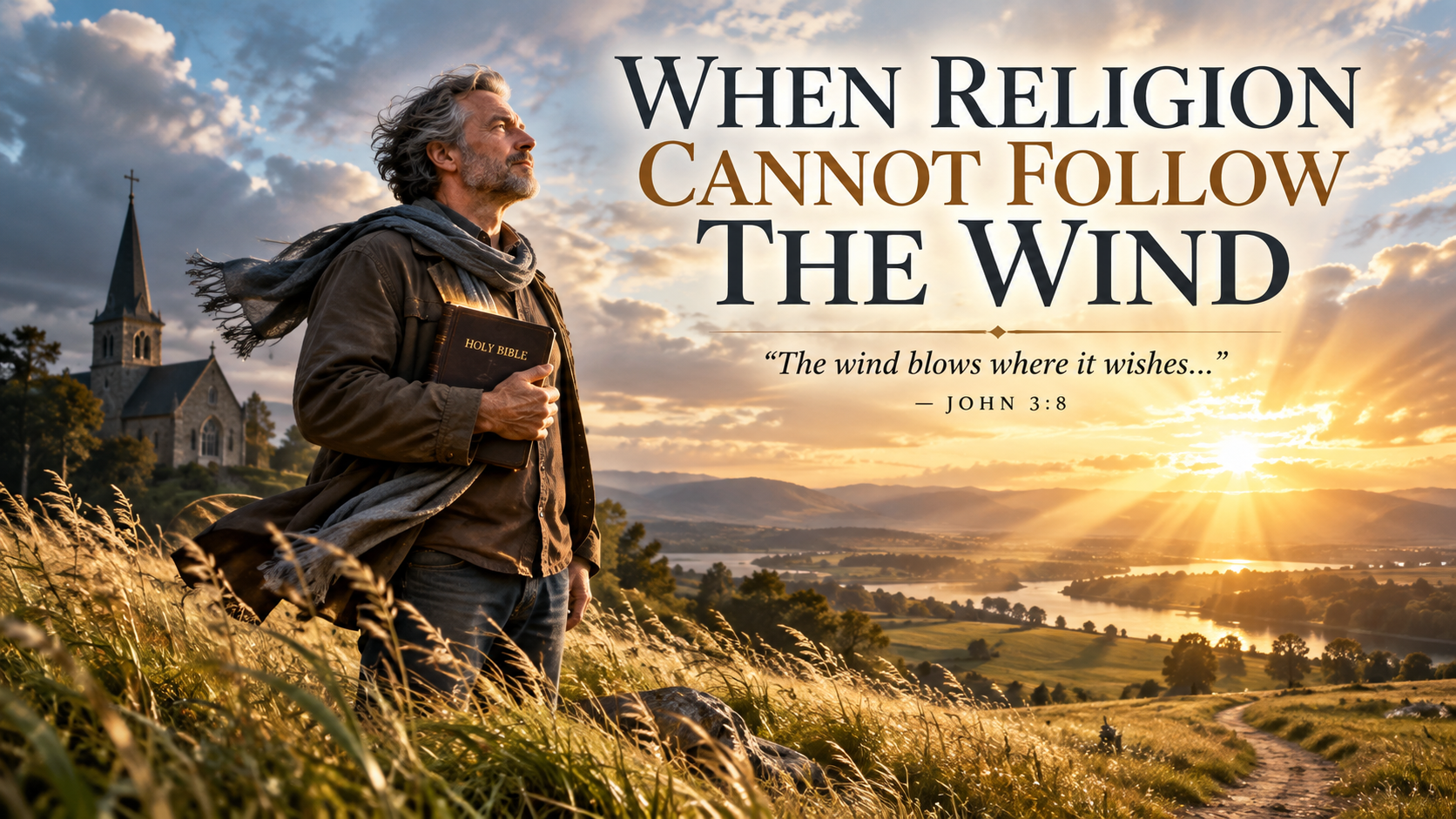
There is a profound difference between knowing how to function inside a religious system and knowing how to move with Holy Spirit. Religious systems thrive on predictability because predictability can be managed, scheduled, repeated, and controlled. Holy Spirit, however, is not subject to human management. Jesus made this unmistakably clear when He said, “The wind blows where it wishes, and you hear its sound, but you do not know where it comes from or where it goes. So it is with everyone who is born of the Spirit” (John 3:8). Spirit-born people are not called into chaos, but neither are they called to live within the suffocating boundaries of human control.
The Church has often become highly skilled at building structures that can continue functioning whether Holy Spirit is moving or not. Services can be timed, programs can be organized, sermons can be delivered, music can be performed, and calendars can remain full while spiritual sensitivity slowly diminishes. None of these things are inherently wrong, but they become dangerous when structure begins replacing dependence. The issue is not whether we have order, but whether our order still makes room for the One who is supposed to be leading us. A ministry can be organized and still be alive, but it can also become so organized that interruption by Holy Spirit feels inconvenient.
This is one of the reasons religious systems frequently struggle when God begins moving outside familiar patterns. When Jesus healed on the Sabbath, touched lepers, ate with sinners, spoke openly with women, challenged established interpretations, and refused to conform to the expectations of religious leaders, He was not rebelling against the Father. He was perfectly obeying the Father. The conflict existed because religious expectation had become more authoritative in the minds of men than the present movement of God. Jesus revealed the painful truth that people can become so committed to what God did yesterday that they resist what He is doing today.
That same danger remains with us. It is possible to defend a pattern so fiercely that we fail to recognize when the cloud has moved. Israel knew this tension well. In the wilderness, the people were not permitted to choose the timing of their movement. When the cloud lifted, they moved. When the cloud remained, they stayed. Their security was not found in having a predictable itinerary but in remaining aligned with the presence of God. The great challenge of Spirit-led living is that it requires continual attentiveness, because yesterday’s direction cannot replace today’s obedience.
This does not mean every sudden impulse should be labeled Holy Spirit. Spiritual maturity requires discernment, and discernment is formed through Scripture, prayer, submission, wisdom, and the fruit produced by what we believe we are hearing. Galatians 5:25 says, “If we live by the Spirit, let us also keep in step with the Spirit.” Keeping in step implies both movement and alignment. We are not running ahead of Him, and we are not standing still after He has moved. The mature believer learns to recognize His pace.
One of the clearest warning signs that religious structure has begun replacing spiritual dependence is when interruption becomes irritating. If Holy Spirit changing the direction of a service feels like a problem, we should ask who the service was truly built around. If God redirecting our personal plans creates resentment, we should ask whether surrender was ever more than a theological idea. If we cannot obey until every detail is explained, we may be depending more heavily on control than faith. The life of the Spirit constantly exposes our desire to know the entire route before taking the next step.
Jesus described new wine requiring new wineskins because some structures cannot carry what God is presently pouring out. The answer is not to despise structure, because Scripture itself reveals order, leadership, discipline, and accountability. The answer is to ensure that structure remains servant rather than master. Healthy structure protects what God is doing without attempting to control Him. Unhealthy structure eventually becomes an institution defending its own continuity.
Paul wrote, “Where the Spirit of the Lord is, there is liberty” (2 Corinthians 3:17). Biblical liberty does not mean lawlessness, emotionalism, or spiritual recklessness. It means freedom from the bondage of human systems that attempt to replace the living leadership of God. Holy Spirit never leads us away from the character of Christ or the authority of Scripture. He does, however, regularly lead us beyond human expectations.
The early Church learned this quickly. Philip was experiencing fruitful ministry in Samaria when the angel of the Lord directed him toward a desert road. From a human perspective, leaving a place of visible success for an isolated road would have seemed irrational. Yet on that road he encountered the Ethiopian official whose conversion would carry the Gospel far beyond what Philip could have planned. Spirit-led obedience often looks inefficient until we understand the assignment hidden inside it.
Peter experienced something similar in Acts 10. His religious formation had given him clear categories concerning who was clean and who was unclean. Then God interrupted those categories through a vision and directed him to the household of Cornelius. Peter had to choose between defending his inherited understanding and obeying the fresh direction of God. His obedience opened a historic door for the Gospel among the Gentiles. The wind was blowing beyond the boundaries Peter had known.
There are moments when Holy Spirit will lead us into things that make perfect sense, and there are moments when obedience will precede understanding. Abraham left without knowing exactly where he was going. Philip ran toward a chariot before knowing what conversation awaited him. Paul was forbidden from entering certain regions before being redirected toward Macedonia. None of these men were spiritually unstable; they were spiritually responsive.
That distinction matters. Spirit-led people are not flighty people who constantly abandon responsibility because they claim God told them something new. Stability and sensitivity belong together. True responsiveness to Holy Spirit produces deeper obedience, greater humility, stronger character, and increasing conformity to Christ. If what we call spiritual leading repeatedly produces confusion, pride, broken commitments, or disregard for Scripture, we should question the source.
One of the tragedies of religious culture is that people can learn how to perform spiritual activity without spiritual dependence. We can learn when to lift our hands, when to say amen, when to pray loudly, when to quote Scripture, and how to sound spiritually mature. Yet none of those behaviors prove that we are presently listening. The question is not whether we know the language of the Spirit, but whether we still recognize His voice.
The remedy is not rebellion against all tradition. Some traditions carry wisdom, continuity, and testimony from generations of faithful believers. The remedy is refusing to allow tradition to become untouchable. Jesus said that men could make the Word of God ineffective through their traditions when those traditions became more authoritative than obedience. Every structure, method, and ministry pattern must remain subject to the Lordship of Christ.
This begins personally before it ever becomes institutional. We should regularly ask whether there are places in our lives where routine has replaced relationship. Have we become so familiar with our devotional pattern that we no longer expect Holy Spirit to speak? Have we become so committed to our ministry calendar that there is no room for divine redirection? Have we mistaken predictability for maturity?
A genuinely Spirit-led life requires surrender because surrender removes our demand to control the outcome. Holy Spirit may lead us to stay when we want to leave, speak when we would rather remain silent, wait when we are ready to move, or move when we are comfortable remaining where we are. The issue is never novelty for novelty’s sake. The issue is obedience.
The remnant the Lord is raising in this hour cannot be governed primarily by religious momentum. Yesterday’s encounter cannot substitute for today’s communion. Yesterday’s strategy cannot automatically determine today’s assignment. Yesterday’s word cannot become an excuse for ignoring what Holy Spirit is presently emphasizing. We honor what God has done while remaining available for what He desires to do next.
There is a generation of believers who are learning again what it means to be moved by the impulses of Holy Spirit. They are not rejecting Scripture, order, or accountability. They are rejecting the idea that human control is the same thing as spiritual maturity. They want to become a people who are deeply rooted in truth and yet responsive enough to move when the Wind begins to blow.
That is the heart behind my book, Spirit Wind People: Those Who Are Moved by the Impulses of Holy Spirit. It is an invitation to move beyond religious predictability and into the biblical reality of a life genuinely led by the Spirit of God. If you sense Holy Spirit calling you into deeper sensitivity, obedience, and surrender, this book was written to help you explore what it means to become one of those who truly follows the Wind.
Stay tuned, the journey continues…..
Stay tuned—the journey continues.
A voice of fire to the Remnant,
— Dr. Russell Welch
Dr. Russell Welch is a published author, prophetic teacher, apostolic builder, and founder of faith-driven publishing and media initiatives. His ministry carries a strong call to equip the Ecclesia for maturity, biblical clarity, spiritual discernment, and Kingdom assignment. Through his writing and teaching, he brings together Scripture, Church history, theology, and spiritual governance while challenging believers to move beyond religious tradition and into the mature life of sons and daughters who are led by Holy Spirit, established in truth, and wholly surrendered to Jesus Christ.
At the heart of this ministry is a burden to prepare and equip the Lord’s Remnant—to awaken identity, restore biblical order, strengthen spiritual maturity, and help believers recognize the assignments God has placed before them. The vision is not simply to produce messages, books, or media, but to help form a people who carry the character of Christ, hear the voice of Holy Spirit, and faithfully advance the Kingdom of God wherever the Father sends them.
To learn more about Remnant Warrior Ministries, the vision, and the assignment of the Remnant, visit:
https://radical-disciples.org/the-assignment-of-the-remnant/
You can learn more about Spirit Wind People here:

