The Father Is Raising a Living Ekklesia, Not Another Religious Institution
There is an alarm sounding to the Body of Christ, and it is not an alarm of condemnation, but a trumpet of awakening!
The Holy Spirit is calling the Ekklesia to examine what we have built, what we have called holy, and whether the structures we have established truly reflect the eternal purpose of the Father revealed through Jesus Christ. We have entered a time when religious activity can no longer be mistaken for spiritual maturity, impressive facilities can no longer be presented as evidence of divine approval, and the naming of Jesus over a building cannot substitute for the government of the Holy Spirit within His people. The question confronting the modern Ekklesia is not whether we have built something impressive for God, but whether what we are building is actually governed by Christ!
THE FIRST ALARM: JESUS REMOVED THE GEOGRAPHICAL BOUNDARIES OF WORSHIP!
When Jesus encountered the Samaritan woman at the well, she raised a question that continues to govern much of Christianity today: Where is the proper place to worship God? The Samaritans identified their mountain, while the Jews pointed to Jerusalem, each defending the geographical location associated with their religious inheritance. But Jesus did not endorse either location as the permanent center of worship under the New Covenant. Instead, He announced a profound transition that would forever change how humanity approached the Father.
John 4:21 declares, “Woman, believe me, the hour cometh, when ye shall neither in this mountain, nor yet at Jerusalem, worship the Father” (KJV).
Then, in John 4:23–24, Jesus reveals that the Father seeks those who worship Him in spirit and in truth. Notice what He did not say! He did not instruct His disciples to establish another sacred mountain, construct another earthly temple, or organize a religious institution around a specially designated place of divine visitation. He revealed that worship would no longer be defined by geographical access, but by the spiritual reality established through Himself. The Father was not seeking another location to occupy; He was seeking worshipers whose lives would be brought into genuine relationship with Him.
WATCHMEN, SOUND THE ALARM!
If Christ has already removed the geographical boundaries of worship, why are we teaching believers to pursue locations as though the Father is more accessible inside certain buildings than He is to His own sons and daughters?
THE SECOND ALARM: THE MOST HIGH DOES NOT DWELL IN TEMPLES MADE WITH HANDS!
Stephen stood before the religious authorities and confronted an understanding of God’s dwelling place that had become dangerously entangled with religious identity. Quoting the prophet Isaiah, he declared in Acts 7:48–49 that the Most High does not dwell in temples made with hands, asking what house humanity could build for the One whose throne is Heaven and whose footstool is the earth. Paul repeated this declaration in Acts 17:24, revealing that the Creator of Heaven and earth cannot be contained within structures constructed by human hands. These passages confront the assumption that divine presence can be possessed, confined, or guaranteed through a physical sanctuary.
Let me be unmistakably clear: There is nothing inherently sinful about purchasing property, building a ministry center, or establishing a place where believers gather for worship, prayer, and Kingdom equipping. The early believers gathered in homes, public places, and other available facilities, yet none of those structures determined their standing before the Father. The danger begins when ministry leaders elevate the building beyond its rightful purpose and begin treating it as though the structure itself possesses a unique spiritual authority. A facility dedicated to Kingdom service is one thing; declaring that Heaven has permanently marked the property as a special dwelling place of God is another.
And here is where the fire of conviction must reach our hearts! Have we established buildings to serve the assignment of Christ, or have we gradually made the preservation, expansion, and reputation of those buildings the assignment itself? Have we convinced believers that they must come to our sanctuary to encounter the Father, when Jesus has already opened the way for them to live in communion with Him? Have we mistaken attendance for discipleship, atmosphere for transformation, and religious excitement for the genuine government of the Holy Spirit? These are not accusations against every ministry with a building; they are questions every leader, including this watchman, must be willing to bring before the Lord.
THE THIRD ALARM: THE FATHER IS BUILDING A LIVING TEMPLE!
Ephesians 2:19–22 unveils something that should shake the foundations of institutional Christianity! Paul identifies believers as members of God’s household, built upon the foundation of the apostles and prophets, with Jesus Christ Himself as the chief cornerstone. He then describes this spiritual building growing into a holy temple in the Lord, with believers being joined together as a habitation of God through the Spirit. The language of construction is unmistakable, but the materials are not concrete, steel, stained glass, or elaborate religious architecture.
The materials are living people redeemed through the blood of Jesus Christ!
Peter confirms this in 1 Peter 2:5, declaring that believers are living stones being built into a spiritual house and holy priesthood. The Father is not merely gathering people into a structure; He is joining redeemed sons and daughters together in Christ to manifest His life upon the earth. This is the New Covenant revelation of the Ekklesia, a people called into Christ, established under His authority, and empowered through the Holy Spirit. We must recover the distinction between assembling the saints for Kingdom purposes and constructing an institution that begins to function as though it possesses the life and authority that belong exclusively to Christ.
Hear this carefully: A building can be dedicated, beautifully furnished, and filled with thousands of people while the lives within it remain untouched by genuine discipleship and spiritual transformation. Conversely, a handful of believers gathered around a kitchen table, surrendered to Christ and governed by the Holy Spirit, are no less the household of God. Numbers do not establish spiritual authority, architecture does not produce holiness, and a ministry’s reputation cannot replace obedience to the Word. The testimony of the Ekklesia must be found in its faithfulness to Christ, its love for one another, its spiritual maturity, and the fruit produced through the Holy Spirit.
THE FOURTH ALARM: STOP CALLING A BUILDING THE PLACE OF HIS PRESENCE WHILE NEGLECTING THE PEOPLE WHO CARRY HIS SPIRIT!
There is a growing fascination within portions of Christianity with establishing houses of glory, places of visitation, portals of Heaven, and sanctuaries supposedly marked by an unusual measure of divine presence. While Scripture certainly records extraordinary manifestations of God’s power in particular locations, it does not authorize us to manufacture a permanent spiritual status for a building simply because we dedicate it or announce a prophetic designation over it. Acts 4:31 describes the place where believers prayed being shaken, but the emphasis of the passage rests upon the Spirit filling the believers and empowering them to speak the Word of God boldly. The physical location witnessed the manifestation; the people received the empowering!
Jesus declares in John 14:23 that those who love Him and keep His Word will experience the abiding fellowship of the Father and the Son. Romans 8:14 identifies those led by the Spirit of God as sons of God, while 1 Corinthians 6:19 describes the believer’s body as the temple of the Holy Spirit. The astonishing revelation of the New Covenant is not that humanity must continually journey to some specially designated earthly location to find God. It is that, through Christ, the Father has brought His redeemed children into a living relationship in which His Spirit dwells within them!
WATCHMEN, WHERE IS THE DISCERNMENT?
Why would we spend millions constructing places where people are encouraged to come and experience the presence of God, yet fail to equip those same people to recognize the Spirit dwelling within them? Why would we celebrate a sanctuary filled with worship while neglecting to teach believers how to walk in obedience, holiness, discernment, sonship, and genuine communion with the Father? What benefit is an extraordinary worship atmosphere if those who leave remain spiritually dependent upon another meeting, another personality, or another manufactured encounter to sustain their relationship with Christ?
The answer is not to abandon corporate worship, for Hebrews 10:24–25 clearly establishes the importance of believers assembling together and encouraging one another. The answer is to restore the purpose of gathering, so that believers are strengthened, equipped, corrected, encouraged, and matured in Christ. Ephesians 4:11–16 reveals that ministry gifts are given for the perfecting of the saints, the work of ministry, and the edifying of the Body of Christ. The gathering is meant to equip the people of God to live from His life, not make them dependent upon a physical location for access to His presence.
THE FIFTH ALARM: THE HOLY SPIRIT IS CALLING FOR REPENTANCE, NOT RELIGIOUS DEFENSIVENESS!
This word is not an attack upon faithful pastors, ministries, or congregations that have sacrificed to establish places where people can gather and encounter the transforming power of the Gospel. Nor is it a declaration that every ministry facility is contrary to the will of God, because such an accusation would go beyond what Scripture actually teaches. Rather, it is an invitation to examine whether our structures remain servants of Christ’s purpose or whether they have gradually become substitutes for the very spiritual realities they were intended to support. The Holy Spirit does not expose these things to humiliate the faithful, but to bring the Body of Christ into greater alignment with the Father.
There is a difference between the conviction of the Holy Spirit and the condemnation of the enemy! Condemnation seeks to produce shame, hopelessness, and separation from the Father, while the Spirit’s conviction brings truth into the light and calls us toward repentance, restoration, and obedience. Romans 8:1 declares that there is no condemnation to those who are in Christ Jesus, while 2 Corinthians 7:10 teaches that godly sorrow produces repentance leading to salvation. When the Holy Spirit exposes religious mixture, His purpose is not to destroy the Ekklesia but to purify our allegiance to Christ.
Therefore, let every ministry leader examine the foundation upon which the work is being established! If Christ is truly the chief cornerstone, then every ministry vision, building project, teaching, financial priority, and expression of worship must remain submitted to His authority. If we are building facilities, let them become places of genuine Kingdom equipping, discipleship, prayer, healing, fellowship, and service. But let us never confuse the structure that accommodates the gathering with the living temple that God Himself is building through the Holy Spirit.
THE FINAL TRUMPET: THE FATHER NEVER CALLED US TO MANUFACTURE HIS PRESENCE!
The Father has not abandoned His people and left them dependent upon another religious structure to regain access to Him. Through the finished work of Christ, we have access by one Spirit unto the Father, as Ephesians 2:18 so powerfully declares. The veil has been opened through Christ, and Hebrews 10:19–22 calls believers to draw near with confidence through His blood. What an extraordinary tragedy it would be if the very people who possess this New Covenant access began living as though communion with the Father depended upon entering another earthly sanctuary!
I believe the trumpet of the Spirit is calling the Ekklesia back to the simplicity, purity, and authority of life in Christ. This does not require us to tear down every church building, but it does require us to confront every theology that elevates a building above the people God has redeemed. It calls leaders to measure their success by the maturity of the saints rather than the grandeur of their facilities, and it calls believers to recognize that their relationship with the Father was never intended to begin when a worship service opens and end when the doors close. The Father desires a people who abide in Christ, walk in His Spirit, and carry His testimony wherever they are sent!
WATCHMEN, LET THE TRUMPET SOUND!
We do not need another generation of believers who know how to attend a sanctuary but do not understand how to live as the habitation of God through the Spirit. We need sons and daughters awakened to their identity in Christ, established in the Word, governed by the Holy Spirit, and equipped to advance the Kingdom of God. We need shepherds who are willing to disciple people beyond the walls of their institutions and leaders who understand that genuine Kingdom authority cannot be purchased, constructed, or manufactured through religious branding. We need the Ekklesia to recover the revelation that the Father is not merely looking for somewhere to visit; He is forming a people in whom His life is made manifest through Jesus Christ!
A PRAYER OF REPENTANCE AND REALIGNMENT
Heavenly Father, in the name of Jesus Christ, we humble ourselves before You and invite the searching fire of Your Holy Spirit to examine our hearts, our ministries, and everything we have established in Your name. Wherever we have substituted religious accomplishment for spiritual obedience, forgive us and bring us into alignment with Your eternal purpose. Wherever we have elevated buildings, personalities, programs, or ministry reputations above the authority of Your Son, expose that mixture and cleanse our hearts. Let Your conviction produce genuine repentance, never condemnation, and let Your truth restore what religious tradition has obscured.
Father, awaken Your sons and daughters to the reality of who they are in Christ, and raise up shepherds who will equip Your people to live under the government of the Holy Spirit. Restore the revelation of the living Ekklesia, joined together in Christ, built upon His foundation, and established as Your habitation through the Spirit. Let every facility dedicated to Your service fulfill its rightful purpose, and let no earthly structure become a substitute for the living relationship You have provided through Your Son. We ask for holiness without legalism, spiritual authority without religious control, and Kingdom order without the traditions of men taking precedence over Your Word.
In the mighty name of Jesus Christ, amen!
THE WATCHMAN’S DECLARATION
The Father is not calling us to construct another sacred mountain! He is raising a Spirit-governed Ekklesia, built upon Jesus Christ, the chief cornerstone, and established as His habitation through the Holy Spirit. Let every religious structure be examined by the Word, every ministry assignment be brought under the authority of Christ, and every son and daughter awaken to the life of God within them!
The alarm is not condemnation. It is a call to repentance, restoration, and Kingdom realignment!
Dr. Russell Welch A Watchman & Voice to the Remnant Remnant Warrior Ministries
Dr. Russell Welch, widely known as “Doc. Russ,” is an author, pastor, apostolic teacher, and founder of Remnant Warrior Ministries and Kingdom War College. He serves as Senior Pastor of Highway to Heaven Church in Jacksonville, Florida, where his ministry centers on the recovery of the biblical Ecclesia, spiritual formation, discipleship, prayer, spiritual warfare, and equipping believers for Kingdom service.
He is the author of numerous books and teaching resources addressing Scripture, theology, Christian discipleship, spiritual warfare, the Ecclesia, and the recovery of biblical Christianity. Through his writing, teaching, and ministry, Dr. Welch carries a continuing burden to call believers beyond religious Christianity into mature discipleship, deeper biblical understanding, intimacy with Christ, and active participation in the life and mission of His Ecclesia.
THE REMNANT REVOLUTION CONTINUES! Explore our growing collection of Scripture-centered teachings dedicated to awakening, training, equipping, and raising up the Remnant. Discover A Remnant Revolution and subscribe to walk with us in this Kingdom assignment.
The Father’s House is a call to believers, pastors, intercessors, reformers, and Kingdom builders who recognize that the Church cannot be restored merely through better programs or stronger institutions. It must recover the headship of Christ, the government of the Holy Spirit, biblical spiritual order, genuine family, the equipping of the saints, and the active participation of every believer in the life and mission of the Ecclesia.
This is not a call to abandon the Church. It is a call to recover her.
There is a profound difference between experiencing the presence of Holy Spirit and living under the government of Holy Spirit. Many believers can recall moments when the presence of God became unmistakable, when a service shifted, when prayer became unusually weighty, or when a word from the Lord pierced through confusion and brought clarity. Those moments matter, and they should never be dismissed. Yet visitation is not the highest expression of Spirit-led life. The deeper call is to become a people whose direction, timing, priorities, decisions, and obedience are governed by Holy Spirit.
Romans 8:14 declares, “For as many as are led by the Spirit of God, they are the sons of God.” Paul does not describe mature sons and daughters as those who are occasionally moved upon by the Spirit, but as those who are led by Him. That language points to government, not merely encounter. It speaks of movement, direction, submission, and continual responsiveness. The mature believer does not simply recognize the presence of Holy Spirit when He manifests; the mature believer learns to organize life around His leadership.
This is where the language of “Spirit Wind People” becomes more than poetic imagery. In John 3:8, Jesus compared the movement of the Spirit to the wind, saying that the wind blows where it wills and that its movement cannot be controlled by human hands. The implication is not instability or spiritual randomness. The implication is that Holy Spirit remains sovereign, and those who are born of the Spirit must learn to move with Him rather than demand that He conform to their plans. A Spirit Wind person is not merely someone who enjoys spiritual movement. A Spirit Wind person is someone who has surrendered the right to govern the direction.
The Church has often celebrated visitation while resisting government. We welcome moments of refreshing, revival language, powerful worship, prophetic utterance, and manifestations of the Spirit, yet we are not always as eager when Holy Spirit challenges our structures, exposes our traditions, interrupts our calendars, or requires us to abandon something that once worked well. It is possible to hunger for His presence while still protecting our own preferences. It is possible to ask Him to move while quietly setting the boundaries around where and how He is permitted to do so. Yet genuine surrender requires more than inviting Holy Spirit into what we have already decided; it requires allowing Him to decide.
Israel’s wilderness journey provides a powerful picture of this principle. The cloud of the Lord was not simply something to admire above the tabernacle. The cloud governed movement. Exodus 40:36 says, “And when the cloud was taken up from over the tabernacle, the children of Israel went onward in all their journeys.” When the cloud moved, they moved. When the cloud remained, they remained. Their lives were ordered around the presence of God rather than around convenience, preference, or human timing.
That remains a needed pattern for the Ecclesia today. We have become skilled at building programs, calendars, conferences, preaching schedules, ministry systems, and institutional rhythms, but the question must always remain whether the cloud is still there. What God breathed upon in one season can become an idol in the next if we refuse to release it after He has moved on. Methods are not sacred merely because they once produced fruit. A Spirit-governed people must always be willing to ask whether Holy Spirit is still breathing upon what they are doing.
This does not mean rejecting order, planning, wisdom, or structure. Scripture never presents Holy Spirit as the author of chaos. The issue is not whether we plan, but whether our plans remain submitted. The issue is not whether we build, but whether we build what Heaven is breathing upon. The issue is not whether we use strategy, but whether strategy remains subordinate to revelation. The danger comes when the structure becomes more important than the Spirit who originally inspired it.
This is where self-government must die. Humanity’s fall in Eden was not simply about eating forbidden fruit; it was an act of autonomous rule. The temptation was to determine good and evil apart from God. That impulse toward self-rule remains deeply embedded in fallen human nature. We want God close enough to bless us, but not always close enough to govern us.
Jesus confronted this directly when He said, “If any man will come after me, let him deny himself, and take up his cross daily, and follow me” (Luke 9:23). Self-denial is not self-hatred. It is the surrender of autonomous rule. To take up the cross is to acknowledge that our lives are no longer self-owned and self-directed. Paul reinforced this in 1 Corinthians 6:19–20 when he wrote, “Ye are not your own. For ye are bought with a price.”
That truth becomes extremely practical for anyone who desires to live as a Spirit Wind person. Holy Spirit may interrupt a plan that appears perfectly reasonable. He may redirect a ministry assignment that seemed certain. He may require waiting when every natural instinct says to move, or movement when comfort says to remain. He may forbid something that appears outwardly good because it is not His present assignment. Spirit-led living therefore demands a surrender deeper than emotional enthusiasm; it requires the willingness to obey when His direction conflicts with our preference.
Acts 16 gives one of the clearest examples of this kind of divine interruption. Paul and his companions attempted to preach the Word in Asia, yet Scripture says they were forbidden by Holy Spirit. They then attempted to enter Bithynia, and again “the Spirit suffered them not” (Acts 16:7). Their desire was righteous, their mission was biblical, and their intention was honorable, yet Holy Spirit still said no. Only after those closed doors came the Macedonian vision that redirected the mission.
This reveals an essential principle for mature spiritual leadership. A good idea is not always a God assignment. Something can be biblical in principle and still not be the present instruction of Holy Spirit. Mature sons and daughters must learn to ask not merely whether something is good, but whether it is obedience. This distinction is one of the dividing lines between religious activity and Spirit-governed ministry.
The ability to follow Holy Spirit also requires that we learn to recognize His voice. Jesus said in John 10:27, “My sheep hear my voice, and I know them, and they follow me.” Hearing is connected to knowing. The more deeply we know the character of God through Scripture, prayer, communion, and obedience, the more clearly we recognize what is consistent with Him. This is why spiritual sensitivity can never be separated from biblical grounding.
Holy Spirit will never contradict the Word He inspired. Impressions must be tested, prophetic words must be weighed, desires must be examined, and open doors must be discerned. Not every opportunity is an assignment, not every emotional impulse is revelation, and not every internal voice is Holy Spirit. First John 4:1 instructs believers to “try the spirits whether they are of God.” Discernment is not unbelief; it is spiritual stewardship.
Samuel provides an instructive example of how discernment develops over time. When the Lord first called him, he assumed Eli was speaking. Samuel was not rebellious; he simply had not yet learned to distinguish the voice of God. With instruction and repeated encounter, he learned to respond, “Speak, LORD; for thy servant heareth” (1 Samuel 3:9). That posture is central to Spirit-governed life because it places hearing before action and surrender before interpretation.
The secret place is where this kind of hearing is formed. Public authority is usually born in private communion. Jesus repeatedly withdrew from crowds and activity to pray, and Luke 5:16 records that “he withdrew himself into the wilderness, and prayed.” If Jesus guarded the secret place, then those who claim to follow His pattern cannot afford to live continually surrounded by noise. The ear of the spirit is sharpened in the place where competing voices grow quiet.
Many believers struggle to discern Holy Spirit because their inner world is never still. The mind is constantly being filled with opinions, notifications, crises, conversations, social media, news, and the expectations of others. Yet Elijah discovered that God was not always speaking through the spectacular. There was wind, earthquake, and fire, but then came the still small voice. The lesson is not that God never moves dramatically, but that intimacy requires attentiveness.
The secret place also trains obedience. Every time Holy Spirit convicts and we repent, sensitivity grows. Every time He redirects and we follow, sensitivity grows. Every time He says wait and we refuse to force the outcome, sensitivity grows. Every act of obedience strengthens the inner capacity to recognize His leadership.
This has enormous implications for the Ecclesia. If individual believers are called to live under the government of Holy Spirit, then congregations must also learn to function under that same government. Holy Spirit is not an invited guest whose role is to bless what leadership has already determined. Christ remains the Head of the Church, and Holy Spirit is the living presence of God among His people. A Spirit-governed Ecclesia must therefore retain the ability to hear, adjust, respond, and obey.
Acts 13 gives a compelling picture of this. As the believers ministered to the Lord and fasted, Holy Spirit said, “Separate me Barnabas and Saul for the work whereunto I have called them” (Acts 13:2). The gathering created space to hear, and when Holy Spirit spoke, the community responded. This is fundamentally different from constructing a ministry agenda and then asking God to bless it afterward.
The restoration of the Ecclesia will therefore require more than structural reform. It will require recovered submission. We must once again become a people capable of hearing when Holy Spirit says, “Send them,” “Wait,” “Go,” “Do not enter there,” “Turn aside,” “Speak,” or “Be silent.” The issue is not merely whether we believe Holy Spirit still speaks. The issue is whether we are prepared to obey when He does.
There is also a critical distinction between stability and predictability. Some believers become uncomfortable with language about being led by Holy Spirit because they associate it with emotionalism, chaos, or impulsive behavior. Yet Scripture presents the opposite. Holy Spirit produces love, joy, peace, longsuffering, gentleness, goodness, faith, meekness, and temperance. His government forms mature, grounded, stable people.
What His government disrupts is not biblical stability, but human control. Jesus Himself was perfectly stable in identity, mission, and obedience, yet His ministry could not be reduced to a formula. Sometimes He healed with a word, sometimes with touch, sometimes through unusual means, sometimes immediately, and sometimes after delay. He was not inconsistent. He was responsive to the Father.
That is the kind of stability Spirit Wind people must recover. We are not anchored to methods; we are anchored to Christ. We are not committed to maintaining yesterday’s pattern simply because it worked yesterday. We are committed to obeying the present direction of Holy Spirit while remaining firmly rooted in the truth of Scripture.
The question before us, then, is not whether we enjoy the wind of the Spirit. The question is whether we will allow the wind to lead us. Are we willing to change direction when Holy Spirit changes the assignment? Are we willing to release what He says has ended? Are we willing to walk away from something successful if His presence is no longer upon it? Are we willing to move toward an assignment we did not choose, or wait when we do not understand why He has said no?
This is where Spirit Wind people are formed. They are formed in the tension between revelation and obedience, between calling and surrender, between movement and stillness. They are not defined merely by spiritual experiences, but by sustained submission to the government of Holy Spirit. The next generation of mature sons and daughters will not simply know how to talk about the wind. They will know how to move when the wind moves.
Stay tuned—the journey continues. A voice of fire to the Remnant, — Dr. Russell Welch
Dr. Russell Welch is a published author, prophetic teacher, apostolic builder, and founder of faith-driven publishing and media initiatives. His ministry carries a strong call to equip the Ecclesia for maturity, biblical clarity, spiritual discernment, and Kingdom assignment. Through his writing and teaching, he brings together Scripture, Church history, theology, and spiritual governance while challenging believers to move beyond religious tradition and into the mature life of sons and daughters who are led by Holy Spirit, established in truth, and wholly surrendered to Jesus Christ.
At the heart of this ministry is a burden to prepare and equip the Lord’s Remnant—to awaken identity, restore biblical order, strengthen spiritual maturity, and help believers recognize the assignments God has placed before them. The vision is not simply to produce messages, books, or media, but to help form a people who carry the character of Christ, hear the voice of Holy Spirit, and faithfully advance the Kingdom of God wherever the Father sends them.
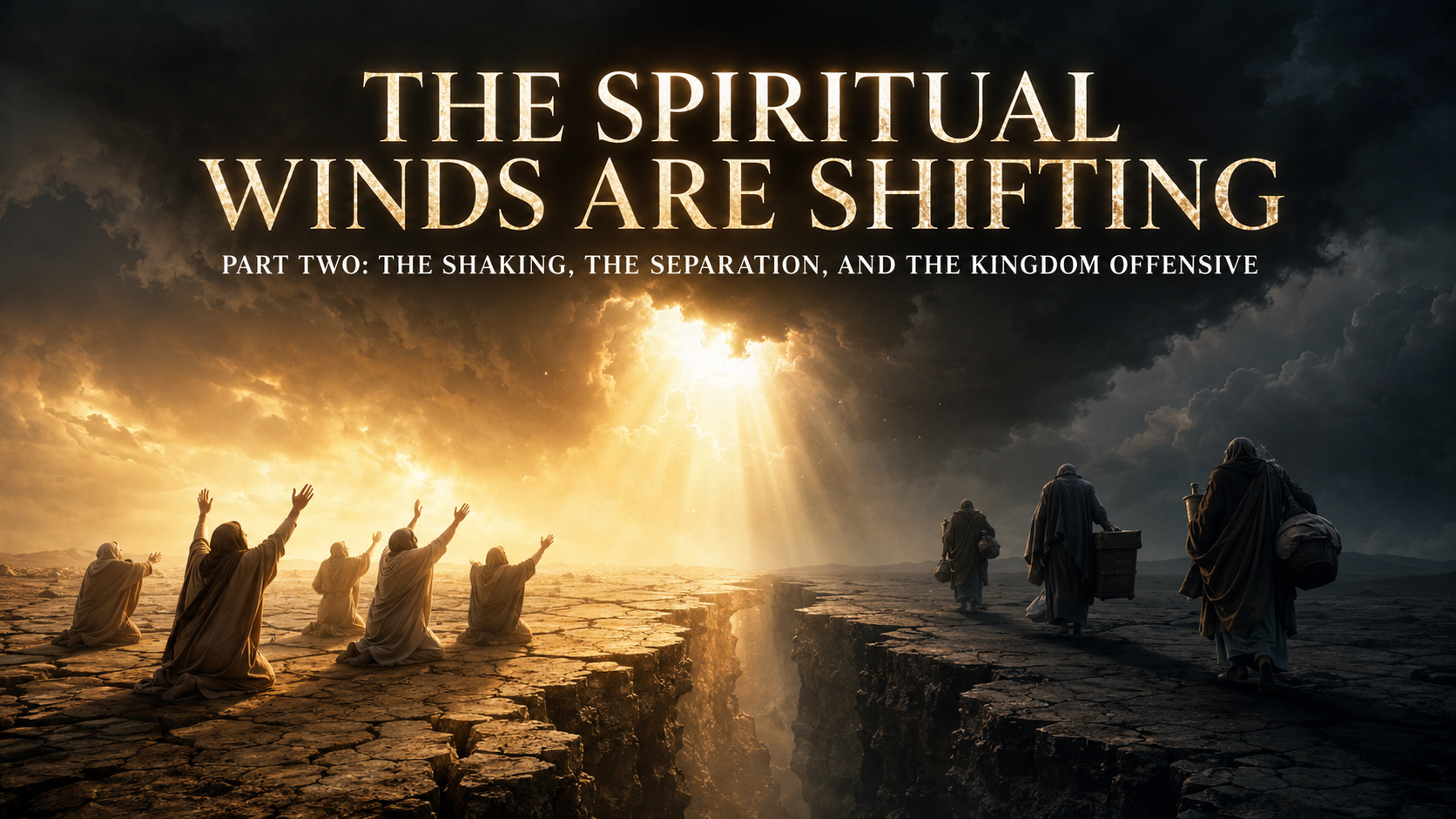
Part Two: The Shaking, the Separation, and the Kingdom Offensive
“Whose voice then shook the earth: but now he hath promised, saying, Yet once more I shake not the earth only, but also heaven.” — Hebrews 12:26
The spiritual winds are shifting across America, but this movement is bringing more than awakening. It is also bringing a divine shaking that is exposing foundations, revealing loyalties, and separating the surrendered from the comfortable. In Part One, we examined how Holy Spirit has been preparing Heaven’s response in the secret place. Now we must understand that those whom God intends to use publicly must first allow Him to govern, purify, and establish them privately.
The shaking is not evidence that God has lost control. It is evidence that He is confronting everything that has attempted to occupy His rightful place. Hebrews 12:27 declares that the shaking signifies “the removing of those things that are shaken, as of things that are made, that those things which cannot be shaken may remain.” God is not shaking His people to destroy them; He is shaking loose the things that have kept them dependent upon religious systems, cultural approval, human personalities, and counterfeit forms of security.
Everything built upon Christ will remain, but everything established through pride, compromise, manipulation, and human ambition will eventually tremble. The Lord loves His Ecclesia too much to allow her to enter the coming hour carrying the very corruption she has been called to confront. Before the Church can become Heaven’s answer to a culture in crisis, she must permit Holy Spirit to expose every place where the culture has already discipled her.
The Shaking Is Separating the Surrendered from the Comfortable
The separation now taking place is not determined by denominations, titles, buildings, or the size of a congregation. It is revealing the difference between those who merely speak the language of the Kingdom and those who have surrendered themselves to the government of the King. Many have learned how to discuss revival, warfare, authority, and awakening, but the shaking will reveal whether those truths have become foundations within them or merely language around them.
For too long, portions of the American Church have attempted to remain acceptable to a culture that has declared war against the truth of God. Biblical convictions have been softened to avoid offense, holiness has been replaced by self-improvement, and the Gospel of the Kingdom has been reduced to a promise of personal comfort. Romans 12:2 commands, “Be not conformed to this world: but be ye transformed by the renewing of your mind.” A Church that receives its identity from the culture will never possess the spiritual authority required to transform it.
The Lord is confronting a form of Christianity that offers people inspiration without transformation, membership without discipleship, and promises without surrender. Jesus did not call us to add Him to our existing lives while continuing to govern ourselves. He called us to deny ourselves, take up our cross, and follow Him. The shaking will expose the difference between those who desire the benefits of Christ and those who have surrendered to the Lordship of Christ.
This does not mean that the Remnant is a spiritually superior class of believers who have earned the right to judge everyone else. The genuine Remnant is marked by humility because its members recognize how deeply they depend upon the mercy and grace of God. They are not those who boast that they survived the fire; they are those who emerged from it knowing that only the presence of Jesus preserved them. Pride cannot lead the Remnant because pride would transform a holy assignment into another human movement.
The American Church Is Being Called Back to Its Foundation
The spiritual crisis confronting America did not begin in government buildings, classrooms, entertainment studios, or corporate boardrooms. It began when the Church gradually surrendered its responsibility to proclaim truth, disciple nations, and demonstrate the nature of God’s Kingdom. Darkness advances wherever light is concealed, and corruption gains strength whenever those entrusted with truth become silent for the sake of acceptance.
First Peter 4:17 declares, “For the time is come that judgment must begin at the house of God.” This judgment is not the uncontrolled anger of God directed toward His people. It is the righteous examination of a Father who refuses to allow His sons and daughters to remain immature, compromised, and powerless. His correction is evidence that He has not abandoned His Church but intends to restore her to her original calling.
The Lord is exposing hidden motives, unhealthy alliances, corrupt leadership, and doctrines shaped more by culture than by Scripture. Those who respond with humility will be purified and strengthened, but those who defend their compromise will find themselves increasingly unable to discern what God is doing. Proverbs 9:10 declares, “The fear of the Lord is the beginning of wisdom.” Without holy reverence, people will continue attempting to use the name of Jesus while resisting His authority, claiming His promises while rejecting His commands, and speaking of His love while redefining His truth.
The Ecclesia was never created to become a weekly gathering of religious spectators. Jesus used a governmental term when He declared, “I will build my church; and the gates of hell shall not prevail against it” (Matthew 16:18). He was announcing a people entrusted with the keys of the Kingdom, commissioned to represent Heaven’s authority and establish the influence of His righteous government upon the earth.
The Remnant Must Move from Reaction to Revelation
One of the enemy’s most effective strategies has been keeping believers in a constant state of reaction. Every headline, controversy, political statement, and cultural crisis demands immediate attention, draining the strength of God’s people and distracting them from their actual assignments. When the Church is governed by outrage, it becomes predictable, manipulatable, and spiritually exhausted.
Holy Spirit is teaching the Remnant to move from revelation rather than reaction, to pray before speaking, discern before engaging, and wait for Heaven’s strategy before entering a battle. Isaiah 30:21 declares, “And thine ears shall hear a word behind thee, saying, This is the way, walk ye in it.” The sons and daughters of God must become more sensitive to the voice of Holy Spirit than they are to the demands of the surrounding culture.
Jesus demonstrated this pattern throughout His earthly ministry. He was never controlled by crowds, the accusations of religious leaders, or the threats of political authorities. In John 5:19, He declared, “The Son can do nothing of himself, but what he seeth the Father do.” His authority flowed from His agreement with the Father, and His actions were governed by divine purpose rather than human pressure.
This means the Remnant cannot afford to fight every battle that appears before it. Some conflicts are distractions intended to consume time, weaken focus, and pull believers away from prayer. Other battles are genuine assignments requiring courage, perseverance, and public engagement. The difference can only be recognized through intimacy with Holy Spirit. Those who remain in the secret place will receive Heaven’s timing, wisdom, and strategy, while those governed primarily by emotion will eventually become exhausted, bitter, or spiritually exposed.
A Kingdom Offensive Is Not a Fleshly Attack
The Kingdom offensive now beginning is not a call for hostility against people. It is a call to confront the spiritual powers, lies, and cultural strongholds destroying people. The Gospel does not give us permission to hate those trapped in deception; it commands us to carry the truth that can set them free. Ephesians 6:12 establishes that our struggle is not against flesh and blood, while the armor described in Ephesians 6:14–17 consists of truth, righteousness, peace, faith, salvation, and the Word of God.
Second Corinthians 10:4 declares, “For the weapons of our warfare are not carnal, but mighty through God to the pulling down of strong holds.” Our weapons are not violence, vengeance, intimidation, or uncontrolled rage. We advance through prayer, truth, holiness, courageous proclamation, compassionate evangelism, righteous action, and unwavering obedience to Christ. Every genuine Kingdom advance must display the character of the King whose authority we claim to represent.
The Remnant must reject the temptation to become like the darkness it confronts. We cannot expose hatred while carrying hatred, challenge deception while exaggerating the truth, or oppose lawlessness while refusing the government of Holy Spirit in our own lives. James 1:20 warns that “the wrath of man worketh not the righteousness of God.” Human anger may gather attention and generate emotional reactions, but only spiritual authority can dismantle strongholds, awaken consciences, and produce lasting transformation.
Heaven’s offensive movement will be seen as believers pray with authority, preach Christ without apology, defend the innocent, strengthen families, disciple children, serve their communities, and speak truth within every sphere of influence. It will be seen when Christian educators refuse to surrender the minds of children, when business leaders practice righteousness, when pastors preach the whole counsel of God, and when ordinary believers carry the presence of Jesus into their workplaces and neighborhoods.
The King Is Calling His People into Alignment
Before the Lord entrusts His people with greater authority, He brings them into deeper alignment. Kingdom authority is never separated from Kingdom character, and those who represent Heaven must be willing to submit every part of their lives to Heaven’s government. Personal ambition, political loyalties, denominational traditions, hidden offenses, and the desire for human approval must all be placed upon the altar.
If Jesus is truly King, then He possesses the right to correct our thinking, redirect our steps, confront our motives, and remove whatever within us does not reflect His nature. We cannot declare His Lordship over the nation while resisting His Lordship over our private lives. The authority to confront rebellion in the culture is cultivated through our willingness to confront rebellion within ourselves.
Psalm 139:23–24 records David’s prayer: “Search me, O God, and know my heart: try me, and know my thoughts: and see if there be any wicked way in me.” This must become the prayer of the Remnant. We cannot simply ask God to expose corruption in Washington, Hollywood, education, or the media; we must invite Him to expose every concealed compromise within our hearts.
Those who willingly undergo this inward reformation will be trusted with greater spiritual responsibility. They will not mistake authority for dominance or governmental identity for self-importance. They will understand that Kingdom authority exists to serve the purposes of the King, liberate captives, establish righteousness, and reveal the nature of the Father. The mature sons and daughters of God do not use authority to magnify themselves; they use it to make Jesus visible.
The Weary Warriors Are Being Strengthened
Many within the Remnant have endured extended seasons of isolation, misunderstanding, warfare, and hidden preparation. They have wondered whether their prayers were accomplishing anything and whether the promises spoken over their lives would ever come to pass. Yet Isaiah 40:31 declares, “They that wait upon the Lord shall renew their strength; they shall mount up with wings as eagles.” The waiting was not wasted, and the wilderness was not evidence of abandonment. God was developing endurance, discernment, and dependency upon His presence.
The Lord is calling these weary warriors to rise without carrying the bitterness of previous seasons into their next assignment. Some have been wounded by churches, betrayed by leaders, or rejected because they refused to compromise. Those wounds must be healed in the presence of Jesus because woundedness cannot be permitted to govern what God is preparing to do through them.
The scars of previous battles should become testimonies of God’s faithfulness rather than weapons used against everyone who comes near us. Jesus retained the scars of His crucifixion after His resurrection, but those scars became evidence of victory and redemption. In the same way, the Remnant must allow Holy Spirit to transform pain into wisdom, rejection into compassion, and past warfare into mature spiritual authority.
A joining of generations is also taking place. Seasoned spiritual fathers and mothers are being connected with younger Fire-Brands who carry courage, hunger, and a refusal to accept powerless religion. Malachi 4:6 speaks of the hearts of the fathers turning toward the children and the hearts of the children toward their fathers. The wisdom of those who have endured previous battles and the passion of those now emerging must come together.
The seasoned must resist the temptation to control the emerging generation, while the young must resist the temptation to dishonor those who prepared the ground before them. One generation carries seasoned discernment while another carries fresh strength. When humility governs both, the joining of the generations becomes a powerful weapon against the enemy’s attempt to create division, suspicion, and spiritual orphanhood.
America Is Standing at a Spiritual Crossroads
America is not merely facing an economic, political, or cultural crisis. This nation is standing at a spiritual crossroads where it must decide whether it will return to righteousness or continue descending into rebellion and confusion. Psalm 33:12 declares, “Blessed is the nation whose God is the Lord.” This blessing does not rest upon patriotic slogans or historical claims alone; it requires a people who acknowledge God through obedience, justice, mercy, and reverence for His truth.
The Lord’s purpose is not simply to preserve an American way of life. His desire is to awaken a people who will demonstrate the life of His Kingdom. If America is to walk as a sheep nation, it must be recognized not merely by what it opposes but by what it embodies. A nation that honors God must value life, protect children, defend the vulnerable, uphold justice, respect righteous law, strengthen families, and remain generous toward those genuinely in need.
Righteousness must become more than a political slogan; it must become a visible standard within the Church and among those claiming the name of Christ. We cannot demand integrity from civil leaders while excusing dishonesty in spiritual leaders. We cannot condemn sexual corruption in the culture while concealing immorality behind pulpits, and we cannot demand justice from government while tolerating favoritism, manipulation, and abuse within the Church.
The coming days may test this nation severely, but the outcome has not been surrendered to darkness. Second Chronicles 7:14 still declares that if God’s people humble themselves, pray, seek His face, and turn from their wicked ways, He will hear from Heaven, forgive their sin, and heal their land. The responsibility begins with the people of God. We cannot demand repentance from the nation while resisting repentance in the Church, and we cannot call the culture back to righteousness while privately tolerating the very things we publicly condemn.
The Sound of the Remnant Is Beginning to Rise
There is a sound forming across America that does not originate from political rallies, religious entertainment, or the ambitions of men. It is the sound of consecrated prayer, biblical proclamation, courageous repentance, and surrendered worship. It is the sound of sons and daughters coming into agreement with the throne of God. As this sound increases, long-established strongholds will begin to tremble because darkness recognizes the authority carried by a people who have abandoned self-preservation and given themselves completely to Jesus.
Joel 2:11 declares, “The Lord shall utter his voice before his army: for his camp is very great: for he is strong that executeth his word.” This army is not defined by physical weapons, political parties, or earthly aggression. It is a people who execute the Word of the Lord through obedience. They love what He loves, oppose what He opposes, and refuse to move beyond the boundaries of His character.
Romans 8:19 declares, “For the earnest expectation of the creature waiteth for the manifestation of the sons of God.” Creation is not waiting for another religious system, celebrity preacher, or political personality. It is waiting for mature sons and daughters who know the Father, hear Holy Spirit, reveal the nature of Christ, and exercise Kingdom authority without pride, compromise, or fear.
The spiritual winds are shifting because Holy Spirit is breathing upon what appeared dormant. Embers are becoming flames, hidden voices are being summoned to speak, and those who once felt alone are discovering that God has preserved thousands who have not bowed their knees to Baal. The darkness may grow louder, but it is not becoming stronger than the throne of God.
An Apostolic Declaration over the Remnant and America
We declare that everything established through pride, deception, compromise, and rebellion will be shaken, while everything founded upon Jesus Christ will remain. We declare that the Ecclesia is awakening from complacency, returning to the authority of Scripture, and recovering her identity as Heaven’s governmental assembly upon the earth. The Church will no longer measure success merely by crowds, buildings, finances, or platforms, but by obedience, transformed lives, mature disciples, and the visible manifestation of Christ.
We decree that weary warriors are receiving fresh strength, hidden intercessors are being called forward, seasoned spiritual fathers and mothers are embracing their assignments, and emerging Fire-Brands are being purified by the presence of God. The generations will not be divided by jealousy, pride, or suspicion. They will come together under the government of King Jesus, carrying wisdom, courage, discernment, and holy fire into the places where darkness has attempted to establish its throne.
We declare that America will not be peacefully surrendered to socialism, communism, secular humanism, moral confusion, or hatred for God. Every deceptive stronghold will be confronted by truth, every hidden work of darkness will be exposed by light, and every captive willing to receive Christ will find freedom through the Gospel. We will not fight people, but we will confront the powers destroying them with the weapons of righteousness, prayer, truth, love, and the Word of God.
We decree that Jesus Christ remains King, His Kingdom cannot be shaken, and His purposes for this hour will not be overturned by the schemes of darkness. The Remnant is rising—not to glorify itself, dominate others, or create another religious empire, but to reveal the King, advance His righteousness, liberate captives, and carry the Light of Yahweh’s presence into every dark place.
The shaking has begun, but so has the awakening. The separation is becoming visible, but so is the consecrated company being prepared through it. The spiritual winds are shifting, Heaven’s Remnant is taking its place, and the sound of surrendered sons and daughters is beginning to rise across America.
Stay tuned, the journey continues…..
A voice of fire to the Remnant,
— Dr. Russell Welch
Dr. Russell Welch is a published author, prophetic teacher, apostolic builder, and founder of faith-driven publishing and media initiatives. He is known for crafting bold, Kingdom-centered messages that call the Ecclesia into maturity, doctrinal clarity, and governmental authority. With a passion for equipping the Remnant and honoring generational legacy, Dr. Welch writes and teaches at the intersection of Scripture, history, and spiritual governance, challenging believers to live as sons and daughters who legislate Heaven on earth through truth, holiness, and unwavering fidelity to Christ.
Be sure to check out his book,Spirit Wind People: Those Who Are Moved by the Impulses of Holy Spirit, available exclusively on Amazon.
Explore spiritual growth and learn the art of developing a life that is positioned to hear God’s voice for divine guidance.
Welcome to a journey of spiritual growth and personal development, where we will explore the importance of developing a life that is positioned to hear God’s voice. In this fast-paced world, it is easy to become disconnected from our spiritual selves and miss out on divine guidance. However, by cultivating spiritual awareness and deepening our connection with God, we can tap into His wisdom and discern His voice.
Throughout this faith journey, we will explore the significance of hearing God’s voice and the transformative effects it can have on our lives. We will discuss practical strategies for nurturing our relationship with God, practicing spiritual discernment, and embracing moments of silence and stillness. Together, we will learn to listen with an open heart and grow in faith and trust.
Are you ready to embark on this incredible journey of developing a life attuned to hearing God’s voice? Let’s dive in and discover the beauty and power of connecting with God on a deeper level.
Key Takeaways:
Cultivating spiritual awareness and deepening your connection with God are essential to hearing His voice.
Spiritual discernment is the ability to distinguish God’s voice from other influences in our lives.
Embracing moments of silence and stillness allows us to tune in to God’s whispers and prompts.
Listening with an open heart and growing in faith and trust are vital aspects of developing a life that hears God’s voice.
By developing a life tuned in to hearing God’s voice, we can experience a deeper sense of purpose and divine guidance in our lives.
Understanding the Significance of Hearing God’s Voice
Before delving into the practical aspects of developing a life tuned in to hearing God’s voice, it is essential to understand the significance of this ability. Hearing God’s voice allows us to align our actions and decisions with His will, leading to a more fulfilling and purpose-driven life. It strengthens our spiritual connection and provides divine guidance that surpasses human understanding.
In a world filled with noise and distractions, it can be challenging to truly connect with God and discern His voice. However, when we prioritize hearing God’s voice and actively seek His guidance, we open ourselves up to His transformative power.
“My sheep listen to my voice; I know them, and they follow me.” – John 10:27
When we develop the ability to hear God’s voice, our spiritual growth is enhanced. We become more attuned to the whispers of the Holy Spirit, gaining insight and wisdom that can only come from a divine source.
By cultivating a spiritual connection through prayer, meditation, and studying God’s Word, we create a space for His voice to be heard. It is through this connection that we can receive the divine guidance we need to navigate life’s challenges and make decisions that align with His purpose for us.
Hearing God’s voice also brings a deep sense of assurance and peace. When we are unsure of which path to take, His voice provides clarity and direction, guiding us towards what is best for our spiritual journey.
“The steps of a man are established by the LORD, when he delights in his way.” – Psalm 37:23
The Transformative Power of Hearing God’s Voice
Hearing God’s voice not only transforms our individual lives but also impacts our communities and the world around us. When we are aligned with His will, we become vessels of His love, compassion, and grace.
Through divine guidance, we are empowered to make a positive difference and bring about meaningful change. We can serve others with purpose and walk in the footsteps of Jesus, spreading His message of hope and salvation.
When we choose to hear God’s voice and follow His guidance, we are positioned to experience a life that is rich in spiritual growth, deepened relationships, and a profound sense of purpose. The journey of hearing God’s voice is one that will continually transform and shape us, leading us to a life of fulfillment and divine alignment.
The Benefits of Hearing God’s Voice
Benefits
Explanation
Alignment with God’s will
Hearing God’s voice helps us align our actions and decisions with His divine will, leading to a more purpose-driven life.
Spiritual growth
Hearing God’s voice deepens our relationship with Him, nurturing our spiritual growth and understanding of His character.
Divine guidance
Through hearing God’s voice, we receive guidance and direction that surpasses human understanding, allowing us to navigate life’s challenges with confidence.
Clarity and peace
Hearing God’s voice brings clarity and peace to our hearts and minds, allowing us to make decisions that align with His purpose.
Transformed lives
By following God’s voice, our lives are transformed, and we become vessels of His love, compassion, and grace.
Cultivating Spiritual Awareness
In order to develop a life that is positioned to hear God’s voice, it is crucial to cultivate spiritual awareness. This involves deepening our connection with God through various spiritual practices such as prayer, meditation, and studying His Word. By intentionally setting aside time for these activities, we create an environment that is conducive to hearing His voice and receiving His guidance.
Spiritual growth is a journey that requires commitment and consistent effort. When we engage in these practices regularly, we open ourselves up to a deeper understanding of God’s presence in our lives. Through prayer, we communicate with God and express our desires, concerns, and gratitude. This intimate conversation strengthens our relationship with Him and increases our spiritual awareness.
Meditation is another powerful practice that allows us to quiet our minds and create space for God’s voice to be heard. By stilling our thoughts and focusing on His presence, we become more attuned to His guidance and promptings. In the peaceful silence of meditation, we can experience a heightened awareness of His divine presence and direction.
Studying God’s Word is essential for developing spiritual awareness. The Bible is a rich source of wisdom and guidance, and by immersing ourselves in its teachings, we gain a deeper understanding of God’s character and will. Regularly reading and reflecting on Scripture helps us align our thoughts and actions with His truth, increasing our sensitivity to His voice.
“Prayer, meditation, and studying the Bible are like spiritual exercises that strengthen our spiritual awareness and receptivity to God’s voice.”
As we cultivate spiritual awareness, we become more attuned to God’s presence throughout our day. We begin to recognize His gentle whispers, guiding nudges, and the promptings of the Holy Spirit. This heightened awareness allows us to navigate life with a renewed sense of purpose and direction.
Table: The Benefits of Cultivating Spiritual Awareness
Benefits
Explanation
Deepened Connection with God
Cultivating spiritual awareness enhances our relationship with God, enabling us to experience a deeper connection with Him.
Heightened Intuition
As we become more spiritually aware, our intuition and discernment skills sharpen, allowing us to make wiser decisions guided by God’s wisdom.
Greater Peace and Clarity
By attuning ourselves to God’s voice, we experience a sense of peace and clarity that transcends the challenges and uncertainties of life.
Alignment with God’s Will
Cultivating spiritual awareness helps us align our thoughts, desires, and actions with God’s will, enabling us to live in accordance with His divine purpose.
In summary, developing a life that is positioned to hear God’s voice requires cultivating spiritual awareness. Through prayer, meditation, and studying His Word, we deepen our connection with God and create an environment that is receptive to His guidance. As we become more spiritually aware, we experience the benefits of a closer relationship with God and a heightened ability to hear His voice in our lives.
Hearing His voice woven throughout the scriptures
When it comes to developing a life that is positioned to hear God’s voice, one powerful place to look is the scriptures. The Bible is not just a collection of ancient texts, but rather a living and active word that reveals the heart and character of God. As we dive into its pages, we can discover the many ways that God has spoken to His people throughout history.
From the creation story in Genesis to the prophetic words of the prophets, we see God’s voice woven throughout the scriptures. The Bible is filled with stories of individuals who listened to God’s voice and allowed it to guide their lives. They experienced supernatural interventions, miraculous provisions, and divine wisdom because they were tuned in to God’s voice.
However, hearing God’s voice is not limited to those in biblical times. The scriptures remind us that God is the same yesterday, today, and forever. The same God who spoke to Moses through a burning bush or guided David in his battles is still speaking to His people today. It is up to us to silence the noise of the world around us and tune our hearts to hear His voice.
Developing a life that is positioned to hear God’s voice requires daily immersion in the scriptures. As we study and meditate on the word of God, we begin to recognize His voice more clearly. We can discern His guidance, His correction, and His comfort as we delve deeper into His truth.
So, let us not neglect the power of God’s word in our pursuit of hearing His voice. Let us open our hearts to the scriptures, allowing them to shape and mold us into vessels that are receptive to God’s voice. With humility and a desire to know Him more, we can position ourselves to hear His voice and experience His presence in our lives.
Nurturing a Relationship with God
Nurturing a relationship with God is a continuous process that requires dedication and commitment. Developing a life tuned in to hearing God’s voice involves engaging in a faith journey where we seek to know Him more intimately. Regularly spending time in prayer, reading the Bible, and attending worship services helps foster a deeper connection with God, making it easier to hear His voice.
When we prioritize our relationship with God, we open ourselves up to His presence and guidance. Just as any relationship requires time and effort to grow, our connection with God also requires intentional nurturing. Here are some key practices that can help us strengthen our bond with Him:
Prayer: Set aside dedicated time each day to communicate with God. Share your joys, concerns, and desires with Him. Developing a consistent prayer life helps us cultivate an open line of communication with our Heavenly Father.
Reading the Bible: Dive into the timeless wisdom and teachings contained within the Scriptures. Reading and studying the Bible not only deepens our knowledge but also allows God’s Word to penetrate our hearts and minds. It is through His Word that God often speaks to us and provides guidance.
Attending Worship: Engage in regular corporate worship by participating in church services and gatherings where we can connect with other believers and experience the presence of God collectively. Worship creates an atmosphere that facilitates spiritual connection and receptiveness to hearing God’s voice.
Living in Alignment: Align our actions, thoughts, and values with God’s teachings. Living in obedience to His commandments and principles shows our commitment to Him and deepens our spiritual connection. It also positions us to receive His guidance and direction more clearly.
Nurturing a relationship with God is an ongoing journey that unfolds over time. It requires us to be intentional in creating space for Him in our lives, seeking His presence, and aligning our hearts with His. When we prioritize our spiritual growth and connection with God, we position ourselves to hear His voice more clearly and experience His guidance and love in profound ways.
Key Takeaways:
– Nurturing a relationship with God requires dedication and commitment.
– Regular prayer, reading the Bible, and attending worship services help foster a deeper connection with God.
– Living in alignment with God’s teachings and values strengthens our bond with Him.
– Prioritizing our relationship with God positions us to hear His voice more clearly and experience His guidance and love.
Practicing Spiritual Discernment
In our journey of spiritual growth, developing the ability to discern God’s voice is of utmost importance. Spiritual discernment is the skill that allows us to distinguish between the voice of God and other influences in our lives. By honing this skill, we can accurately recognize when God is speaking and discern His divine guidance.
Spiritual discernment empowers us to navigate life’s challenges and make decisions that align with God’s will. It is the key to understanding His purpose for our lives and ensuring that we walk in His paths of righteousness.
One of the fundamental ways to cultivate spiritual discernment is through prayer. By seeking God’s wisdom and guidance in our decision-making process, we open ourselves to hearing His voice more clearly. Through the power of prayer, we invite divine intervention into our lives and gain insights that surpass our human understanding.
Additionally, seeking wise counsel from experienced and trusted individuals can contribute to our spiritual discernment. Proverbs 15:22 reminds us that “Plans fail for lack of counsel, but with many advisers, they succeed.” When we seek input from those who are spiritually mature and grounded in biblical principles, we can gain valuable perspectives that help us discern God’s voice amidst the noise of the world.
Aligning our decisions with biblical principles is another crucial aspect of spiritual discernment. By studying God’s Word and seeking His truth, we equip ourselves with a solid foundation for distinguishing His voice. As Psalm 119:105 says, “Your word is a lamp for my feet, a light on my path.” The more we immerse ourselves in Scripture, the clearer His voice becomes in our lives.
Practicing Spiritual Discernment:
Benefits:
1. Prayer
Invites divine guidanceEnhances clarity of God’s voice
2. Seeking Wise Counsel
Receives insights from spiritually mature individualsGains multiple perspectives for discernment
3. Aligning with Biblical Principles
Establishes a solid foundation for discernmentGuides decision-making in accordance with God’s will
Practicing spiritual discernment equips us to accurately interpret God’s voice and receive His divine guidance in our lives. It enables us to make choices that align with His purposes, leading us on a path of spiritual growth and a deepened connection with Him.
Embracing Silence and Stillness
In a world filled with noise and distractions, it’s essential to embrace silence and stillness if we want to hear God’s voice. By creating moments of quiet reflection and solitude, we create the space needed to tune in to His whispers and prompts. Embracing silence is not about emptiness, but rather an intentional practice that allows us to connect with God on a deeper level.
Practicing mindfulness opens our hearts and minds to the presence of God in our midst. It involves being fully present in the moment, free from the constant chatter of our thoughts and worries. When we intentionally seek moments of silence, we create an environment where God can speak to us and guide us on our journey of spiritual growth.
Just as the psalmist says, “Be still, and know that I am God” (Psalm 46:10), we experience a profound awareness of God’s presence when we quiet our minds and hearts. In the stillness, we eliminate distractions and cultivate a heightened awareness of the spiritual realm. It is in these moments that we become more attuned to God’s voice, hearing His gentle whispers leading us forward.
“In the silence of the heart, God speaks.” – Mother Teresa
During times of silence and stillness, we can engage in practices such as meditation, prayer, and contemplation. These disciplines help us to clear our minds and focus our attention on God. As we surrender our worries, anxieties, and agendas, we create the space for God to speak directly to our hearts.
By embracing silence and stillness, we invite God to work in our lives in remarkable ways. We open ourselves up to His wisdom, guidance, and revelation. In the quiet moments, we discover a profound sense of peace and clarity that transcends the noise of the world.
The Benefits of Embracing Silence and Stillness
When we embrace silence and stillness, we reap numerous benefits in our spiritual journey. Here are a few:
Deepened spiritual awareness: By cultivating silence, we become more sensitive to God’s presence and His workings in our lives.
Increase in spiritual discernment: As we quiet external distractions, we can better discern God’s voice amidst the noise of the world.
Heightened focus and clarity: Silence helps us clear our minds and gain clarity on the direction God wants us to take.
Increased intimacy with God: By creating space for silence, we develop a deeper connection with God and experience a more intimate relationship with Him.
Benefits of Embracing Silence and Stillness
1. Deepened spiritual awareness
2. Increase in spiritual discernment
3. Heightened focus and clarity
4. Increased intimacy with God
Embracing silence and stillness may initially feel uncomfortable in our fast-paced world, but the rewards are immeasurable. When we intentionally create space for silence, we position ourselves to hear God’s voice with greater clarity. It is in this space that true transformation and spiritual growth occur.
Learning to Listen with an Open Heart
Listening with an open heart is an essential aspect of developing a life tuned in to hearing God’s voice. It goes beyond just hearing with our ears; it involves opening ourselves up to truly listen and understand the messages that God wants to convey to us.
When we approach God with humility and a willingness to surrender our own agendas, we create space for His voice to be heard. By setting aside our biases and preconceived notions, we become receptive to His leading and ready to accept His guidance.
Listening with an open heart requires a posture of humility that acknowledges our need for divine direction and wisdom. It means acknowledging that God’s ways are higher than our ways and that His thoughts are higher than our thoughts. As we let go of our own desires and submit to His will, we position ourselves to receive His messages with clarity and understanding.
Being Receptive to Holy Spirit Guidance
Do you hunger for a more intimate relationship with the Holy Spirit?
Have you heard stories of people experiencing the fire of His presence, and wish you could as well? Many believers share this longing for a deeper encounter with the third person of the Trinity, the one who indwells us and promises to guide us into all truth (John 16:13).
Being receptive to Holy Spirit guidance means being attuned to God’s voice in the midst of the noise and distractions of everyday life. It requires intentional effort to create sacred spaces where we can tune out the world and tune in to God’s voice.
“There is power in the quiet, the stillness, the moments of solitude. It is in these moments that God’s voice can be heard most clearly.”
– John Smith
Practicing silence and stillness allows us to quiet our minds and open our hearts to hear God. It is in these moments of solitude that we can experience a deeper connection with Him and gain insights into His plans for our lives.
As we learn to listen with an open heart, we give God permission to speak into our lives and shape our decisions. Our receptiveness to His guidance strengthens our spiritual connection and fosters a sense of intimacy with our Creator.
Through the practice of listening with an open heart, we allow God’s voice to resonate within us and transform our lives. His guidance leads us on a path of spiritual growth, personal development, and fulfillment.
Cultivating a Posture of Humility and Openness
Cultivating a posture of humility and openness is an ongoing process that requires intentional reflection and self-awareness. It involves letting go of our own agendas and surrendering to God’s will. By doing so, we create the space necessary for His voice to penetrate our hearts and guide our steps.
When we approach God with humility, we acknowledge that He knows what is best for us and that His plans far exceed our own. This posture of surrender allows us to align our desires with His and positions us to receive His wisdom and direction.
Openness is the key that unlocks the door to deeper spiritual connection. It means being willing to hear God’s voice even when His message challenges us or takes us outside of our comfort zone. Through this openness, we allow Him to stretch us, shape us, and mold us into the people He desires us to be.
Ultimately, learning to listen with an open heart is a lifelong journey of growth and transformation. It requires us to constantly seek God’s presence, seek His guidance, and lean on His understanding. As we develop this deep listening skill, we position ourselves to hear God’s voice more clearly and experience a greater sense of spiritual connection and fulfillment in our lives.
Growing in Faith and Trust
Growing in faith and trust is a fundamental part of developing a life that is positioned to hear God’s voice. As we deepen our relationship with God, we learn to trust His guidance and step out in faith, even when the path may seem uncertain. Strengthening our faith and trust in Him enables us to fully rely on His voice and confidently follow His leading.
Trusting God requires a surrender of control and a willingness to let go of our own understanding. It is about acknowledging that His ways are higher than ours and that His plans for us are good. By placing our faith in Him, we open ourselves up to the incredible possibilities and divine guidance that He has in store for us.
It is important to remember that faith is not about having all the answers or never experiencing doubt. Everyone goes through seasons of uncertainty, but it is in those moments that our faith is tested and refined. It is in the midst of doubt that we have the opportunity to lean on God, seek His wisdom, and grow stronger in our trust in Him.
“Trust in the Lord with all your heart, and do not lean on your own understanding. In all your ways acknowledge Him, and He will make straight your paths.” – Proverbs 3:5-6
Learning to allow Holy Spirit to govern our lives
In our journey of faith, one of the most important aspects is learning to allow the Holy Spirit to govern our lives. When we surrender our will and desires to Him, we open ourselves up to a world of divine guidance and peace. But how do we develop a life that is positioned to hear God’s voice? It starts with cultivating a heart of humility and obedience.
First and foremost, we need to recognize that we are not in control. When we realize that God is the ultimate authority in our lives, it humbles us and allows us to submit to His leadership. This requires us to let go of our own desires and preferences, trusting that God’s plans for us are far greater than anything we could imagine.
Next, we must develop a habit of spending time in God’s presence. Through prayer, worship, and studying His Word, we position ourselves to hear His voice. It is in these moments of stillness that the Holy Spirit can speak to us and reveal His plans and purposes for our lives.
Finally, we need to be willing to step out in faith and obey His leadership. Sometimes, God may call us to do things that are outside of our comfort zone or go against our natural inclinations. But when we trust in His wisdom and guidance, we can be confident that He has our best interests at heart.
Learning to allow the Holy Spirit to govern our lives is a lifelong process. It requires us to continually surrender and seek Him, developing a heart that is sensitive to His voice. But as we do so, we will experience a deep sense of peace, fulfillment, and purpose as we walk in step with God’s divine plan for our lives.
A Faith Journey Filled with Divine Guidance
Developing a life tuned in to hearing God’s voice is a continuous journey of faith. It is a process of surrendering to His will, seeking His guidance, and aligning our lives with His purposes. As we embark on this journey, we can have confidence that God will never leave us or forsake us.
In our pursuit of divine guidance, it is important to cultivate a habit of seeking God’s voice through prayer, studying His Word, and spending time in His presence. These spiritual disciplines create a space for God to speak to our hearts and reveal His plans for us.
Additionally, it is crucial to surround ourselves with a community of believers who can support and encourage us in our faith journey. Having accountability partners, mentors, and friends who are also pursuing a life attuned to hearing God’s voice can greatly aid our spiritual growth and provide insights and perspectives that sharpen our discernment.
As we continue to grow in faith and trust, let us remember that hearing God’s voice is not just about receiving personalized instructions or answers to our prayers. It is about deepening our relationship with Him, aligning our hearts with Him, and inviting Him to be the guiding force in every area of our lives.
Trusting in God’s Perfect Timing
One of the challenges we may face on our faith journey is impatience, especially when it comes to waiting for God’s guidance or the fulfillment of His promises. However, it is essential to understand that God’s timing is perfect and His ways are higher than ours.
God may not answer our prayers or provide guidance in the way we expect or within the timeframe we desire. But during the waiting seasons, He is shaping our character, building our faith, and preparing us for what lies ahead.
Trusting in God’s perfect timing requires unwavering faith and a surrender to His sovereignty. It involves embracing the process of waiting and allowing God to work in us and through us. As we patiently trust in Him, we can have confidence that He is orchestrating every detail of our lives for our ultimate good and His glory.
Let us hold onto the promises of God, knowing that His faithfulness endures forever. As we continue to grow in faith and trust, we can rest assured that He will guide us every step of the way, leading us to a life that is truly in alignment with His will and purposes.
Overcoming Obstacles and Doubts
The journey of developing a life tuned in to hearing God’s voice is a transformative one, but it is not without its challenges. Doubts, fears, and external distractions often threaten to hinder our ability to listen and discern. However, with the right strategies and a reliance on biblical wisdom, we can overcome these obstacles and deepen our spiritual connection with God.
Practical Strategies for Overcoming Obstacles:
Prayer: Committing to regular prayer is essential in overcoming obstacles and doubts. Prayer allows us to express our concerns and fears to God and surrender them to His divine care. Through prayer, we can find strength, peace, and clarity to overcome any challenges that come our way.
Scripture Study: Spending time studying the Bible equips us with the wisdom and promises of God. When doubts arise, immersing ourselves in the Word can provide reassurance and reinforce our faith. The Bible serves as a guide and a source of truth, helping us navigate through uncertainties and find answers to our questions.
Community: Surrounding ourselves with like-minded believers and a supportive spiritual community can provide encouragement and solidarity on our faith journey. Sharing our struggles and learning from others’ experiences can help us gain clarity, overcome doubts, and grow in our relationship with God.
Journaling: Keeping a journal can be a powerful tool for overcoming obstacles and doubts. Writing down our thoughts, prayers, and moments of divine guidance allows us to reflect on our experiences and see how God has been at work in our lives. Journaling helps us recognize patterns, identify areas of growth, and build a tangible record of God’s faithfulness.
Biblical Wisdom for Overcoming Doubts:
“Trust in the LORD with all your heart and lean not on your own understanding; in all your ways submit to him, and he will make your paths straight.” – Proverbs 3:5-6
This verse reminds us to trust in the Lord wholeheartedly, even when doubts and uncertainties arise. By relinquishing our reliance on our own understanding and submitting to God’s guidance, we can navigate through obstacles and find our paths illuminated by His divine wisdom.
Through the combination of practical strategies, reliance on Scripture, and a deep faith in God, we can overcome obstacles and doubts that hinder our spiritual growth. By persevering and staying connected to our Creator, we position ourselves to hear His voice more clearly and experience spiritual discernment.
Practicing Obedience and Alignment
Developing a life tuned in to hearing God’s voice requires more than just spiritual growth and divine guidance. It demands a conscious effort to practice obedience and align our actions with God’s will. When we surrender our desires and submit to His guidance, we position ourselves to receive His wisdom and direction, allowing Him to work through us in profound ways.
“Trust in the Lord with all your heart and lean not on your own understanding; in all your ways submit to him, and he will make your paths straight.” – Proverbs 3:5-6 (NIV)
Aligning our lives with God’s purposes may seem challenging, as it often requires stepping out of our comfort zones and relinquishing control. However, it is through this obedience that we find true fulfillment and experience the fullness of God’s blessings.
To practice obedience and alignment, we can:
Seek His Will: Spend time in prayer and reflection, seeking God’s guidance and asking Him to reveal His will for your life. As you listen, pay attention to the prompting of the Holy Spirit and the lessons found in His Word.
Embrace His Timing: Trust that God’s timing is perfect and that He knows what is best for us. Be patient and wait for His guidance, even when it is challenging to see the bigger picture.
Follow His Word: Study the Bible and align your actions with its teachings. Allow God’s Word to shape your decisions and guide your daily choices.
Remain Faithful: Even in difficult times or when faced with adversity, remain steadfast in your faith. Stay close to God, seeking His strength, wisdom, and guidance to navigate any challenges.
As you put these practices into action, you will find yourself growing in your ability to hear God’s voice and discern His will. Remember, developing a life that is positioned to hear God’s voice is not an overnight journey but a continuous one. Stay committed to living in obedience and alignment with God’s purposes, and you will witness the transformative power of walking closely with Him.
The Fruit of a Life Tuned in to Hearing God’s Voice
A life tuned in to hearing God’s voice bears the fruit of spiritual growth, personal development, and a deepened relationship with God. When we position ourselves to hear His voice and follow His guidance, we experience a transformative journey that brings clarity, peace, and a sense of purpose. Through this aspect of our faith journey, we cultivate a closer connection with God and unlock the fullness of His divine plan for our lives.
By developing a life that is positioned to hear God’s voice, we embark on a faith journey that fosters spiritual growth. We become more attuned to the whispers of the Holy Spirit, gaining wisdom and insight that surpasses human understanding. Our faith is strengthened as we witness the faithfulness of God’s guidance in every aspect of our lives.
Not only does developing a life tuned in to hearing God’s voice contribute to our spiritual growth, but it also leads to personal development. Through Holy Spirit guidance, we gain a deeper understanding of our unique talents, passions, and purpose. We discover our true identity in Christ and are empowered to live out our calling with confidence and authenticity. As we embrace God’s voice, we are transformed from the inside out.
The fruit of developing a life tuned in to hearing God’s voice is a deepened relationship with God Himself. Through intimacy with Him, we experience a love that is unparalleled and unconditional. We find solace and comfort in His presence, knowing that He is always with us and guiding our steps. Our spiritual connection becomes a source of strength, joy, and hope as we navigate life’s challenges with the assurance that we are never alone.
In conclusion, developing a life tuned in to hearing God’s voice is a transformative journey that leads to spiritual growth, personal development, and a deepened relationship with God. It is an invitation to embark on a faith journey where we position ourselves to receive divine guidance and experience the abundant life that God has prepared for us. May we cultivate a heart that is attentive to His voice and embrace the fruit that comes from living a life in tune with the heartbeat of our Heavenly Father.
Fruit of a Life Tuned in to Hearing God’s Voice
Description
Spiritual Growth
Deepening connection with God, wisdom and insight beyond human understanding
Personal Development
Discovering unique talents, passions, and purpose, living authentically
Deepened Relationship with God
Unparalleled love and intimacy, solace and comfort in His presence
Conclusion
In our pursuit of a deeper connection with God, developing a life tuned in to hearing His voice is paramount. This lifelong journey requires intentional effort and a continuous effort to deepen our relationship with Him. By focusing on spiritual growth, cultivating spiritual awareness, practicing discernment, and embracing silence, we position ourselves to hear His voice and receive divine guidance.
As we embark on this faith journey, we open ourselves up to a life filled with purpose and divine direction. By nurturing our spiritual connection, we gain clarity, peace, and a sense of fulfillment. The ability to hear God’s voice enables us to align our actions and decisions with His will, leading to a life of spiritual growth and personal development.
Let us continue to pursue this path of developing a life tuned in to hearing God’s voice. As we remain steadfast in our commitment, may our faith journey be a testament to the transformative power of divine guidance. May we experience the joy and fulfillment that comes from walking in alignment with God’s purposes and live a life that is positioned to hear His voice.
FAQ
Why is it important to develop a life tuned in to hearing God’s voice?
Developing a life tuned in to hearing God’s voice is crucial because it allows us to align our actions and decisions with His will. It leads to a more fulfilling and purpose-driven life, strengthens our spiritual connection, and provides divine guidance that surpasses human understanding.
How can I cultivate spiritual awareness?
Cultivating spiritual awareness involves deepening our connection with God through prayer, meditation, and studying His Word. By intentionally setting aside time for spiritual practices, we create an environment conducive to hearing His voice and receiving His guidance.
What is spiritual discernment, and why is it important?
Spiritual discernment is the ability to distinguish between God’s voice and other influences in our lives. It is important to develop this skill so that we can better recognize when God is speaking and discern His guidance. Through prayer, seeking wise counsel, and aligning our decisions with biblical principles, we can strengthen our spiritual discernment and accurately interpret God’s voice.
How can I embrace silence and stillness to hear God’s voice?
In a world filled with noise and distractions, embracing silence and stillness is crucial for hearing God’s voice. Creating moments of quiet reflection and solitude allows us to tune in to His whispers and prompts. Practicing mindfulness and intentionally seeking moments of silence help us create space for God to speak to us and guide us on our journey.
How can I overcome doubts and obstacles in hearing God’s voice?
The journey of developing a life tuned in to hearing God’s voice is not without challenges. Doubts, fears, and external distractions can hinder our ability to listen and discern. By relying on practical strategies and biblical wisdom, we can overcome these obstacles and deepen our spiritual connection with God.
What is the fruit of a life tuned in to hearing God’s voice?
A life tuned in to hearing God’s voice bears the fruit of spiritual growth, personal development, and a deepened relationship with God. The ability to hear His voice and follow His guidance brings clarity, peace, and a sense of purpose to our lives.