As I have been spending more time in the secret place, the Father has been confirming several things in me, especially concerning where Holy Spirit has brought me and where He is now taking me. One of the clearest shifts has been in the area of surrender. I have had to become honest with the Lord about whether I truly wanted His plans or whether I simply wanted Him to bless mine. That difference may sound subtle, but spiritually it is enormous. Genuine surrender means that even good opportunities, ministry invitations, relationships, platforms, and gatherings must still be brought before the Lord.
Over the years, I have received many invitations to attend ministry events, conferences, meetings, and gatherings. Last year especially, it seemed as though every time I turned around, I was going somewhere else. There is nothing wrong with conferences or ministry events in themselves. People can receive genuine revelation, prophetic encouragement, healing, deliverance, and renewed hunger for God in those environments. I have personally seen the Lord touch people in powerful ways through gatherings of that kind.
What Holy Spirit began to confront in me, however, was whether I was actually asking Him if I was supposed to go. That question began to expose the difference between activity and obedience. We can become so accustomed to moving from event to event that we stop asking whether the Spirit of God is actually leading us there. We assume that because something is Christian, prophetic, apostolic, revival-oriented, or spiritually exciting, it must automatically belong on our calendar. Yet Romans 8:14 does not say that those who stay busy are the sons of God. It says, “For all who are allowing themselves to be led by the Spirit of God are sons of God.”
I have always appreciated the Amplified translation because it expands the idea of yielding to the leadership of the Spirit. That verse is much more than a doctrinal statement concerning identity. It describes a way of life. We can preach on sonship, teach on sonship, sing about sonship, and write about sonship, but if we are not allowing Holy Spirit to govern our decisions, then we are missing the practical power of the passage. To be led means that I may receive an invitation and still hear the Lord say no. It means I may be offered a platform and still be required to remain hidden. It means a gathering may be genuinely powerful and still not be my assignment.
Jesus modeled this kind of dependence perfectly. In John 5:19 He said that the Son could do nothing of Himself, but only what He saw the Father doing. That standard confronts the ministry culture we have become accustomed to, because we often measure faithfulness by how much a person is doing. Heaven measures something deeper. Heaven looks at obedience. There are seasons when the most spiritual thing a person can do is decline the invitation, stay home, remain in the secret place, and obey what the Father is saying privately.
Another area where the Lord has been dealing with me concerns discernment. There have been times when I have been invited into ministry settings where Holy Spirit immediately showed me red flags. Years ago, I would have been much quicker to speak publicly about those things. I often felt that if I discerned something, then I had some responsibility to expose it. The Lord has matured that understanding in me.
There are certainly times when deception must be confronted and when biblical accountability is necessary. Scripture does not call us to silence in the face of everything that is wrong. However, not everything Holy Spirit reveals is permission to broadcast it. Sometimes He shows us something because He wants us to intercede. Sometimes He allows us to see a weakness in another ministry because He wants us to stand in the gap rather than stand in judgment. Discernment must remain submitted to love, humility, and the heart of the Father.
The deeper question is no longer simply, “What am I seeing?” The deeper question is, “Father, why are You allowing me to see it?” There is a great difference between discernment and accusation. Discernment recognizes what is present. Intercession carries what God reveals back into prayer. Accusation takes what has been discerned and uses it to condemn. As we mature in the Lord, we must learn the difference.
This has also made me more aware of ministries that have been built upon unresolved offense. There are churches and ministries that have all the right language. They know how to talk about revival, the prophetic, apostolic alignment, Kingdom, remnant, reformation, spiritual warfare, and awakening. They know how to dress the part and speak the language, but beneath the surface there can still be a foundation of offense, rejection, bitterness, or reaction.
This is where the picture of Ishmael becomes important. Ishmael was produced through human effort when trust in God’s timing broke down. In the same way, it is possible to build something that appears spiritual but was actually birthed out of impatience, pain, rebellion, or offense. A ministry can begin because someone was hurt in another church, offended by another leader, rejected by a spiritual family, or unwilling to remain under a process of correction. If that wound is never healed, then what was birthed in pain can eventually become a culture built around pain.
That does not mean every ministry birthed after conflict is illegitimate. It does mean that unresolved offense is dangerous. Offense can disguise itself as discernment. Rebellion can disguise itself as reformation. Isolation can disguise itself as consecration. A person can convince themselves that everyone else is compromised when, in reality, they have simply never allowed the Lord to heal what wounded them.
Hebrews 12:15 warns us not to allow a root of bitterness to spring up and defile many. That is significant because bitterness does not remain contained. If it exists in leadership, it eventually affects culture. If it exists in the foundation of a ministry, it eventually influences the people being discipled within that ministry. This is why the secret place is so important. The secret place exposes what public ministry can hide.
One of the strongest lessons the Father taught me concerning this came years ago during the Lakeland Revival. Before the public news ever broke concerning serious issues in the leadership, I knew something was wrong. I did not know exactly what was happening behind the scenes, but I carried an inner witness that something was not right. At the same time, people were still being touched by the Lord. Some testified of healing. Others experienced conviction, restoration, or genuine encounters with God.
That raised an important question for me. How could God move among people in an environment where serious problems were also present? I asked the Father about it, and He led me to Psalm 139:7–12, where David declares that there is nowhere we can go from His Spirit and nowhere we can flee from His presence. Whether in heaven, in the depths, in darkness, or in the farthest place imaginable, God is still there.
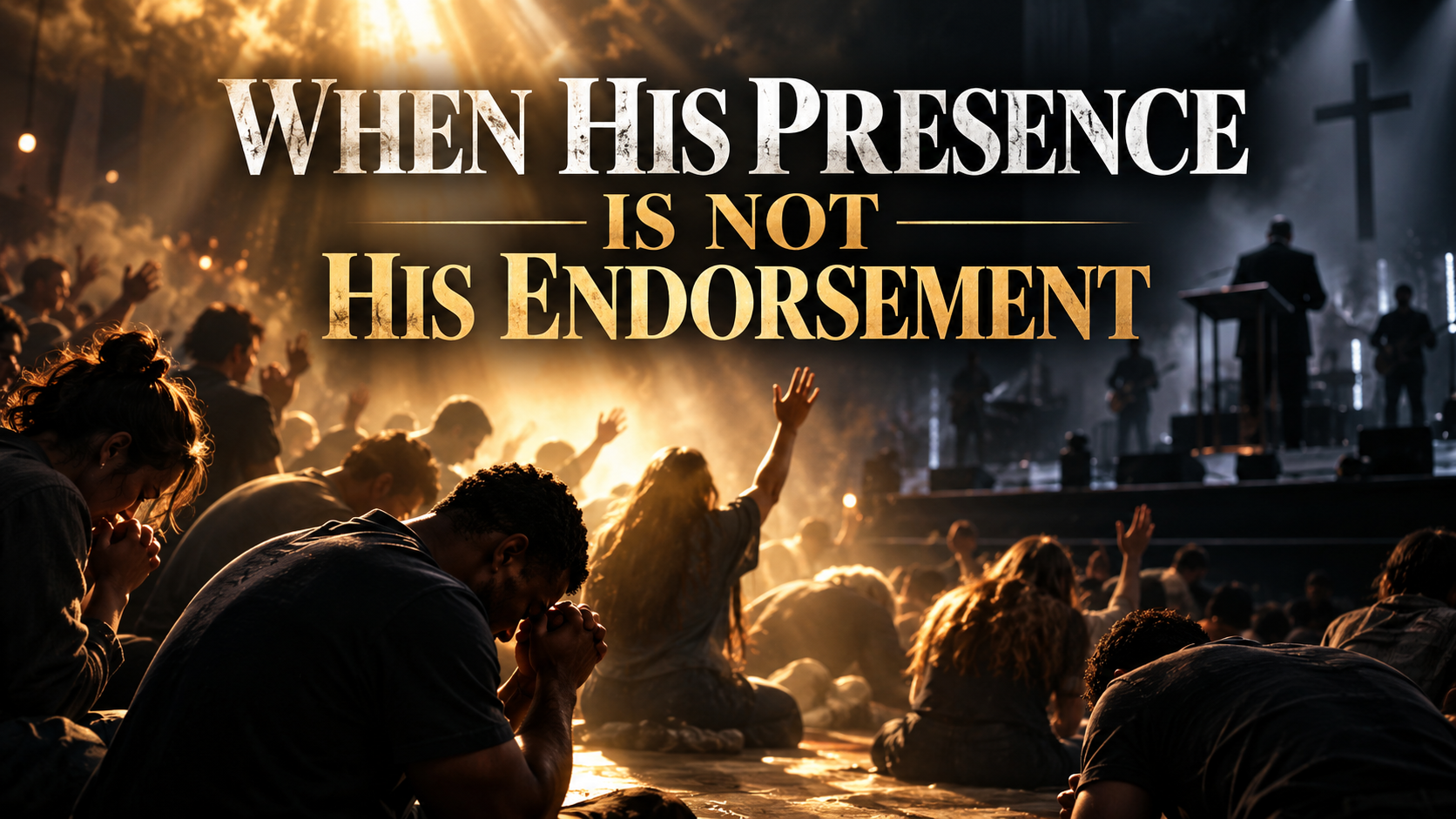
As I read that passage, I felt the Father impress something upon me that I have never forgotten: His presence in a place is not always an endorsement of the ministry. Sometimes His presence is an answer to the cries of His sons and daughters.
That distinction is critically important for the Church.
We have often assumed that if people are being healed, blessed, touched, or encountering God, then everything connected with that ministry must therefore be approved by God. Scripture does not support that conclusion. God is merciful, and He responds to hungry hearts. He hears the cries of His people. He can minister to someone in spite of the failures, immaturity, or even sin of the vessel through which ministry is taking place.
The faithfulness of God to His people must never be confused with an unrestricted endorsement of every leader, doctrine, structure, method, or private decision attached to a ministry. Israel saw water come from a rock even when Moses himself was being corrected for disobedience. The Corinthian church functioned in spiritual gifts while at the same time struggling with serious moral and relational issues. The presence of gifts did not erase the need for correction, and the mercy of God toward people did not mean everything occurring within those environments was acceptable.
This is why Jesus told us to examine fruit. Matthew 7:16 says, “You will know them by their fruits.” Fruit takes time. Charisma can appear immediately. Anointing can attract a crowd quickly. A powerful atmosphere can move people emotionally within minutes. Fruit, however, is revealed over seasons.
Character is fruit. Humility is fruit. Repentance is fruit. Faithfulness is fruit. Truth is fruit. How a leader handles correction is fruit. How a ministry treats people when they are no longer useful to the platform is fruit. How leadership responds when questioned is fruit. How people behave outside of public ministry is fruit.
The Church has become far too accustomed to asking whether a service was powerful instead of asking whether the fruit is healthy. We ask how many people attended, while the Father may be asking how many are actually being formed into the image of Christ. We ask whether there were manifestations, while He may be asking whether Jesus was glorified. We ask whether something supernatural happened, while Holy Spirit is teaching us to discern what spirit is shaping the culture.
Not everything supernatural is automatically from God, and not everything God does through an imperfect vessel means He approves of everything connected with that vessel. Mature discernment requires us to hold both truths at the same time.
The secret place changes how we see all of this. The longer you remain in the presence of the Father, the less impressed you become with platforms, titles, crowds, and visibility. You begin to realize that being known by God matters far more than being known by people. You would rather hear His whisper than receive another microphone. You would rather walk in His approval than gain public recognition. You become more willing to obey quietly than perform publicly.
The secret place also exposes motives. It forces us to ask why we feel the need to be everywhere, why we become disappointed when we are not invited, why we feel more important when we are seen, and why hidden seasons make us uncomfortable. Those questions reveal whether our identity is rooted in ministry activity or in relationship with the Father.
Jesus Himself frequently withdrew from crowds. Luke 5:16 says that He often slipped away into the wilderness to pray. That should arrest our attention. The One person who possessed a legitimate answer for every human need still refused to allow human need to replace communion with the Father. If Jesus protected the secret place, then none of us can afford to treat it casually.
Another lesson Holy Spirit has been pressing into me is that I do not have to attend everything God is doing. God may genuinely be moving somewhere and still tell me not to go. Someone may genuinely carry an anointing and still not be assigned to my life. A conference may be powerful and still not belong on my calendar. A ministry relationship may appear strategic and still not be ordained by God for this season.
This is where Romans 8:14 becomes practical. Sonship means being led. Sometimes He leads us in, and sometimes He leads us out. Sometimes He tells us to speak, and sometimes He tells us to remain silent. Sometimes He exposes something because He wants us to warn, and sometimes He exposes something because He wants us to pray. Sometimes He allows us to see dysfunction simply so that we understand what not to reproduce.
Maturity means recognizing that we do not have to participate in everything in order to honor what God may be doing there.
Israel moved when the cloud moved, and Israel remained when the cloud remained. Numbers 9 repeatedly emphasizes that they journeyed at the command of the Lord and encamped at the command of the Lord. That picture carries enormous significance for the Church today. The remnant must learn to follow the cloud again.
We need apostles who are not driven by influence, prophets who are not driven by visibility, pastors who are not driven by comparison, teachers who are not driven by recognition, and evangelists who are not driven by numbers. We need sons and daughters who have learned how to recognize the movement of the Spirit and who are willing to stay when He says stay and move when He says move.
The days ahead will require that kind of discernment. There will be gatherings that appear powerful but still require wisdom. There will be voices that sound authoritative but must be tested. There will be opportunities that appear strategic but are not assignments from heaven. There will be places where God touches people because He loves them, even while other things within that environment still need correction.
That is why the secret place cannot be optional.
The secret place is where our hearing is refined, our motives are purified, our offense is exposed, and our obedience is tested. It is where we learn the difference between being busy for God and being led by God. It is where we learn that His presence is precious, but His presence among hurting people is not always His endorsement of everything surrounding them.
My prayer in this season is that the Father would strip away everything in me that still desires activity more than obedience. I want Him to teach me to recognize His voice even when everyone else is moving in another direction. I want the courage to go when He says go and the humility to remain when He says stay. I want my discernment to remain free from accusation, my heart free from offense, and my motives clean before Him.
Above all, I want Romans 8:14 to become more than something I preach. I want it to become the description of my life. “For all who are allowing themselves to be led by the Spirit of God are sons of God.”
The hour before us does not need more religious activity. It needs sons and daughters who know how to follow the Spirit of God, who know how to discern fruit, who know how to intercede without becoming accusers, and who know the difference between the mercy of God toward His people and the endorsement of a ministry system.
That is where genuine Kingdom obedience begins.
— Dr. Russell Welch
A Watchman & Voice to the Remnant.

