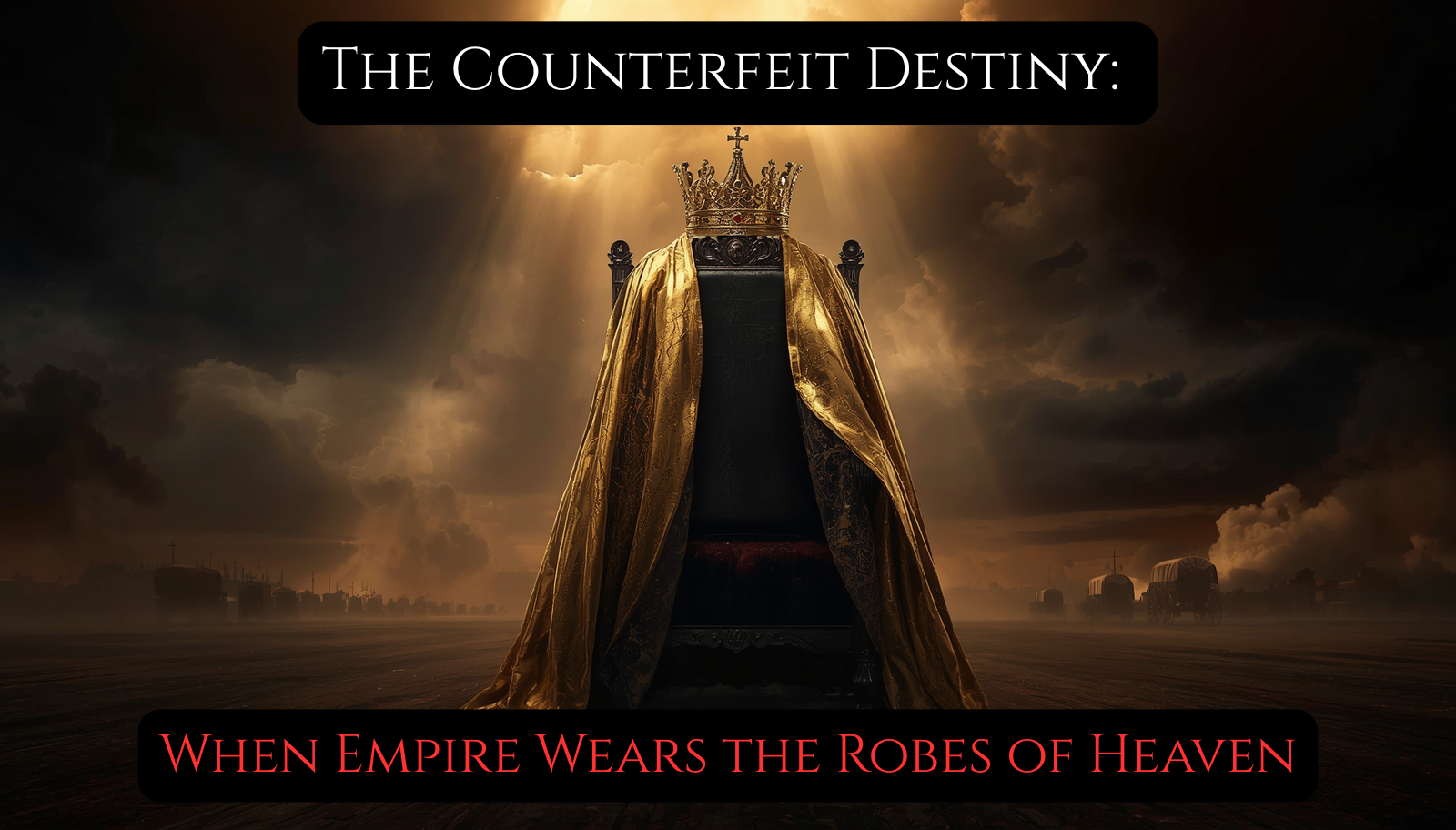
There is an old spirit that has walked the corridors of this nation for two hundred years, and it did not come dressed as a devil. It came dressed as a preacher. It quoted Providence. It spoke of destiny. It stood in pulpits and printed itself in newspapers, and it convinced generations of believers that the expansion of a nation and the advance of the Kingdom of God were the same thing.
They called it Manifest Destiny.
In 1845, a newspaper editor named John O’Sullivan gave the spirit its name, writing that it was America’s “manifest destiny” to overspread the continent — allotted, he said, by Providence itself. And the churches of that era did not test the spirit. Many of them baptized it. From denominational pulpits across this land, the doctrine was preached as though Heaven had signed the deed. God, they said, had ordained the conquest. God had sanctioned the removal. God was on the side of the wagon and the rifle and the treaty that would be broken before the ink dried.
But hear me, Remnant — Heaven never endorsed it. And it is time the Ekklesia said so out loud.
Two Kingdoms, Two Spirits
When Jesus stood before Pilate, He drew the line that every generation of believers must find again: “My kingdom is not of this world. If My kingdom were of this world, My servants would fight” (John 18:36). The Kingdom of God has never advanced by displacement. It has never grown by the crushing of peoples. It does not annex land; it redeems hearts. It does not march behind armies; it moves behind the Lamb.
Manifest Destiny was something else entirely. It was a pseudo-political, pseudo-religious spirit — the ancient spirit of empire wearing borrowed garments — and it accomplished what that spirit always accomplishes. Native peoples were driven from their homes and their dead. Families were dislocated and brutalized. A war of acquisition was waged against a neighbor. The expansion it celebrated poured fuel on the fire of slavery until the nation itself was torn open in civil war. That is the fruit. And Jesus taught us plainly: “By their fruits you will know them” (Matthew 7:20).
Do you remember the wilderness? The enemy took Jesus to a high mountain and showed Him all the kingdoms of the world and their glory, and said, “All these things I will give You if You will fall down and worship me” (Matthew 4:8–9). Territory in exchange for worship. Dominion in exchange for compromise. Jesus refused that offer. Manifest Destiny is what it looks like when a nation’s religion accepts it.
This is why I do not hesitate to call it what it is: an anti-Christ belief. Not because the people who held it were all wicked — many were sincere, catechized into it from childhood, never once hearing it challenged from the pulpit. But “anti-Christ” means what it says: in the place of Christ, instead of Christ, a counterfeit of Christ. Any doctrine that puts the sword where the cross belongs, that puts national conquest where the Great Commission belongs, that claims the authority of Heaven for the ambitions of men — that doctrine stands in the place of Christ. And whatever stands in His place stands against Him.
The Difference Between Dominion and Domination
Here is where the Remnant must have clear eyes, because the counterfeit only works when the Church forgets the genuine.
Yes — the Kingdom of God is advancing. Yes — the kingdoms of this world will become the kingdoms of our Lord and of His Christ (Revelation 11:15). Yes — we are called to disciple nations (Matthew 28:19). But look carefully at how Heaven does it: “Not by might, nor by power, but by My Spirit, says the Lord of hosts” (Zechariah 4:6). The weapons of our warfare are not carnal (2 Corinthians 10:4). The Kingdom takes ground through repentance, through love that lays its life down, through the preached Word and the demonstrated Spirit — never through the forced removal of the peoples God so loved that He sent His Son for them.
When the disciples wanted to call down fire on a village that rejected Jesus, He turned and rebuked *them* — not the village. “You do not know what manner of spirit you are of. For the Son of Man did not come to destroy men’s lives but to save them” (Luke 9:55–56). Write that over the whole sad chapter of Manifest Destiny. The men who invoked God’s name over the trail of the dispossessed did not know what spirit they were of. And a Church that will not say so today does not yet know either.
Why This Matters Now
I am not writing this to shame our ancestors from a comfortable distance. I am writing because spirits do not retire. The same seduction returns to every generation in new clothing: the whisper that says the Kingdom of God needs an earthly empire to succeed, that God’s purposes ride on political conquest, that the Church’s inheritance is secured by power rather than by the blood of the Lamb.
Beloved, our destiny is manifest — but it was made manifest at a cross, not at a border. It was purchased in blood, but the blood was His own, freely given, not the blood of the displaced. The true Ekklesia does not need the sword of empire, because she carries the sword of the Spirit. She does not take territory by removing peoples; she takes territory by reaching them.
So let the Remnant be the generation that finally tests the spirits (1 John 4:1). Let us honor what was genuinely of God in our history — the revivals, the awakenings, the praying men and women — while refusing to sanctify what God never sanctioned. Repentance is not weakness; it is the doorway to authority. A Church that can grieve rightly over the counterfeit is a Church that can carry the genuine.
The Kingdom is still advancing. The King is still on His throne. And His destiny for this nation was never conquest.
It was always harvest.
“The Son of Man did not come to destroy men’s lives but to save them.” — Luke 9:56”
We must descern ths witrh Spiritual eyes wide open!
Manifest Destiny was especially widespread within nineteenth-century white evangelical Protestantism—particularly among Methodist, Baptist, Presbyterian, Congregationalist, and Restorationist circles—though it was never the legitimate teaching of Christ or the official doctrine of one denomination.
Lastly, this dangerous and demonic-laced doctrine was never taught by Christ, His apostles, or the leaders of His Ecclesia. Nothing in the New Testament authorizes a nation to seize territory, displace peoples, or baptize political ambition as the will of Heaven. Manifest Destiny did not arise from the teachings of Jesus; it emerged as a named political-religious ideology in 1845, when journalist and editor John L. O’Sullivan used the phrase while arguing for the annexation of Texas. He claimed it was America’s “manifest destiny” to spread across the continent allotted by Providence, and later used the same language concerning the Oregon Territory. This was not apostolic doctrine, Kingdom theology, or the Gospel of Christ. It was national ambition clothed in religious language and presented as though Heaven had endorsed it.
So, again, this demonic doctrine was not born from the Kingdom. It was born when portions of the Church mistook American expansion for the advancement of God’s Kingdom.
We must become the altar where the fire falls again.
Stay tuned, the journey continues…..
A voice of fire to the Remnant,
— Dr. Russell Welch
Dr. Russell Welch is a published author, prophetic teacher, apostolic builder, and founder of faith-driven publishing and media initiatives. He is known for crafting bold, Kingdom-centered messages that call the Ecclesia into maturity, doctrinal clarity, and governmental authority. With a passion for equipping the Remnant and honoring generational legacy, Dr. Welch writes and teaches at the intersection of Scripture, history, and spiritual governance, challenging believers to live as sons and daughters who legislate Heaven on earth through truth, holiness, and unwavering fidelity to Christ.
Be sure to check out his book, Spirit Wind People: Those Who are Moved by the Impulses of Holy Spirit, available exclusively on Amazon.

