The Billion-Dollar Religious Machine and the Coming Reformation of the American Church
I want you to imagine, for a moment, what might happen if the American Church experienced a genuine, Holy Ghost-ignited, reformational revival that fundamentally transformed our understanding of ministry, stewardship, and the advancement of the Kingdom of God. I am not speaking of another season of emotionally charged meetings, increased attendance, or the familiar religious excitement that eventually settles back into institutional routine. I am speaking of a profound spiritual awakening in which the fire of God’s presence brings the Church into divine confrontation with its own priorities, exposes the systems we have constructed in the name of ministry, and restores the biblical mandate to equip the saints, make disciples, and demonstrate the Kingdom of God in the earth.
What if such a reformation caused us to reconsider the billions of dollars flowing through American Christianity each year? What if, instead of continually expanding the financial demands of institutional religion, we began making substantial investments in the very people Christ commissioned us to equip? What might happen to our communities, our families, and even our nation if the Church redirected a greater portion of its resources toward developing mature disciples, strengthening struggling households, establishing sustainable Kingdom enterprises, caring for the vulnerable, and releasing believers into their God-given assignments?
These questions deserve considerably more than a passing thought, especially when we begin examining the financial realities of organized religion in America.
According to Giving USA’s 2025 report, charitable contributions designated for religion in the United States reached approximately $146.5 billion in 2024. Separately, research published through Faith Communities Today (FACT) identified a congregational spending pattern in which approximately 44% of expenditures went toward salaries and personnel, 26% toward buildings and facilities, 13% toward missions and benevolence, and 11% toward programs and ministry support.
If we apply those percentages to the national giving figure as an illustrative exercise, the resulting estimates suggest approximately $64.5 billion for personnel, $38.1 billion for facilities, and $19 billion for missions and benevolence. These figures should not be mistaken for an audited national accounting, since the two studies measure different categories and populations. Nevertheless, they provide a sobering framework for examining the financial priorities that have come to characterize much of institutional Christianity.
Consider the implications. In this hypothetical national comparison, approximately $102.6 billion would be associated with maintaining personnel and physical infrastructure, while approximately $19 billion would be associated with missions and benevolence. Certainly, faithful ministers deserve financial support, and facilities can serve legitimate purposes in advancing the Gospel. Scripture itself establishes the principle that those who labor in the Word are worthy of appropriate support (1 Timothy 5:17–18). However, acknowledging these legitimate expenses does not remove our responsibility to examine whether the institutional structure has gradually become more important than the Kingdom mission it was established to serve.
Have we reached a place in American Christianity where preserving the religious institution consumes more of our attention, energy, and resources than equipping the people of God to fulfill the purposes of Christ?
I believe this question strikes at the heart of the apostolic reformation the Church so desperately needs.
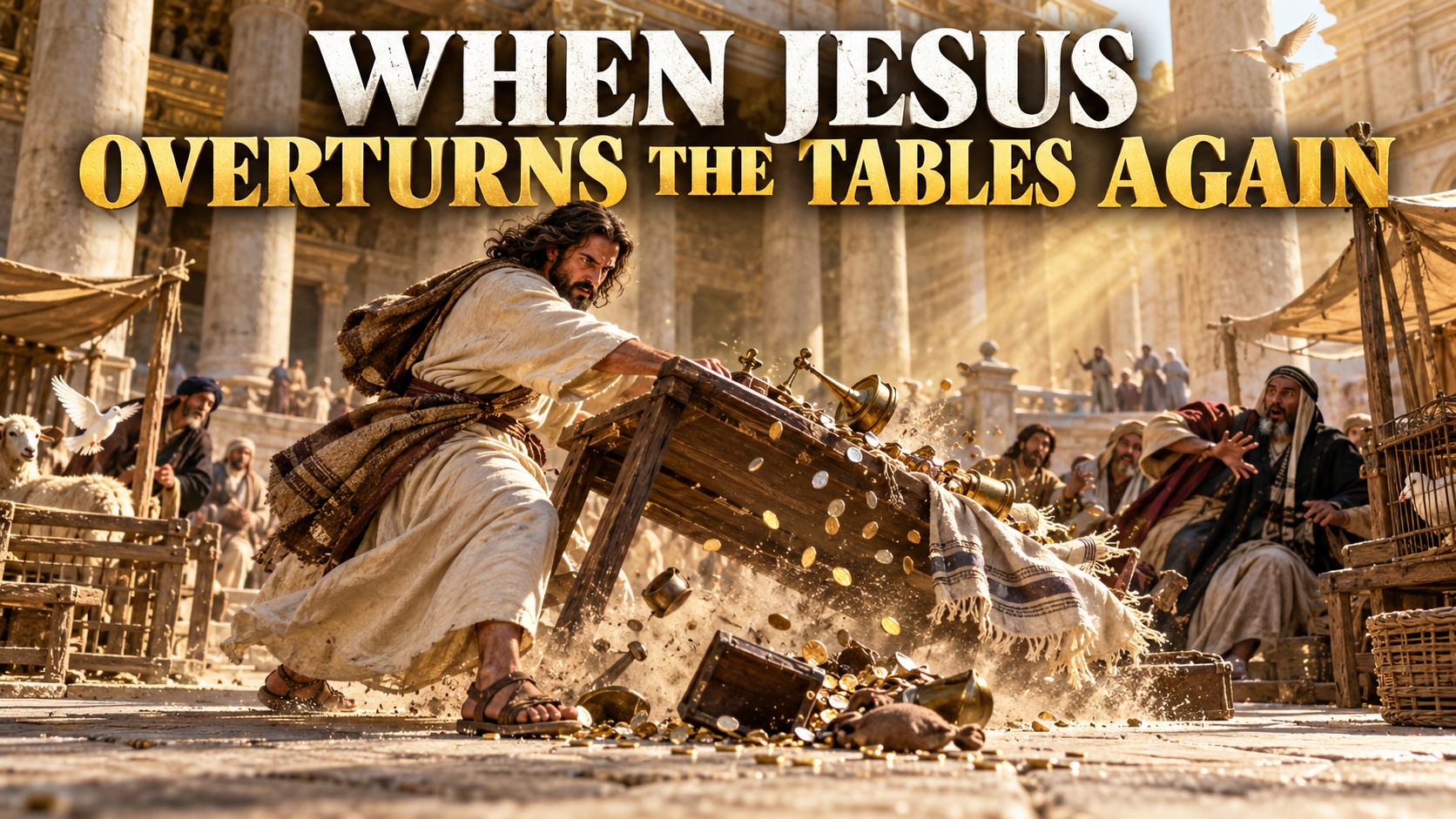
When Jesus entered the Temple in Matthew 21:12–13, He encountered a religious environment in which commercial activity had become entangled with the sacred purposes of worship. His response was neither passive nor diplomatic. He overturned the tables of the money changers and confronted those who had permitted the Father’s house to become something other than what God intended. His declaration remains a solemn warning: “My house shall be called the house of prayer; but ye have made it a den of thieves.”
We must understand that Jesus was confronting a specific historical abuse within the Temple system, not issuing a blanket condemnation of every financial transaction associated with ministry. Nevertheless, the spiritual principle is unmistakable. Whenever religious activity begins to displace divine purpose, whenever institutional interests become more important than obedience, and whenever the structures established to facilitate worship and ministry begin to consume the very mission they were created to advance, the Church must be willing to submit itself to the searching judgment of God’s Word.
And that brings me to a question I believe the American Church must seriously consider: Could we be approaching another season in which the Lord, by the convicting and purifying work of the Holy Ghost, begins overturning the tables of our religious priorities?
I am convinced that genuine apostolic reformation will require considerably more than changing our worship styles, modifying our organizational structures, or introducing another generation of ministry programs. It will demand a fundamental recovery of the biblical understanding of the Church itself. The ekklesia was never intended to function merely as a religious institution dependent upon a professional ministry class to perform the work of the Kingdom. According to Ephesians 4:11–16, Christ gave apostles, prophets, evangelists, pastors, and teachers for the equipping of the saints, so that the entire Body might mature and participate in the work of ministry.
This distinction is foundational. Ministry leadership exists to equip and establish the people of God, not to create a permanent system of spiritual dependency in which believers remain spectators while religious professionals carry the responsibility for advancing the Kingdom. When the institutional Church becomes increasingly preoccupied with sustaining its operational machinery, we must ask whether we have gradually inverted the very purpose for which Christ established His ministry gifts.
Now consider another possibility. If only 10% of the estimated $146.5 billion in annual religious giving were redirected toward intentional Kingdom investment, that would represent approximately $14.65 billion every year. Imagine the transformational possibilities if even a portion of those resources were responsibly invested in raising up mature disciples, establishing apostolic training centers, strengthening families, providing vocational development, creating employment opportunities, supporting Kingdom-minded entrepreneurs, planting healthy congregations, and addressing the practical needs of the communities in which we live.
We could begin confronting the destructive cycles of poverty, hopelessness, addiction, and generational instability that continue to devastate countless American families. We could develop believers who are spiritually mature, economically productive, and equipped to exercise godly influence within education, business, government, and the broader culture. We could move beyond defining outreach primarily as inviting people into our buildings and begin demonstrating the transforming power of the Gospel within the communities surrounding them.
And perhaps most importantly, we could begin restoring something of the remarkable community of faith described in the book of Acts.
Acts 4:32–35 presents a picture of believers who understood that their possessions and resources carried responsibilities extending beyond personal comfort and institutional preservation. Their generosity was not merely an occasional charitable activity; it was the practical expression of a people whose lives had been radically transformed by the resurrection of Jesus Christ and the outpouring of the Holy Ghost. Scripture declares in Acts 4:34, “Neither was there any among them that lacked.” The passage does not suggest that the early Church operated without leadership or structure, but it unmistakably reveals a community in which spiritual conviction produced tangible responsibility for the well-being of others.
Compare that biblical picture with the considerable financial resources flowing through American Christianity today, and we are confronted with an uncomfortable question. How is it possible for the Church to possess such extraordinary collective financial capacity while so many within our communities continue struggling without meaningful support, discipleship, or opportunities for restoration? The answer is undoubtedly complex, and we should resist simplistic accusations against those faithfully serving under difficult financial circumstances. Nevertheless, complexity must never become an excuse for avoiding honest examination.
I am not suggesting that every congregation should sell its property, eliminate pastoral compensation, or abandon the organizational structures necessary for responsible ministry. Such conclusions would be both impractical and biblically careless. What I am suggesting is that the Church must recover the courage to evaluate its expenditures through the lens of Kingdom purpose rather than institutional tradition. Buildings should serve people. Financial resources should facilitate ministry. Leadership should equip believers. And every organizational structure should remain accountable to the commission of Jesus Christ.
The question is not whether the Church should have resources, but whether those resources are being administered in a manner consistent with the character, priorities, and purposes of the King.
I believe the coming reformational work of the Holy Ghost will confront the tendency to confuse religious success with Kingdom fruitfulness. We have become remarkably proficient at measuring attendance, income, property ownership, organizational expansion, and public visibility. Yet the New Testament places extraordinary emphasis upon spiritual maturity, obedience, generosity, unity, righteousness, discipleship, and the demonstration of Christ’s life through His people.
A congregation can possess impressive facilities and still fail to equip its members for the work of ministry. A ministry can generate substantial revenue and still neglect the poor. An organization can enjoy widespread recognition while producing relatively little evidence of genuine spiritual transformation. Conversely, a modest congregation with limited financial resources may exercise profound Kingdom influence through faithful discipleship, sacrificial generosity, and sustained service to its community. The determining measure of spiritual fruitfulness has never been the size of the institution, but its faithfulness to Christ.
This is why I believe the Remnant must understand that reformation is not fundamentally a campaign against buildings, pastors, denominational structures, or financial prosperity. It is a call to restore the preeminence of Jesus Christ over everything that bears His name. It is a summons to examine whether our traditions, ambitions, expenditures, and institutional loyalties have become obstacles to the very Kingdom purposes we profess to advance.
And we must be honest enough to recognize that such examination begins with us.
Those of us who speak prophetically about the failures of institutional Christianity must be equally willing to submit our own ministries, financial decisions, leadership practices, and personal ambitions to the same standard. Genuine apostolic reformation cannot be reduced to criticizing the religious establishment while reproducing its excesses under a different name. If we are calling the Church to return to biblical foundations, then our own lives and ministries must demonstrate the accountability, humility, generosity, integrity, and sacrificial service we proclaim.
The fire of the Holy Ghost does not merely expose corruption in someone else’s house. It first searches and purifies the hearts of those who claim to carry His presence.
I believe the American Church is approaching a critical moment in which the distinction between preserving religious systems and advancing the Kingdom of God will become increasingly difficult to ignore. Whether this results in widespread institutional reformation will depend, in part, upon our willingness to repent, reconsider our priorities, and embrace the costly obedience that genuine transformation requires.
My prayer is that the Lord will raise up a generation of apostolic leaders, faithful shepherds, mature disciples, and courageous reformers who are more concerned with the advancement of His Kingdom than the preservation of their own platforms. Men and women who understand that the Church does not exist to perpetuate an institution, but to reveal Jesus Christ, equip His people, and bear witness to His reign throughout the earth.
The American Church does not lack the financial capacity to make a profound difference in this nation. What we must recover is the biblical vision, spiritual maturity, and Kingdom conviction necessary to steward those resources according to the purposes of God.
Perhaps the most searching question before us is not how much more money the Church needs to accomplish its mission, but how faithfully we have stewarded the extraordinary resources already entrusted to our care.
And if the Holy Ghost begins overturning the tables of institutional preservation, religious ambition, and misplaced priorities, may we possess the humility to recognize His correction and the courage to embrace His reformation.
For the Church that Jesus Christ is building was never intended to become a monument to religious achievement. It is a living, Spirit-filled Body, called to reveal the glory of its Head, equip the saints for the work of ministry, and demonstrate the reality of His Kingdom until He comes.
The hour does not simply demand another revival that fills our buildings. It demands a Holy Ghost reformation that transforms our understanding of what the Church was established to be.
Let the fire of God purify His house, restore His order, and awaken His people.
The King is worthy of nothing less.
Stay tuned, the journey continues…..
A voice of fire to the Remnant,
— Dr. Russell Welch
ABOUT THE AUTHOR
Dr. Russell Welch is a published author, prophetic teacher, apostolic builder, and founder of faith-driven publishing and media initiatives. His ministry carries a strong call to equip the Ecclesia for maturity, biblical clarity, spiritual discernment, and Kingdom assignment. Through his writing and teaching, he brings together Scripture, Church history, theology, and spiritual governance while challenging believers to move beyond religious tradition and into the mature life of sons and daughters who are led by Holy Spirit, established in truth, and wholly surrendered to Jesus Christ.
At the heart of this ministry is a burden to prepare and equip the Lord’s Remnant—to awaken identity, restore biblical order, strengthen spiritual maturity, and help believers recognize the assignments God has placed before them. The vision is not simply to produce messages, books, or media, but to help form a people who carry the character of Christ, hear the voice of Holy Spirit, and faithfully advance the Kingdom of God wherever the Father sends them.
To learn more about Remnant Warrior Ministries, the vision, and the assignment of the Remnant, visit:
For the word of God is quick, and powerful, and sharper than any twoedged sword, piercing even to the dividing asunder of soul and spirit, and of the joints and marrow, and is a discerner of the thoughts and intents of the heart. The Assignment There is a specific charge upon Dr. Russell Welch, and … Continue readingThe Assignment of the Remnant
 Radical Disciples – A Remnant Revolution
Scriptural foundations: Matthew 21:12–13; Acts 2:42–47; Acts 4:32–35; Ephesians 4:11–16; James 1:27; 1 Peter 4:17.
Research references: Giving USA 2025, reporting 2024 charitable giving; Faith Communities Today, FACTs on Finance, based on the FACT 2020 study. National dollar allocations discussed above are hypothetical illustrations, not independently verified expenditure totals.

