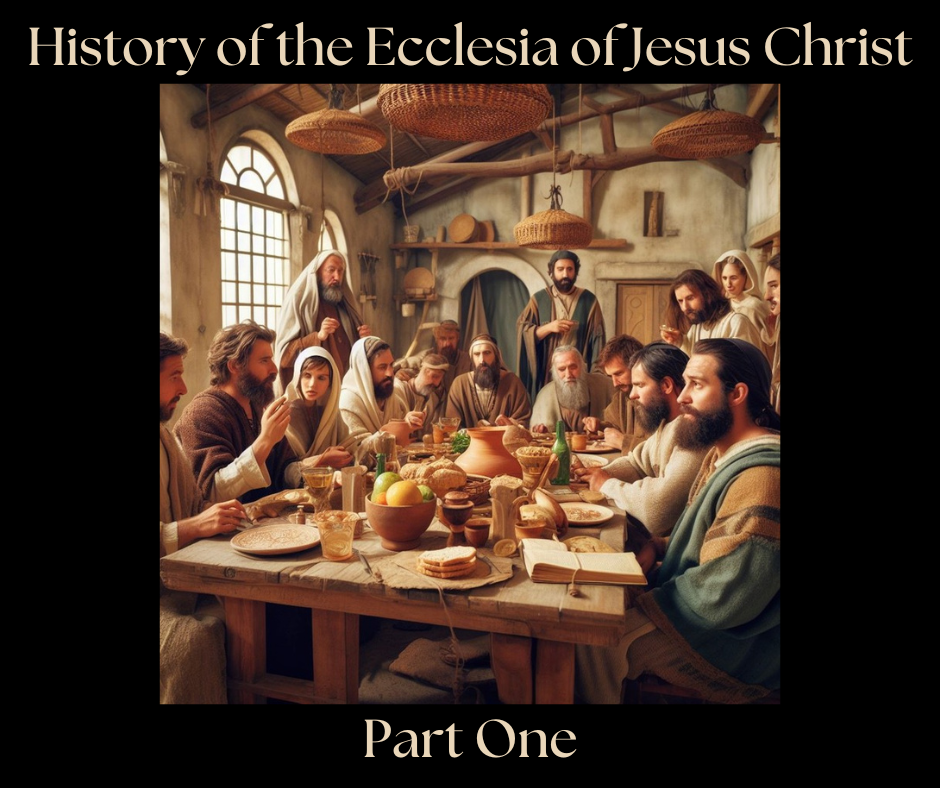
Part one of a three part series………
The Ecclesia in the Acts: Understanding Its Meaning and Significance
The term “ecclesia” has long been embraced by Christadelphians as a replacement for the word “church,” and rightly so. “Ecclesia” carries with it a rich tapestry of meaning and significance, rooted in both history and theology.
However, as with any term that becomes commonplace, there is a risk that its vitality may diminish over time. This raises an important question for believers: How do we truly perceive our ecclesia?
Exploring the depth of this term invites us to consider its historical context and its implications for our communal and individual faith experiences. In the New Testament, particularly in Hebrews 12:18-24, the ecclesia is compared to the Israelites at Mount Sinai, a momentous event in biblical history.
The writer starkly contrasts the terrifying experience of the Israelites with their encounter with God—a scene filled with fire, darkness, and fear—with the ecclesia’s arrival at Mount Zion, the city of the living God. Here, the ecclesia is depicted as part of a celestial assembly, a gathering of angels, just men made perfect, and Jesus, the mediator of a new covenant.
This imagery elevates the ecclesia beyond mere physical assembly, positioning it as an ongoing spiritual reality steeped in divine presence and purpose. The historical roots of the term “ecclesia” can be traced back to ancient Greece, particularly around the fourth century BC.
It was in this context that a constitution emerged to formalize the governing assembly of Athens, known as the ecclesia. This assembly was comprised of citizens who convened to deliberate on matters of policy, declare war, elect officials, and administer justice.
The term literally means “the called-out ones,” reflecting a sense of community and responsibility among its members. This democratic assembly emphasized ideals of “freedom and equality,” principles that resonate with the communal aspects of the ecclesia in a spiritual sense.
The relevance of the ecclesia transcends its political connotations, extending into the framework of the early Christian community as depicted in the Acts of the Apostles. When Christ spoke to Peter and the apostles in Matthew 16:18, declaring, “Upon this rock, I will build my ecclesia,” He was not introducing a new concept, but rather recontextualizing a term imbued with collective significance.
The early ecclesia, much like the Greek assembly, was called to convene, support one another, and collectively navigate the challenges of faith in a world rife with opposition.
In the Book of Acts, we see the ecclesia in action, as believers come together in unity, sharing resources, and spreading the gospel. However, it is also evident that the term “ecclesia” was not limited to a mere physical gathering.
The events in Acts 19 illustrate how the word “ecclesia” was used to denote both official assemblies and, at times, chaotic gatherings driven by mob mentality.
The case of Demetrius, who incited a riot against Paul and the believers in Ephesus, serves as a cautionary tale about the potential for distortion in communal settings.
Thus, examining the ecclesia through both its historical and biblical lenses reveals a multifaceted understanding of what it means to be part of this assembly.
It challenges believers to recognize their role as part of a larger spiritual community, one that calls for engagement, mutual support, and a commitment to the teachings of Christ.
As we reflect on our own ecclesia today, we must strive to keep its meaning alive and vibrant. It invites us to ponder how we gather, support one another, and ultimately, how we embody the values and principles established on Sinai and exemplified in the Acts of the Apostles.
By embracing the fullness of the ecclesia, we ensure that it remains a dynamic force for spiritual growth, unity, and service in a world that often seeks to divide. In doing so, we honor its profound legacy and reaffirm our commitment to being the “called-out ones” in every aspect of our lives.
The term “ecclesia,” with its richness in historical and cultural significance, serves as a bridge between the Judaic roots of early Christianity and its evolution into a distinct faith.
With its origins in the Septuagint (LXX), the Greek translation of the Hebrew Bible, ecclesia encapsulates the essence of a gathered community—a concept that resonated deeply with both Jews and early Christians. As we explore its implications, we uncover how this term shaped the understanding of community, authority, and divine purpose in the formative years of the Christian faith.
The Septuagint was created in the 3rd century BC by Jewish scholars in Alexandria, Egypt, who sought to make their sacred texts accessible to a Greek-speaking audience. In this translation, ecclesia appears as a noun seventy-seven times, establishing its foundational role in the relationship between God and His people.
Notably, it was in the context of divine assembly that the term first emerged, as documented in Deuteronomy 4:10, where Moses addresses the Israelites at Mount Sinai, urging them to remember the day of the assembly (ecclesia).
This moment was not merely a historical event; it signified the establishment of a covenant community called to hear God’s words and pass them on to future generations, thereby reinforcing the importance of collective worship and obedience.
Jesus’s use of the word “ecclesia” in Matthew 16:18, where He declares, “upon this rock I will build my ecclesia,” is particularly poignant. His choice of terminology indicates a deliberate connection to the rich history of the term as found in the Septuagint.
By employing ecclesia, Jesus indicated the creation of a new community—the body of believers—rooted in the same principles that defined the assembly of Israel.
The Apostles, familiar with the LXX, understood the weight of this word choice and its implications for their mission. They viewed the ecclesia as a continuation of God’s covenant with His people, tasked with embodying His teachings and spreading the message of salvation.
The comparative study of ecclesia and its Hebrew equivalent, “qahal,” further elucidates its significance. While both terms imply a gathering of people, “qahal” emphasizes the act of being called together by God.
This divine summoning establishes a deeper relationship between the community and their Creator, reflecting a commitment to live in accordance with His will. Barclay’s observation highlights this distinction, noting that ecclesia is not just a congregation that happens to come together; it is a body of people called into action by God.
This understanding is crucial for grasping the nature of the early Christian community, which saw itself as divinely commissioned to fulfill God’s mission on Earth.
Moreover, the early church’s identity was distinct from that of the synagogue, which had become a community space for Jewish worship separate from the temple. While synagogues served an essential role in the Jewish faith, they lacked the transformative purpose that Jesus attributed to His ecclesia.
By establishing a new community, Jesus redefined the concept of worship and fellowship, moving beyond the physical confines of the synagogue to create a spiritual temple made up of believers—an idea echoed in 1 Peter 2:5, where Christians are described as “living stones” being built into a spiritual house.
Thus, we see that the term ecclesia as found in the Septuagint serves as a critical link connecting the Jewish heritage of early Christians to the foundation of their faith.
By understanding its historical context and significance, we can appreciate the profound implications of Jesus’s declaration to build His ecclesia. The early church, rooted in the traditions of Israel, embraced its role as a living embodiment of God’s purpose on Earth, fostering a community designed not only for worship but also for action and outreach.
As we reflect on the rich history of ecclesia, we recognize the enduring call for believers to gather, listen, and respond to God’s voice, thereby continuing the legacy of faith that began millennia ago.
~Dr. Russell Welch
Elder / Teacher: Highway to Heaven Church and Founder and Shepherd of Remnant Warrior Ministries / Remnant Warrior School of Spiritual Warfare.
 Radical Disciples - A Remnant Revolution