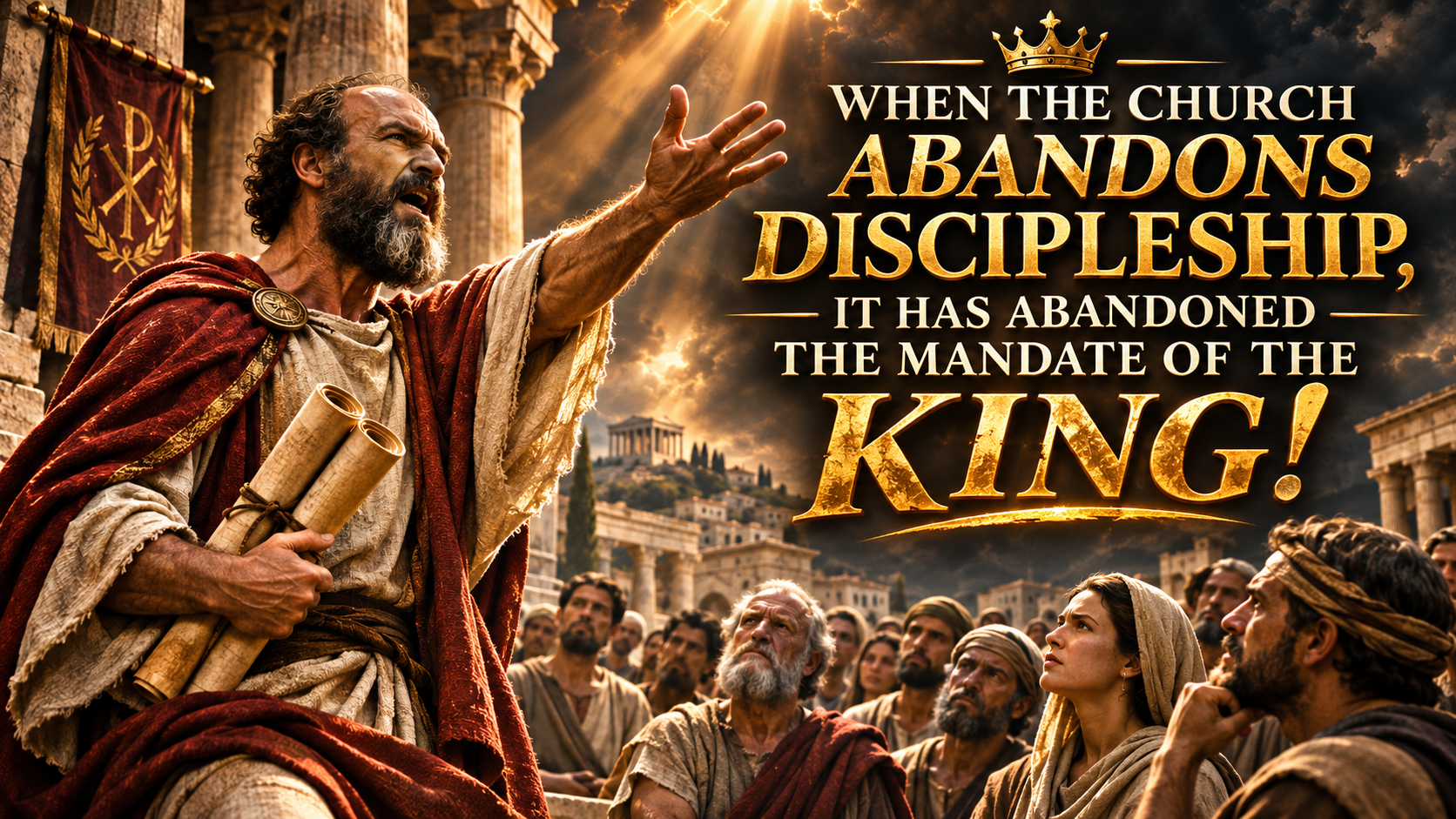
There is a dangerous deception operating within much of modern Christianity, and it is time for the Ecclesia to confront it without compromise. Jesus Christ never commissioned His Church to build religious empires, manufacture loyal members, accumulate institutional wealth, or establish organizations whose primary purpose is their own survival. He commissioned His people to make disciples! When a congregation becomes more invested in maintaining its religious machinery than equipping believers to follow Jesus Christ, it has departed from the very assignment the King entrusted to His Ecclesia. It may still possess a building, a congregation, a budget, impressive programs, and a recognizable name, but none of those things can substitute for obedience to the command of Christ.
Matthew 28:19 (AMP) declares, “Go therefore and make disciples of all the nations [help the people to learn of Me, believe in Me, and obey My words], baptizing them in the name of the Father and of the Son and of the Holy Spirit.” Jesus continues in verse 20 by commanding His followers to teach those disciples to observe everything He commanded. Notice what is absent from His commission! He did not instruct His apostles to build an audience, create a religious brand, or measure Kingdom advancement by the number of people sitting in a sanctuary. The command was to make disciples, baptize them, and teach them to obey Him. Discipleship is not an optional ministry department within the Church; it is central to the mission of the Ecclesia and inseparable from the authority of the risen Christ.
And if Matthew 28 establishes the mandate, Galatians 1:1–13 exposes the danger of surrendering that mandate to human ambition, religious approval, and a corrupted gospel. Paul opens his letter by declaring that his apostleship was “not of men, neither by man, but by Jesus Christ, and God the Father” (Galatians 1:1). His authority did not originate in an institution, a religious hierarchy, or the approval of influential men. It came through the calling of Jesus Christ. Then, with unmistakable urgency, Paul confronts believers who were turning away from the grace of Christ toward a different gospel. In Galatians 1:6–7, he warns that they were being drawn toward a message that was not truly another gospel, but a distortion of the Gospel of Christ.
Church, we must hear the weight of Paul’s warning! When the message of Jesus Christ is distorted to serve the ambitions of men, the consequences are not merely organizational; they are spiritual. When the Gospel becomes a tool for building personal kingdoms, securing religious loyalty, generating financial dependence, or preserving institutional power, it is no longer being faithfully proclaimed according to its divine purpose. The people of God were never redeemed to become permanent spectators supporting the ambitions of religious professionals. They were redeemed through the blood of Jesus Christ, brought into relationship with the Father, indwelt by Holy Spirit, and called to grow into mature, obedient disciples who carry the life and testimony of Christ into the world.
Galatians 1:10 strikes at the very heart of the problem: “For do I now persuade men, or God? or do I seek to please men? for if I yet pleased men, I should not be the servant of Christ.” Here is the question every pastor, apostle, prophet, evangelist, and teacher must confront: Are we preparing people to follow Jesus Christ, or conditioning them to remain dependent upon us? Are we proclaiming the whole counsel of God’s Word, or avoiding biblical truths because they might offend influential donors, reduce attendance, or threaten the financial stability of the organization? Are we raising sons and daughters who recognize the voice of the Shepherd through His Word and the guidance of Holy Spirit, or creating a religious culture where loyalty to leadership is treated as though it were loyalty to God?
Let me make this unmistakably clear: “A church can be financially successful, organizationally impressive, and socially influential while being profoundly unfaithful to the Great Commission.” Religious expansion is not necessarily Kingdom advancement. A crowded sanctuary is not proof that disciples are being made. An expanding budget is not evidence of spiritual maturity. And the ability to attract thousands of people does not automatically demonstrate that those people are being equipped to deny themselves, take up their crosses, and follow Jesus Christ. The question is not simply how many people attend the gathering, but how many are being transformed through the truth of Scripture into obedient followers of the King.
Paul’s warning becomes even more sobering in Galatians 1:8–9, where he declares that anyone proclaiming a gospel contrary to the one the apostles received and preached is to be accursed. Those are not casual words, and we must not misuse them to condemn every congregation whose structure or methods differ from our preferences. But neither dare we diminish their seriousness! Paul was confronting a corruption of the Gospel itself, and his warning establishes an enduring principle: No religious title, apostolic claim, institutional tradition, financial achievement, or charismatic personality possesses the authority to alter the Gospel of Jesus Christ. The message belongs to the King, and those entrusted with proclaiming it are accountable to Him.
This is why Ephesians 4:11–13 is so important. Christ gave ministry gifts for the equipping of the saints, the work of ministry, and the building up of His Body until believers come into maturity. The purpose was never to establish an untouchable religious class that performs ministry while everyone else watches, applauds, and finances the operation. Apostolic and pastoral leadership exists to serve the purposes of Christ by equipping His people, strengthening their faith, grounding them in sound doctrine, and preparing them to fulfill their Kingdom assignments. When leaders make themselves indispensable rather than equipping others for maturity, they have misunderstood the very nature of the authority entrusted to them.
And here is where the warning becomes prophetic: An organization may be legally recognized by earthly governments while operating in direct contradiction to the mission Christ commanded. It may possess impressive credentials, prestigious titles, financial resources, and widespread influence, but those things do not establish spiritual legitimacy before Heaven. In Acts 19:13–16, the sons of Sceva attempted to invoke the name of Jesus without possessing the relationship and authority they presumed to exercise. Their failure revealed a sobering truth: Spiritual authority cannot be manufactured through religious language, borrowed reputation, or outward association. It is not the name on the building that overcomes darkness; it is the victory and authority of Jesus Christ, in whose name His people are called to stand.
We must therefore stop confusing religious influence with Kingdom authority! The powers of darkness are not overcome by membership rolls, celebrity leadership, impressive stages, expensive facilities, or institutional prestige. Ephesians 6:10–18 calls believers to be strong in the Lord and in the power of His might, clothed in the whole armor of God, standing in truth, righteousness, faith, salvation, the Word, and persevering prayer. Our confidence is not in the size of our ministry but in the supremacy of Jesus Christ. The authority entrusted to the Ecclesia must never be separated from surrender to His lordship, obedience to His Word, and dependence upon Holy Spirit.
I am convinced that one of the most urgent needs of this generation is not another wave of religious expansion, but a return to the biblical mandate of making disciples. We need believers who understand their identity in Christ, who know how to handle the Scriptures faithfully, who can discern truth from deception, who walk in holiness, who love their neighbors, who resist the works of darkness, and who carry the Gospel beyond the walls of religious institutions. We need spiritual fathers and mothers who raise mature sons and daughters rather than accumulating followers who remain permanently dependent upon their leadership. We need gatherings where every member is encouraged to grow, serve, pray, minister, and participate in the life of Christ’s Body.
“THE ECCLESIA WAS NEVER COMMISSIONED TO BUILD AN AUDIENCE FOR RELIGIOUS CELEBRITIES. SHE WAS COMMISSIONED TO MAKE DISCIPLES OF JESUS CHRIST!”
And let this be understood: I am not condemning the gathering of believers, the faithful stewardship of financial resources, the existence of church buildings, or the biblical responsibility to support those who labor in ministry. Scripture recognizes the value of gathering, giving, leadership, and mutual support. What I am confronting is the displacement of the Kingdom mandate by an institutional system that treats the people of God as consumers, financial supporters, or loyal followers rather than disciples who must be equipped for spiritual maturity and service.
The real question confronting every congregation is not whether it has developed a successful religious organization, but whether it is fulfilling the assignment Jesus Christ gave it. Are people being taught to obey everything He commanded? Are believers growing in their relationship with the Father, abiding in the Son, and learning to walk under the governance of Holy Spirit? Are they being equipped to fulfill their assignments, demonstrate the righteousness of the Kingdom, and make disciples themselves? Or have they simply become members of a religious institution that requires their attendance, their allegiance, and their financial support while leaving them spiritually unequipped?
The hour has come for the Ecclesia to examine herself in the light of Scripture. We do not need a more sophisticated version of religious consumerism. We need a restoration of biblical discipleship, genuine apostolic equipping, spiritual maturity, and wholehearted obedience to Jesus Christ. We need leaders who fear God more than they fear losing influence, and believers who love the truth more than they love the comfort of religious familiarity.
“IF YOUR MINISTRY EXISTS TO MAKE MEMBERS LOYAL TO YOUR ORGANIZATION RATHER THAN DISCIPLES FAITHFUL TO JESUS CHRIST, YOU HAVE EXCHANGED THE KING’S COMMISSION FOR AN INSTITUTIONAL AGENDA!”
The Great Commission has not been amended. The Gospel has not been placed under the authority of religious institutions. And Jesus Christ has not surrendered His headship over the Ecclesia to the ambitions of men.
The mandate remains unchanged: GO! MAKE DISCIPLES! BAPTIZE THEM! TEACH THEM TO OBEY EVERYTHING JESUS COMMANDED!
It is time to stop building religious audiences and start equipping a generation that knows its King, walks in His truth, and demonstrates His Kingdom.
THE FATHER IS BUILDING A PEOPLE FOR HIS DWELLING, NOT AN EMPIRE FOR MAN’S GLORY!
Dr. Russell Welch
A Watchman & Voice to the Remnant
Radical Disciples — A Remnant Revolution
https://radical-disciples.org/

