Posts Tagged ‘#BiblicalDiscernment’


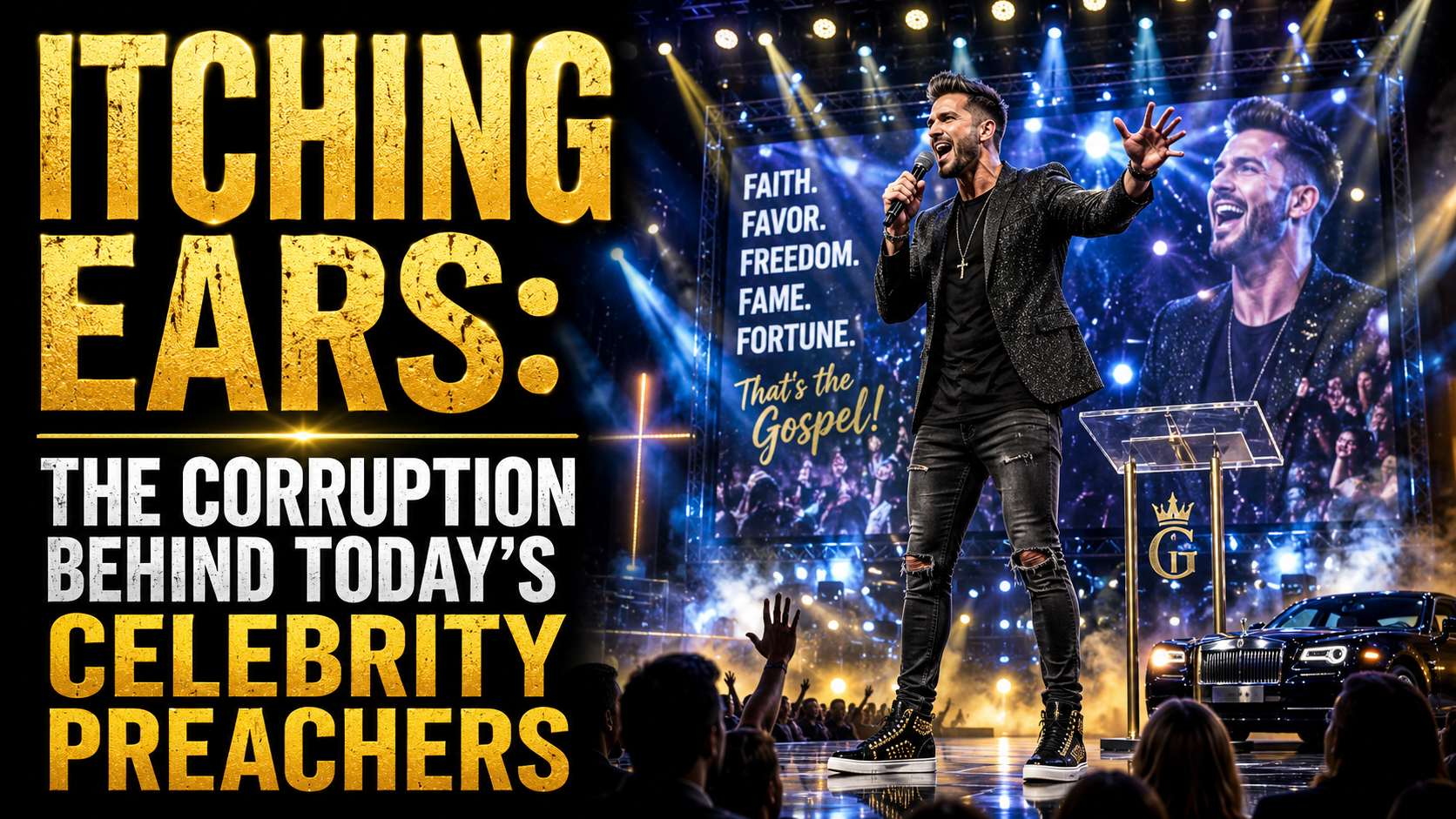
“Big Screens, Skinny Jeans and Smoke Machines”

“For the time will come when they will not endure sound doctrine, but according to their own desires, because they have itching ears, they will heap up for themselves teachers; and they will turn their ears away from the truth, and be turned aside to fables.” — 2 Timothy 4:3

I went looking for the verse that explains what I keep seeing, and I found it.

Somewhere along the way, a strange qualification quietly attached itself to the pulpit. Nobody wrote it into a creed. Nobody voted on it in a denominational meeting.

But walk through the marketing of half the “prophetic voices” and “apostolic leaders” filling your timeline and you’ll find the unwritten job description: sleeve tattoos on both arms, a designer beard maintained better than most people’s marriages, a wardrobe that costs more than a month of rent for half the congregation funding it. Charisma on camera. A logo. A brand.

Somewhere, we stopped asking whether a man walks in the fear of the Lord and started asking whether he looks like he could headline a festival.

“I was in a meeting when brother Mario Murillo asked a piercing question: ‘When did the church become lukewarm? Maybe when we replaced the Holy Spirit with big screens, skinny jeans, and fog machines.’ The problem isn’t a screen, a pair of jeans, or a fog machine. The problem begins when production becomes the substitute for Presence, personality replaces anointing, and the platform becomes more important than the altar.”

The Word Never Asked for a Brand

Paul gave Timothy and Titus the actual job description for anyone who wants to stand in front of God’s people. It has nothing to do with aesthetics.

An overseer must be blameless, not self-willed, not soon angry, not given to wine, no striker, not greedy of filthy lucre — but a lover of hospitality, a lover of good men, sober, just, holy, temperate (Titus 1:7-8).

He must be one that ruleth well his own house, not a novice, and have a good report of them which are without (1 Timothy 3:4-7). Peter told the elders to feed the flock of God, taking the oversight thereof, not for filthy lucre, but of a ready mind; neither as being lords over God’s heritage (1 Peter 5:2-3).

Read those lists as many times as you want. You will not find “must have a compelling personal brand.” You will not find “must dress like he’s about to drop an album.” You will find character. You will find the fear of the Lord. You will find a warning, repeated twice in two different letters to two different men, about money.

That repetition is not an accident. God knew exactly what would try to hijack the pulpit two thousand years later.

Building a Kingdom, or Building a Legacy?

There is a difference between a ministry that builds the Kingdom of God and a ministry that builds a personal empire wearing Kingdom language as a costume.

You can tell the difference by where the money goes. A house of God that pours its resources into reaching the lost, discipling the broken, and caring for the widow and the orphan is building a Kingdom.

A house that pours millions into a private jet, a mansion compound, and a wardrobe budget while quietly building a media empire and a family dynasty to inherit it — that is not a ministry anymore. That is a business with a worship set.

Jesus walked into the temple and turned over the tables of the men who had figured out how to monetize access to God. He did not do it quietly. He did not do it politely. My house shall be called the house of prayer; but ye have made it a den of thieves (Matthew 21:13). If He was willing to flip tables over doves being sold in the outer court, what does He think about a nine-figure media empire built on offerings collected in His name?

Paul asked the Corinthians a question the American Church needs to sit with: we are not as many, which corrupt the word of God: but as of sincerity (2 Corinthians 2:17). The word there for “corrupt” was used for shopkeepers who watered down their wine to increase their profit margin. Paul saw it coming. Peddlers of the gospel, diluting the truth to move more product.

Micah saw it too, centuries earlier: The heads thereof judge for reward, and the priests thereof teach for hire… yet will they lean upon the Lord, and say, Is not the Lord among us? none evil can come upon us (Micah 3:11). Notice that — they still used God’s name. They still claimed His presence. They just taught for hire while doing it.

Itching Ears Built This Platform

None of this could happen without willing customers. Paul didn’t just warn Timothy about corrupt teachers — he warned him about a congregation that would demand them.

They will not endure sound doctrine, but according to their own desires, because they have itching ears, they will heap up for themselves teachers (2 Timothy 4:3).

Read that carefully. The people heap up the teachers. They go looking for a voice that will scratch the itch of what they already wanted to hear, and they will keep hiring and firing preachers until they find one who never makes them uncomfortable.

An itching-ears culture doesn’t want a shepherd who will correct it.

It wants a celebrity who will affirm it, entertain it, and look good doing it. So the marketplace responded exactly the way marketplaces do. It manufactured the product being demanded — polished, tattooed, designer-dressed, and camera-ready — because a congregation with itching ears will fund the platform every single time.

This is not a story about a few bad men. It is a transaction. And it will not stop until the people stop demanding the product.

What the Fear of the Lord Actually Looks Like

Paul reminded the Ephesian elders of his own example: I have coveted no man’s silver, or gold, or apparel… I have shewed you all things, how that so labouring ye ought to support the weak (Acts 20:33-35).

He worked with his hands so the gospel would cost the church nothing extra. He was not chasing a brand. He was making sure the message never got confused with a hustle.

Jeremiah confronted the shepherds who scattered the flock instead of feeding it, and God said plainly: I will visit upon you the evil of your doings (Jeremiah 23:2).

Ezekiel said it even sharper — shepherds who feed themselves, clothe themselves with the wool, and let the sheep go hungry and scattered while calling it ministry (Ezekiel 34:2-4).

And Paul, writing to Timothy about the very spirit driving all of this, was blunt: the love of money is the root of all evil: which while some coveted after, they have erred from the faith, and pierced themselves through with many sorrows (1 Timothy 6:10). Not a warning about wealth existing. A warning about what happens to a man’s soul when the love of it gets into the pulpit.

The Question This Leaves Us With

This is not a call to despise every preacher with a tattoo or a nice suit. Character was never measured by ink or by a closet. That was never the point, and turning it into a legalistic checklist would just be a different flavor of missing the mark.

The point is this: somewhere, the qualification for standing in the pulpit quietly shifted from the fear of the Lord to the size of a platform. Somewhere, a congregation started confusing a brand with an anointing. Somewhere, “does he look like he could carry the room” replaced “does he tremble at the Word of the Lord.”

Paul told Timothy the itching-ears season was coming. He didn’t tell him to be surprised by it. He told him what to do instead: preach the word; be instant in season, out of season; reprove, rebuke, exhort with all longsuffering and doctrine (2 Timothy 4:2).

Stay faithful to the Word, even when — especially when — it stops being what people want to hear.

The Church does not need more celebrities. It needs shepherds who love the sheep more than they love the brand.

We must become the altar where the fire falls again.

Stay tuned, the journey continues…..

A voice of fire to the Remnant,

— Dr. Russell Welch

Dr. Russell Welch is a published author, prophetic teacher, apostolic builder, and founder of faith-driven publishing and media initiatives. He is known for crafting bold, Kingdom-centered messages that call the Ecclesia into maturity, doctrinal clarity, and governmental authority. With a passion for equipping the Remnant and honoring generational legacy, Dr. Welch writes and teaches at the intersection of Scripture, history, and spiritual governance, challenging believers to live as sons and daughters who legislate Heaven on earth through truth, holiness, and unwavering fidelity to Christ.

Be sure to check out his book, America at War: The Spiritual Battle for a Nation’s Soul, available exclusively on Amazon

Scripture references: 2 Timothy 4:2-3 • Titus 1:7-8 • 1 Timothy 3:4-7 • 1 Timothy 6:10 • 1 Peter 5:2-3 • 2 Corinthians 2:17 • Matthew 21:13 • Micah 3:11 • Jeremiah 23:1-2 • Ezekiel 34:2-4 • Acts 20:33-35


This isn’t a left vs. right fight. It never was. It’s freedom vs. domination. And the door being used… may not be the one you’d expect.


To My Fellow Americans — All of You

Before you read another word, I need you to know something: this is not an attack on you.

If you’ve voted Democrat your entire life — because you believe in helping the poor, protecting the vulnerable, expanding opportunity, and fighting against inequality — those are not bad values. They are, in many ways, profoundly American values.

This is a warning for you. Because good people, with good intentions, are sometimes handed a flag they didn’t design — and don’t fully see yet.


The Oldest Strategy in the Art of War

There is a reason the story of the Trojan Horse has survived thousands of years. It is not remembered because it was a great military victory. It is remembered because it revealed a timeless truth about how power is truly taken:

Not by force at the front gate. But by invitation through the side door.

No movement in history that sought to dominate a free people has ever announced itself honestly. They have always arrived wearing the language of liberation. They have always spoken the words that good-hearted people most want to hear:

Equality. Justice. Progress. The people.

And history — without a single exception — shows us what comes next when those words are used not as destinations, but as vehicles.


What Is Actually Happening in America Right Now

There is a faction — not the whole of the Democratic Party, but a loud, organized, and strategically placed faction within it — that is pushing an agenda that goes well beyond traditional liberal or progressive values.

This is not about raising taxes or expanding healthcare. Reasonable people can debate those things. This is something different.

This faction has pushed, with remarkable consistency, for:

  • The dismantling of local law enforcement — not reform, dismantling — leaving communities, particularly the most vulnerable ones, without protection
  • The systematic erosion of free speech, rebranded as “harm reduction” and “misinformation control”
  • The redefinition of merit, due process, and equal protection under the law based on group identity rather than individual rights
  • An open hostility toward Judeo-Christian faith in the public square, while simultaneously treating any criticism of other ideological or religious systems as bigotry
  • The rewriting of American history not to add nuance, but to fundamentally delegitimize the very foundations of constitutional self-governance

These are not liberal policies. They are the preconditions — tested and proven across the 20th century — for the collapse of free societies.


The Useful Door

Here is what history teaches us that most people never learn until it is too late:

Radical movements rarely build their own door. They use the one that’s already open.

The early Bolsheviks rode in on the legitimate grievances of starving Russian workers. They did not announce a gulag. They announced bread and land.

The early Iranian Revolution rode in on legitimate anger at a corrupt Shah. They did not announce the crushing of women’s rights. They announced liberation from oppression.

In both cases — and in every similar case — the people who opened the door were not the ones who walked through it last.

The socialists who helped bring the Ayatollah Khomeini to power were among the first people he imprisoned and executed once control was secured. They were useful. Then they were not.

This is not a conspiracy theory. This is a pattern, documented in university history courses, written in the blood of millions, and ignored in every generation by people who were certain their revolution was different.


A Question Every Democrat Deserves to Be Asked

If you are a Democrat who believes in:

  • Women’s rights and equality
  • LGBTQ+ dignity and protection
  • Free expression and artistic freedom
  • A secular government that does not impose religious law
  • The right to leave or critique any religion without fear

Then you need to ask yourself one honest question:

Which of those values would survive under a theocratic system?

Not rhetorically. Historically. Concretely.

Because the radical ideological current that has embedded itself within progressive spaces — particularly on university campuses, in activist networks, and increasingly in municipal politics — has formed a tactical alliance with political Islam that cannot be explained by shared values. These ideologies are, at their core, incompatible on almost every social issue the left claims to hold dear.

The only thing they share is a common short-term enemy: the constitutional American order.

The alliance is tactical. It is temporary. And the people being used as the vehicle will not be the ones who determine what happens at the destination.


This Is Not About Hating Muslims

Let this be absolutely clear: this is not an indictment of Muslim Americans.

The overwhelming majority of Muslim Americans are exactly what every immigrant group in American history has been — people who came here, or were born here, seeking the same freedom, opportunity, and dignity that every American deserves. They are doctors, soldiers, teachers, neighbors, and patriots.

This is about a specific political ideology — not a faith, but a theo-political movement — that has openly and repeatedly stated its intention to replace constitutional governance with religious law. That movement exists. It has funders, strategists, and a long game. And it is not shy about its goals in its own literature, even when it is careful about its language in public.

The distinction between a Muslim American neighbor and a radical theo-political movement is not complicated. It is the same distinction between a Christian American neighbor and a theocratic movement that would impose its interpretation of Scripture on every citizen by force of law.

Both extremes are a threat to the same Constitution. Both must be named honestly.


The Voting Booth Is Still There — For Now

Here is the most urgent thing this moment demands you understand:

The ballot is the last peaceful tool a free people possesses.

Not social media. Not protests. Not petitions. The vote.

And it is not guaranteed. Not because of some shadowy plan to cancel elections — but because a people that stops using freedom will, eventually, stop having it. Apathy is its own form of surrender.

Every generation of Americans has faced a moment when the cost of engagement felt too high, the choices felt too corrupt, the system felt too broken. Every generation that walked away from that moment paid a price the next generation inherited.

We are at that moment again.


The Call

This is not a call to become Republican. This is not a call to abandon every value you’ve held.

This is a call to wake up to the difference between:

  • The party you thought you were supporting
  • And the faction within it that is using your good intentions as cover for an agenda you did not sign up for

Ask the hard questions. Demand honest answers from your candidates and your leaders. Watch what they do when they have power, not just what they say when they want it.

Look at the cities where these policies have been most aggressively implemented. Look at the outcomes — not through a partisan lens, but through the eyes of the people who actually live there.

And then vote. Vote like someone who understands that the booth you walk into today exists because someone before you was willing to fight for it — and that someone after you is counting on you not to waste it.


The Bottom Line

This is not left versus right.

This is not Democrat versus Republican.

This is the oldest battle in human history:

Freedom versus Domination. Light versus Darkness. The dignity of the individual versus the machinery of control.

Every true American — regardless of party, regardless of background — was made for this moment.

The question is simply whether we will be awake enough to meet it.


Share this with someone who needs to hear it — especially someone you disagree with. The people most worth reaching are not the ones already in your corner.

We must become the altar where the fire falls again.

Stay tuned, the journey continues…..

A voice of fire to the Remnant,

— Dr. Russell Welch

Dr. Russell Welch is a published author, prophetic teacher, apostolic builder, and founder of faith-driven publishing and media initiatives. He is known for crafting bold, Kingdom-centered messages that call the Ecclesia into maturity, doctrinal clarity, and governmental authority. With a passion for equipping the Remnant and honoring generational legacy, Dr. Welch writes and teaches at the intersection of Scripture, history, and spiritual governance, challenging believers to live as sons and daughters who legislate Heaven on earth through truth, holiness, and unwavering fidelity to Christ.

Be sure to check out his book, “America at War: The Spiritual Battle for a Nation’s Soul” available exclusively on Amazon.

Amazon Author Page