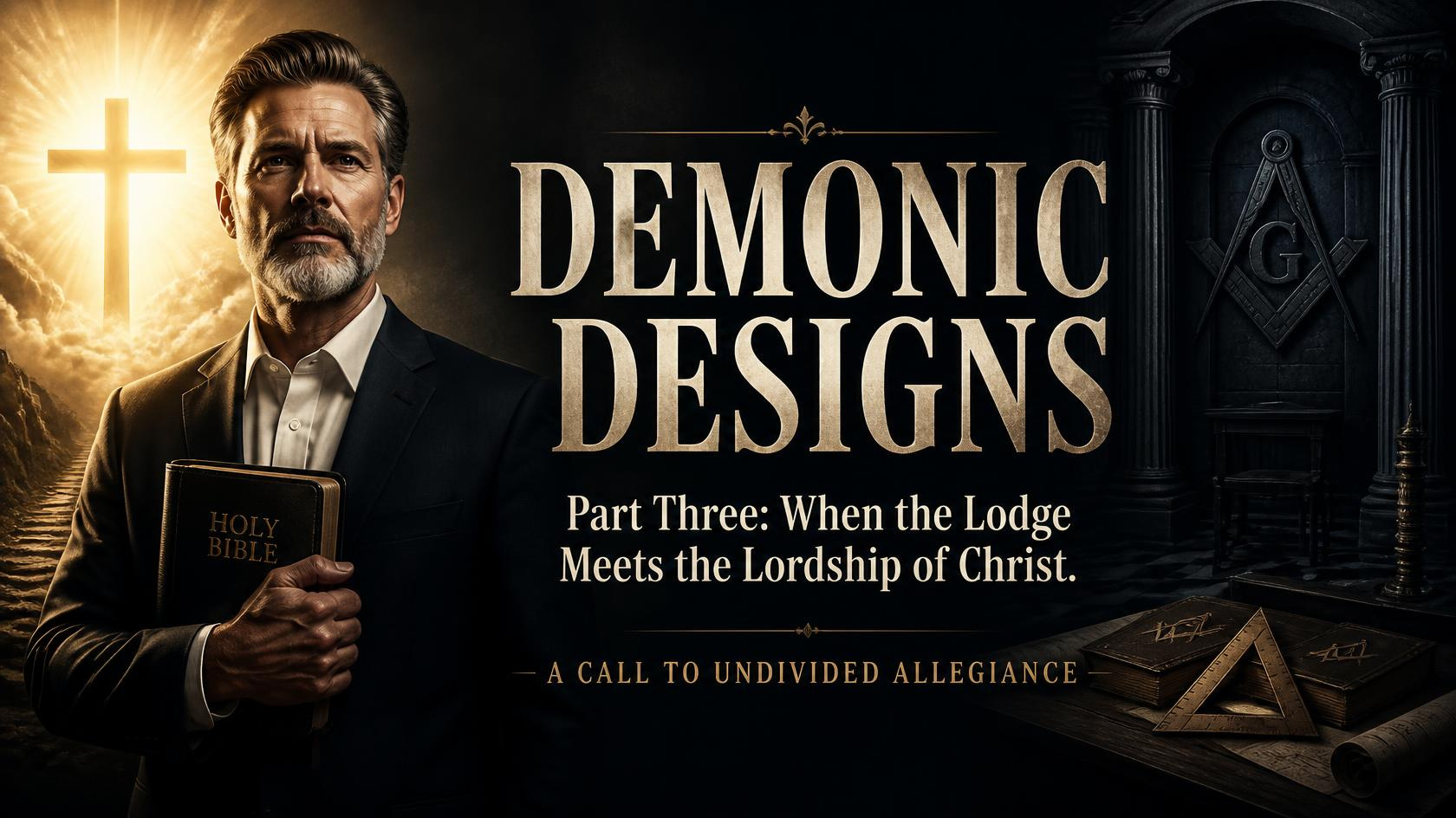
Part Three of the Demonic Designs Series
There comes a point in spiritual discernment when general principles are no longer enough. Eventually, the believer must examine the structure itself and ask whether its practices, language, obligations, and spiritual framework can stand beneath the exclusive lordship of Jesus Christ. In Part One of this series, we established that the central issue surrounding Freemasonry is not rumor, conspiracy, or guilt by association. The central issue is lordship. In Part Two, we examined the biblical weight of vows, covenants, spoken agreements, and divided allegiance. Part Three now brings those principles directly into the lodge.
The question before us is not whether Freemasons perform charitable works, promote morality, or include sincere Christian men among their members. Many do. The question is whether participation in Freemasonry requires a Christian to enter a religiously plural framework, make solemn obligations, participate in ritual ceremonies, and use spiritual language that deliberately leaves the identity of God broad enough to accommodate contradictory beliefs. That question deserves careful examination because good intentions do not automatically make every spiritual structure compatible with the Gospel.
This discussion also does not require sensational claims about hidden governments, satanic conspiracies, or mysterious secret degrees. Those arguments often distract from concerns that are already visible within Freemasonry’s own published explanations of its beliefs and practices. Freemasonry openly acknowledges its ceremonies, degrees, obligations, symbols, confidential signs and words, belief in a Supreme Being, and use of sacred texts. Those documented features provide sufficient ground for a serious biblical examination without exaggeration.
The issue is therefore much more focused. What happens when someone who has already surrendered his life to Jesus Christ enters a system intentionally designed to accommodate different and even contradictory understandings of God? That is where the question of Christian allegiance becomes unavoidable.
BEGIN WITH WHAT FREEMASONRY SAYS ABOUT ITSELF
A fair examination should begin by allowing Freemasonry to describe itself. Modern Masonic organizations commonly present Freemasonry as a social, moral, fraternal, and charitable institution centered upon integrity, friendship, respect, service, and personal development. They generally deny that Freemasonry is a religion and emphasize that men from different religious backgrounds may participate while retaining their own beliefs.
Freemasonry teaches primarily through ceremonies and symbolic degrees. The three foundational Craft degrees are Entered Apprentice, Fellow Craft, and Master Mason. These ceremonies use allegory, symbolism, architectural imagery, moral instruction, and the language of building to communicate lessons concerning character, conduct, mortality, duty, and personal development.
None of those elements, standing alone, proves that something is spiritually evil. A square and compass are not inherently demonic. An apron is not inherently demonic. A lodge room, architectural imagery, ceremonial language, or symbolic instruction should not automatically be classified as occult simply because it appears unfamiliar or mysterious.
Biblical discernment must go deeper than symbols and appearances. Christians must examine what the symbols represent, what the ceremonies communicate, what commitments are being made, what spiritual language is being used, and whether the entire structure can remain subject to Jesus Christ. Paul instructed believers to “prove all things” and to “hold fast that which is good” in 1 Thessalonians 5:21. That requires careful examination rather than fear, speculation, or hysteria.
THE PROBLEM OF THE “SUPREME BEING”
Regular Freemasonry traditionally requires belief in a Supreme Being. Christian Masons sometimes point to that requirement as evidence that the organization honors God, yet the wording itself deserves careful examination because the phrase is intentionally broad. It does not identify the Supreme Being specifically as the Father revealed through Jesus Christ, nor does it require participants to share one theological understanding of God.
Within the Masonic framework, men from different religious traditions may retain their own understanding of deity while participating in the same fraternity. A Christian may understand the Supreme Being as the God of Scripture, while another member may interpret the same language through an entirely different religious tradition. The structure is able to function precisely because the identity of God remains broad enough to accommodate those differing beliefs.
That creates an immediate theological tension for the Christian because Christianity does not merely confess belief in a higher power. The Gospel declares that God has revealed Himself through Jesus Christ. Jesus said, “he that hath seen me hath seen the Father” in John 14:9, and He declared in John 14:6 that no one comes to the Father except through Him. Peter likewise proclaimed in Acts 4:12 that salvation is found in no other name.
The apostolic Gospel therefore does not present Jesus as one possible religious interpretation among several acceptable alternatives. Christianity proclaims Christ as the definitive revelation of the Father and the only mediator of salvation. This does not give Christians permission to mistreat, ridicule, or dishonor people of other faiths. We are called to love them, serve them, and respect their dignity while remaining faithful to the truth entrusted to us.
Tolerance toward people, however, is not the same as theological equivalence between beliefs. The Christian must therefore ask whether participation in a spiritual framework intentionally broad enough to accommodate contradictory understandings of God is compatible with the confession that Jesus Christ alone reveals the Father.
THE GREAT ARCHITECT OF THE UNIVERSE
Freemasonry commonly uses the designation “Great Architect of the Universe” as language that allows members of differing religious traditions to speak of deity without requiring agreement concerning God’s identity. The phrase may sound harmless to a Christian because Scripture itself uses architectural imagery concerning God. Hebrews 11:10 describes God as the builder and maker of the heavenly city, and the created order certainly reveals divine intelligence and design.
The concern, therefore, is not the phrase itself. The concern is the theological purpose the phrase serves inside Freemasonry. Within Christianity, every title applied to God receives its meaning from God’s self-revelation in Scripture. The believer does not fill the identity of God with whatever meaning seems personally appropriate. Scripture governs our understanding of who God is.
Within a plural religious framework, however, a broad title allows people with contradictory beliefs about God to participate together while assigning different identities to the deity being acknowledged. One man may be thinking of the Triune God revealed in Christ while another understands deity through an entirely different theology. The common language works because it does not require the disagreement to be resolved.
This raises an important question for the disciple of Jesus Christ. When I participate in spiritual language intentionally designed to remain compatible with competing understandings of God, am I simply practicing tolerance, or am I entering a framework where the exclusive claims of Christ must remain undefined for the sake of unity? The answer matters because biblical allegiance is concerned not only with what I privately mean in my own mind, but also with the spiritual meaning of the structure in which I willingly participate.
THE VOLUME OF SACRED LAW
The same concern appears in the Masonic use of what is often called the Volume of Sacred Law. Depending upon the jurisdiction and religious background of the participant, a Bible or another text considered sacred may serve in that ceremonial role. A Christian may take an obligation with the Bible present, while someone from another faith may use a different religious text.
For the Christian, however, Scripture is not simply one sacred book among several interchangeable expressions of religious devotion. The Bible is the written testimony through which God has revealed His covenant purposes, His redemptive work, the Gospel of Jesus Christ, and the apostolic witness entrusted to the Church. It is not merely sacred because Christians personally prefer it. Its authority arises from the God who speaks through it.
This creates another theological question that cannot be dismissed as intolerance. The issue is not whether someone from another religion has the civil right to regard another book as sacred. The issue is whether a Christian can participate in a spiritual system where the Bible functions ceremonially as his sacred text while a contradictory religious text may perform the same function for another participant.
The question is not about social courtesy. It is about confession, authority, and whether the Christian can treat Scripture as one religious option within a ceremonial structure while simultaneously confessing that the Word of God uniquely reveals the truth of God in Christ.
THE LANGUAGE OF LIGHT
Freemasonry frequently uses the imagery of light, knowledge, building, moral development, and progressive understanding. These concepts are not inherently occult, and Christians should be cautious about labeling every reference to light as spiritually corrupt simply because Freemasonry also uses the term. Scripture itself is filled with the language of light, wisdom, understanding, growth, and maturity.
The decisive question is what constitutes true spiritual light. Jesus did not merely say that He possessed light or could help people discover light. He declared in John 8:12, “I am the light of the world.” John likewise wrote that in Christ was life and that this life was the light of men.
The Christian therefore cannot separate ultimate spiritual illumination from Jesus Christ. Human beings may certainly learn moral lessons, philosophy, architecture, mathematics, leadership, history, and social responsibility outside the Church. Truth in those areas may be discovered through observation, study, and experience.
Spiritual light, however, reaches beyond general knowledge. When a ceremonial system uses sacred language concerning enlightenment while deliberately refusing to identify Jesus Christ as the exclusive source and center of that light, the believer must examine whether the framework remains compatible with the Gospel. The real question is not whether Christ can be personally included within the system. The question is whether Christ governs the meaning of the system.
SECRECY, OBLIGATIONS, AND RITUAL
Modern Freemasonry is far more publicly visible than it once was. Masonic organizations maintain public websites, publish historical information, sponsor charities, conduct public events, and openly discuss many aspects of their traditions. It would therefore be inaccurate to claim that everything about Freemasonry is hidden.
Certain elements, however, remain confidential. Ritual details, signs, words, grips, and portions of degree ceremonies have traditionally been restricted to initiated members. Again, confidentiality by itself does not prove spiritual evil. Families, governments, ministries, businesses, and individuals may all maintain legitimate confidential matters.
The biblical concern arises when confidentiality becomes joined to solemn obligation and spiritual ceremony. The disciple must ask what was promised, what is being concealed, what authority stands behind the obligation, and whether that commitment can remain completely subordinate to Jesus Christ.
No fraternity, institution, ministry, government, or personal relationship possesses the right to create a protected area of allegiance beyond the examination of Christ. The believer belongs wholly to Jesus, which means every promise, agreement, membership, loyalty, and confidential obligation must remain subject to His authority.
WHAT ABOUT THE SYMBOLS?
Popular Christian discussions of Freemasonry often become preoccupied with symbols. The square and compasses, apron, working tools, temple imagery, acacia, trowel, pillars, and other Masonic symbols have generated countless interpretations, some historically responsible and others highly speculative.
A stronger Christian approach refuses to build its case upon speculation. Symbols should be evaluated according to their actual historical and ceremonial use rather than through imaginative association. If a Masonic symbol is drawn from stonemasonry and is used as a moral allegory, Christians should acknowledge that accurately rather than assigning a sinister meaning without evidence.
Truth does not need exaggeration to defend itself. In fact, careless claims weaken legitimate biblical concerns because they allow people to dismiss the entire discussion once one inaccurate statement is exposed.
The deeper questions remain far more important than the symbols themselves. What worldview is being communicated through the ceremonies? What understanding of God is permitted? What commitments are required? What spiritual concepts are being expressed? Most importantly, what position does Jesus Christ occupy within the entire structure?
Those questions reach the heart of the matter.
“BUT FREEMASONRY IS NOT A RELIGION”
Freemasonry officially rejects the description of itself as a religion, and Christians should acknowledge that accurately. It does not ordinarily present itself as a church, claim to administer salvation, or ask members to abandon their established faith tradition. Its defenders frequently emphasize that it is a fraternity rather than a religion.
The Christian examination does not end there, however, because organizational self-description is not the only relevant consideration. Scripture also requires believers to examine practices according to their spiritual character.
If a system requires belief in deity, employs sacred texts, incorporates prayer, administers solemn obligations, uses ceremonial initiation, teaches through spiritual symbols, and speaks in terms of light, sacred architecture, morality, and ultimate accountability, then Christians have legitimate grounds to evaluate those practices theologically. That evaluation does not require us to win a debate over whether Freemasonry technically qualifies as a religion.
The issue is discipleship. Whatever terminology an institution prefers, the Christian must still ask whether his participation remains completely compatible with his covenant allegiance to Jesus Christ.
THE CHRISTIAN ALREADY BELONGS TO ANOTHER COVENANT
This is where the principles examined in Part Two return with greater force. Paul reminded the Corinthian believers that they were not their own because they had been bought with a price. The Christian has already been claimed by Jesus Christ.
Through the New Covenant, we belong to Him. His Blood purchased us, His Spirit indwells us, His Word governs us, His Kingdom defines our citizenship, and His Cross marks the end of our former ownership. Christianity is therefore not one compartment within a larger collection of loyalties. The covenant of Christ reaches into every area of life.
This changes the question completely. The Christian should not merely ask whether Freemasonry allows him to continue identifying as a Christian. The more important question is whether Jesus authorizes him to participate in everything Freemasonry requires.
A system may permit the Christian to retain personal devotion to Jesus while still refusing to make the exclusive lordship of Christ foundational to the shared structure. For the disciple, personal permission is not the final standard. The lordship of Jesus is.
GOOD MEN DO NOT MAKE EVERY SYSTEM GOOD
One of the reasons this discussion can become emotionally charged is that many Freemasons are honorable, generous, sincere men. Some have served their communities faithfully for decades. Others have supported hospitals, charities, children, veterans, education, widows, and people in genuine need.
Those facts should be acknowledged. This article is not claiming that every Mason is wicked, occultic, dishonest, demonized, or consciously opposed to Jesus Christ. Such accusations would be reckless and unnecessary.
People and systems must be distinguished from one another. A sincere person can participate in a structure without recognizing every theological implication of that structure. Christians themselves have repeatedly done this throughout Church history.
Sincerity does not make anyone immune from error. Every believer remains capable of accepting traditions, practices, teachings, or relationships that eventually require deeper examination. Spiritual maturity includes the humility to place even long-standing associations before the Lord and ask whether they remain compatible with His Word.
The issue, then, is not whether good Freemasons exist. Clearly they do. The real issue is whether the structure of Freemasonry itself can withstand serious biblical examination.
CAN A CHRISTIAN BE A FREEMASON?
At this point, the discussion becomes deeply personal because the believer must move beyond theory and examine his own participation. Can a follower of Jesus willingly enter a ceremonial fraternity that intentionally accommodates multiple contradictory understandings of God while maintaining undivided allegiance to Christ?
Can a Christian participate in sacred language that must remain broad enough for another participant to understand God in a completely different way? Can a believer make solemn Masonic obligations and maintain ritual commitments while keeping those obligations entirely subordinate to Jesus Christ? Can the Bible function as the Christian’s Volume of Sacred Law inside a system where another religious text performs the same ceremonial role for someone else without creating a theological contradiction?
These are not questions that should be answered carelessly or emotionally. They should be brought before Scripture, prayer, and the searching work of the Holy Spirit.
The biblical standard, however, remains clear. Jesus Christ does not ask for first place among several competing spiritual loyalties. He claims lordship over the whole person. Romans 14:9 declares that Christ died, rose, and lived again that He might be Lord of both the dead and the living.
The Gospel does not present Jesus as one respected spiritual teacher within humanity’s broader religious search. It announces Him as Lord, Savior, King, and the unique revelation of the Father. That is the line the disciple cannot surrender.
WHY I CALL THIS A DEMONIC DESIGN
The title of this series requires careful explanation because I am not calling every Freemason demonic. I am identifying a spiritual pattern that Scripture repeatedly warns believers to recognize.
The enemy’s most effective deceptions are not always openly evil. Mixture is often far more dangerous than obvious darkness because mixture preserves enough truth, morality, respectability, and goodness to prevent people from examining what has been combined with it. The serpent did not begin by denying the existence of God. He distorted what God had spoken and introduced another interpretation.
Paul later warned the Church concerning “another Jesus,” “another spirit,” and “another gospel.” His concern was not that deception would always arrive looking completely foreign. His concern was that something could resemble truth closely enough to gain access while quietly altering the foundation.
This is where the concept of demonic design becomes important. Morality is good. Brotherhood can be good. Charity is good. Personal discipline, service, loyalty, and the pursuit of wisdom can all be good. Yet good elements cannot automatically sanctify a framework that creates theological mixture.
The deeper danger is any structure that makes divided spiritual allegiance appear reasonable. A believer may continue to love Jesus personally while participating in a system whose shared spiritual language cannot allow the exclusive claims of Christ to govern everyone involved. That is precisely the kind of mixture the Remnant must learn to recognize.
IF YOU ARE A CHRISTIAN MASON
If you are reading this as a Christian who currently belongs to a Masonic lodge, this article is not an invitation to panic or fear. It is not telling you that every person in your lodge is evil, that your family is cursed, or that demons are hidden behind every symbol you have encountered.
The invitation is far more serious than that. Bring the entire matter before Jesus Christ without defensiveness, fear, or predetermined conclusions.
Examine the obligations you have made, the spiritual language you have repeated, the ceremonies in which you participated, the symbolism you were taught, and the commitments you were asked to preserve. Then compare those things carefully with Scripture.
Ask the Lord whether anything within those experiences competes with your absolute allegiance to Him. Do not begin with family tradition, social respectability, personal loyalty to friends, or the reputation of the organization. Begin with Christ.
The believer who genuinely wants truth has nothing to fear from examination. If something is compatible with Christ, biblical scrutiny will not destroy it. If something is incompatible with Christ, loyalty to Jesus requires that we be willing to release it.
FREEDOM DOES NOT REQUIRE FEAR
If the Holy Spirit reveals that a believer has entered agreements, vows, ceremonies, or obligations inconsistent with the New Covenant, the biblical response is not terror. The response is repentance, renunciation, and restored allegiance.
Repentance means acknowledging what the Lord reveals and turning from it. Renunciation means withdrawing agreement from anything that contradicts our covenant with Christ. Neither requires superstition, panic, or endless preoccupation with darkness.
Colossians 1:13 declares that the Father has delivered believers from the power of darkness and transferred them into the Kingdom of His beloved Son. That is the believer’s position in Christ.
Deliverance is therefore not the endless study of darkness. It is the restoration of rightful government under Jesus Christ. The goal is not to become obsessed with what the enemy may have done in the past, but to bring every area of life back beneath the authority of the King.
THE FINAL QUESTION IS LORDSHIP
After three parts, the series returns to the issue with which it began. The ultimate question concerning Freemasonry is not whether every Mason is a bad man, whether Freemasonry performs charitable works, whether its members hold admirable moral values, or whether every symbol has a questionable origin.
The deeper question is whether a disciple of Jesus Christ can participate in a ritual and fraternal system intentionally broad enough to accommodate contradictory understandings of God without creating tension with the exclusive spiritual allegiance required by the Gospel.
That question deserves prayer, Scripture, courage, humility, and complete honesty. The Remnant cannot afford spiritual mixture simply because the mixture is socially respectable, historically established, or populated by good people.
We cannot confess that Jesus is Lord while reserving areas of spiritual allegiance where His exclusive authority must remain undefined for the sake of another system. Every covenant, every commitment, every oath, every association, and every area of our identity must come beneath His government.
The believer belongs to Christ completely. Our bodies belong to Him, our words belong to Him, our worship belongs to Him, our covenants belong to Him, and our allegiance belongs to Him. There can be no hidden room within the life of a disciple where the lordship of Jesus is not permitted to enter.
A PRAYER OF RENUNCIATION AND COMPLETE ALLEGIANCE
Father, I come before You through Jesus Christ alone. I acknowledge that Jesus is Lord, that I have been purchased by His Blood, and that my life belongs completely to You. Holy Spirit, search my heart and reveal every vow, oath, agreement, association, ceremony, or spiritual commitment that has competed with the lordship of Jesus Christ.
Where I have participated knowingly or unknowingly in anything contrary to Your truth, I repent and bring it beneath the authority of the Cross. I renounce every agreement that contradicts my covenant with Jesus Christ, and I withdraw my spiritual consent from every word, oath, vow, or allegiance that does not honor Him.
I reject fear, condemnation, superstition, and every counterfeit form of spiritual light. My allegiance belongs to Jesus Christ, my worship belongs to Him, my identity belongs to Him, and my future belongs to Him. I declare that Jesus Christ is Lord over my spirit, soul, body, home, family, calling, and future.
Holy Spirit, lead me in truth, teach me obedience, and give me courage to walk in the light without compromise. Bring every area of my life into agreement with the government of Christ and establish me in the freedom, truth, and authority of Your Kingdom.
In Jesus’ name, amen.
THE REMNANT MUST WALK IN UNDIVIDED ALLEGIANCE
The answer to spiritual mixture is not paranoia. The answer is consecration, biblical discernment, and complete surrender to Jesus Christ.
The Church does not need believers who are terrified of symbols, organizations, secret societies, or hidden conspiracies. We need disciples who know Christ so deeply that counterfeit light becomes recognizable because they have learned to walk in the presence of the True Light. We need believers who understand the Gospel well enough to recognize theological mixture without becoming consumed by fear.
Jesus Christ does not need to compete for the throne. He already owns it. Our responsibility is to ensure that every room of our lives agrees with that reality.
The Remnant has not been called merely to identify darkness. We have been called to walk in such clarity, holiness, and allegiance that darkness loses its influence wherever the Kingdom of God is established.
A voice of fire to the Remnant,
We were prepared to carry Heaven’s answer into it.
— Dr. Russell Welch
A Watchman & Voice to the Remnant
Dr. Russell Welch is a published author, prophetic teacher, apostolic builder, and founder of faith-driven publishing and media initiatives. He is known for crafting bold, Kingdom-centered messages that call the Ecclesia into maturity, doctrinal clarity, and governmental authority. With a passion for equipping the Remnant and honoring generational legacy, Dr. Welch writes and teaches at the intersection of Scripture, history, and spiritual governance, challenging believers to live as sons and daughters who legislate Heaven on earth through truth, holiness, and unwavering fidelity to Christ.
GO DEEPER
This three-part series introduces the biblical concerns examined more fully in Demonic Designs: The Christian’s Guide to Unmasking Freemasonry. The book explores Masonic oaths, secrecy, symbolism, degrees, sacred language, religious pluralism, spiritual allegiance, and the biblical call for believers to remain wholly devoted to Jesus Christ.
If this series has caused you to reconsider Freemasonry, family involvement with the lodge, past Masonic obligations, or the spiritual significance of agreements made outside the lordship of Christ, Demonic Designs provides a deeper biblical framework for continuing that examination. The goal is not fear of darkness, but greater allegiance to Christ and greater confidence in the truth that freedom is found under His government.
Read Demonic Designs: The Christian’s Guide to Unmasking Freemasonry on Amazon: