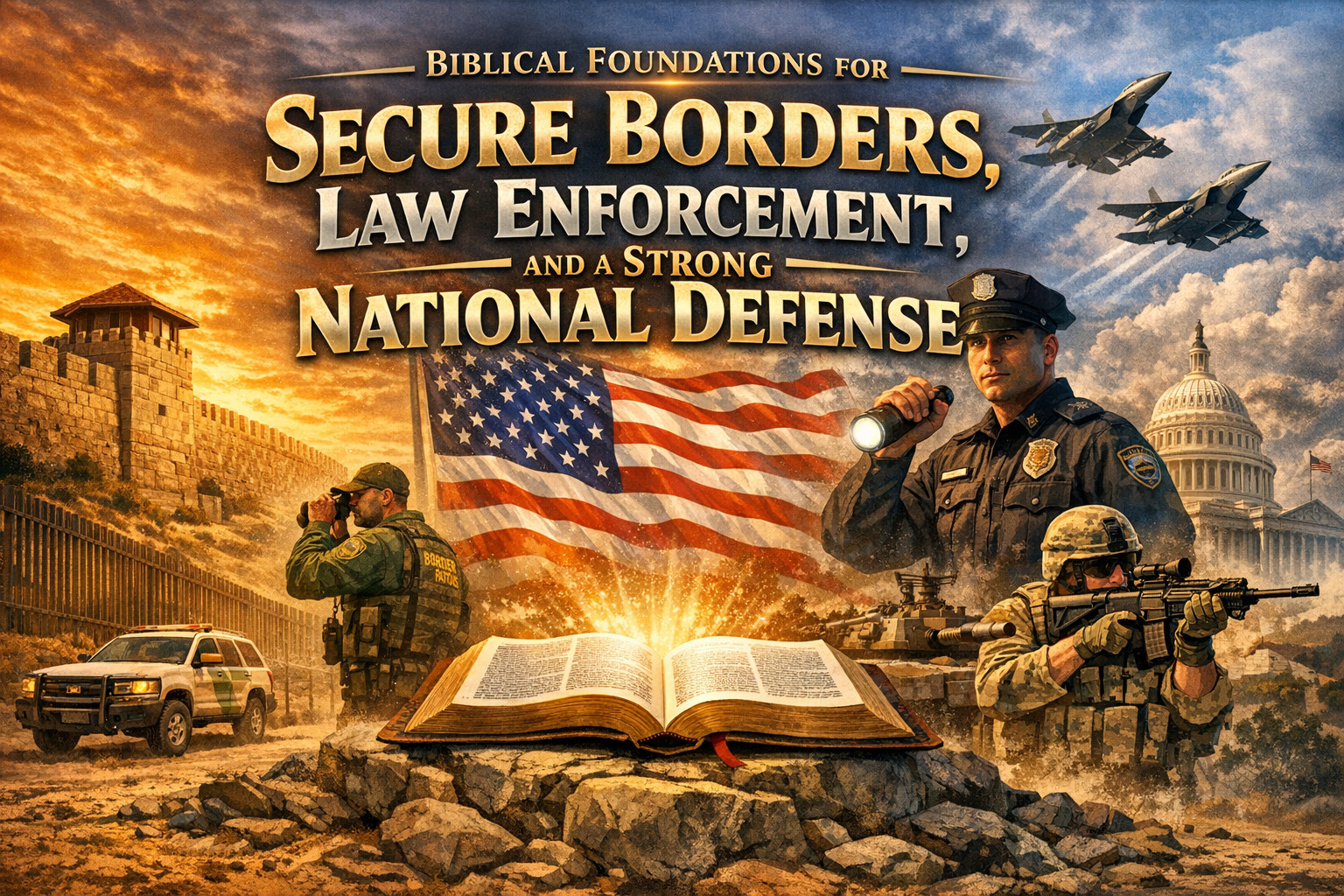
“A Scriptural and Constitutional Defense of National Sovereignty.”
In every generation, nations face the question of identity and responsibility: what does it mean to protect the people within our borders while remaining compassionate to those who seek refuge beyond them? The debate over immigration and border enforcement is not merely political; it is deeply moral and spiritual. Scripture and the Constitution of the United States point toward the same conclusion — that order, law, and justice are essential expressions of love, not contradictions of it.
1. God and the Principle of Boundaries
From Genesis forward, boundaries are part of creation’s design. Genesis 1 portrays God separating light from darkness, land from sea — establishing distinction for the sake of life and harmony. Later, in Acts 17:26, Paul declares that God “determined the times before appointed, and the bounds of their habitation.” The existence of nations with borders is not an accident of history but a reflection of divine order.
Biblical Israel understood this clearly. The borders of the promised land were set and guarded (Numbers 34), and foreigners who entered were welcomed under defined laws (Leviticus 19:33–34). The obligation to protect and regulate entry did not oppose compassion; rather, it ensured that justice to the “stranger” could function within a stable framework. Without boundaries, mercy itself becomes impossible to administer.
2. The Constitutional Mandate for Rule of Law
America’s founders, long students of Scripture, built the same concept of ordered liberty into the Constitution. Article I, Section 8 assigns Congress the authority to “establish a uniform rule of naturalization,” making immigration a national responsibility rather than a state or private one. The executive branch, under Article II, is charged to enforce these laws faithfully.
This framework mirrors biblical stewardship: authority delegated by God requires both compassion and accountability. When government neglects enforcement or abandons clear processes, two injustices occur. First, the lawful immigrant who follows the rules sees those efforts devalued. Second, the citizen — whose security and resources the state must guard — bears the weight of disorder.
3. Law Enforcement as a Ministry of Order
Romans 13 calls civil government “the minister of God … for good,” assigned to restrain evil and promote peace. A coherent immigration‑enforcement agency fulfills that role by preserving dignity for both citizens and newcomers. The goal is not hostility toward the foreigner but stewardship of national trust — a structured process that allows mercy to flow without chaos.
Scripture never confuses compassion with abdication. Nehemiah rebuilt Jerusalem’s walls not to keep people out forever, but to create safe space for worship, commerce, and community to flourish. Likewise, modern nations must maintain secure, lawful entry points so generosity can function wisely.
4. Justice and Mercy in Partnership
The prophets consistently tied mercy to justice. Isaiah 1:17 commands, “Seek justice, relieve the oppressed, judge the fatherless, plead for the widow.” Justice requires systems — laws applied consistently by accountable people. When enforcement dissolves, exploitation increases: smugglers profit, migrants suffer, citizens fear. A nation that values human life cannot outsource border policy to chaos.
A biblically informed policy therefore calls for:
- Clear laws and consistent enforcement.
- Compassionate pathways for legitimate asylum and citizenship.
- Accountability for governmental agencies tasked with stewardship of resources and security.
These principles serve both Scripture and Constitution, two documents that presume moral order over anarchy.
5. The Moral Center of Sovereignty
Sovereignty is not supremacy. It is responsibility — the duty of leaders to care for those within their charge. Jesus rebuked shepherds who scatter the flock (Ezekiel 34 echoed the same reprimand). Open borders without order produce suffering that masquerades as kindness. Secure borders administered with truth and justice safeguard those inside and dignify those who enter lawfully.
The heart of the matter is stewardship: how do we manage what God has entrusted to us? Just as families steward their homes, nations steward their land and laws. To fail in that calling is to neglect biblical responsibility and constitutional oath alike.
A Nation’s Defense: The Biblical and Constitutional Mandate for a Military
Scripture affirms that peace is best preserved when righteousness is protected by strength. From Israel’s earliest history, the defense of a people was not left to chance or sentiment but organized under divine direction. In Numbers 1, Moses was commanded to “take a census of all the congregation … every male by their divisions, all who are able to go out to war.” Defense was one of the nation’s sacred responsibilities, established by God’s instruction, not human ambition.
In the Old Testament, Israel’s armies were never portrayed as instruments of aggression but as ministries of protection—guarding covenant land, families, and worship from those who sought to destroy them. Deuteronomy 20 outlines moral rules of engagement, proving that God values justice even in warfare. The soldiers were consecrated, not celebrated for violence but commissioned to preserve peace through obedience and courage.
In the New Testament, the pattern of legitimate force continues. Romans 13 describes the governing authority as “the servant of God, an avenger who carries out God’s wrath on the wrongdoer.” This grants civil government the right—and duty—to restrain evil, protect citizens, and preserve order. The Apostle John did not condemn soldiers for bearing arms; instead, he instructed them to act with integrity (Luke 3:14). A properly disciplined and moral military is therefore a biblical extension of leadership under divine accountability.
In American constitutional design, that same principle is embedded with remarkable clarity. Article I, Section 8 assigns Congress the power “to raise and support Armies” and “to provide and maintain a Navy,” ensuring that national defense is governed by elected representatives—not kings or generals. The Constitution’s checks and balances were created precisely so that necessary force would never become abusive force. Defense, in the American framework, is stewardship of life and liberty.
To neglect defense is to misunderstand peace. Psalm 144 opens with David’s prayer: “Blessed be the Lord my rock, who trains my hands for war, and my fingers for battle.” This is not the cry of a warmonger but of a shepherd‑king acknowledging that freedom without vigilance is naïve. Peace requires preparation; safety demands structure.
A biblical view of military power therefore holds three truths in tension:
1. War is never the goal; peace is the mandate. (Romans 12:18)
2. Strength is a trust from God, not a tool for pride. (Deuteronomy 8:17 – 18)
3. Defense of the innocent is a moral obligation. (Psalm 82:4 – “Rescue the weak and the needy; deliver them from the hand of the wicked.”)
When a nation uses its armed forces to deter aggression, protect borders, and defend allies against tyranny, it is living out a timeless theological truth: righteous power in right hands serves the cause of peace. Our military, governed by the Constitution and guided by moral restraint, stands not as a symbol of domination but as an instrument of justice—a hedge around freedom so that faith, family, and conscience may flourish within its safety.
Conclusion
A stable nation rests on three pillars of stewardship: secure borders, just law enforcement, and a disciplined military. Each reflects divine and constitutional order working in harmony. Boundaries protect identity; laws preserve justice; strength defends peace.
Scripture teaches that God Himself “set the boundaries of nations” (Acts 17:26) and commanded leaders to govern fairly within them. To protect those boundaries through lawful processes is an act of obedience, not fear. When civil authority enforces immigration statutes with truth and equity, it honors both the foreigner seeking refuge and the citizen whose safety must be ensured. Compassion without order descends into chaos; order without compassion becomes tyranny. The biblical balance is law tempered by mercy and mercy protected by law.
In the same way, a nation’s military exists by design, not accident. Romans 13 recognizes rulers as “servants of God” commissioned to restrain evil. The Constitution echoes this charge, empowering Congress to raise and support armies—not for conquest, but to guarantee liberty for future generations. A moral people defend their freedom precisely so that virtue and hospitality can survive within it.
Together, these institutions—law‑enforcement at the gates and a just military at the borders—form the hedge of peace around the Republic. They translate timeless biblical wisdom into practical governance: men and women under authority, protecting a people under God. Secure borders affirm sovereignty; righteous enforcement upholds justice; and an honorable military ensures that the peace we enjoy remains defended. To preserve these duties faithfully is to honor both the Word of God and the Constitution of the United States—the two covenants that call us to steward what has been entrusted to our hands.
America’s immigration debate must recover its spiritual compass. Secure borders and lawful enforcement are not acts of fear but of faith — faith that justice and mercy can co‑exist, that discipline is a form of love, and that a nation governed by law honors God more than one governed by emotion.
In a time of confusion, the ancient wisdom still applies: build the wall, open the gate, and judge rightly at the gate. Boundaries make compassion possible; law turns kindness into policy; and together they reflect both the Word of God and the Constitution of this Republic.
— Dr. Russell Welch
Dr. Russell Welch is a published author, prophetic teacher, apostolic builder, author, and founder of faith-driven publishing and media initiatives. He is known for crafting bold, Kingdom-centered messages that call the Ecclesia into maturity, doctrinal clarity, and governmental authority. With a passion for equipping the Remnant and honoring generational legacy, Dr. Welch writes and teaches at the intersection of Scripture, history, and spiritual governance, challenging believers to live as sons and daughters who legislate Heaven on earth through truth, holiness, and unwavering fidelity to Christ.
Be sure to check out his book: America at War: The Spiritual Battle for a Nation’s Soul , available exclusively on Amazon … here
 Radical Disciples - A Remnant Revolution