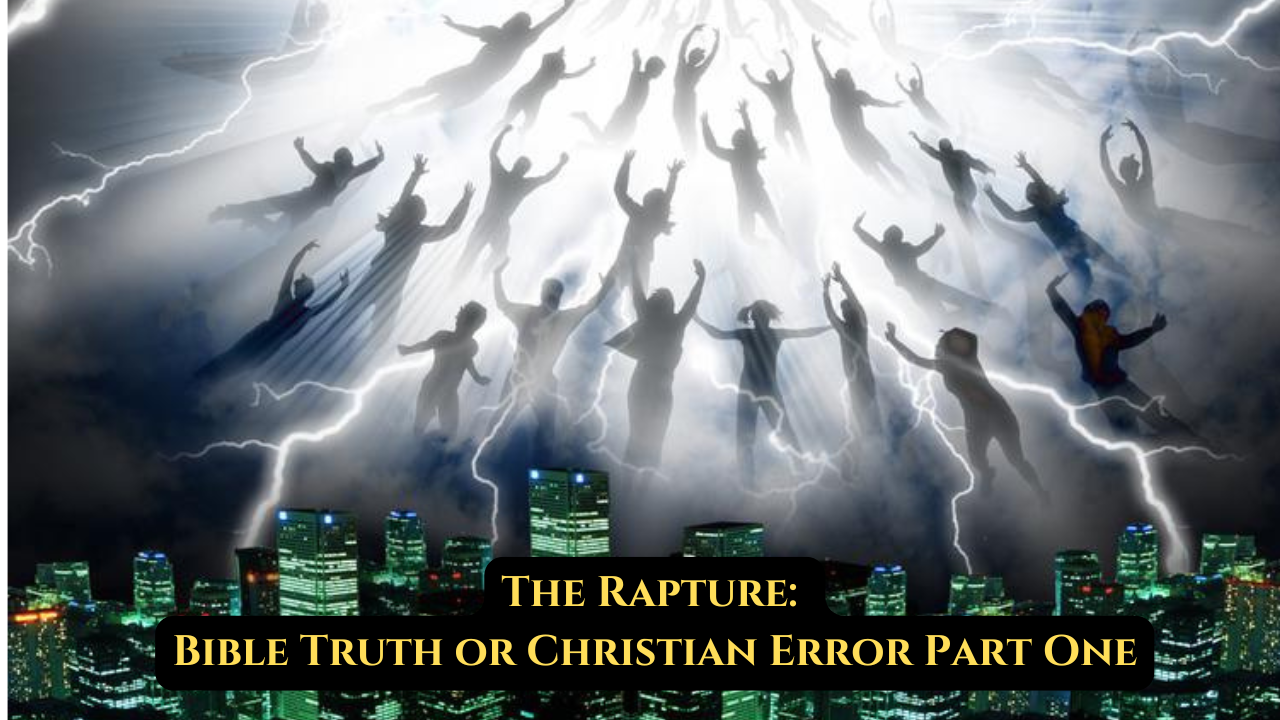
The doctrine of the Rapture, a widely debated topic within Christian eschatology, raises profound questions regarding its scriptural basis and logical coherence. After engaging in discussions about the Rapture, it becomes apparent that there are significant issues surrounding its interpretation.
Over the next two days I will lay out the argument that I have used in several debates (which I was considered the winner) that aims to explore whether the Rapture is simply an error of interpretation, a matter of differing viewpoints, or a doctrine that should be firmly rejected. Through a critical analysis, it becomes evident that the Rapture is not only unbiblical but also illogical, prompting a reevaluation of its legitimacy in the context of Christian belief.
First and foremost, the argument that the Rapture is unbiblical is compelling. A fundamental issue is the absence of any explicit mention of a distinct Rapture event in the Scriptures, separate from the Second Coming of Jesus Christ. Proponents of the doctrine often dissect various biblical passages, claiming that some refer to the Rapture while others pertain to the Second Coming.
Yet, this division is made without clear scriptural justification. The assumption that there exists a Rapture necessitates a prior belief in its existence, which leads to a circular interpretation of Scripture. To accept the Rapture, one must first impose the concept onto the biblical text rather than deriving it from a straightforward reading of scripture itself.
This poses a fundamental challenge to its validity as a doctrine grounded in scriptural truth. Moreover, the illogical nature of the Rapture doctrine further undermines its credibility. The doctrine presents a series of contradictions that defy rational thought.
For instance, proponents claim that the Rapture is the coming of Christ yet argue that it is not the Second Coming. This paradox begs the question: how can an event that is described as a coming of Christ not be acknowledged as His return?
Such semantic gymnastics create confusion and render the doctrine incoherent. Additionally, the assertion that the Rapture occurs on the “Last Day,” while simultaneously suggesting it can happen years prior, raises further questions regarding its consistency.
If the Rapture is indeed the resurrection of believers, it cannot logically occur before the Last Day, as Scripture explicitly states that resurrection takes place then. This inconsistency highlights a fundamental flaw in the doctrine’s framework.
Furthermore, the implications of the Rapture doctrine raise significant theological concerns. If believers are to be taken up in a Rapture before the end of the world, what becomes of Christ’s promises regarding eternal life and resurrection on the Last Day?
The biblical promise that those who believe in Him will be raised on the Last Day appears to contradict the Rapture narrative. This contradiction not only challenges the reliability of Jesus’ words but also calls into question whether the doctrine diminishes the integrity of the biblical message.
If Christ’s promises are rendered obsolete for those who come to faith after the supposed Rapture, the doctrine potentially transforms the nature of salvation and the promises of God.
But again, lets take a closer look at one of the key passage the escapist like to stand on which is 1 Thessalonians 4:15-17, where the Apostle Paul addresses the concerns of the Christian community in Thessalonica regarding the fate of those who have died before Christ’s return.
However, upon closer examination, it becomes apparent that Paul’s intent was not to outline an escapist theology but to articulate a hope grounded in bodily resurrection and the ultimate reunion of believers at Christ’s return to earth. For a brief moment, let us dive into the nuances of Paul’s language, the Greek terminology he employed, and the broader implications of his teachings, ultimately arguing that the rapture, as commonly understood, is a misinterpretation of the biblical text.
To grasp Paul’s message in 1 Thessalonians, it is essential to recognize the context in which he wrote. The Thessalonian church was grappling with questions surrounding death and the second coming of Christ.
Paul reassures them that those who have died—referred to metaphorically as “fallen asleep”—are not lost or forsaken but will be resurrected at the Lord’s coming. He emphasizes a shared destiny for both the living and the deceased, portraying the return of Christ as a joyous event marked by a physical resurrection, rather than a sudden evacuation from the earth.
The phrase “caught up together with them in the clouds to meet the Lord in the air” has often been interpreted as a promise of escaping earthly existence. However, when viewed in the larger context of Pauline theology, particularly in tandem with his writings in 1 Corinthians 15 and Romans 8, it becomes evident that the emphasis is not on leaving the earth but on the transformation and glorification of believers at Christ’s return.
One focal point of this analysis is the interpretation of the Greek term “ἀήρ” (air), which Paul uses in this passage. Many contemporary interpretations associate this term with “sky,” suggesting a heavenly ascent. However, a closer examination reveals that “ἀήρ” refers specifically to the lower and denser atmosphere.
This distinction is critical; it indicates that Paul was not advocating for a departure into the upper realms of heaven but rather a transformative encounter in the earthly atmosphere.
Contrastingly, the Greek term for heaven, “οὐρανός,” connotes a higher, transcendent space. By choosing “ἀήρ” over “οὐρανός,” Paul highlights a connection to the earthly realm, reinforcing the notion that the ultimate goal is not escape but resurrection and reuniting with Christ, who is returning to earth.
Furthermore, the mixed metaphors present in Paul’s language complicate the rapture narrative. The imagery of being “caught up” is not indicative of a one-time event but rather a communal experience that celebrates the fulfillment of God’s promise of resurrection.
Paul’s use of metaphoric language reflects his intent to convey hope and assurance rather than a detailed blueprint of end-time events. It is vital to acknowledge that Paul, like Jesus, did not envision a distant future characterized by a Great Tribulation or a need for believers to be evacuated from the planet. Instead, both figures shared a vision of God’s kingdom coming to fruition on earth, culminating in a physical resurrection that included all believers.
Thus we find that the belief in the rapture, as popularly understood, seems to diverge significantly from the teachings of Paul and the intentions of the biblical text.
By analyzing the linguistic choices and the broader context of 1 Thessalonians, it becomes clear that Paul’s message centers on resurrection, hope, and the ultimate fulfillment of God’s promises in the physical realm.
Rather than an escape to the heavens, Paul offers a vision of restoration and reunion that invites believers to embrace their earthly existence while looking forward to a transformative encounter with Christ.
But let us continue in the realm of biblical interpretation, Paul’s use of mixed metaphors serves as a powerful tool for conveying profound theological concepts. His connections to the Old Testament, particularly through the figures of Moses and the imagery from Daniel, illuminate his understanding of God’s relationship with humanity and the nature of Christ’s return.
By examining these metaphors, we can grasp the depth of Paul’s message and its implications for the early Christian community, particularly in the face of persecution.
The first metaphor Paul employs is that of Moses descending from Mount Sinai with the Law, heralded by the blast of a trumpet. This powerful image evokes the moment when God descended to meet Moses, establishing a divine-human connection that highlights God’s initiative to engage with humanity.
In this context, God’s trajectory is downward, symbolizing His willingness to come to us, rather than demanding that we ascend to Him. This downward motion invites reflection on the nature of divine authority and the responsibilities of those who receive God’s revelation.
Moses’s ascent to the mountaintop signifies a moment of divine encounter, yet it is the act of coming down that emphasizes the importance of service and accessibility. Paul’s metaphor encourages believers to embody this same movement—leaving behind the heights of spiritual privilege to serve and uplift those who are “below.”
The second image Paul draws upon originates from the Book of Daniel, where the “one like the son of man” represents the vindication of God’s people over their adversaries. Here, clouds symbolize divine authority and judgment, reinforcing the idea that God’s intervention is both powerful and redemptive.
In applying this metaphor to the early Christian community, Paul reassures believers facing persecution that their suffering is not in vain. Rather, it is a part of a larger narrative in which God will ultimately rescue and restore His people.
This theme resonates deeply with those who find themselves marginalized or oppressed, offering hope in the promise of vindication and divine justice.
Moreover, Paul introduces a third image that transcends the biblical narrative—an emperor visiting a city, welcomed by a jubilant procession.
This metaphor captures the anticipation of Christ’s return and the role of the church as an active participant in ushering in the Kingdom of God. The imagery of a royal procession implies a sense of communal expectation and celebration, inviting believers to envision themselves as heralds of a new creation.
Again, contrary to popular interpretations of the “rapture,” Paul’s portrayal emphasizes a collective, rather than individualistic, experience of Christ’s return. This understanding aligns with his broader theological framework, where resurrection and restoration take precedence over mere escape from earthly trials.
Ultimately, Paul’s mixed metaphors paint a rich tapestry of hope and purpose for the Christian community. Through these images, he articulates a vision of God’s kingdom that transcends the temporal and physical confines of our world.
Rather than promoting a theology centered on escaping the earth, Paul envisions a future where heaven and earth unite in harmony, establishing a perpetual, divine reign on this planet. This eschatological view emphasizes resurrection, healing, and the establishment of God’s eternal kingdom, fostering a sense of belonging and mission within the community of believers.
In exploring Paul’s metaphors, we are reminded that he is not the sole voice in this conversation—Jesus’ teachings and actions also warrant consideration. As we engage with the broader narrative of scripture, we can deepen our understanding of the profound implications of Christ’s return and what it means for our lives today.
Through this exploration, we are called not only to anticipate the future but to actively participate in the unfolding of God’s kingdom in the here and now, embodying the love and grace that reflect the heart of the divine.
In the part two of this thread, we will dive into the scriptures and look at what Jesus taught or didn’t teach about the rapture.
~Dr. Russell Welch
Elder / Teacher: Highway to Heaven Church and Founder and Shepherd of Remnant Warrior Ministries / Remnant Warrior School of Spiritual Warfare.
 Radical Disciples - A Remnant Revolution