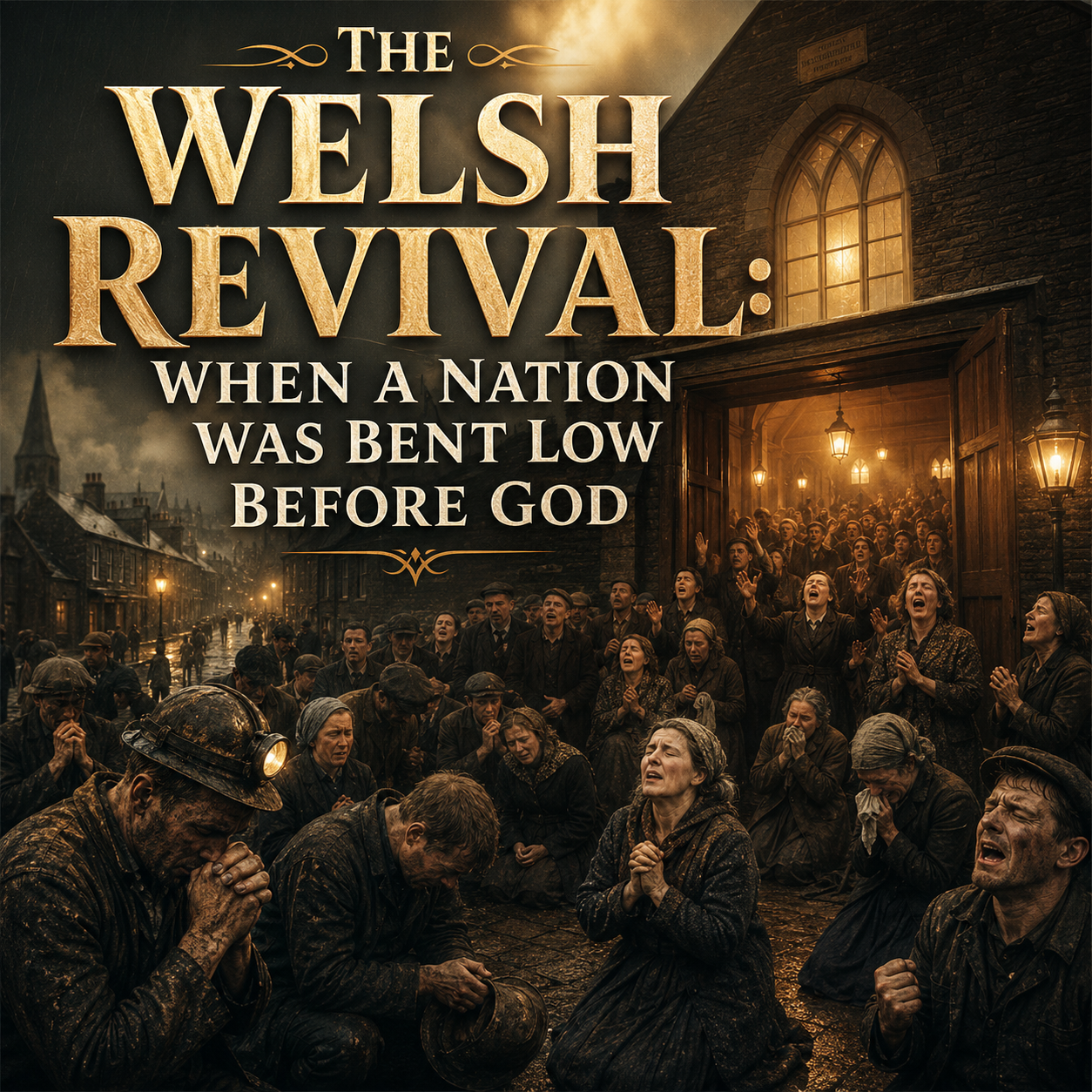
When a people bow low in repentance, Heaven can set an entire nation on fire with revival.
Revival does not begin when men become impressive; revival begins when men become broken. The Welsh Revival of 1904–1905 reminds us that a nation can be shaken when ordinary people come under extraordinary conviction. It was not launched by celebrity machinery, polished promotion, or religious entertainment, but by prayer, repentance, worship, and surrender. Wales became a testimony that when God bends a people low before Him, the fire that falls upon them can cross oceans. Historical accounts consistently connect this awakening with Evan Roberts, a young Welshman whose burden for souls became one of the defining sparks of the movement.
Evan Roberts was not a polished platform personality when the flame began to spread. He was a former coal miner and ministerial student, only in his mid-twenties, yet he carried a holy desperation that many established voices had lost. Scripture says, “Not by might, nor by power, but by my spirit, saith the LORD of hosts” (Zechariah 4:6). That verse seemed to breathe through Wales as meetings erupted not around human performance, but around the manifest dealings of God. The Lord often chooses hidden vessels so that no flesh can glory in His presence.
The heart of the Welsh Revival was conviction of sin. This was not shallow emotion, religious excitement, or temporary enthusiasm; people were pierced by the holiness of God. Jesus said Holy Spirit would “reprove the world of sin, and of righteousness, and of judgment” (John 16:8), and that is exactly what revival does when it is pure. It does not flatter the soul; it brings the soul into the light. Wales was not merely stirred — Wales was searched.
Historical reports describe prayer meetings, spontaneous worship, public confession, and deep repentance as marks of the revival. Many gatherings were not controlled by formal programs but moved with a holy sensitivity to the Spirit’s leading. One recurring watchword associated with Evan Roberts was the call to obey the Spirit, and that phrase captures the atmosphere of the movement. When Holy Spirit governs a room, man’s agenda bows, pride loses its seat, and the fear of the Lord becomes weightier than religious routine.
The Welsh Revival also carried a sound. It has often been remembered as a revival that moved through singing as much as through preaching. Worship became more than music; it became the cry of a nation bending its heart before God. The Psalms declare, “Let every thing that hath breath praise the LORD” (Psalm 150:6), and Wales seemed to answer with tears, hymns, prayers, and holy surrender. When worship is purified by repentance, it becomes a weapon that breaks atmospheres.
There was also a clear burden for souls. The testimony commonly repeated from the revival is that thousands upon thousands were converted in a short period of time, with some historical summaries estimating around 100,000 converts during the awakening. Whether one debates exact numbers or methods of counting, the undeniable record is that the movement deeply impacted Welsh religious life and sent shockwaves far beyond its borders. True revival does not merely fill buildings; it awakens consciences, transforms homes, and confronts society with eternity.
One of the most sobering features of the Welsh Revival was how deeply it touched ordinary life. The fire did not remain locked inside chapel walls. When conviction grips a people, business practices change, speech changes, relationships change, entertainment changes, and hidden sin loses its hiding place. Proverbs 14:34 declares, “Righteousness exalteth a nation: but sin is a reproach to any people.” Wales became a witness that national healing must begin with spiritual confrontation.
The revival was not born in comfort, but in hunger. Before the movement became widely known, there were years of prayer, local awakenings, and spiritual preparation in Wales. Men like Joseph Jenkins and Seth Joshua are often connected to the spiritual atmosphere that preceded Evan Roberts’ public role. This matters because revival rarely appears suddenly, even when it seems sudden to history. Beneath the visible flame, there are usually hidden altars, unseen tears, and nameless intercessors who have refused to let go of God.
The Welsh Revival reminds the modern Church that Holy Spirit does not need our machinery to move. He may use platforms, buildings, media, and organization, but He is never dependent upon them. Acts 2 shows us that when the Spirit was poured out, the sound from Heaven gathered the crowd before Peter ever preached the sermon. The first advertisement of Pentecost was not a campaign strategy; it was the presence of God. Wales, in its own hour, became another reminder that when Heaven breathes, people come.
Yet we must also speak with wisdom: revival history is never spotless because people are never flawless. The Welsh Revival carried glory, but it also carried strain, excess, controversy, and human weakness. Evan Roberts himself would later withdraw from public ministry, reminding us that vessels must be guarded even when the fire is real. The lesson is not to despise revival, but to steward it with Scripture, humility, rest, accountability, and obedience. Fire must be welcomed, but fire must also be tended at the altar of truth.
What crossed oceans from Wales was not merely a story, but a hunger. The revival influenced spiritual conversations far beyond Wales and is often discussed in connection with the wider awakening atmosphere that preceded and overlapped early Pentecostal stirrings, including movements that would soon emerge in other nations. When God ignites one place, the smoke of that altar can be smelled in another. Habakkuk 2:14 declares, “For the earth shall be filled with the knowledge of the glory of the LORD, as the waters cover the sea.” Wales became one burning witness that the glory of God was never meant to remain regional.
The cry of the Welsh Revival still speaks: bend low, confess fully, pray deeply, worship purely, obey Holy Spirit quickly, and burn for souls again. The Church does not need another performance-driven religious moment; she needs a holy visitation that restores the fear of the Lord. If God could shake mining towns, chapels, families, workers, students, and entire communities in Wales, He can shake our cities again. But the altar must be rebuilt before the fire falls. May the Lord bend us low until Christ is exalted high.
Stay tuned, the journey continues…..
— Dr. Russell Welch
Dr. Russell Welch is a published author, prophetic teacher, apostolic builder, author, and founder of faith-driven publishing and media initiatives. He is known for crafting bold, Kingdom-centered messages that call the Ecclesia into maturity, doctrinal clarity, and governmental authority. With a passion for equipping the Remnant and honoring generational legacy, Dr. Welch writes and teaches at the intersection of Scripture, history, and spiritual governance, challenging believers to live as sons and daughters who legislate Heaven on earth through truth, holiness, and unwavering fidelity to Christ.
Be sure to check out his book: The Consecrated Firebrand: A Warrior’s Guide to Holy Living, available exclusively on Amazon … here

