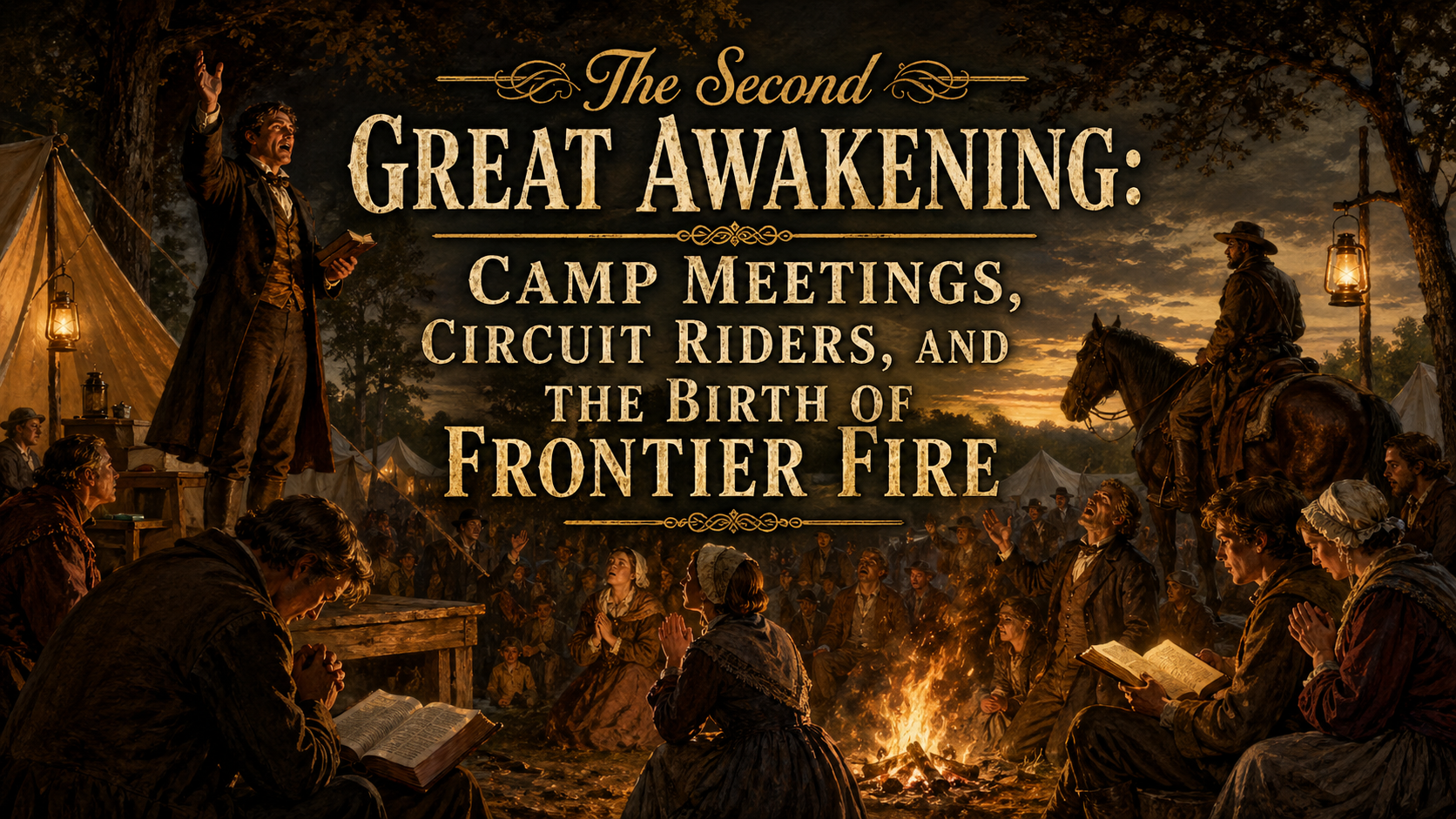
When the wilderness became an altar, the fire of God began riding through the frontier
The Second Great Awakening rose in America as a holy answer to a young nation wrestling with expansion, moral drift, frontier disorder, and spiritual hunger. After the First Great Awakening shook the colonies with the fear of the Lord, the second awakening carried revival into the wilderness, the camp meeting, the college, the village, and the public square. It was not merely a season of emotional religion; it became a furnace where conviction, repentance, evangelism, reform, and discipleship were pressed into the conscience of a nation. The cry of Acts 3:19 seemed to thunder again: “Repent ye therefore, and be converted, that your sins may be blotted out.” Revival came not to entertain the people, but to bring them under the searching eye of God until sin was confessed, Christ was exalted, and lives were visibly changed.
One of the early flames came through men like Timothy Dwight at Yale, who preached Christ into an environment where unbelief and skepticism had gained dangerous ground among the young. Revival among students revealed that the Father was not only reaching the wilderness settler, but also the intellectual class being discipled by the spirit of the age. This was a direct rebuke to the lie that education must be separated from the fear of the Lord. Proverbs 1:7 declares, “The fear of the LORD is the beginning of knowledge: but fools despise wisdom and instruction.” The Second Great Awakening therefore did not begin as a polished movement of religious celebrity, but as a work of conviction, prayer, preaching, and holy disruption among souls who had drifted from God.
The camp meetings became one of the great marks of this awakening, especially on the American frontier, where families traveled for miles and gathered under the open heavens to hear the Word preached with fire. Peter Cartwright, the Methodist circuit rider, described the Cane Ridge atmosphere by saying, “The heavenly fire spread in almost every direction,” and he recorded that the noise of praise and conviction could be heard for miles. These meetings were rugged, imperfect, and often controversial, but they carried a raw hunger that challenged cold formalism and lifeless religion. The wilderness itself became an altar, and the cry of Luke 14:23 seemed to rise across the frontier: “Go out into the highways and hedges, and compel them to come in, that my house may be filled.” The Lord was showing America that the Gospel was not chained to stained glass, polished pulpits, or religious respectability.
Francis Asbury, Peter Cartwright, Barton W. Stone, and countless lesser-known circuit riders carried the message through mud, danger, sickness, exhaustion, and opposition. These men were not building brands; they were carrying burdens. Their ministry reminds us of Paul’s charge in 2 Timothy 4:2: “Preach the word; be instant in season, out of season; reprove, rebuke, exhort with all longsuffering and doctrine.” They rode into regions where churches were scarce, Bibles were treasured, sin was public, and souls were starving. The power of the movement was not convenience, but consecration; not applause, but assignment. The Second Great Awakening teaches the modern Ecclesia that true revival always produces workers willing to go where comfort refuses to travel.
Charles Grandison Finney became one of the most recognized voices of the later Second Great Awakening, especially through his preaching in the burned-over district of New York and his later writings on revival. In his Lectures on Revivals of Religion, Finney pressed the Church to understand that revival required cooperation with God through prayer, repentance, preaching, and obedience, not passive waiting while sin remained untouched. Whether one agrees with every element of Finney’s theology or not, his urgency exposed a sleeping Church that had too often mistaken inactivity for reverence. Romans 12:11 gives the spirit of that burden: “Not slothful in business; fervent in spirit; serving the Lord.” Finney’s voice helped shape a generation that believed revival must move beyond the altar into moral action, public righteousness, and visible reform.
Lyman Beecher also stood as a significant voice in this era, particularly in the moral reform movements that grew out of revival conviction. His work against intemperance reflected a broader awakening truth: when God revives a people, He does not merely touch their church attendance; He confronts their habits, appetites, public sins, and private compromises. Beecher’s temperance sermons exposed the destructive nature of indulgence in a society where drunkenness was tearing families, communities, and souls apart. This connects powerfully with Titus 2:11–12, which declares that grace teaches us to deny “ungodliness and worldly lusts” and to live “soberly, righteously, and godly, in this present world.” Revival that does not discipline the flesh will soon become emotion without transformation.
The Second Great Awakening also gave birth to, or powerfully strengthened, many reform movements, including missions, Bible societies, abolitionist efforts, temperance work, and renewed concern for the poor and the enslaved. This does not mean every stream of the movement was pure, nor does it mean every leader carried equal theological soundness, but it does show that awakened hearts began to wrestle with public righteousness. James 2:17 says, “Even so faith, if it hath not works, is dead, being alone.” The fire of God was never meant to remain locked in a meeting; it was meant to walk into homes, businesses, laws, communities, and nations. When revival is genuine, it reforms the conscience before it reforms culture. The order is critical, because flesh will try to change society without first bowing before the Lordship of Christ.
The lesson for Radical Disciples today is that the Second Great Awakening was both a warning and a witness. It warns us that a nation can drift quickly when the fear of the Lord is neglected, but it also witnesses that God can raise a holy fire among ordinary people when repentance, preaching, prayer, and obedience return to the center. Joel 2:28 declares, “I will pour out my spirit upon all flesh,” yet the same prophetic atmosphere calls the people to fasting, weeping, mourning, and returning to the Lord with all the heart. America does not need a revival that merely fills tents, stages, churches, or stadiums; she needs a revival that produces crucified disciples. The Second Great Awakening reminds us that when the fire of God truly falls, the altar is restored, the wilderness begins to worship, and a generation is summoned out of compromise into obedience.
Stay tuned, the journey continues…..
— Dr. Russell Welch
Dr. Russell Welch is a published author, prophetic teacher, apostolic builder, author, and founder of faith-driven publishing and media initiatives. He is known for crafting bold, Kingdom-centered messages that call the Ecclesia into maturity, doctrinal clarity, and governmental authority. With a passion for equipping the Remnant and honoring generational legacy, Dr. Welch writes and teaches at the intersection of Scripture, history, and spiritual governance, challenging believers to live as sons and daughters who legislate Heaven on earth through truth, holiness, and unwavering fidelity to Christ.
Be sure to check out his book: The Consecrated Firebrand: A Warrior’s Guide to Holy Living, available exclusively on Amazon … here

