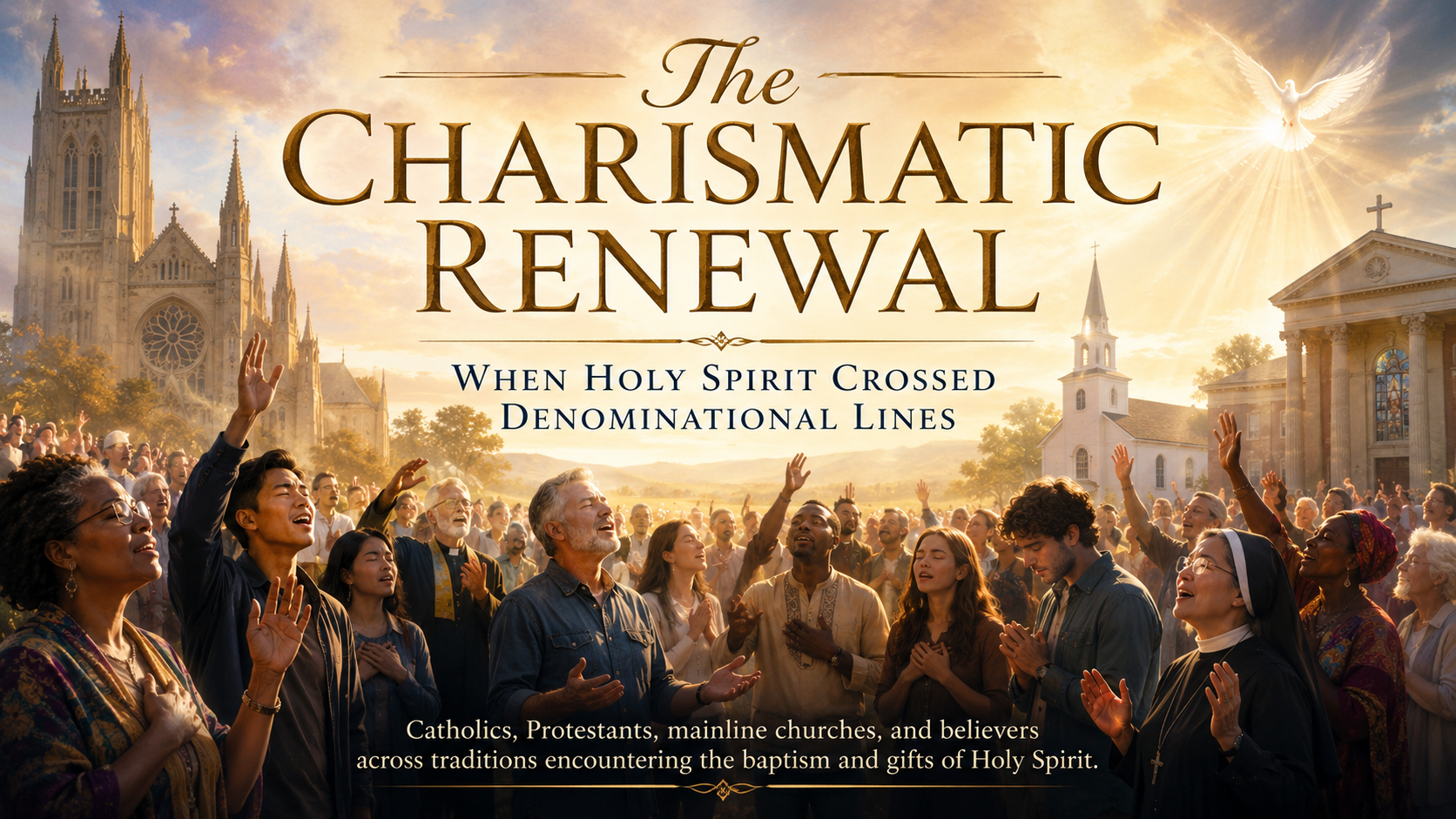
When Holy Spirit Crossed Denominational Lines
There are moments in Church history when Heaven seems to lean over the walls men have built and breathe again upon the Body of Christ. The Charismatic Renewal was one of those moments.
It was not birthed in one denomination. It was not confined to one stream. It was not owned by one theological camp, one worship style, one church tradition, or one ecclesiastical system. It was the wind of Holy Spirit moving where He desired, awakening Catholics, Protestants, Anglicans, Methodists, Presbyterians, Lutherans, Baptists, mainline believers, and countless others to the living reality of the baptism and gifts of Holy Spirit.
For many, Christianity had become respectable, organized, educated, and polished — but powerless. The language of faith remained, but the fire had grown cold. Churches still confessed the creed, sang the hymns, prayed the prayers, and preached the Scriptures, but deep within the hearts of many believers there was a cry for more. Not more religion. Not more programs. Not more committees. More of God.
And Holy Spirit answered.
He stepped across denominational lines and reminded the Church that He was never the property of one tradition. He was not bound to stained glass, pipe organs, revival tents, liturgies, seminaries, or Pentecostal storefronts. He was the Spirit of the living God, poured out upon sons and daughters, servants and handmaidens, old and young, rich and poor, clergy and laity.
This renewal became a divine interruption.
In places where the gifts of the Spirit had been explained away, people began praying in tongues. In churches where healing had been reduced to something God once did long ago, people began laying hands on the sick with fresh faith. In traditions where prophecy had been buried under suspicion, believers began to recover the reality that God still speaks. In communities where worship had become predictable, praise began to rise with tears, freedom, surrender, and holy hunger.
The Charismatic Renewal did not erase doctrinal differences. It did not make every tradition the same. It did something far more prophetic. It revealed that Holy Spirit could awaken hunger inside places many had already written off. He could set hearts on fire inside Catholic prayer groups, Episcopal churches, Methodist gatherings, Lutheran fellowships, Baptist homes, and Presbyterian Bible studies. He could visit people who did not yet have all their theology in perfect order, because revival has never waited for men to become impressive enough to deserve it.
This is one of the great lessons of the Charismatic Renewal: God is not nearly as nervous about crossing our lines as we are.
That does not mean truth no longer matters. It means Holy Spirit knows how to awaken people into truth. The fire of God does not come to flatter broken systems. It comes to awaken hungry hearts, expose dead religion, and call the people of God back to the living Christ.
For many believers in the 1960s and 1970s, this renewal felt like a second Pentecost in their personal lives. They had known about God, but now they were encountering Him. They had recited prayers, but now prayer became communion. They had heard sermons about Jesus, but now Jesus felt near, living, present, and personal. The Scriptures came alive. Worship became intimate. Evangelism became bold. Spiritual gifts became normal again.
And perhaps one of the most radical marks of this renewal was that ordinary believers began to realize they were not second-class citizens in the Kingdom.
The gifts of Holy Spirit were not reserved for famous evangelists, pulpit ministers, or denominational leaders. Mothers, fathers, college students, businessmen, priests, pastors, teenagers, and housewives began to discover that the same Spirit who moved in the book of Acts still moved through surrendered vessels.
The Church was being reminded that ministry was never meant to be locked behind a platform.
This was dangerous to religious systems because it awakened the priesthood of all believers. It reminded the people of God that every son and daughter carries a measure of Kingdom assignment. It restored holy expectation to the pews. People no longer came merely to observe church. They came ready to encounter God, hear His voice, receive His power, and carry His presence into the world.
This is what dead religion fears most: believers who wake up.
The Charismatic Renewal also carried an unmistakable witness to unity. Not the shallow unity that ignores truth. Not the compromised unity that says doctrine does not matter. But the kind of unity seen in Acts 10, when Holy Spirit fell upon Cornelius and his household, and Peter had to admit that God had given the same gift to people he had not expected to receive it.
That moment shook Peter’s categories.
The Charismatic Renewal shook the categories of many believers too.
Some Protestants had to wrestle with the fact that Catholics were encountering Holy Spirit in ways they could not deny. Some Catholics had to recognize that God had used Pentecostals and evangelicals to help open the door to renewed hunger for the Spirit. Mainline believers had to face the reality that the gifts of Holy Spirit were not dead relics of the past. Pentecostals had to recognize that Holy Spirit was moving beyond their own familiar camp.
Heaven was confronting pride on every side.
This is what revival does. It humbles the people who thought they owned the fire, and it awakens the people who thought the fire was no longer available.
Yet we must also be honest. Like every move of God, the Charismatic Renewal had its tensions, excesses, and immature expressions. Some chased gifts without developing character. Some pursued manifestations without surrendering to holiness. Some made emotional experience the center instead of Christ Himself. Some opened doors to confusion because they lacked grounding in Scripture and discipleship.
But we must never allow the abuses of a movement to make us despise the grace that was truly present in it.
The answer to wildfire is not to ban fire. The answer is to restore the altar.
The early Church did not separate the Word from the Spirit. They did not choose between doctrine and power. They did not believe holiness and spiritual gifts were enemies. They preached Christ crucified and risen, called men to repentance, healed the sick, cast out demons, prophesied, prayed in tongues, worshiped with fire, and lived under the government of Holy Spirit.
The Charismatic Renewal was, at its best, a divine reminder that the Church was never supposed to become a museum for memories of what God used to do. She was called to be a living temple, filled with the glory and power of the risen Christ.
This is why the renewal still matters.
We are living in another hour where many churches have form but little fire. Many have branding but little burden. Many have platforms but little presence. Many have teaching but little trembling. Many have religious activity but little evidence that the Spirit of God is resting in power upon the people.
The Charismatic Renewal asks us a dangerous question:
Have we made peace with a Christianity that can function without Holy Spirit?
Because if we can hold services, build organizations, preach sermons, sing songs, and manage ministries without desperate dependence upon the Spirit of God, then we have not built an upper room. We have built a machine.
And machines do not birth revival.
Only surrendered people do.
The Remnant in this hour must recover what the Charismatic Renewal helped restore: a living hunger for the fullness of Holy Spirit. Not hype. Not disorder. Not spiritual entertainment. Not gifts divorced from holiness. Not emotionalism without obedience. But the holy fire of God resting upon sons and daughters who know Jesus, love the Word, walk in purity, move in power, and refuse to reduce Christianity to intellectual agreement.
We need the baptism of Holy Spirit again.
We need prayer rooms where the presence of God becomes weighty.
We need churches where the gifts of the Spirit are welcomed with wisdom, tested by Scripture, and released through love.
We need believers who do not merely talk about the book of Acts, but become living witnesses that the same Spirit still fills, still speaks, still heals, still delivers, still empowers, and still sends.
The Charismatic Renewal was not the finish line. It was a signpost.
It pointed back to Pentecost and forward to a Church that must be both grounded and burning. It reminded us that the Father pours out His Spirit not so we can build movements around experiences, but so we can bear witness to the risen Son.
Holy Spirit did not cross denominational lines to create a new religious brand.
He crossed them to awaken the Body.
He crossed them to confront dead religion.
He crossed them to release hunger.
He crossed them to restore power.
He crossed them to remind the Church that Jesus did not leave His people as orphans.
And now, in our generation, the question remains.
Will we protect our systems, or will we prepare the altar?
Will we defend powerless religion, or will we cry out for fresh fire?
Will we settle for being historically correct about past revivals, or will we become living vessels of Holy Spirit in the present hour?
The Charismatic Renewal still speaks.
It tells us that Holy Spirit is not finished crossing lines, shaking rooms, filling vessels, awakening sons and daughters, and calling the Church back to the fire of Pentecost.
The Remnant must not merely study the renewal.
We must become the altar where the fire falls again.
Stay tuned, the journey continues…..
A voice of fire to the Remnant,
— Dr. Russell Welch
Dr. Russell Welch is a published author, prophetic teacher, apostolic builder, and founder of faith-driven publishing and media initiatives. He is known for crafting bold, Kingdom-centered messages that call the Ecclesia into maturity, doctrinal clarity, and governmental authority. With a passion for equipping the Remnant and honoring generational legacy, Dr. Welch writes and teaches at the intersection of Scripture, history, and spiritual governance, challenging believers to live as sons and daughters who legislate Heaven on earth through truth, holiness, and unwavering fidelity to Christ.
Be sure to check out his book, Spirit Wind People: Those Who are Moved by the Impulses of Holy Spirit, available exclusively on Amazon.

